
OEM/ODM
Scent for a Private-Label Robot Mop Solution: Fragrance-Free, Light Scent or Pet Formula?
Direct answer
Match scent to the buyer and channel: fragrance-free for baby, sensitive-skin and scent-averse markets, a light scent for mass-market homes, and a lightly scented pet formula that relies on odor-reducing ingredients rather than more fragrance. Any scent change means retesting foam, residue and material compatibility.
Choosing a robot mop solution scent, step by step
-
Define the buyer and channel
Mass-market homes, baby, pet or a market with its own scent preferences; Chinese ecommerce, Amazon U.S. or Europe. The buyer and channel decide whether you go fragrance-free, light scent or pet formula.
-
Sample a few candidate scents
Make two or three samples with different scents or fragrance levels on the same base formula, keeping everything else the same so they're easy to compare. CleenU ships free samples in 3–5 days.
-
Judge scent at real use levels
Dilute at the label ratio, mop a room, and smell the working solution and the floor at set times. Note strength, any harshness and how long it lingers.
-
Retest foam, residue and stability
After you pick a scent, retest foam, residue, hot and cold stability and material compatibility to confirm the scent hasn't undone the low-foam, low-residue performance.
-
Set the label and listing wording
Describe scent accurately: "contains no fragrance" for fragrance-free, the specific scent for scented versions, and "helps reduce everyday pet odors" for the pet formula, never "eliminates odors."
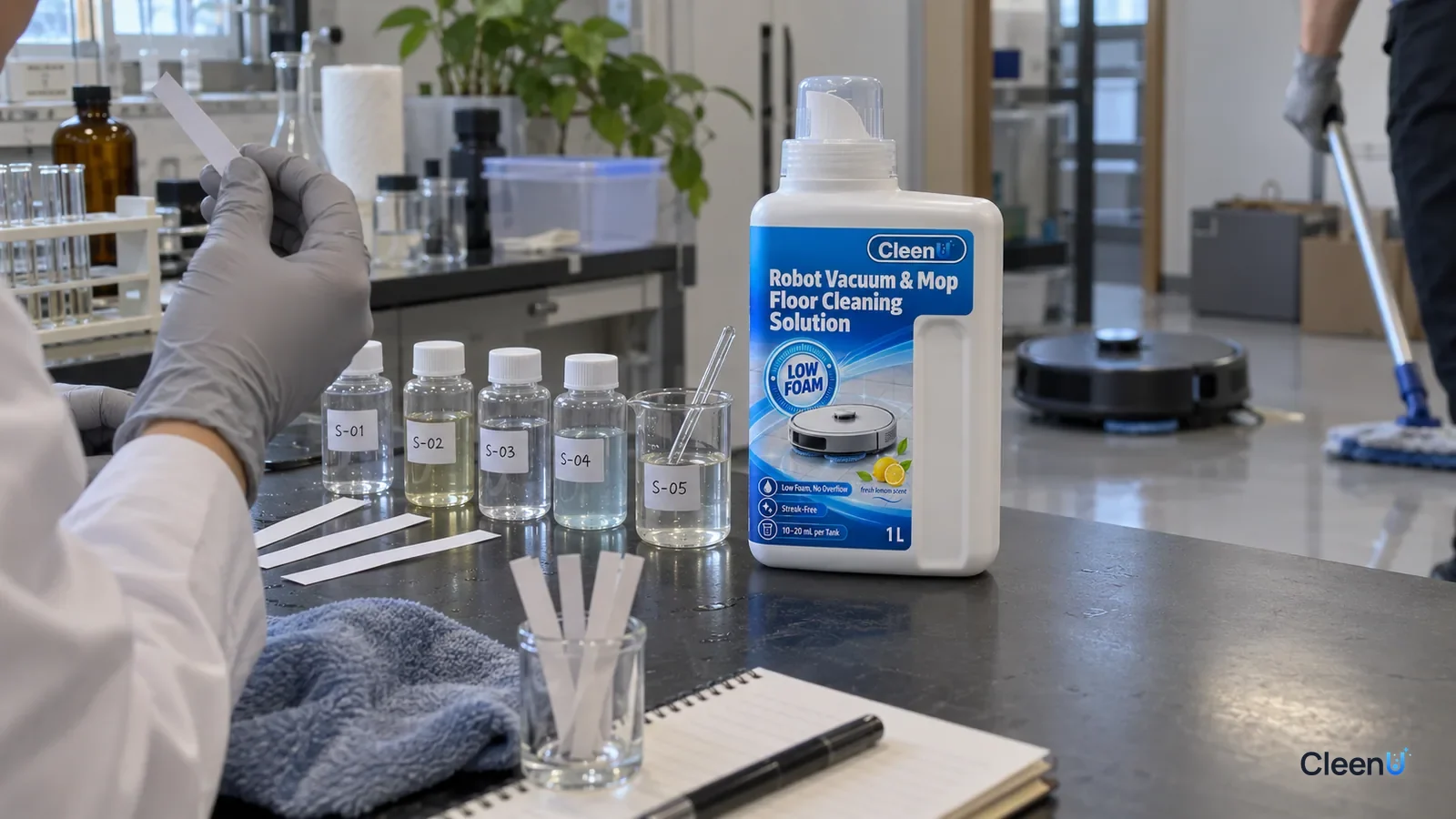
Scent is one of the questions brands wrestle with most when they launch a private-label robot mop cleaning solution. Should it smell like anything? Does a stronger scent sell better, or is fragrance-free safer? Is a pet version just the regular one with more fragrance?
Scent is more than a preference. It decides who the product is for and how the listing talks about it, and it feeds back into the formula itself. Fragrance is an oily mixture, and how much you use and which one you pick can change foam, residue and stability, and even affect tank seals and tubing. Choosing a scent means answering two questions together: who is buying, and can the formula carry it.
Start with the buyer: who each scent suits
Fragrance-free suits homes with babies and toddlers, people sensitive to smells, allergy-prone users and markets that prefer "clean, no scent." Its selling point is no added smell; after mopping, the room just smells clean. It also works as the base product in a line, serving buyers who flatly don't want fragrance.
A light scent is the safe choice for mass-market homes. Robot mops typically run daily or every other day, over the whole floor with little water, so any scent spreads through the house. A strong scent is pleasant the first time and cloying by the tenth, and some people find it harsh. A light scent gives a fresh note while mopping and fades quickly with airflow, which is why it has the broadest appeal. Lemon and other fresh scents are familiar in cleaning products and rarely miss.
A pet formula is for cat and dog owners, whose biggest complaint is pet odor. The heart of a pet version isn't a stronger scent. It's an odor-reducing ingredient in the formula, such as a cyclodextrin, which can trap some small odor molecules inside its ring-shaped cavity so fewer of them reach the air. A light scent on top keeps the floor smelling fresh. Masking pet odor with heavy fragrance tends to backfire: the scent and the pet smell blend into something more complicated, and pets are more sensitive to strong smells than we are.
CleenU's two versions show the approach. The regular formula has a lemon scent. The pet-home formula adds a cyclodextrin odor-reducing ingredient and carries a lighter lemon scent. Both are neutral, low-foam concentrates at pH 6.5 to 7.5 that dilute at about 1:50 to 1:100, with 10 to 20 mL per fill usually enough. For how the two differ, see pet vs regular robot mop solution.
Then look at the channel: scent preferences by market
Scent acceptance varies a lot by channel and market.
Chinese ecommerce: mass-market products lean light and fresh, with lemon, white tea and green tea scents well accepted. Baby and pet niche channels show clear demand for fragrance-free and pet-specific products.
The U.S.: fragrance-free has a steady audience, especially among allergy-prone and sensitive users. Mass-market products commonly use lemon and fresh scents. Pet products lean on "pet odor," but still should avoid heavy fragrance.
Europe: some consumers pay close attention to fragrance allergens, and certain allergens must be declared on labels. If you plan to sell in Europe, ask your fragrance supplier for allergen information at the selection stage and plan the label from the start.
Channel also shapes the product line. Many brands start with one light-scent mass-market product, then add fragrance-free and pet versions. If the brand is built around babies or pets, it's usually better to start with fragrance-free or the pet formula.
How fragrance affects the formula, and why a scent change means retesting
Many brands see scent as a simple swap of one fragrance for another. In a robot mop solution, fragrance matters in four ways.
Foam: fragrance is oily and needs surfactants to disperse it in water, a process called solubilization. More fragrance needs more solubilizer, and some solubilizers foam. Some fragrance components also change how stable foam is. A formula that was low-foam can foam more after a scent change, making false full-tank alerts in the dirty tank more likely.
Residue: fragrance and solubilizer don't evaporate, or evaporate slowly. The more you use, the more stays on the floor after mopping, which can leave floors tacky or streaky.
Stability: if the fragrance isn't fully solubilized, the product can turn cloudy or separate. Some fragrance components oxidize and discolor with heat or light, so the product yellows over time, a common source of "my solution changed color" complaints. See robot mop solution changed color or separated.
Material compatibility: some fragrance components, such as terpenes like limonene, can swell certain rubbers and plastics. Concentrate sitting for long periods in an auto-dosing compartment and its tubing raises the risk for fragrance-heavy formulas.
So once you pick or change a scent, retest at least foam height and how fast it collapses, residue after mopping at the label ratio, hot and cold stability, and compatibility with tank and compartment materials.
How much fragrance counts as "light"
There's no single standard. It depends on the fragrance's strength, the formula and the effect you want. For a robot mop solution, judge lightness by the diluted solution and the mopped floor, not by sniffing the concentrate.
Concentrate that smells strong isn't necessarily strong in use. Diluted 1:50 to 1:100, fragrance drops to roughly 1% to 2% of its level in the bottle, and what you smell while mopping depends on that diluted amount.
Evaluate in real conditions. Add the solution at the label ratio to the clean water tank, mop an ordinary-sized room, and smell it while mopping, 10 minutes later and after 30 minutes of airflow. Note how strong it is and whether it smells harsh.
Use several noses. People perceive scent differently, so have a few people rate it separately, including someone sensitive to smells.
Fragrance-free doesn't mean nothing added
There are two ways to make a fragrance-free product: add no fragrance at all, or add a small amount of a masking ingredient to neutralize the raw materials' own smell, since some surfactants and other ingredients have a faint base odor.
A formula with no fragrance at all may give off a faint base odor while mopping. That's normal and fades with airflow. If your target market defines fragrance-free as "contains no fragrance," don't add fragrance to mask it, or the fragrance-free claim no longer holds. Make that clear with your manufacturer during sampling.
Minimum order and lead times
Minimum order is 500 bottles. Free samples ship in 3–5 days, and bulk production is scheduled after packaging and label approval. Retesting after a scent change can follow test methods we agree on together, and pricing and timing are subject to the formal quote and order confirmation.
CleenU's two base robot mop solution formulas
- Scent
- Regular: Lemon; Pet homes: Fragrance-free
- Odor-reducing ingredient
- Regular: None; Pet homes: Cyclodextrin
- pH
- 6.5 to 7.5
- Formula
- Low-foam nonionic surfactants with a defoamer; no particles, no wax, no chlorine
- Dilution
- About 1:50 to 1:100; 10 to 20 mL per fill
- Standard pack
- 1 L concentrate with a measuring cap
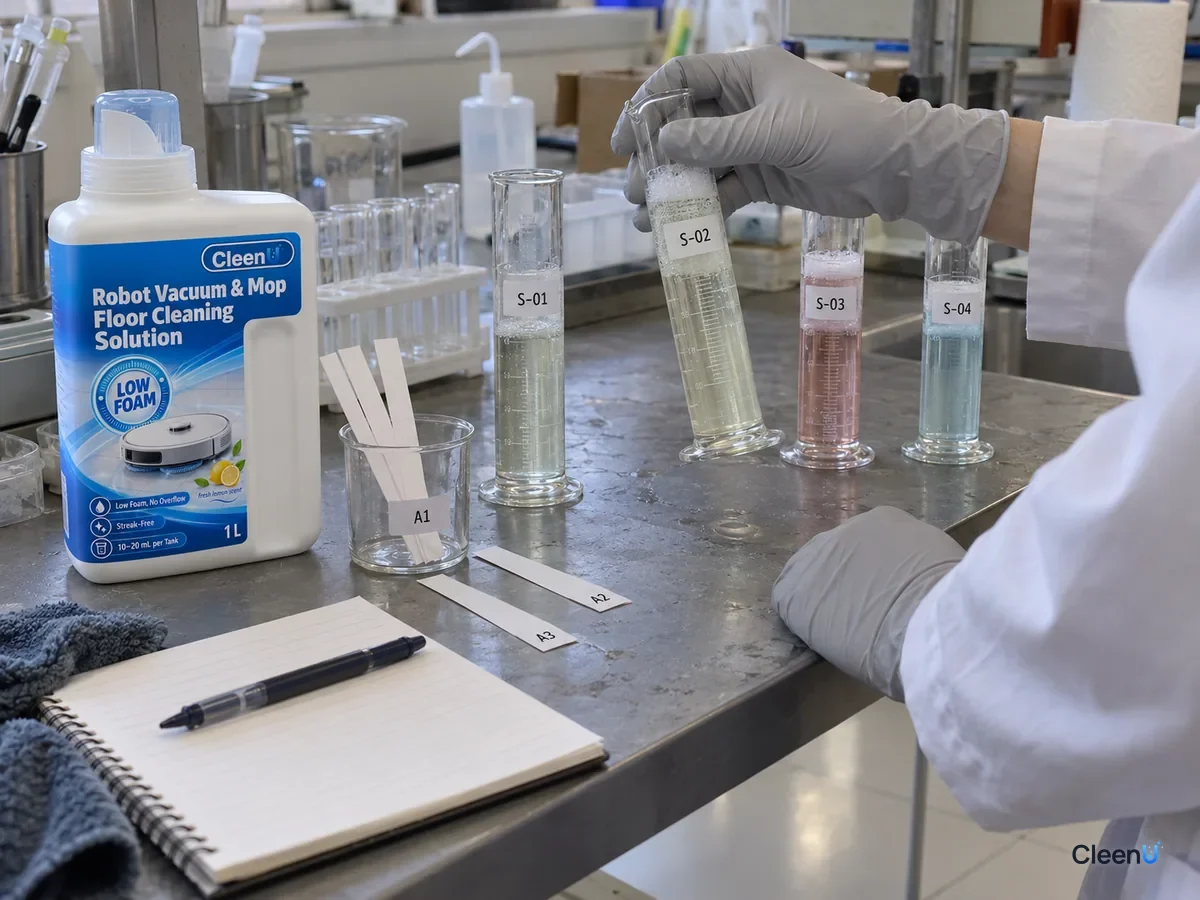
How to tell whether a pet formula's odor control works
A pet formula earns its place through odor reduction, so judge it on odor, not on how nice it smells. One simple comparison: put the same amount of diluted pet urine, or a solution soaked from used pet litter, on two identical floor panels to mimic a pet odor source. Wipe one with the regular formula's working solution and the other with the pet formula's. Once dry, seal each in an identical container and have several people compare odor strength blind.
That's a direction for evaluation, not a standard method, and the result only shows a relative difference under those conditions. It can't be turned into an odor-removal percentage. Pet urine should be blotted up and treated on its own first; a robot mop can't replace that step, and it's worth saying so in the listing. See robot mop tips for pet homes.
Scent claims on the label
Scent claims also need to rest on facts you can state. "Fresh lemon scent," "light scent that fades quickly with airflow" and "contains no fragrance" are fine as long as they match the formula. Be careful with "long-lasting scent all day." The longer a scent lingers, the more fragrance is left on the floor, which contradicts a low-residue claim. For a pet formula, say "helps reduce everyday pet odors," never "eliminates odors" or "permanent odor removal."
CleenU Robot Vacuum Cleaning Solution works in most robot mops from Roborock, iRobot (Roomba Combo and Braava), Ecovacs Deebot, Dreame and Narwal, and in floor washers such as Tineco. Add it to the clean water tank or the dock's designated detergent compartment as your manual directs. CleenU isn't affiliated with these brands; the names only indicate compatibility.
This article is part of the Robot Vacuum Cleaning Solution & Maintenance Guide, which covers the full maintenance schedule and links to every troubleshooting guide.
Common questions about robot mop solution scents
Does a stronger scent sell better?
A light scent is the safer bet. Robot mops run often and cover the whole floor, so a strong scent gets tiresome or harsh, and more fragrance means more foam and residue.
Should a pet formula smell stronger than the regular one?
No. A pet formula relies on odor-reducing ingredients, and its scent should be lighter, so it doesn't blend with pet smells and stays easier on pets' noses.
If only the scent changes, do I still need to retest?
Yes. Fragrance affects foam, residue, stability and material compatibility, so retest at least foam, residue and hot and cold stability.
The fragrance-free version smells faintly while mopping. Is that normal?
Yes. Some raw materials have a faint base odor that can come through while mopping and fades with airflow. With no fragrance added, "contains no fragrance" still holds.
Can you match a well-known brand's scent?
We can develop a similar style of scent, but don't use the other brand's name in marketing or suggest it's the same product.
What should I watch for with scent when selling in Europe?
Get fragrance allergen information from the fragrance supplier first, check allergen labeling against the target market's rules, then set the fragrance level.
Our buyers' cats avoid freshly mopped floors. Which scent should our pet formula use?
Go fragrance-free or very light, and let odor-control ingredients handle pet smells. Cats and dogs react to scent more strongly than people, and fragrance builds up in a closed tank and on pads. During sampling, have pet owners check whether animals avoid mopped areas before you lock the scent.
To build a custom scent on a stable, neutral, low-foam formula, start by requesting a sample of CleenU's Robot Vacuum Cleaning Solution.
Choose a robot mop solution's scent by buyer and channel. Go fragrance-free for baby, sensitive and scent-averse markets. Pick a light scent for mass-market homes so it feels fresh while mopping and fades quickly with airflow. For pet homes, use a lightly scented formula that relies on odor-reducing ingredients rather than heavy fragrance. Because fragrance affects foam, residue, stability and material compatibility, judge scent at real use levels and retest foam, residue and hot and cold stability whenever you pick or change it. Describe scent accurately on the label, and skip "long-lasting scent" or "eliminates odors," which contradict low residue or can't be proven.