
OEM/ODM
Selling Robot Mop Cleaning Solution on Amazon: Listing and Compliance Basics
Direct answer
In your listing, state which machines it works with, how to dilute it and where to add it, and when not to use it. Prepare an SDS and label information for Amazon's hazmat review. Only make claims you can support: no disinfecting or germ-kill claims, and no "fits every robot" promises.
How cross-border sellers typically work with CleenU
-
Brief
Confirm your target market, lead machines, format and size, scent, packaging, label language and estimated first order.
-
Samples and testing
Starting from our neutral, low-foam concentrate, free samples ship in 3–5 days with a suggested ratio and test method so you can validate on your target machines.
3–5 days
-
Documents
We provide the SDS and other documents for the confirmed formula and support your label review.
-
Packaging and label approval
Confirm the bottle, measuring cap, seal, carton and label artwork.
-
Production and shipping
After packaging and labels are approved, bulk production is scheduled when the order is confirmed.
Scheduled with the order
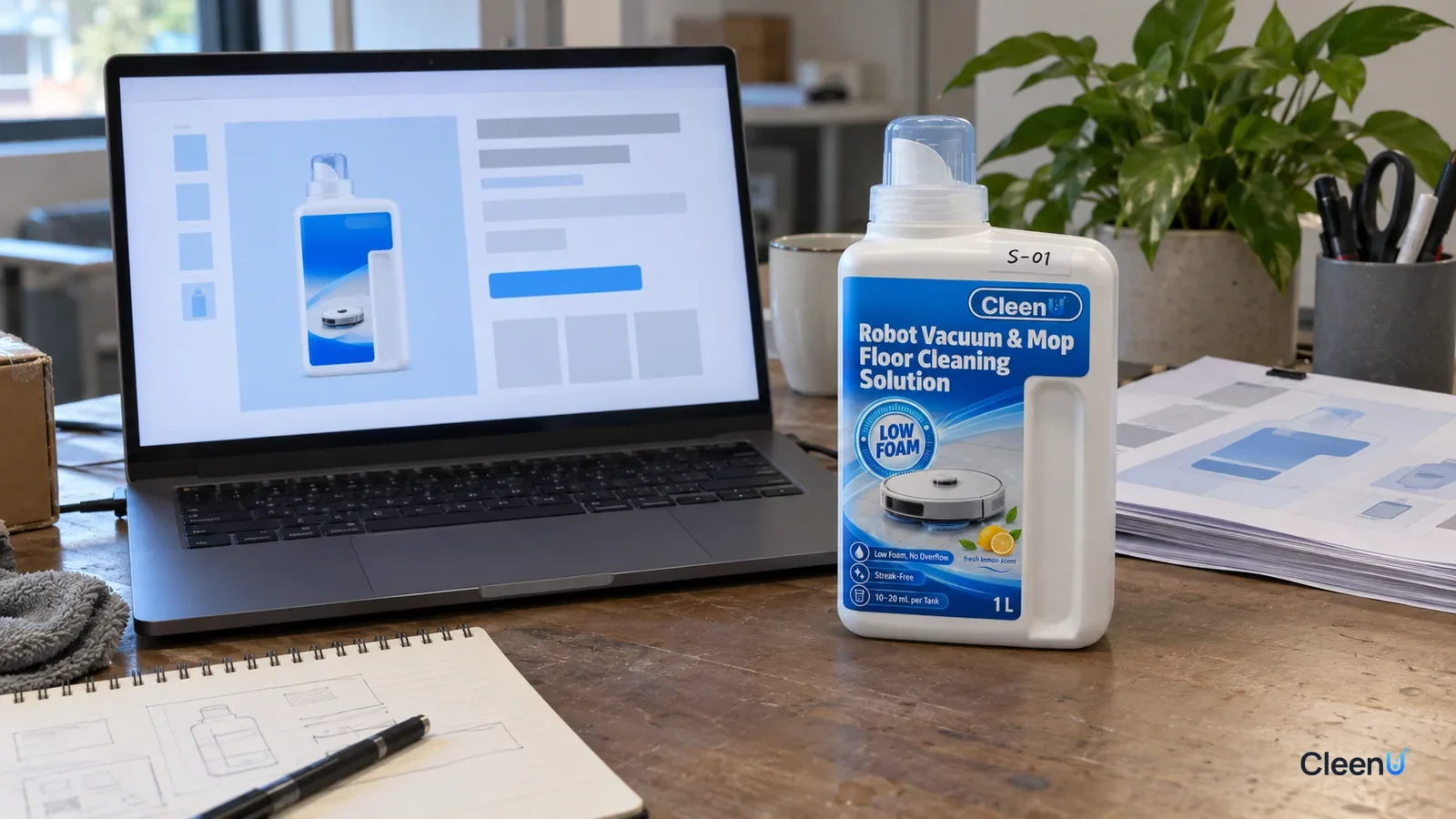
Robot mops keep spreading through American homes, and the cleaning solution that goes with them has become a steady repeat-purchase category on Amazon. Plenty of sellers like it for its modest price point, high repeat rate and manageable shipping volume, and want to launch their own brand.
But cleaning solution is a chemical product, with a few more hurdles than typical home goods: Amazon's dangerous goods review, labeling and ingredient disclosure rules, limits on performance claims, and a steady stream of "will this work in my robot?" questions. Skip the prep and you can expect slow listings or restrictions at best, and waves of bad reviews and returns at worst.
Here are the key steps, from a manufacturer's perspective. Platform policies and regulations change, so check Amazon's current requirements and the rules in your target market before you list, and work with a compliance specialist when needed.
Product selection: pick your market and machines first
Leading robot mop brands in the U.S. include iRobot (Roomba Combo and Braava), Roborock, Ecovacs Deebot, Dreame and Narwal, and Tineco is common among floor washers. Decide which brands and series you'll target, and which of those have auto-dosing docks.
On format, cross-border shipping is billed by volume and weight, so concentrate has a clear edge. A 1-liter concentrate at about 1:50 to 1:100, usually 10 to 20 mL per fill, gives roughly 50 to 100 runs; ready-to-use needs dozens of times the volume for the same number of runs. For more on formats, see private-label robot mop cleaning solution: concentrate, ready-to-use or auto-dose first.
Compliance: documents to prepare before listing
SDS (Safety Data Sheet). Amazon typically runs a dangerous goods (hazmat) review on cleaning products and chemicals, and asks sellers to upload an SDS in the required format. Amazon uses it to classify the product, decide whether it can go into FBA, and set storage and shipping requirements. The manufacturer prepares the SDS from the formula, and it must match the product you actually sell.
Shipping classification. Ocean and air freight each have rules for liquid chemicals. A neutral, low-foam, non-flammable robot mop solution is usually among the easier liquids to ship, but the classification comes from the SDS and your forwarder's and carrier's requirements.
Labeling. The label needs what your target market requires: product name, purpose, directions, precautions, storage, responsible party information and net contents. Some jurisdictions also require ingredient disclosure for cleaning products; California's Cleaning Product Right to Know Act, for example, requires certain ingredients to be disclosed on the label or online. Confirm the rules for each state and country you'll sell in.
Claims. In the U.S., products that claim to kill, disinfect, sanitize or inhibit germs are generally pesticides that must be registered with the EPA. Making those claims without registration can get a listing pulled and invite regulatory trouble. A robot mop solution is a cleaning product, so don't write germ-kill percentages, "disinfects" or anything like it.
Listing: nail three things and you'll cut questions in half
Which machines it works with. State the brands and series you've tested or confirmed, with "most models" and "follow your manual," for example: works in most robot mops from Roborock, iRobot (Roomba Combo and Braava), Ecovacs Deebot, Dreame and Narwal, and in floor washers such as Tineco. Add that you aren't affiliated with those brands and the names only indicate compatibility. Don't make an unqualified universal-fit claim. The first time someone's machine has a problem, that line becomes a one-star review and a return.
How to use it. Add it to the clean water tank or the dock's designated compartment, never the dirty tank. State the dose by tank size, such as "10 to 20 mL per 1-liter tank," matching the cap markings. Say that auto-dosing use depends on the model's manual.
When not to use it. Machines whose manual prohibits additives; never mix with other cleaners or disinfectants; don't overdose; not for unsealed or waxed wood or carpet.
Put these in the first bullets and the images, and you'll see far fewer "will it work," "how much" and "why is it foaming" questions and reviews.
Using other brands' names in titles and keywords
Robot mop solution shoppers often search for "Roomba cleaning solution" or "Roborock cleaning solution," so it's tempting to put those brand names in your title. Be careful.
Amazon generally doesn't allow using someone else's trademark in your title or brand field in a way that implies affiliation or authorization. Leading the title with it, making it prominent, or blending it with your own brand name all risk being seen as misleading.
Describing compatibility is fine when it's clearly descriptive, such as "compatible with" or "works in," placed in bullets or the description with "most models" and "follow your manual," plus a note that you aren't affiliated with those brands.
Don't stuff competitor brand names into backend search terms. Category and use-case terms are safer: robot mop cleaning solution, robot vacuum floor cleaner, dock detergent, low-foam, concentrate, pet homes and so on.
Keep other brands' logos out of your images, and don't stage your product next to their original packaging in a way that suggests it's an OEM accessory.
That reduces the risk of IP complaints and listing restrictions, and it tells shoppers clearly what they're buying: a universal solution compatible with several brands, not a brand's own consumable. Shoppers often ask about that difference too; see brand-name vs universal robot vacuum cleaning solution.
Images and A+ content: show how to use it
Beyond the main image, plan at least: the product alongside a few common dock styles (without other brands' logos in a way that suggests endorsement); a close-up of the cap markings with a "10 to 20 mL per 1-liter tank" graphic; where to add it (clean tank and dosing compartment, with the dirty tank crossed out); a low-foam comparison; and floors it suits and doesn't.
Every claim in your images is held to the same limits as your copy: no germ-kill percentages, no absolute safety promises and no unqualified all-brand compatibility claims.
Fix the most common review complaints before launch
"It foams and the dock says the tank is full": use a low-foam formula and make the dose clear on the cap and label.
"It runs out too fast": state roughly how many runs a bottle gives, and match the cap markings to the right dose.
"The bottle leaked": add a seal and run inversion, drop and shipping simulation tests. For more on packaging, see packaging robot mop cleaning solution: caps, dosing and leak prevention.
"The smell is too strong": keep the scent light or offer fragrance-free.
"It doesn't work in my robot": state compatibility clearly, with "follow your manual."
What CleenU can offer
MOQ and lead time
MOQ starts at 500 bottles. Free samples ship in 3–5 days. After packaging and labels are approved, bulk orders are scheduled when the order is confirmed. SDS and other documents are provided per project after inquiry. Final pricing, MOQ and lead time follow the formal quote and order confirmation. Platform review and regulatory requirements follow the latest rules from Amazon and your target market.
Base specifications of the current robot mop solution
- Type
- Neutral, low-foam concentrated robot mop cleaning solution
- pH
- 6.5 to 7.5 (25°C)
- Formula
- Low-foam nonionic surfactants with defoamer; no particles, no wax, no chlorine
- Dilution
- About 1:50 to 1:100; 10 to 20 mL per fill is usually enough
- Floors
- Tile, vinyl plank, laminate, sealed hardwood
- Default pack
- 1 L concentrate with measuring cap
- Shelf life
- 24 months unopened
Handling reviews and Q&A after launch
The most common buyer questions in this category are "Will it work in my model?", "How much do I add?", "Why is it foaming?" and "Does it smell?" Prepare standard answers in advance.
Compatibility: list the confirmed brands and say "works with most models; please follow your robot's manual," without promising any specific model.
Dosing: answer by the label ratio and remind buyers "water first, then solution, less is more."
Foam: suggest checking for overdosing, mixing with other liquids, and whether the tank was rinsed before switching.
Reply to negative reviews specifically and helpfully, with actionable steps like using less, rinsing the tank or running once with plain water. For machine faults, suggest contacting the robot brand's support and describing how the solution was used. These replies are held to the same limits: no germ-kill or disinfecting claims and no universal-fit promises.
This article is part of the Robot Vacuum Cleaning Solution & Maintenance Guide, which covers the full maintenance schedule and links to every troubleshooting guide.
What sellers ask about selling robot mop solution on Amazon
Do I need an SDS to list robot mop cleaning solution?
Usually, yes. Cleaning products are chemicals, and Amazon typically runs a hazmat review that requires an SDS in the proper format. Check Amazon's current requirements.
Can my listing say it kills germs or sanitizes?
No. In the U.S., germ-kill and disinfecting claims generally require EPA registration, and a cleaning product making them risks removal and regulatory action.
Can I claim a universal fit?
Better not. List confirmed brands with "most models, follow your manual," and note that you aren't affiliated with those brands.
Is concentrate or ready-to-use better for cross-border?
Usually concentrate. It's smaller, cheaper to ship and cheaper per run, and its value is easy to explain on the product page.
What are the MOQ and lead time?
MOQ starts at 500 bottles, free samples take 3–5 days, and bulk is scheduled after packaging and labels are approved, subject to the formal quote.
Can the factory provide English directions for the label?
We can provide basic directions, precautions and storage text for reference. The final label must be checked against your target market's regulations.
Can my Amazon title say "for Roborock" or "for Roomba"?
Keep other brands out of the title opening and the brand field. Platforms generally bar using someone else's trademark in a way that implies affiliation. Put compatibility in bullets and the description, say "works with most models; follow your manual," note there is no affiliation, and use category words in search terms.
Can my listing say the solution is pet-safe?
Avoid a blanket "pet-safe" claim. State the formula facts and the directions instead: neutral, low-foam, no wax or chlorine, dilute by the label, let the floor dry before pets come back, and stop use if a pet shows any unusual reaction. That answers the concern without overclaiming.
To build an Amazon private-label line on a neutral, low-foam 1-liter concentrate with a measuring cap and clearly stated compatibility, start with the CleenU Robot Vacuum Cleaning Solution.
Selling robot mop cleaning solution on Amazon comes down to three things. Prepare compliance documents early, including an SDS in the required format and label content your market requires. Make the listing and images clear on compatible machines, where to add it, how much to use and when not to use it. And only make claims you can support: no disinfecting or germ-kill claims and no universal-fit promises. Concentrate suits cross-border channels best. CleenU can start from a neutral, low-foam concentrate with free samples in 3–5 days, SDS support and bulk scheduled when the order is confirmed. Platform policies and regulations follow the latest official requirements.