
Troubleshooting
How Should Brands Handle Robot Mop Solution Complaints? Five Common Types and the Order to Check Them
Direct answer
Complaints typically fall into five types: foam and false full-tank alerts, sticky or slippery floors, odors, no dispensing, and leaks or bulging bottles. Check safety first, then whether complaints cluster on one batch, then usage and the machine, and finally compare against a retained sample from the same batch.
Run every complaint through this order
- Safety: any skin or eye discomfort, harsh smell, or visibly bulging bottle? If so, stop use, follow the label, then keep going
- Batch code: ask for a photo of the batch code and check whether recent complaints cluster on it
- Location: was solution added to the clean water tank, the auto-dosing cartridge, or by mistake to the dirty water tank?
- Dose: how much per fill, was water added to the cartridge, and was it mixed with other cleaners or disinfectants?
- Machine: model, last time the filter and cartridge were cleaned, any recent error codes
- Retained sample: retest a retained sample from the same batch under the same conditions and compare with the customer's report
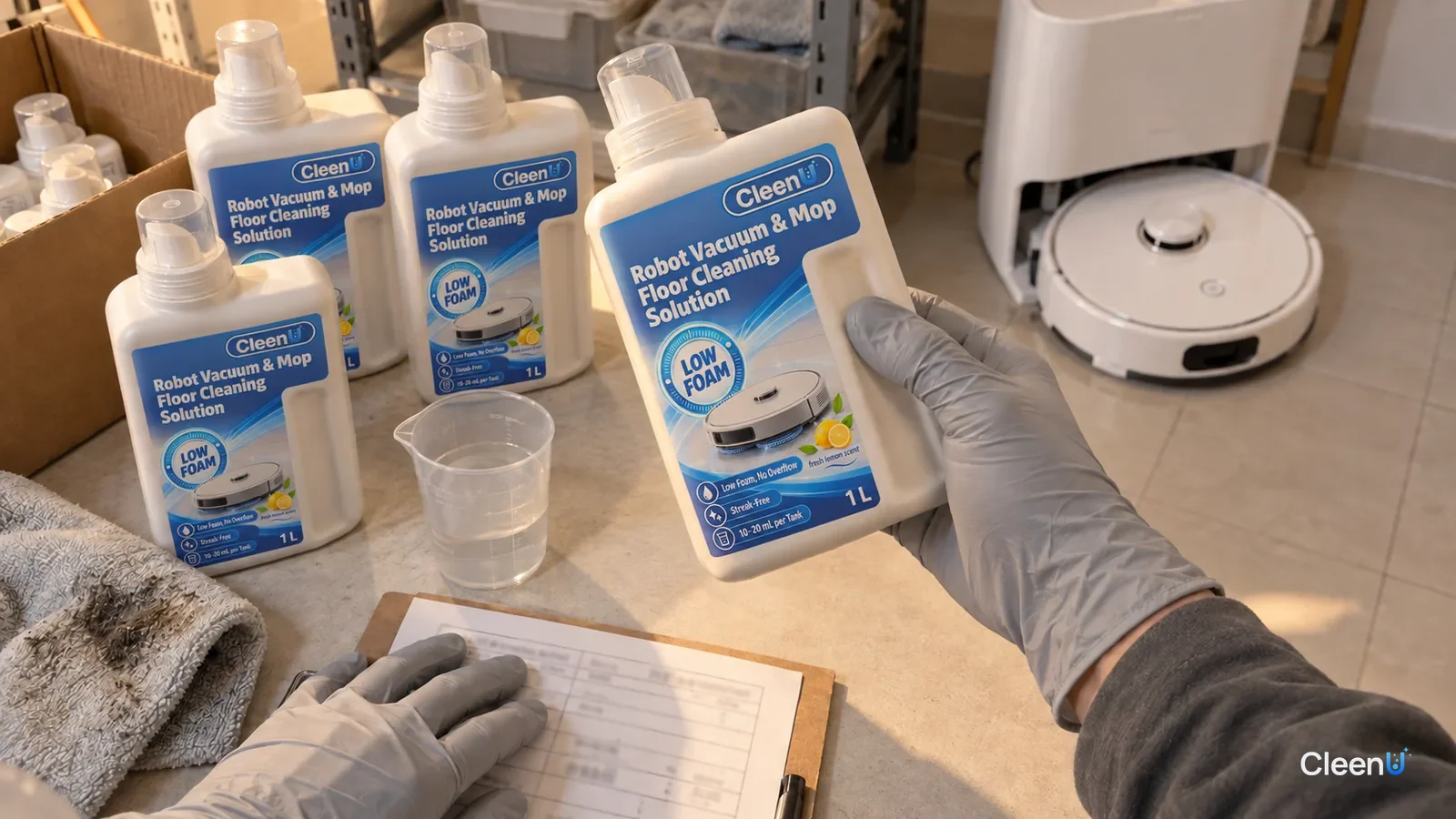
Robot mop solution complaints sound all over the place: "The dirty tank keeps saying it's full." "My floors feel tacky." "The dock smells." "It says the solution is low." "The bottle leaked." Grouped together, they typically land in five types. Each can come from usage, the machine, or the batch, and each calls for a different fix: coach usage issues, refer machine issues to the robot maker, and quarantine, trace, and replace for batch issues.
So support teams don't need a one-size-fits-all apology script. They need a fixed order of checks, then a look at each of the five types.
Triage order: safety, then batch, then usage
Safety comes first because discomfort and bulging bottles shouldn't wait for a root cause. The batch code is the fastest way to separate one person's usage from a batch problem: unrelated customers reporting the same symptom on the same batch is stronger evidence than any single description. Usage and machine checks are cheap and usually settled in one conversation, so retained-sample retests are saved for what those steps can't rule out.
A batch code is only useful if production can trace it. CleenU runs five quality checkpoints: incoming materials, weighing verification before batching, an in-process check before filling, first-piece and patrol checks during filling, and finished-goods inspection, with batch traceability. A customer's batch code leads to the raw-material lots and production record behind it. We also recommend brands keep a few retained bottles from every batch, stored cool until the end of shelf life.
When a complaint comes in, answer these in order
-
Step 1 Does the customer report skin or eye discomfort, a harsh smell, or a bulging bottle?
- Yes
- Ask them to stop using it and ventilate; for skin or eye contact, follow the label and rinse with water. Don't open a bulging bottle; set it aside somewhere cool and log the batch code.
- No
- Go to the next check
-
Step 2 Have there been several complaints with the same symptom on the same batch code recently?
- Yes
- Treat it as a batch issue. Pause shipments of that batch, pull the production record, retest retained samples, and replace the customer's product while results are pending.
- No
- Go to the next check
-
Step 3 Was the solution added in the wrong place, overdosed, diluted in the cartridge, or mixed with another product?
- Yes
- Treat it as a usage issue. Walk the customer through emptying and rinsing, then refilling in the right place at the right dose, and check one or two runs.
- No
- Go to the next check
-
Step 4 Does the machine have a clogged filter, a crusted cartridge, sensor errors, or did the problem start before switching solutions?
- Yes
- Guide cleaning of the relevant parts; if errors continue, refer the customer to the robot maker's support.
- No
- Get the customer's product back and retest it side by side with a retained sample from the same batch, then decide based on the result.
Type 1: foam and false full-tank alerts
How customers describe it. "The dirty tank keeps saying full, and it's half foam." "The dock foams when it washes the pads." "There's a film of bubbles on the floor."
Three questions to ask first. Where and how much do they add, and on a cartridge dock, are they also adding solution to the clean water tank? Was another product still in the tank or cartridge before switching, and have they mixed in dish soap, laundry detergent, or disinfectant? Have they been mopping heavy-soil areas like the kitchen, under the dining table, or a pet feeding spot?
Usage or batch? Usage factors are common with foam: solution in both the cartridge and the clean water tank doubles the strength, leftover high-foam product mixes with the new one, and food residue puts foam-stabilizing protein into dirty water. If the customer confirms a single fill point, the label dose, and a rinse before switching, foam is still heavy, and the same batch has similar complaints, retest the retained sample.
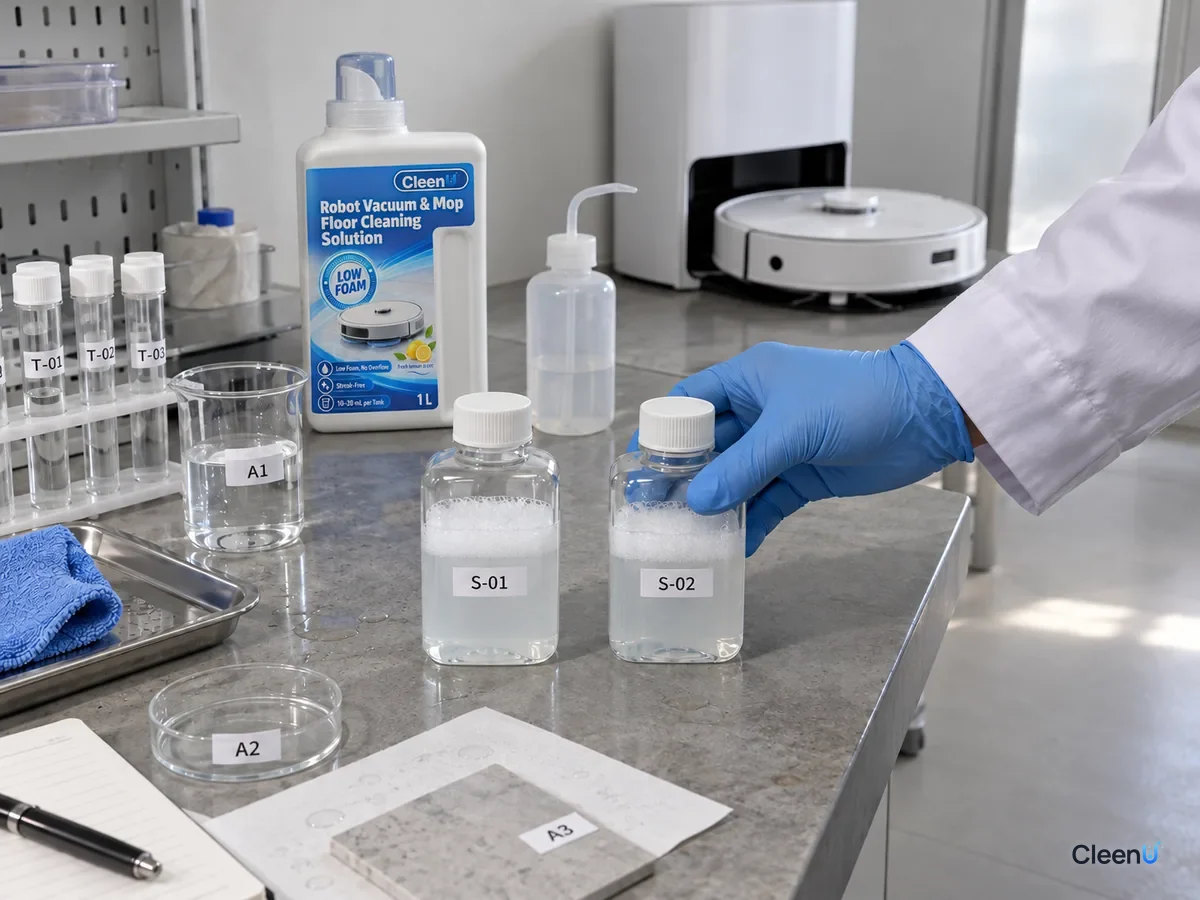
How to compare. Dilute the retained sample and the return at the label ratio in two clear bottles, shake each 10 times, and compare foam height and collapse; repeat with a little milk to simulate protein soil. If both stay low-foam, the cause is likely usage or the machine. If the return foams much more, check whether another liquid got into it or the batch is off. For the mechanism behind false full-tank alerts, see Robot vacuum says the dirty water tank is full when it isn't.
Sample reply. "Thanks for the photos. Heavy foam usually comes from where or how much solution is added, or leftover product. Please empty and rinse the dirty tank and cartridge, add concentrate only to the cartridge on a cartridge dock, and mop one room. If foam is still heavy, send us the batch code and we'll retest a retained sample."
Type 2: sticky or slippery floors
How customers describe it. "Floors feel tacky after mopping." "There's a draggy film." "The floor keeps getting more slippery." "Dark tile looks hazy."
Three questions to ask first. How much do they add, how big is the tank, and do they add extra when floors look dirty? What's the floor, and has it ever been waxed or treated with a shine product? Is it slippery while wet, or still slippery or sticky once fully dry?
What's going on. Residue is roughly working-solution concentration times the liquid film left behind, so doubling the dose roughly doubles it, and a saturated pad or high water flow adds more film. In hard water, calcium and magnesium combine with floor-grease breakdown products into calcium soap, a draggy, whitish film customers also call sticky. Slippery while wet is just the water film; still slippery once dry usually points to film-formers, silicone-type residue, old wax, or long-term overdosing.
Usage or batch? If cutting back to the label dose, or mopping once with plain water and then at the normal dose, clearly helps, the cause is dose or old residue. Move to a retained-sample retest only if a plain-water control area is fine at the label dose, the treated area stays tacky, and the same batch has several similar complaints.
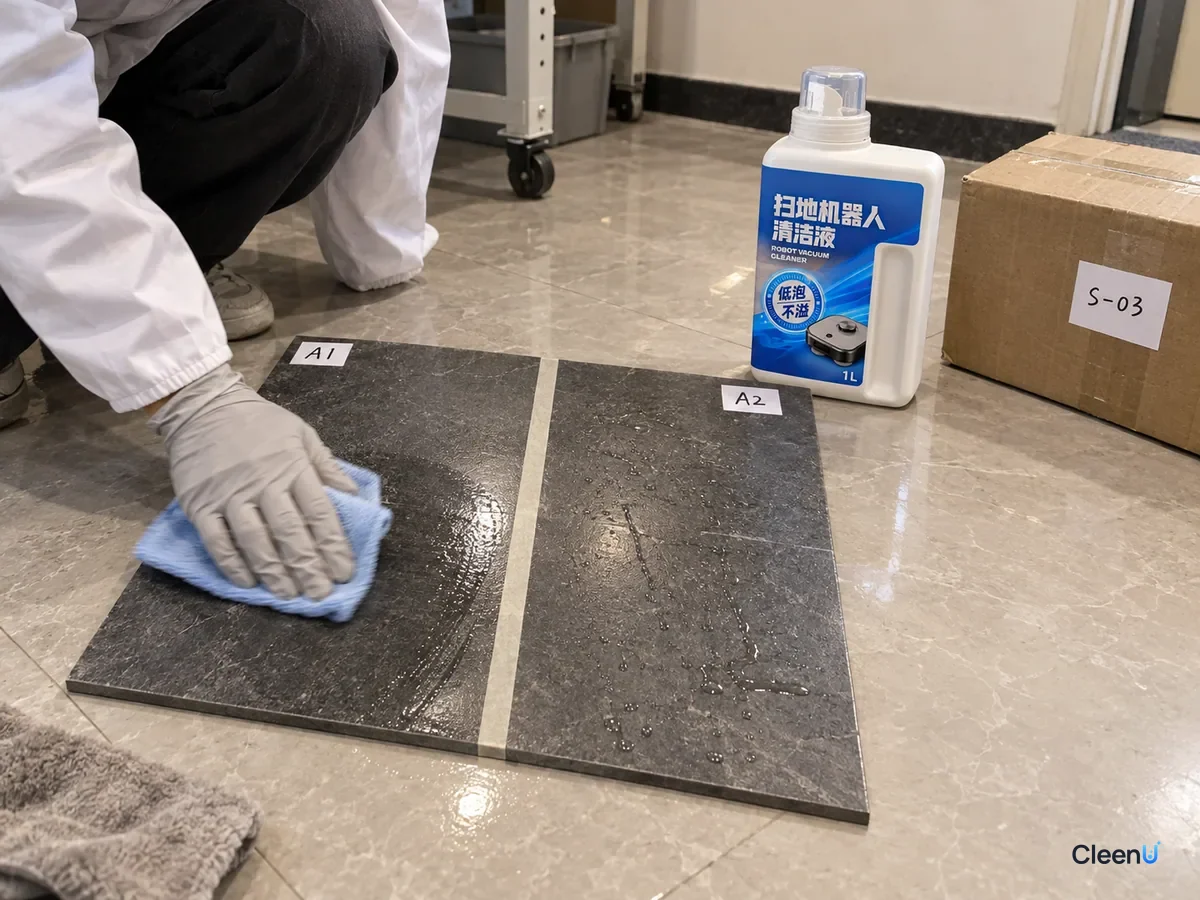
How to compare. Dilute the retained sample and the returned product at the label ratio, wipe each on a mirror or dark tile next to a plain-water patch, let them air-dry, and compare haze against the light and drag under a fingertip. CleenU Robot Mop Cleaning Solution contains no wax and no particles, and a retained sample from the same batch at the normal dose is your baseline. For more, see Sticky floors after robot mopping and Floors getting slippery after robot mopping.
Sample reply. "Tacky floors usually come from a little too much solution or old residue. Please mop once with plain water to lift what's there, then use 10 to 20 mL per liter of water (about 0.3 to 0.7 fl oz per quart), starting at the low end. If the floor still feels tacky once fully dry, tell us the floor type and the batch code and we'll compare."
Type 3: odors
How customers describe it. "The dock stinks." "The clean water tank smells musty." "The bottle smells different from before." "There's a sharp smell in the room after mopping."
Three questions to ask first. Where is the smell coming from: the dirty tank, the clean tank, the pads, or the bottle itself? How long does mixed working solution sit in the tank, and is the dirty tank emptied after every run? When was the bottle opened, where is it stored, and has it been in sun or heat?
What's going on. Pin down the source first. Dirty-tank and pad odors usually come from bacteria breaking down leftover soil: proteins into hydrogen sulfide, thiols, and amines, fats into short-chain fatty acids, faster in warm, wet, low-oxygen conditions. Fragrance only covers it briefly. A musty clean tank often traces to standing solution and biofilm. An off smell or yellowing in the bottle suggests a stability issue or contamination after opening. A sharp smell after mopping calls for ruling out mixing with bleach or other cleaners.
Usage or batch? Dirty-tank, pad, and clean-tank odors are mostly maintenance: dirty water left sitting, working solution left overnight, pads not dried. An off smell or clear color change in the concentrate itself, with similar reports on the same batch, points to the product or batch.
How to compare. Open the retained sample and compare its smell, color, and clarity with the customer's description or the returned bottle. If the retained sample is normal and the return isn't, ask how the bottle was stored and used after opening, such as dipping a used measuring cup back into the bottle or storing diluted solution. The Pet Homes version is fragrance-free and uses a cyclodextrin-based odor neutralizer, so "it has no scent" is expected; explain that clearly. For dirty-tank odors, see Robot vacuum dirty water tank smells.
Sample reply. "Could you tell us whether the smell comes from the dirty tank, the pads, or the bottle? From the tank or pads, it's usually bacteria breaking down soil in leftover dirty water, so empty, rinse, and dry them, and mix solution fresh each day. If the concentrate in the bottle smells different, please stop using it and send us the batch code and a photo of the liquid."
Type 4: no dispensing or "solution not detected"
How customers describe it. "The dock keeps saying the solution is low, but I just filled it." "The cartridge level never goes down." "It doesn't seem to be using any solution."
Three questions to ask first. What's the model, and is the dispenser refillable or a sealed factory box? Is the cartridge seated, was it dried before refilling, and was water added? Where is the dock, and how cold has it been?
What's going on. A small metering pump draws concentrate through a pickup port. Three things can stop it: thickening in the cold; leftover rinse water diluting concentrate into a middle range where surfactants form a liquid-crystal gel over the port; and concentrate drying into a crust. With sealed, non-refillable dispensers such as Narwal's auto-dispensing box, simply add the solution to the clean water tank at the label ratio instead of filling the box.
Usage or batch? If rinsing, drying, and refilling with concentrate fixes it, it's usage or maintenance; if warmth fixes it, it's cold. Retest flow on a retained sample only when several correctly filled machines at normal temperatures fail to draw and complaints cluster on one batch.
How to compare. Bring the retained sample and the return to the same temperature, pour each into a narrow cup to compare flow, then add a little water to each and watch for jelly-like thickening. CleenU Robot Mop Cleaning Solution's viscosity is designed for dock auto-dosing compartments, so the retained sample serves as the baseline. For full troubleshooting, see Robot vacuum auto-dosing not working and Robot dock not using or detecting solution after a switch.
Sample reply. "Please check that the cartridge is pushed all the way in. Then empty it, rinse the pickup port with warm water, let it dry completely, and refill with concentrate only, no water. If your dock has a sealed factory dispenser, add the solution to the clean water tank at the label ratio instead. If it still says low, send us your model and the batch code."
Type 5: leaks and bulging bottles
How customers describe it. "The bag was wet when it arrived." "There's liquid around the cap." "The bottle is swollen." "It hissed when I opened it."
Three questions to ask first. Did it leak on arrival or after some use? Is the inner seal intact and the cap tight? Where has the bottle been stored, near a heater, in a car, or in direct sun, and has the liquid's color or smell changed?
What's going on. Leaks often happen in transit: a loose or under-torqued cap, a poorly sealing liner, a crushed carton, or temperature and pressure swings. Bulging has two kinds of causes. Physical: stored somewhere hot, the air and vapor inside expand, and the bottle partly recovers once cool. Chemical or biological: microbes growing in a contaminated product produce carbon dioxide and other gases, often with yellowing, cloudiness, or a sour smell, or ingredients slowly react with each other or the packaging. The second kind means the product has failed and shouldn't be used or sold.
Usage or batch? One leak on arrival with an intact inner seal and a loose cap points to shipping. Several leaks on one batch call for checking that batch's capping and packaging. Bulging with color or smell changes, or several bulging bottles on one batch, is a batch issue: pause the batch, pull the production record, and observe retained samples.
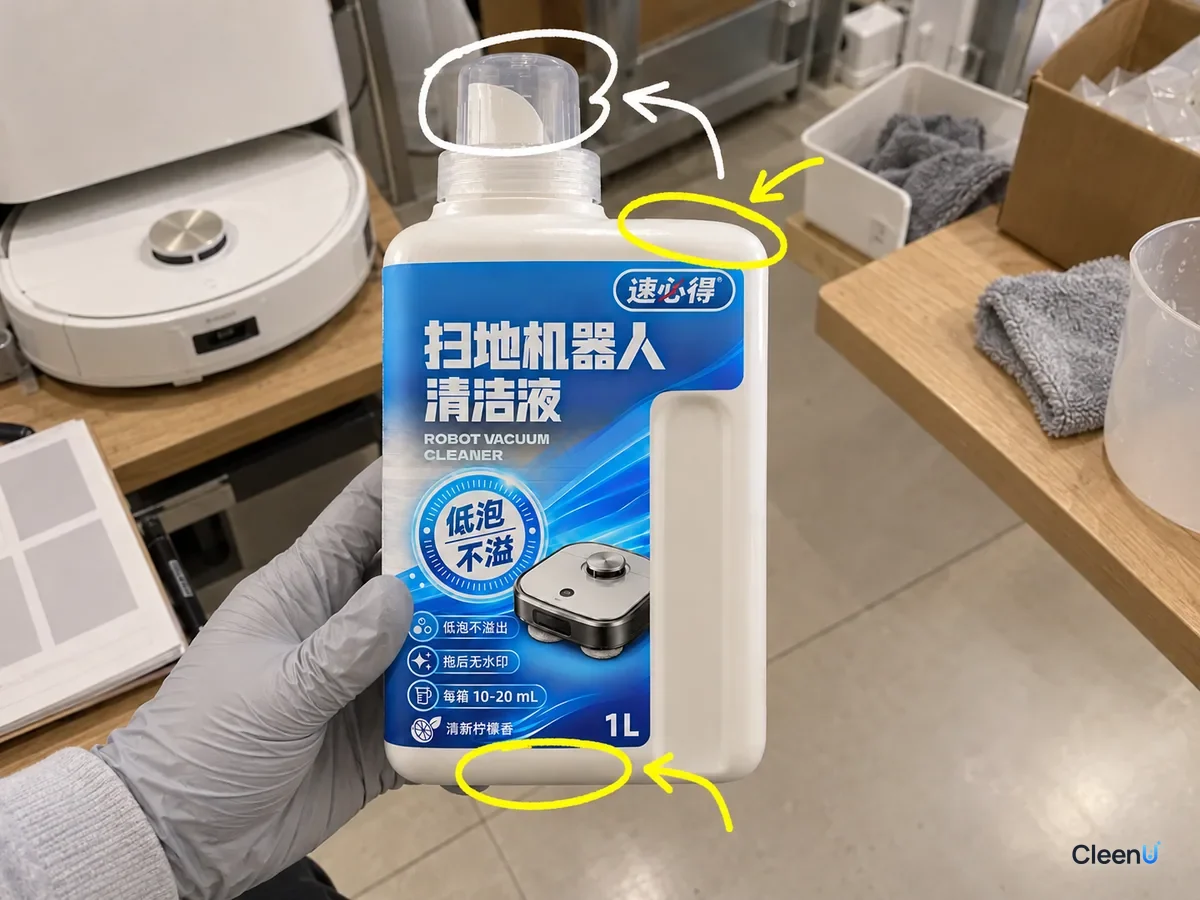
How to compare. Compare the retained sample with the customer's photos, and keep it somewhere cool to see whether it also bulges or discolors. CleenU's robot mop solution can carry an inner seal under the cap, and drop and leak tests run on the final packaging; if several bottles from one batch leak, the batch code leads back to the packaging lots and filling record. For more on bulging and yellowing, see Robot mop solution bottle bulging or turning yellow.
Sample reply. "We're sorry your bottle arrived leaking. Please don't use a swollen bottle or force it open; set it aside somewhere cool. Send us photos of the batch code, the cap, and the outer packaging, and we'll ship a replacement first and trace the cause by batch."
The five types at a glance
Five common complaint types: what to check and what to do
| Complaint type | Usage or machine causes to check first | Signs it's the product or batch | Action |
|---|---|---|---|
| Foam and false full-tank alerts | Double dosing, overdosing, leftover old or high-foam product, heavy-soil areas | Still foamy with correct use, several complaints on one batch, retained sample retests high | Empty and rinse, add in one place only; quarantine and retest if batch-related |
| Sticky or slippery floors | Overdosing, saturated pads, old wax layers, hard water, floor not dry | Still tacky at label dose with a clean plain-water control, several complaints on one batch | Plain-water re-mop and lower dose; mirror residue retest if batch-related |
| Odors | Dirty water left sitting, solution left overnight, pads not dried, mixing with bleach | Off smell or color in the concentrate, similar reports on one batch | Clean and dry, mix fresh; stop and trace if the concentrate is off |
| No dispensing or detection | Cartridge not seated, water in the cartridge, cold, crusted port, sealed dispenser | Correctly filled machines fail to draw, clustered on one batch | Rinse and dry, concentrate only, use the clean tank for sealed dispensers; flow retest if batch-related |
| Leaks and bulging | Loosened in transit, stored in heat | Several leaking bottles on one batch, or bulging with yellowing, cloudiness, or a sour smell | Replace first; pause the batch and check packaging and production records |
Reading retained-sample comparisons
The shake, mirror, narrow-cup, and side-by-side appearance checks above don't need lab equipment, as long as the retained sample and the return get the same dilution, water, temperature, and handling. For the full shake-test method, see How to tell if a robot mop solution is low-foam.
These comparisons only show whether the return matches the retained sample. Both normal: likely usage or the machine. Return off, retained sample normal: think contamination after opening, mixing, or storage. Both off: ask the manufacturer to investigate by batch. When you bring CleenU in, send the batch code, photos, and comparison results together; we can trace production and raw-material records by batch and provide that batch's COA per project.
Preventing complaints at the product level
Many complaints can be headed off at the spec stage; each CleenU Robot Mop Cleaning Solution spec maps to one of the five types. Low-foam nonionic surfactants with a defoamer address foam. A neutral concentrate, pH 6.5–7.5 as a concentrate, with no wax, chlorine, particles, quats, phenols, solvents, or optical brighteners addresses tackiness, slipperiness, and harsh odors. Viscosity designed for dock auto-dosing compartments addresses dispensing. A 1 L (33.8 fl oz) bottle with a measuring cap, diluted about 1:50 to 1:100 with 10 to 20 mL per fill usually enough, helps people dose correctly. An inner seal under the cap, with drop and leak tests on the final packaging, addresses leaks. Shelf life is 24 months unopened. The standard version has a lemon scent; the Pet Homes version is fragrance-free with a cyclodextrin-based odor neutralizer.
We've run foam, residue, and water-path tests on common robot mops and wet-dry vacuums, covering most models from Roborock, iRobot, Ecovacs, Dreame, Narwal, Shark, and Eufy, plus Tineco and Bissell floor washers; for Narwal, it goes in the clean water tank. If a customer's model manual says otherwise, follow the manual. CleenU is not affiliated with any of these brands; names are used only to describe compatibility.
Single-product specs are on the CleenU Robot Mop Cleaning Solution product page. For label and packaging choices that prevent mistakes, see Robot mop solution packaging: spouts, measuring caps, and leak protection.
To build your brand on a low-foam, neutral concentrate with batch traceability: MOQ is 500 bottles, samples ship in about 3 days, bulk runs take about 7 days once packaging is confirmed, and SDS, TDS, and COA are provided per project. Start with our Robot Mop Cleaning Solution.
Escalate right away if you see any of these
Escalate if a customer reports lasting stinging, redness, or swelling after skin or eye contact, or feels unwell after breathing fumes; a bottle bulges along with yellowing, cloudiness, or a sour smell; several complaints with the same symptom hit one batch in a short time; a customer reports damaged machine parts, smoke, or unusual heat; or a customer mixed the solution with bleach or another cleaner and noticed irritating fumes. Don't stop at a standard reply. Ask the customer to stop using it and follow the label, suggest medical care for skin or eye symptoms, pause shipments of the affected batch, and hand the batch code, photos, and conversation to quality control so they can trace it with the manufacturer.
Handling robot mop solution complaints: questions brands ask
What's the first thing to do when a complaint comes in?
Check safety. Ask about skin or eye discomfort, harsh smells, or bulging bottles; if any apply, have the customer stop using the product and follow the label, then ask for the batch code.
How do we tell a usage problem from a batch problem?
Look for clustering on a batch code. Several same-symptom complaints on one batch in a short time point to the batch; a single complaint starts with location, dose, mixing, and machine checks.
Is heavy foam or a false full-tank alert a quality problem?
Start with usage. Double dosing on cartridge docks, overdosing, and leftover old product are common causes; if foam stays heavy with correct use, run a shake retest on a retained sample from that batch.
A Pet Homes customer thinks they got the wrong product because it has no scent. What do we say?
Explain that it's by design. The Pet Homes version is fragrance-free and uses a cyclodextrin-based odor neutralizer instead of added fragrance.
The dock says solution is low, but the cartridge is mostly full. What's the reply?
Walk them through rinsing and drying the cartridge, refilling with concentrate only, and seating it fully. For docks with sealed factory dispensers, switch to adding it to the clean water tank at the label ratio.
Can a bulging bottle still be used?
Don't use it. Set it aside somewhere cool without forcing it open; bulging with yellowing, cloudiness, or a sour smell means the product has failed and the batch should be traced.
Should we replace a leaking bottle before investigating?
Yes, replace first and investigate after. Ask for photos of the batch code, cap, and outer packaging, and check capping and packaging components if several bottles on one batch leak.
Should brands keep their own retained samples?
Yes, a few bottles per batch. Store them somewhere cool until the end of shelf life and compare them with returned products under identical conditions.
When should the manufacturer get involved?
When both the retained sample and the return are off, or one batch draws several same-symptom complaints. Send the batch code, photos, and comparison results, and CleenU can trace production and raw-material records by batch.
A customer asks whether it's OK in their machine. What do we say?
It works in most robot mops and floor washers. Add it to the clean water tank or the dock's designated compartment at about 1:50 to 1:100, 10 to 20 mL (2 to 4 tsp) per fill, and mop one room first.
A customer says floors are sticky after mopping. How do we reply?
Suggest one plain-water mop first, then the label dose. If floors are still tacky once fully dry, ask for the floor type and batch code and run a mirror residue comparison with a retained sample.
Robot mop solution complaints typically fall into five types: foam and false full-tank alerts, sticky or slippery floors, odors, no dispensing, and leaks or bulging bottles. Don't apologize first and guess later. Rule out safety risks, check for clustering on one batch, ask where and how much solution went in and what the machine is doing, then compare against a same-batch retained sample under identical conditions. Coach usage issues, refer machine issues to the robot maker, and quarantine, trace, and replace for batch issues. A low-foam, neutral product with auto-dosing-friendly viscosity, traceable batches, and a clear label prevents many complaints before launch.