
Q&A
Robot Mop Cleaning Solution Froze Over the Winter. Can You Still Use It?
Direct answer
Usually, yes. Let it thaw at room temperature, turn the bottle gently to mix, and use it if it's clear, even and smells normal again. Stop using it if it stays separated, has flakes, smells different or the bottle cracked or bulged. Don't thaw it with hot water or a microwave.
After thawing and mixing, is it still usable?
Yes
- Clear again, or back to its original color and clarity, and even from top to bottom
- Smells the same as before, with no sour, foul or harsh odor
- Pours about as it did before
No
- Separates into layers again after standing, with clearly different color or clarity top and bottom
- Has flakes or grains that won't mix back in
- Smells different, sour, foul or harsh
- The bottle is cracked, leaking or bulging
It depends
- Slightly cloudy but even, with a normal smell: try a small amount and check the floor for tackiness or streaks after mopping, and stop if you see any
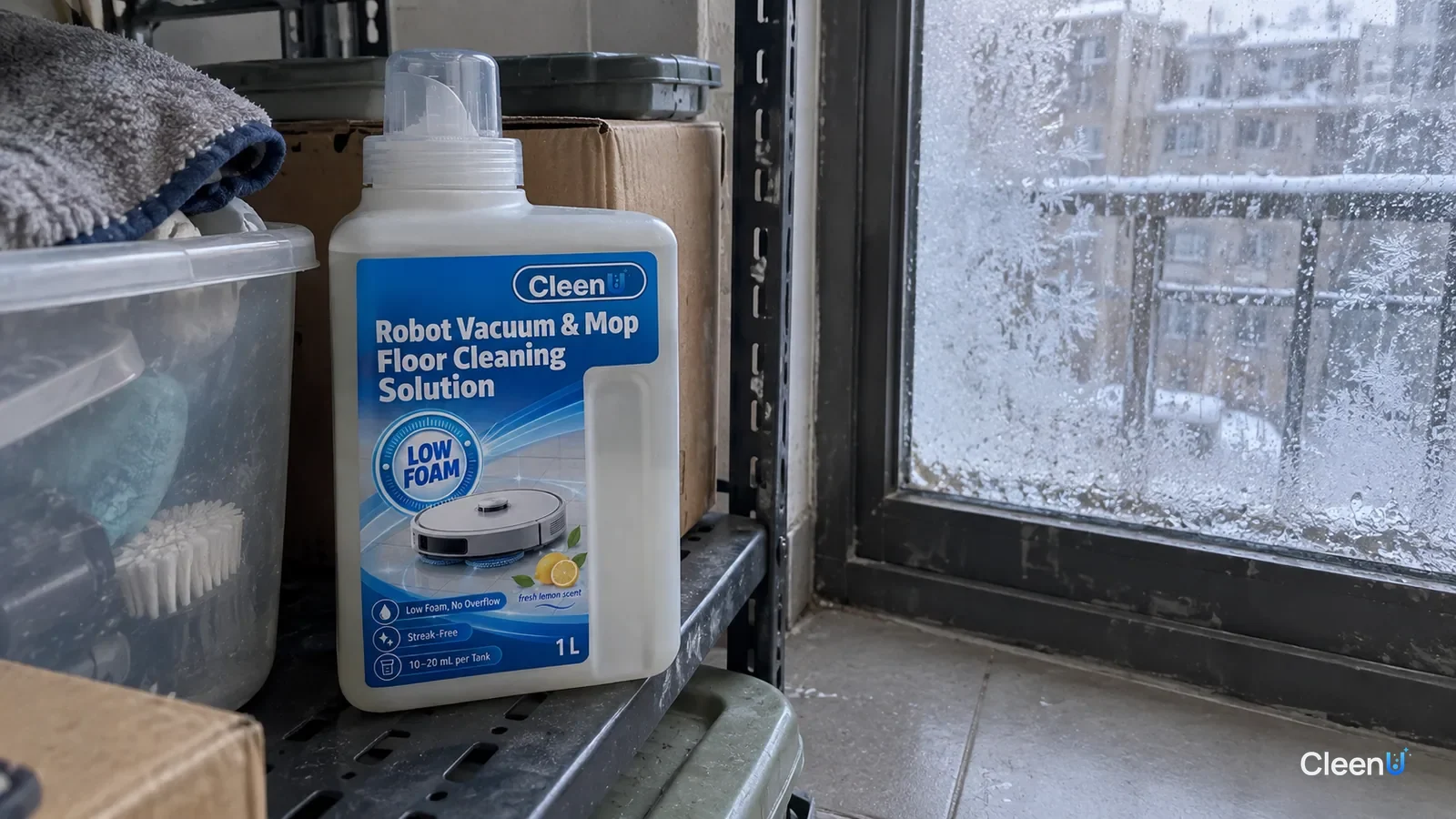
In a cold winter, solution left in an unheated garage, porch or car, or a package left outside on delivery, can turn up cloudy, slushy or frozen solid. The natural worry is that freezing ruined it.
Not necessarily, but it needs a check. Whether a water-based cleaning solution returns to normal after freezing depends on how hard it froze, the formula and how many times it froze and thawed. Thaw it the right way, take a good look, and you'll know whether it's still usable.
Why cleaning solution freezes, and what happens when it does
Robot mop cleaning solution is mostly water, with surfactants, defoamer, fragrance and preservative dissolved in it. Those dissolved ingredients push the freezing point a little below that of plain water, so concentrate has to get somewhat colder than water before it freezes. Still, in an outdoor winter or an unheated garage at well below freezing, it will freeze.
As it freezes, water turns to ice first, and the dissolved ingredients get squeezed into the liquid that hasn't frozen yet, so their local concentration keeps rising. That brings a few changes.
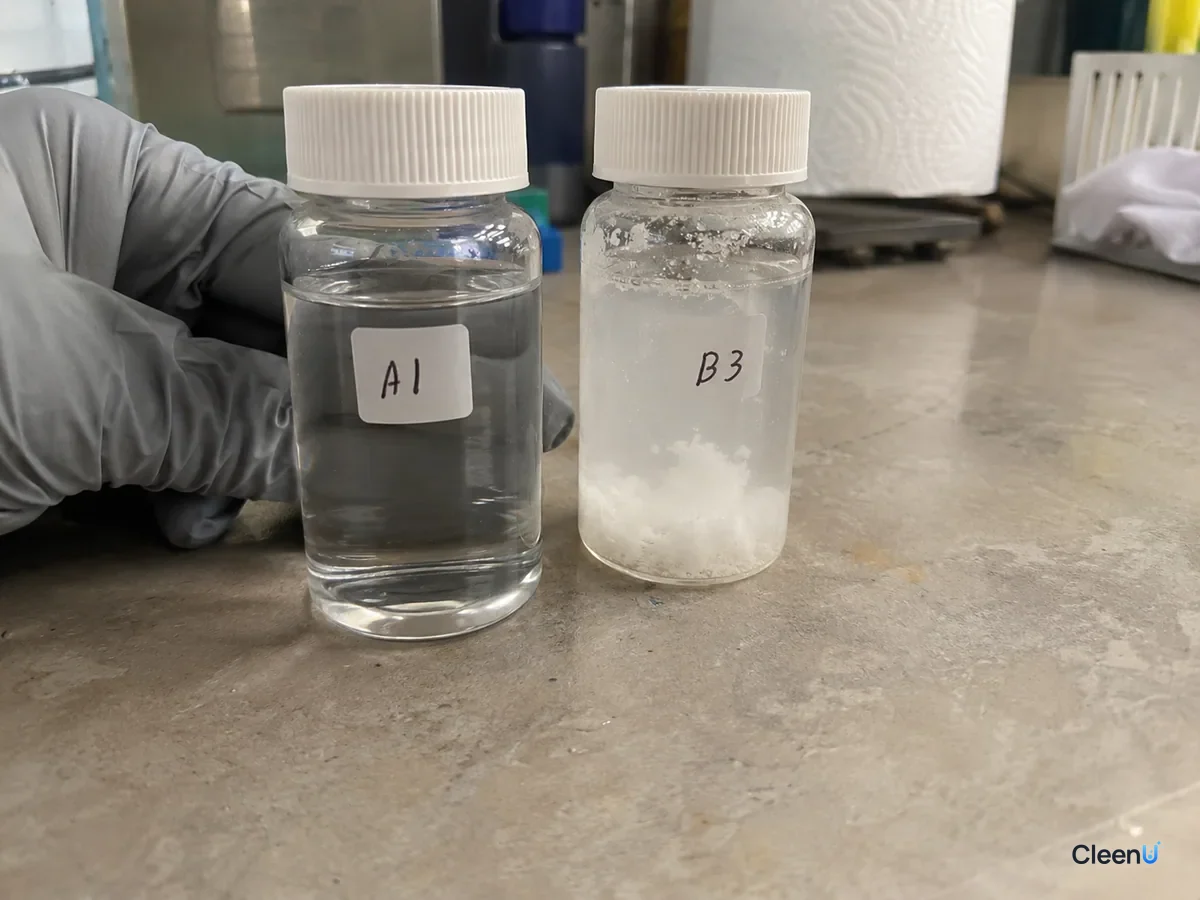
Cloudiness and separation of solids: some surfactants and fragrance become less soluble at low temperature and high concentration, and can come out as white haze, flakes or oily droplets.
Layering: fragrance and some ingredients separate from the water, so after thawing the top and bottom look different in color or clarity.
Texture changes: some thickened formulas get thinner or thicker after freezing and thawing.
Stress on the bottle: water expands as it freezes, so a very full bottle can bulge, crack or loosen its cap.
Thawing: go slow, no heat
Bring it indoors: set the whole bottle somewhere at room temperature to thaw on its own. That takes a few hours to a day, depending on how frozen it is.
Don't heat it: no hot-water bath, no radiator, no microwave. Local overheating can degrade some ingredients and can warp a plastic bottle.
Wait until it's fully thawed: don't shake or use it while there's still ice in it.
Mix gently: once it's fully thawed, tighten the cap and turn the bottle over a few times so any separated ingredients blend back in. Don't shake it hard, or it will foam.
Let it sit, then look: after mixing, let it stand for 30 minutes to an hour, then hold it up to the light.
Why solution with separated solids shouldn't go in the robot
If thawed solution has flakes, grains or oily droplets that won't mix back in, keep it out of your robot mop.
Clogging: a robot's outlet holes, lines and auto-dosing pump are narrow, and flakes or grains can block the holes so the pad gets less water or stays dry. See robot mop pads staying dry.
Uneven cleaning and residue: separated ingredients aren't evenly dispersed, so in the tank the strength varies. Some areas don't get clean, and others get extra residue and feel tacky.
Foam: the balance between defoamer and surfactant is thrown off, so foam can increase and trigger false full-tank alerts in the dirty tank.
Freeze damage vs spoilage
Changes from freezing and changes from microbes can look similar, but their causes differ.
Freeze-thaw: shows up only after freezing, as cloudiness, layering or separated solids, and the smell usually doesn't change. It can often be mixed back at room temperature.
Microbial spoilage: common when a bottle has been open a long time, scooped with a wet cup or topped up with water. It shows as cloudiness, a sour or foul smell and slimy strands, and the bottle may bulge. It can't be undone; stop using it. See bulging bottle or yellowed robot mop solution and robot mop solution changed color or separated.
If frozen solution also smells different, treat it as spoiled and stop using it.
Protect the dock and tanks from freezing too
The robot itself is actually more at risk than the solution. If the dock sits in an unheated garage, porch or cold basement, the water in the tanks and the liquid in the detergent compartment can freeze.
Cracked tanks and lines: freezing water expands and can split the clean tank, dirty tank and narrow lines, causing leaks.
Damaged pump and valves: frozen liquid can seize the pump, and running it that way can damage it.
Battery and electronics: cold hurts battery performance, and some models won't charge or run at low temperatures.
Most robot mop manuals set temperature limits for use and storage, generally recommending normal indoor temperatures. In winter, don't keep the dock anywhere that freezes. If you won't use it for a while, empty and dry the clean and dirty tanks, and pour concentrate from the detergent compartment back into its bottle or handle it as the manual says. For what to do before storage, see robot vacuum storage tips.
If the robot has already sat somewhere cold, bring it indoors for a few hours so the body and any liquid warm to room temperature, check the tanks and lines for cracks and leaks, then turn it on.
Mixed working solution freezes more easily than concentrate
Cleaning solution freezes below plain water because of what's dissolved in it. Concentrate has more dissolved ingredients, so its freezing point is somewhat lower. Once diluted 1:50 to 1:100 in the clean tank, the working solution is nearly plain water and freezes close to 0°C (32°F), more easily than the concentrate.
So in winter, what freezes first is often the water in the dock's clean tank, near the detergent compartment outlet and in the lines, not the concentrate bottle in the cabinet. Besides possibly cracking tanks and lines, frozen working solution can thaw unevenly: water freezes first, the leftover liquid gets stronger, and if you mop with it unmixed, the first few minutes of water may be too concentrated and more likely to streak.
The fix is simple: pour out working solution that froze in the tank, rinse the tank and mix a fresh batch at the label ratio. Don't keep using frozen working solution. Mixed solution should be used the same day anyway, and in winter that matters even more.
The more freeze-thaw cycles, the higher the risk
One light freeze that thaws quickly is something most formulas recover from. Repeated freezing and thawing, such as indoors by day and on a cold porch by night for several rounds, separates the ingredients and disperses them again each time, making recovery harder and permanent layering or sediment more likely. So don't move solution back and forth between warm and cold; keep it in one steady indoor spot.
Storing cleaning solution in winter
Keep it indoors at room temperature, away from radiators and direct sun, not on a porch, in a garage or in the car.
If it has to go somewhere cold, make sure the cap is tight and the bottle stands upright.
Watch winter deliveries: packages may sit in the cold for a while, so let the bottle warm up indoors before checking it.
Mind the shelf life: CleenU Robot Vacuum Cleaning Solution, for example, has a 24-month unopened shelf life. Once opened, follow the label and store it somewhere cool, dark and frost-free.
CleenU Robot Vacuum Cleaning Solution is a neutral, low-foam concentrate at pH 6.5 to 7.5 with low-foam nonionic surfactants and a defoamer, no wax, no chlorine and no particles. It dilutes at about 1:50 to 1:100; 10 to 20 mL per fill is usually enough. It comes in a 1 L bottle with a measuring cap.
CleenU Robot Vacuum Cleaning Solution works in most robot mops from Roborock, iRobot (Roomba Combo and Braava), Ecovacs Deebot, Dreame and Narwal, and in floor washers such as Tineco. Add it to the clean water tank or the dock's designated detergent compartment as your manual directs. CleenU isn't affiliated with these brands; the names only indicate compatibility.
Low-temperature stability for brands
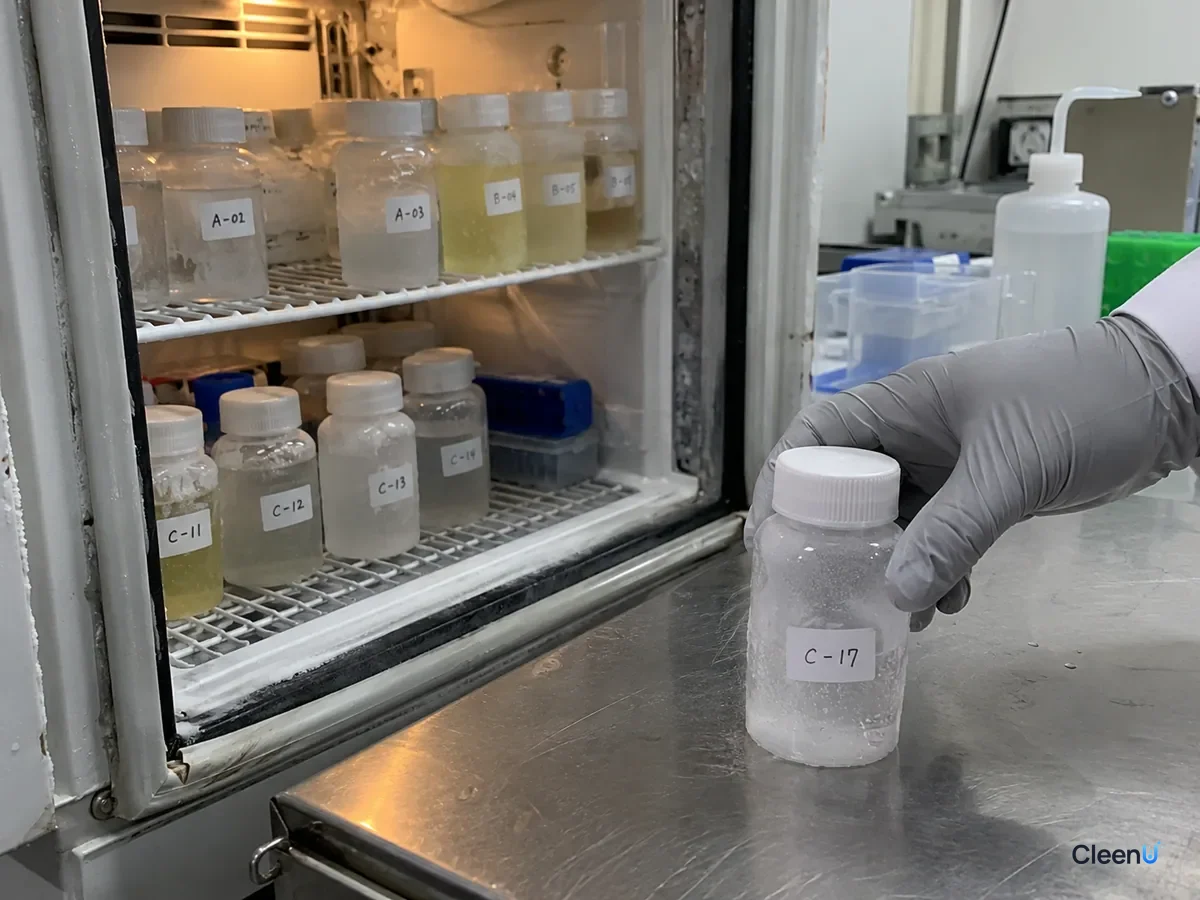
For brands and distributors, winter shipping and warehousing in cold markets are a source of cleaning solution complaints. Before launch, you can add cold and freeze-thaw cycling to stability testing: freeze samples, bring them back to room temperature, repeat for several rounds, and check whether appearance, smell, viscosity and foam recover. Test conditions and pass criteria are set per project, and results only show how that formula behaves under those conditions. For stability testing methods, see cleaning solution stability testing.
This article is part of the Robot Vacuum Cleaning Solution & Maintenance Guide, which covers the full maintenance schedule and links to every troubleshooting guide.
Common questions about frozen cleaning solution
My cleaning solution froze solid. Can I still use it?
Thaw it at room temperature first, turn it gently to mix and let it stand. If it's clear, even and smells normal, use it. If it has sediment that won't mix in, stays layered or smells different, stop.
Can I speed up thawing with hot water?
No. Local overheating can degrade some ingredients and warp a plastic bottle. Let it thaw slowly at room temperature.
It's a little cloudy after thawing. What happens if I use it in the robot?
Slight, even cloudiness with a normal smell is fine to try in a small amount. If there are flakes or grains, don't add it, since they can clog outlet holes and the dosing pump.
Does freezing once make the solution work worse?
If it comes back clear and even, it generally works normally. After repeated freeze-thaw cycles, or if it separates or has sediment, cleaning and foam performance may change, so stop using it.
My dock is on an unheated porch. What should I watch for in winter?
Move it indoors. Water freezing in the tanks and lines can crack parts, and cold hurts the battery. Follow the manual's temperature limits for use and storage.
The bottle bulged when it froze. Is it still usable?
If the bottle returns to shape after thawing with no cracks or leaks, judge the liquid by its look and smell. If the bottle cracked, leaks or stays bulged after thawing, stop using it.
The tanks froze in my porch dock. Can I turn the robot right back on?
Not yet. Let the tanks and lines thaw at room temperature first, since expanding ice can crack tanks, pumps or tubing. Check for leaks, then run a test cycle, and move the dock indoors or empty both tanks before the next cold snap.
For a neutral, low-foam robot mop solution with a 24-month unopened shelf life and a measuring cap, choose Robot Vacuum Cleaning Solution.
Robot mop cleaning solution that froze over the winter is usually still usable. Thaw it at room temperature, never with hot water or a microwave, turn it gently once fully thawed, let it stand and check it. If it's clear, even, smells normal and pours normally, keep using it. If it separates again, has flakes or grains that won't mix in, smells different, or the bottle cracked, leaks or bulges, stop, so it doesn't clog outlet holes, leave residue or foam more. Pour out working solution that froze in the tank and mix fresh. In winter, keep solution indoors somewhere cool, keep the dock out of freezing spots and empty the tanks before storage. Brands can add freeze-thaw cycling to pre-launch stability testing.