
How-to
Can You Use Third-Party Cleaning Solution in a Roborock? Where It Goes and How to Set It Up
Direct answer
Yes. The key is picking the right one and adding it in the right place: a low-foam, neutral, particle-free concentrate with no disinfectants, in the dock cartridge only if you have one, otherwise diluted about 1:50 to 1:100 in the clean water tank.
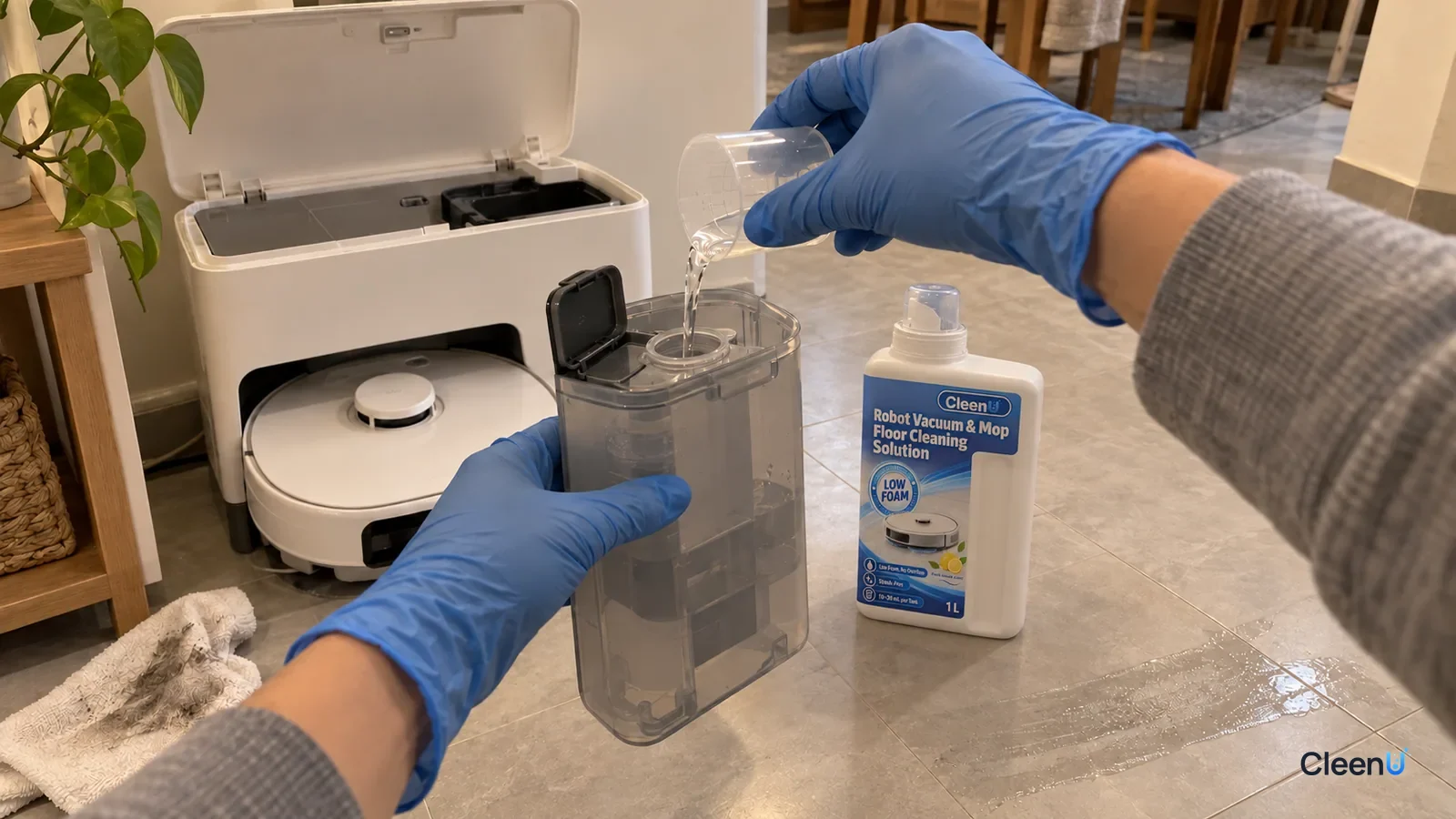
Yes, you can use a third-party cleaning solution in a Roborock. The key is picking the right one and adding it in the right place. Pick for four things: low foam, so it holds up to a vibrating mop and dock scrubbing; neutral pH, so it's gentle on gaskets, plastic tanks, and tubing; no particles or wax, so nothing dries into a crust on the filter or outlets; and no disinfectants, so floors dry clean. Then match the dosing to your dock: concentrate goes in the cartridge if you have one, and everything else gets diluted about 1:50 to 1:100 in the clean water tank.
Plenty of owners can't find Roborock solution locally at a reasonable price, or simply run out. The useful question is how to pick and add a third-party solution well. Below, we walk through how liquid actually moves through a Roborock, the chemistry of foam, heat, and materials, how to compare dilution ratios across brands, quick tests you can run at home, and step-by-step setup for each type of dock.
Four things to look for: low foam, neutral, particle-free, no disinfectants
A robot mop's water path is far more involved than a bucket and mop. The clean tank, pump, outlets, mop pads, dock wash tray, and dirty-water pickup all touch the solution. Map those stages onto the formula, and the shopping list comes down to four points.
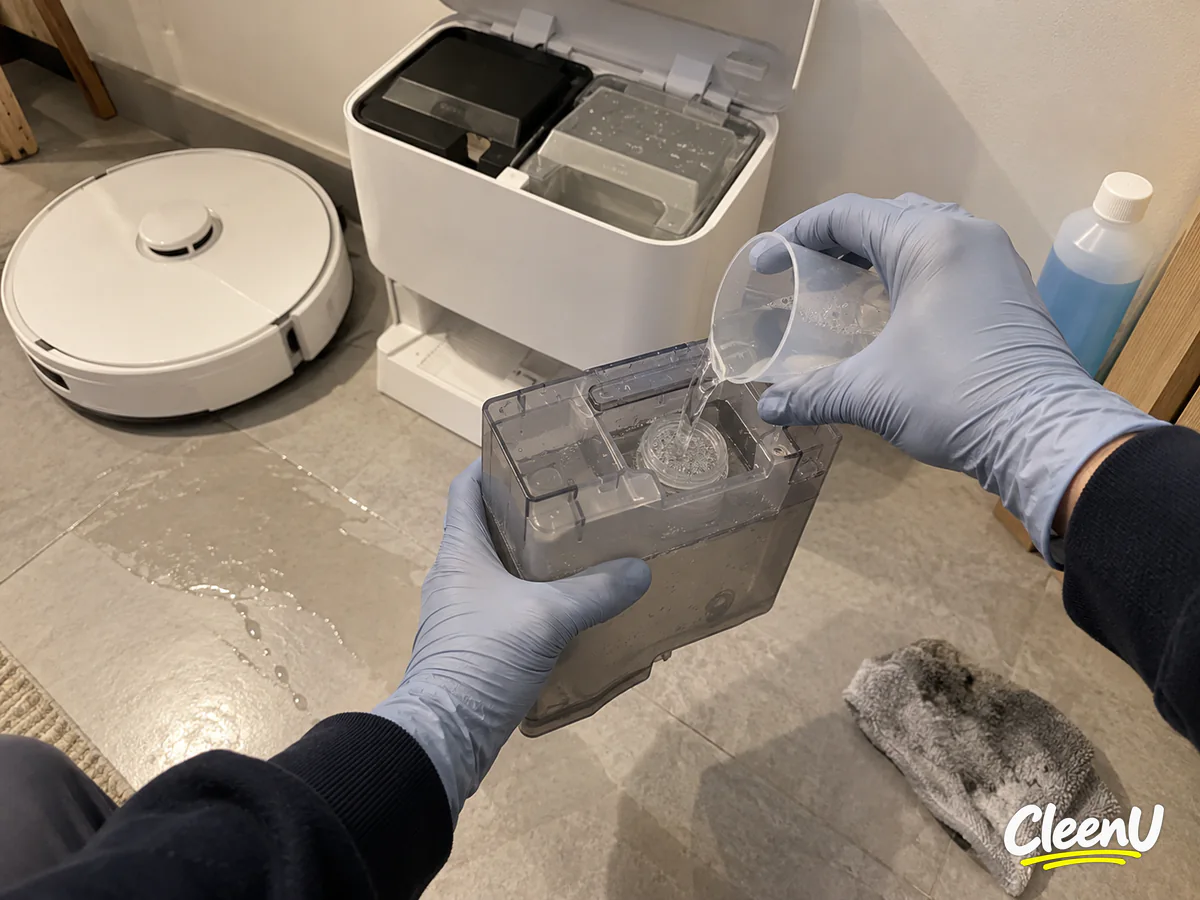
- Low foam: the solution makes little foam, and the foam collapses fast, whether the mop is vibrating on the floor, being scrubbed in the dock, or getting pulled into the dirty water tank.
- Neutral pH: gaskets, plastic tanks, pumps, and tubing sit in this liquid for months, and a neutral system is the gentlest on all of them.
- Particle-free, no wax: no particles, waxes, or film-forming polymers, so nothing dries into a crust and filters and outlets stay clear.
- No disinfectants: no chlorine, quats, or phenols, so floors dry without extra residue, which also suits homes with kids and pets.
Each of those maps to specific parts of the machine and specific chemistry, which the rest of this guide covers.
Which kind of Roborock do you have? Check for a solution cartridge
Where cleaning solution goes depends on whether your dock has a cleaning solution cartridge. Some owners call it an auto-dosing or detergent compartment. Here's what Roborock's own materials confirm:
- The S8 MaxV Ultra and S8 Max Ultra have a cartridge. The S8 Pro Ultra from the same generation does not.
- The Saros 10 and Saros 10R have a cartridge.
- For other models, including the Qrevo variants, S7, and S9, cartridge availability varies by region and published sources don't always agree. Check your manual.
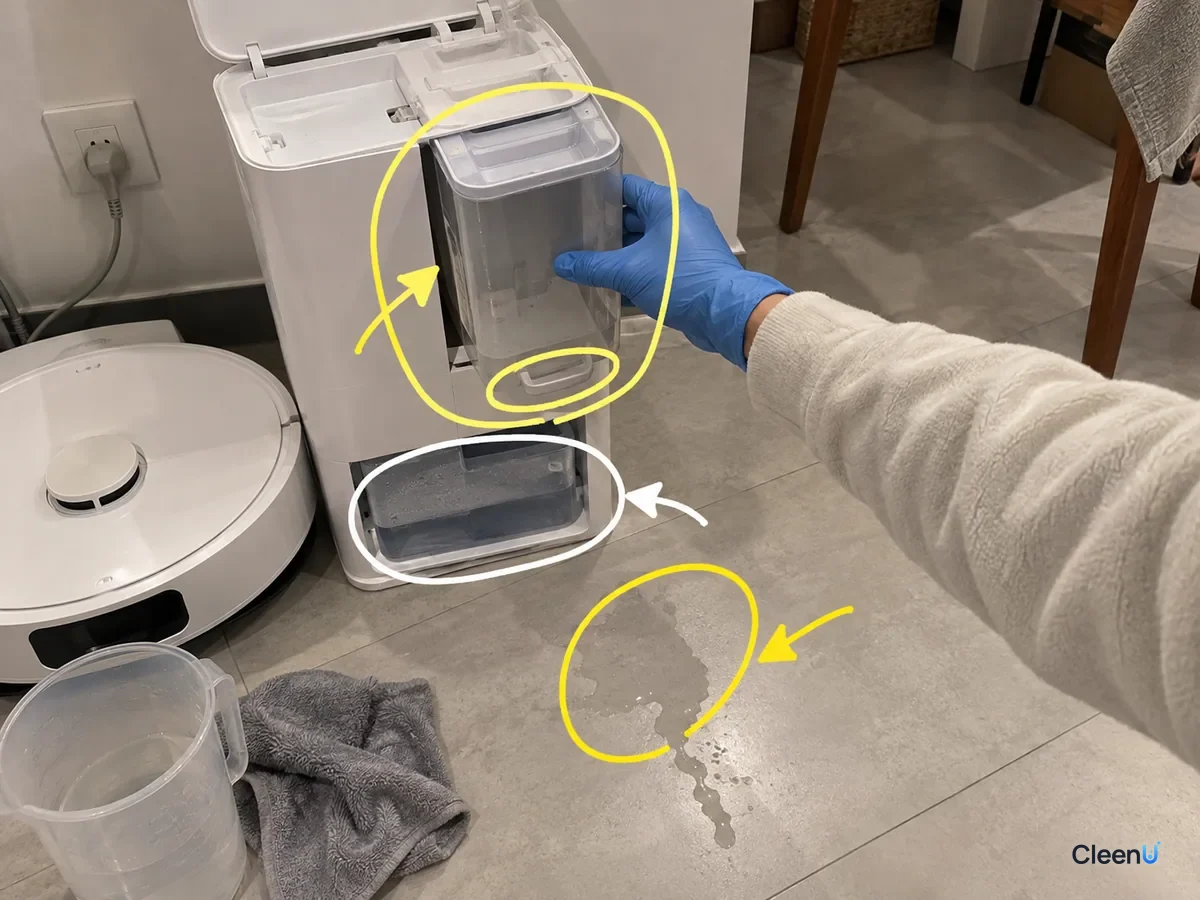
The quick physical check: lift the dust bin cover on top of the dock and look for a small removable container with a handle. The S8 Max Ultra manual describes exactly that: open the dust container cover, pull the cartridge out by its bottom handle, fill it, and slide it back.
The two setups route liquid very differently, and that changes both where you add solution and how much.
Docks with a cartridge. The dock's pump draws solution from the cartridge at a preset ratio and blends it into two water streams: the water used to wash the mop and the water used to refill the robot's tank. The manual says the robot automatically adds solution to mop-washing and refill water according to the preset ratio, and that smart solution filling can be turned off in the app. That's why, on these models, solution goes in the cartridge only. The manual specifically warns to add solution only to the cartridge to avoid an overly high concentration. The logic is straightforward: the cartridge is already dosing, so pouring more into the clean water tank doubles what reaches your floor.
Models without a cartridge. Here you mix the solution into clean water yourself. If your dock has a clean water tank, it goes there. Older robots with an onboard tank take it in the robot. From the clean tank, water goes to the robot, and an electric pump meters it onto the mop at the flow level you set in the app. You control the ratio completely, so measuring is the step that matters most.
Either way, never add cleaning solution to the dirty water tank. It doesn't clean anything there, and the foam can confuse the water-level sensing.
Why low foam comes first in a Roborock
Nearly every stage of a robot mop's water path whips air into liquid. A vibrating or spinning mop churns the solution against the floor. In the dock, the mop is scrubbed and rinsed with turbulent water. Dirty water is pulled into the tank by suction, which mixes air and liquid again. That's why foam control is the first thing to check when you pick a solution for a robot mop.
Whether foam lasts depends on the film around each bubble. Surfactant molecules have a water-loving end and an oil-loving end, and they line up along that film. When part of the film stretches thin, its surface tension rises, and liquid from the surrounding film flows in to repair it. That's the Marangoni effect, and it's what makes foam "self-healing." The anionic surfactants common in dish soap and laundry detergent are very good at this, which is why their foam is thick and long-lasting. Protein soils from the floor, like food residue, pet saliva, and foot sweat, dissolve into the water and reinforce the bubble film too. That's why the same solution foams more in a dirty kitchen than in a clean-water test.
Pick a genuinely low-foam solution and you'll see three payoffs in a Roborock:
- Cleaner filters and tubing: with little foam, dust and hair aren't carried into the filter, so it goes longer between rinses.
- Accurate tank readings: water-level sensing in the dirty tank, whether electrode- or float-based, reads a liquid surface, not a foam cap, so the "tank full" alert means what it says.
- Clean-drying floors: the working solution spreads as an even film and dries without bubble marks or streaks.
Low-foam robot mop formulas usually work two ways. The main surfactants are low-foaming nonionics, such as fatty alcohol ethoxylates with a low ethylene oxide (EO) count or EO/PO block copolymers, which produce little foam and unstable foam. A small amount of defoamer is then added; it slips into the bubble film, disrupts the orderly surfactant layer, and creates weak spots that let bubbles pop. Low foam doesn't mean weak cleaning. Cleaning comes from wetting, emulsifying, and dispersing soil, and suds are mostly a visual cue.
How foam forms, and how a low-foam formula knocks it down
- Mop vibration and dock rinsing trap air in the working solution, forming bubbles
- Surfactants line the bubble film, and the Marangoni effect repairs thin spots, stabilizing the foam
- Protein soils from the floor dissolve in and strengthen the film further
- Low-foam surfactants stabilize bubbles poorly, and defoamer creates weak points in the film
- The film can't repair itself, bubbles collapse quickly, and the dirty tank holds liquid instead of foam
Hot-water mop washing changes how a solution behaves
Many newer Roborock docks wash mops with hot water. Roborock's materials say hot water is used early in the main wash to work with the cleaning solution, reaching about 140°F (60°C) on some models, and the Saros 10 and 10R are listed at up to about 176°F (80°C), paired with auto dosing and warm-air drying. Temperature is rarely discussed when people compare solutions, but it matters.
First, nonionic surfactants have a cloud point. Above it, the surfactant separates from water, the solution turns cloudy, and cleaning power temporarily drops. Formulators often use this on purpose: in hot water, some low-foam nonionics act as defoamers, helping control foam during mop washing, then dissolve again as the water cools. A formula meant for hot docks balances cloud point and foam control so it doesn't foam out of control in hot water or drop out and stick to tubing.
Second, heat speeds up chemistry. Reactions and material aging generally run faster as temperature rises. A strongly alkaline or acidic solution, or one with solvents, will be harder on rubber gaskets and plastic parts at 140–176°F than at room temperature. That's one reason we think robot mop solution should be neutral and solvent-free: a neutral system stays gentler on materials in hot water.
Third, warm-air drying concentrates residue. After washing, the dock blows warm air over the mop and wash tray. Water evaporates, and whatever was dissolved in it stays behind. So choose an easy-rinsing, particle-free formula without waxes or film-forming polymers. It leaves little behind, redissolves easily the next time water flows through, and keeps pads soft and outlets clear.
What not to put in a Roborock tank: vinegar, bleach, alcohol, and floor polish
The parts that sit in liquid inside a Roborock fall into three groups: rubber or silicone seals (at the tank openings, cartridge connector, and pump), plastic parts (tanks, tubing, the cartridge), and a few metal parts (inside the pump, contacts, fasteners). Several household liquids people reach for in a pinch are hard on them.
- Acids such as vinegar or citric acid solutions can corrode metal over time and age some rubbers. iRobot's support site states plainly that adding vinegar to the water can cause corrosion.
- Chlorine bleach is a strong oxidizer that can harden and crack rubber and corrode metal. It's also used up quickly by organic soil on the floor, so it doesn't do much in a mop anyway. Roborock's manual says not to use disinfectants.
- Solvents, including rubbing alcohol and alcohol-based glass cleaner, can swell some rubbers and cause hairline cracks in stressed plastic parts, a failure called environmental stress cracking.
- Products with particles, waxes, or film-forming polymers, like some floor polishes and shine boosters, are designed to leave a film. Inside a robot, that film builds up on filters, outlets, and pads.
So when you shop, the ingredient profile matters more than the scent. Look for neutral pH, no solvents, no chlorine or acids, no particles, no waxes or film-formers, and no disinfectants. Get those right, and seals, tubing, and outlets stay in good shape for the long haul.
How much to use: cartridge docks and tank-only models work differently
Tank-only models are easy: dose by tank volume. CleenU Robot Mop Cleaning Solution dilutes at about 1:50 to 1:100, which works out to:
Dose by tank volume (about 1:50 to 1:100)
- 0.5 L (about 17 oz)
- about 5–10 mL
- 1 L (about 34 oz)
- about 10–20 mL
- 2 L (about 68 oz)
- about 20–40 mL
- 4 L (about 1 gal)
- about 40–80 mL
For routine mopping, the low end is enough. For greasy footprints or floors that haven't been mopped in a while, use the high end, or just run a second pass. Measure by the label ratio. Doubling the dose doesn't double the cleaning. It mostly doubles the foam and residue.
A common question: Roborock's own solution says 1:200 or 1:300 (a help article says 1:300, the US page for the 1 L bottle says 1:200), and a third-party solution says 1:50 to 1:100. Is the third-party one worse value? The ratios can't be compared directly. A dilution ratio is only a volume ratio between concentrate and water; what cleans your floor is how much active ingredient is left in the tank after mixing. The math is simple:
In-use strength ≈ active surfactant content ÷ dilution ratio
Run a few numbers through it. Many robot mop solutions on the market carry about 2% active surfactant. At 1:200, that leaves only about 0.01% active in the tank; at 1:500, about 0.004%. That rarely cleans, so people pour in more and the ratio on the label stops meaning anything. CleenU Robot Mop Cleaning Solution carries 15% active surfactant, so diluted 1:100 it still delivers about 0.15%: about 15 times the 1:200 mix and nearly 40 times the 1:500 one, which is why it keeps cleaning after dilution. The 2% figure is a typical level for illustration, not any particular brand. To compare, divide active content by the dilution ratio first, then mix each per its own label, mop the same stretch of floor, and judge cleaning, foam, and how the floor feels dry. For cost, divide the bottle price by the number of fills. High ratios are also less forgiving: over-pouring by 5 mL matters far more at 1:300 than at 1:50.
Cartridge docks make it easier. You fill the cartridge with concentrate, and the dock blends a preset amount into the mop-wash and refill water. Your only job is to check the first run: if the floor dries without tackiness or haze and the dirty tank isn't foamy, keep those settings. If you want it lighter, set smart solution filling to run every other cycle in the app. Don't dilute the concentrate inside the cartridge; a watered-down solution sitting in the cartridge is more likely to spoil. Choose a concentrate with stable viscosity that still flows in the cold, and the dock will draw it smoothly.
For more on dosing, see How much cleaning solution should you put in a robot mop?
Step-by-step setup for your model
Cartridge docks, tank-only models, and your first run
Dock with a solution cartridge
Pull the cartridge and check the fill line
Lift the dust bin cover on top of the dock and pull the cartridge out by its bottom handle. Find the max fill line. If Roborock solution is still inside, use it up or pour it out, rinse with water, and let it air-dry. Don't mix different products in the cartridge.
Caution:One product per cartridge makes dosing and foam easy to judge.
Add concentrate, not past the max line
Pour in the concentrate straight, without water, up to the max line. Wipe drips off the opening and connector, slide the cartridge back until it seats, and confirm smart solution filling is on in the app.
Tank-only model
Water first, then solution
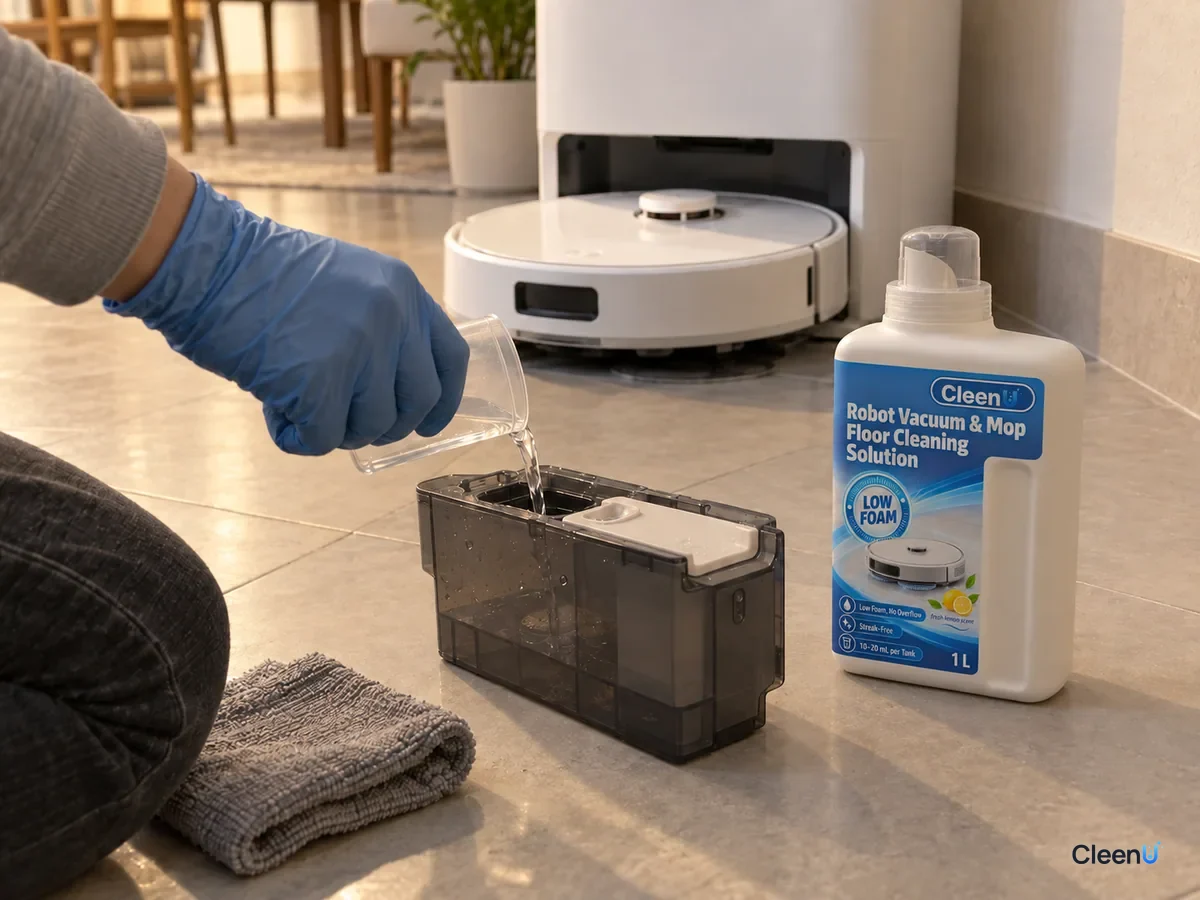
Fill the clean water tank to the level you need, then measure solution at about 1:50 to 1:100 with the cap, for example 10–20 mL per liter of water. Water first, then solution, keeps foam down. Swirl gently; don't shake hard.
Caution:Never add any solution to the dirty water tank.
First run
Mop one room and check three things
The first time you switch, mop just one room you use a lot. Then check three things. Is there a foam layer in the dirty water tank? Once the floor is dry, does it feel tacky under a bare hand or sock? Is there a hazy film on dark or polished floors?
Adjust based on what you see
If you see foam or tackiness, use less solution on tank-only models. On cartridge docks, turn off smart solution filling and use it every few runs. If the floor is clean, not tacky, and the tank isn't foamy, keep those settings for everyday use.
Routine care
Rinse the cartridge and filter regularly
Wipe the cartridge opening each time you refill. Every so often, empty the cartridge, rinse it with water, let it dry, and refill. Rinse the filter with water. Before storing or moving the robot, empty the cartridge and let it dry completely.
Foam or tacky floors after a run? Adjust in this order
A dirty tank that's mostly foam, or a floor that dries tacky or hazy, means too much solution is reaching the floor. Step one: on tank-only models, drop to the low end of the dose; on cartridge docks, set smart solution filling to every other run in the app. Step two: empty the cartridge or tank, rinse with water, and run one mop-wash cycle to flush the extra solution out of the lines. Step three: refill at the label ratio and mop one room to check. If there's a whitish dried ring around the cartridge connector, wipe it off with a damp cloth before you slide the cartridge back.
Three quick tests to vet a third-party solution at home
You don't need lab gear. These take about 15 minutes and tell you whether to keep going.
The shake test for foam. Fill a clean, clear plastic bottle with about 500 mL (17 oz) of water, add solution at its label ratio (5–10 mL at 1:50 to 1:100), cap it, and shake hard 10 times. Then watch the foam. A low-foam formula leaves a thin layer that visibly collapses within a short time; that's the kind to put in a Roborock. Run the same test with dish soap at the same strength for comparison, and the difference is obvious. A formula that barely foams in clean water will foam a bit more after mopping a kitchen floor, because dissolved protein soil strengthens the bubble film. To get closer to real conditions, add a spoonful of dirty mop water to the bottle and shake again. Full method: How to tell if a robot mop solution is low-foam.
The mirror test for residue. Wipe a small patch of mixed solution onto a mirror or dark glass with a clean cloth, wipe a patch of plain water next to it, and let both air-dry. Look at them against the light. High-residue formulas leave a hazy or rainbow film that feels draggy or tacky. A mirror is far more sensitive than a floor, so if it passes here, your floor usually won't feel sticky.
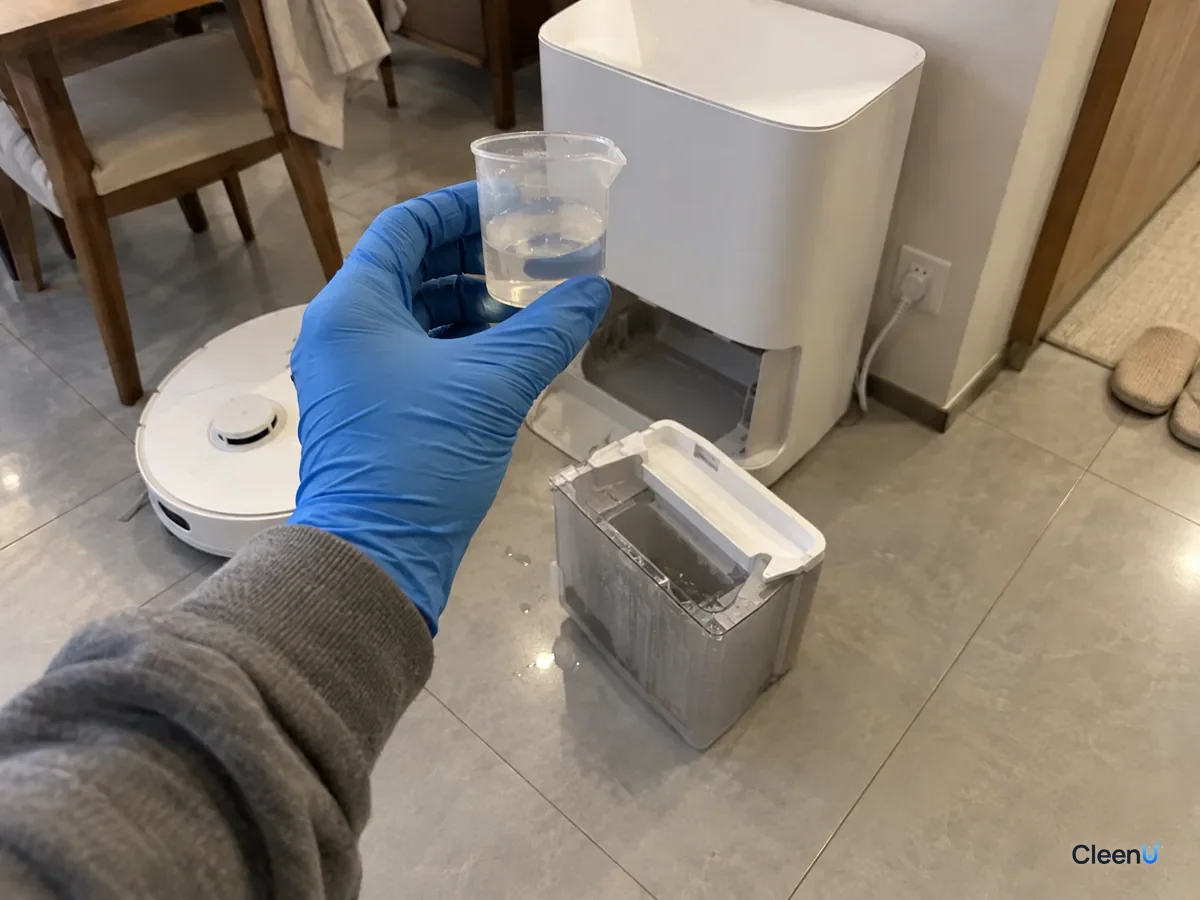
The fridge test for flow. If your dock has a cartridge, pour a little concentrate into a small clear cup and leave it in the refrigerator overnight. Take it out and tilt it right away: does it pour about as easily as it does at room temperature? If so, the dock will still draw it in winter, even in an unheated mudroom or sunroom. It's a rough comparison, not a low-temperature stability test.
Once a solution passes all three, mop one room with it and check the dirty tank and the feel of the floor. At that point you can switch with confidence.
What that looks like in a bottle: CleenU as an example
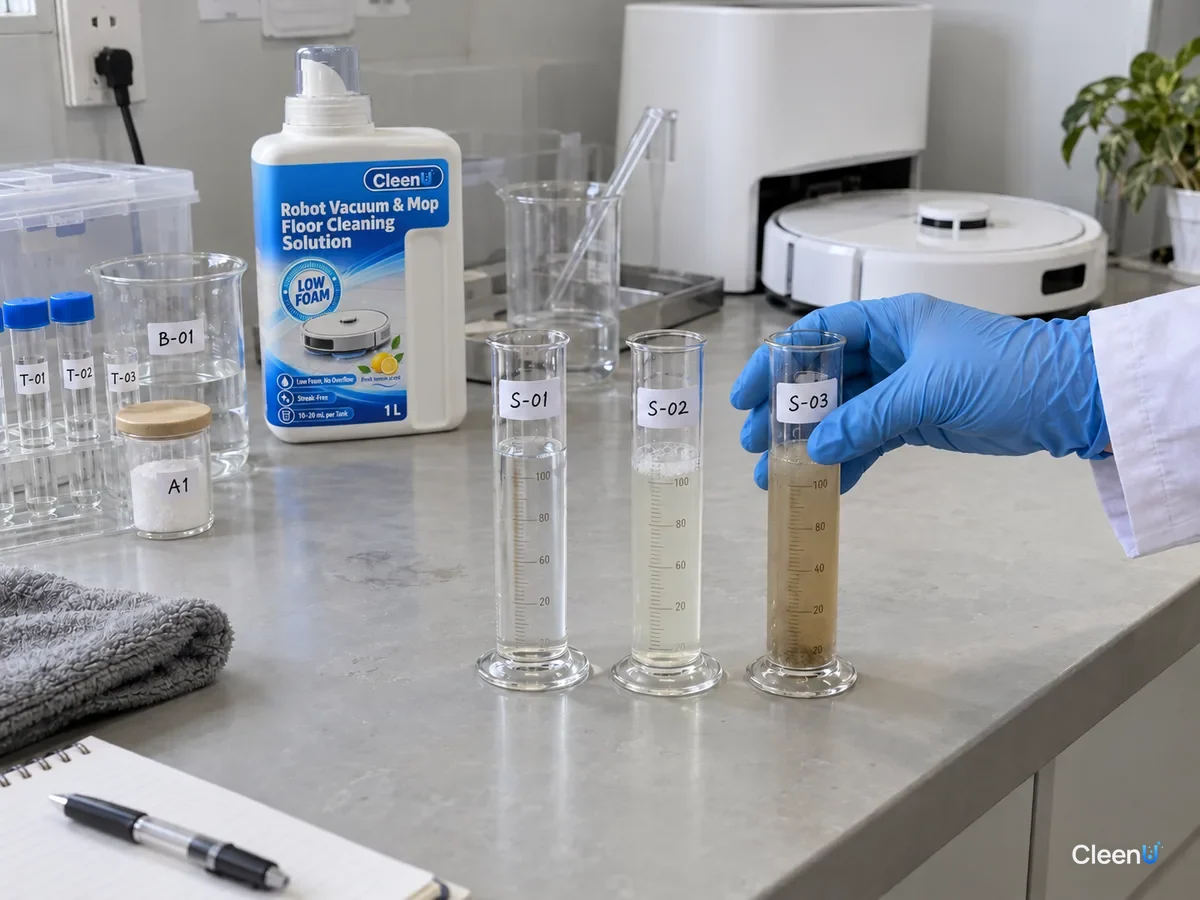
To see the four points in an actual product, take CleenU Robot Mop Cleaning Solution. It's a neutral concentrate, pH 6.5–7.5 as a concentrate, built on low-foam nonionic surfactants with a defoamer, with 15% active surfactant. It contains no wax, chlorine, particles, solvents, or optical brighteners, and no disinfecting ingredients such as quats or phenols. Its viscosity is designed for dock auto-dosing compartments. Each 1 L bottle (about 34 oz) comes with a measuring cap and dilutes about 1:50 to 1:100; 10 to 20 mL per fill is usually enough, so one bottle covers roughly 50 to 100 fills. The standard version has a lemon scent, and the Pet Homes version is fragrance-free. It's a cleaning solution that lifts dust film, greasy footprints, and everyday soil from sealed hard floors, not a disinfectant. Add it to the cartridge or clean water tank as your manual directs. It works with most Roborock models and most robot mops and wet-dry vacuums from iRobot (Roomba Combo, Braava), Ecovacs Deebot, Dreame, Narwal, Shark HydroVac, Eufy RoboVac, Tineco, and Bissell CrossWave. CleenU is not affiliated with these brands; brand names are used only to describe compatibility.
If you're looking for a low-foam, neutral alternative for your Roborock, take a look at our Robot Vacuum & Mop Floor Cleaning Solution.
Common mistakes to avoid
Topping up without emptying first. One product per cartridge keeps dosing and foam easy to read. Before switching, empty the cartridge, rinse it with water, and let it dry.
Adding solution to the clean water tank on a cartridge dock. That's a double dose, and tacky floors and extra foam are almost guaranteed.
Using dish soap or laundry detergent instead. They're built for rich suds in a sink, which is far too much foam for a robot mop. See Why robot mop solution has to be low-foam.
Pouring hot water into the tank. Hot water on newer docks comes from the dock's own heater. Pouring hot water in yourself isn't what the manual calls for and can warp some parts. See Can you put hot water in a robot mop?
Doubling the dose for a "deeper clean." Past a certain concentration, cleaning barely improves while residue and foam keep climbing.
Switching cleaning solution in a Roborock: common questions
Can I use a third-party cleaning solution in my Roborock?
Yes, if you pick the right one and add it in the right place: a low-foam, neutral concentrate with no solvents, particles, or disinfectants. On cartridge docks, put concentrate in the cartridge only; on models without one, dilute about 1:50 to 1:100 in the clean water tank. Never add it to the dirty water tank.
Can I add solution to the clean water tank on a Roborock with a cartridge?
No. On cartridge docks, put solution only in the cartridge and let the dock dose it. Adding more to the clean water tank doubles the concentration and tends to leave floors tacky.
Should I dilute the concentrate before putting it in the cartridge?
No. Fill the cartridge with concentrate and let the dock control the ratio. Diluted solution sitting in the cartridge is more likely to spoil.
How much should I use in a Roborock without a cartridge?
For CleenU Robot Mop Cleaning Solution, dilute about 1:50 to 1:100 in the clean water tank, or 10–20 mL per liter of water. Use the low end for routine mopping and the high end, or a second pass, for dirtier floors.
Roborock solution says 1:300 and a third-party one says 1:50 to 1:100. Is the third-party one more expensive to use?
No, compare the in-use strength instead. Divide active content by the dilution ratio: a 15% concentrate at 1:100 leaves about 0.15% in the tank. Then compare cost per fill, which is bottle price divided by the number of fills.
What kind of solution works best with Roborock's hot-water mop washing?
Choose a low-foam nonionic, neutral, solvent-free concentrate. These ingredients foam little in hot water, and some even help knock foam down above their cloud point, so the label dose is all you need.
After switching, the dock says the solution is low or not detected. What should I do?
Check that the cartridge is fully seated and that the connector isn't blocked by dried residue, then confirm smart solution filling is on in the app. If the alert continues, empty and rinse the cartridge and refill it.
Can I put disinfectant or antibacterial cleaner in a Roborock?
Don't. Chlorine and quat-based disinfectants can harden rubber parts and leave more residue on the floor. Disinfect specific spots by hand when you need to.
My floors feel sticky after mopping. Is it the solution?
Most often it's too much solution. Use less on tank-only models, or turn off smart solution filling and use it every few runs on cartridge docks. If it's still sticky, switch to a lower-residue product.
Which Roborock models does CleenU Robot Mop Cleaning Solution work with?
It works with most Roborock models, and we've run foam, residue, and water-path tests on common robot mops. Put concentrate in the cartridge if your dock has one; otherwise dilute about 1:50 to 1:100 in the clean water tank.
Which solution should pet owners use in a Roborock?
Choose a solution without quats or phenols, with no scent or a very light one, dilute it as directed, and let floors dry before pets walk on them. CleenU's Pet Homes version is fragrance-free and uses a cyclodextrin-based odor neutralizer for pet odors.
How long does a third-party solution keep after opening?
Unopened, it keeps for 24 months. After opening, cap it tightly and store it somewhere cool, out of direct sun and away from freezing. If the robot will sit unused for a while, empty, rinse, and dry the cartridge.
To compare brand-name and universal solutions, see Brand-name vs. universal robot mop cleaning solution.
You can switch cleaning solutions in a Roborock. The key is picking the right one and adding it in the right place: low foam, neutral pH, no solvents, no chlorine or acids, no particles or waxes, and no disinfectants. On cartridge docks, put concentrate in the cartridge only; on tank-only models, dilute about 1:50 to 1:100 and lean toward less. When you compare products, ignore the ratio on the label and divide active content by the dilution ratio to get the in-use strength. Mop one room first, check the dirty tank for foam and the floor for tackiness, and if both look good, make it your routine.