
How-to
What Cleaning Solution Can You Use in a Eufy Robot Vacuum, and How Do You Add It?
Direct answer
Yes. The key is picking a low-foam, neutral, free-flowing one and adding it in the right place: dilute about 1:50 to 1:100 in the clean water tank and leave S1-series bottles unmodified. A refillable dock compartment works too, but use one or the other.
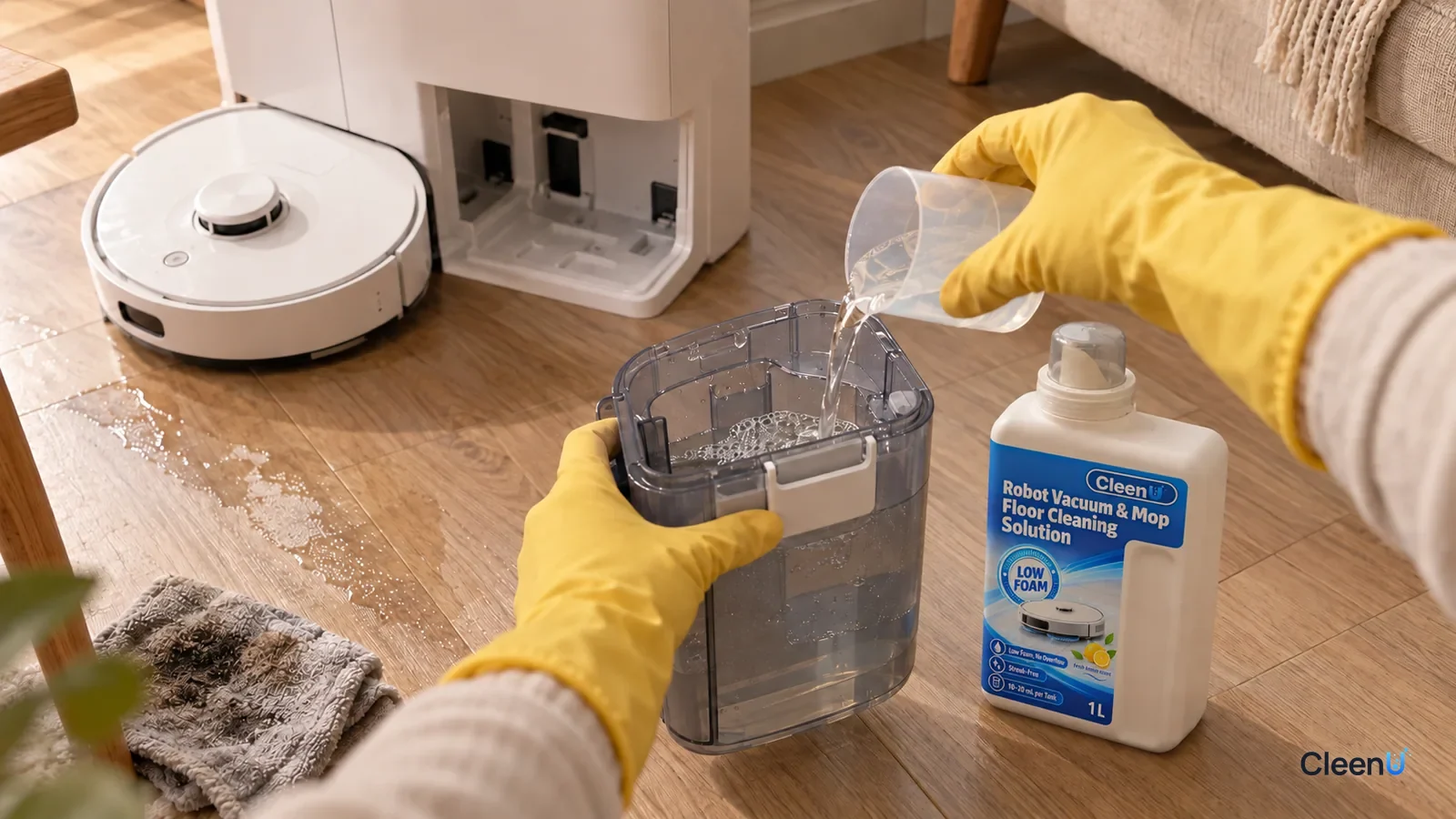
If Eufy solution is hard to find, used up, or just pricey, you can switch. The key is picking the right one and adding it in the right place. Look for four things: low foam; neutral pH; no particles or wax, so the filter and mop stay clean; and good flow, so a dock can still draw it in winter. Then match the method to your model: dilute about 1:50 to 1:100 in the clean water tank, or fill a refillable dock compartment instead, one or the other.
If you do switch, there's something about Eufy that sets it apart. The lineup is wide. There's the S1 series with auto-mixing docks, and there are RoboVac mop models and other docks that rely on a clean water tank. Where and how you add solution is different for each. And one of Eufy's own troubleshooting articles shows exactly what auto-dosing depends on: whether liquid can be drawn out accurately comes down to air pressure in the bottle and the liquid's viscosity. This guide starts there, then covers both types of machine, why flow and cold-weather behavior matter when you pick a solution, and how to test at home.
Know your Eufy: the key numbers from Eufy's own materials
Here's what we could verify from Eufy:
- On the S1 and S1 Pro, the UniClean station mixes cleaning solution with water and injects it into the robot's clean water tank during refills, at a 1:100 ratio. A 600 mL bottle of Eufy solution makes roughly 60 L (about 16 gal) of working solution at that ratio.
- S1 Pro specs list a robot clean water tank of about 240 mL (8 oz) and a dirty tank of 220 mL, plus a 3.0 L clean tank and a 2 L dirty tank in the station. The roller mop is continuously rinsed with the clean water and solution mix as it works.
One Eufy troubleshooting article is especially revealing. It covers an S1 Pro using less solution than expected. Mark the current level on the solution bottle, then let the robot use a full station tank of about 2,800 mL (about 95 oz) of clean water. At 1:100, the solution level should drop about 28 mL. If it drops much less, Eufy suggests drilling a small hole near the top of the bottle so air can get in, then retesting with another full tank.
That tells us two things. The S1's auto-mixing draws from a closed bottle, so air pressure inside the bottle affects dosing. And Eufy itself acknowledges that real-world dosing can drift from the design ratio. The next section explains why, because the same physics decides which third-party solutions are suitable for auto-dosing.
For other models, such as the various Omni docks, check your manual for whether there's auto-dosing and where solution goes. We don't list them model by model here.
How auto-dosing measures: air pressure, viscosity, and the pump
Auto-dosing is a small pump drawing a set amount of solution from a bottle or reservoir and blending it with water. Three things decide how accurate that draw is.
Air pressure in the bottle. In a rigid, sealed bottle, every milliliter pumped out leaves a milliliter of empty space. If no air gets in, that space is a partial vacuum that holds the liquid back, so each pump stroke pulls less, and it gets worse as the bottle empties. That's why Eufy suggests a small hole near the top: air flows in, pressure returns to normal, and the pump draws freely. Refillable reservoirs usually have a vent, but if dried residue blocks it, you get the same under-dosing.
Viscosity. In a narrow tube, flow is roughly inversely proportional to viscosity. Double the thickness and, at the same pressure, flow drops by about half. Small dosing pumps use long, thin intake tubes, and thick solution fills them slowly. If a pump stroke isn't completely filled, it dispenses less than its setting. Peristaltic pumps are less sensitive, but with thick enough liquid, the tubing can't refill fast enough either.
Temperature. Most surfactant concentrates get thicker as they get colder. In winter, a dock on an enclosed porch, by a drafty window, or in an unheated room may be drawing a noticeably thicker liquid than in summer, so dosing quietly shrinks as the weather turns.
So a solution suited to auto-dosing has to do more than stay low-foam and neutral. It should stay thin and smooth across normal room temperatures, without clinging to the bottle or stringing.
What changes how much an auto-dosing dock dispenses
- The dock's dosing pump draws a set amount of solution from a bottle or reservoir
- As liquid leaves a rigid sealed bottle, a partial vacuum forms and each stroke pulls less
- Thicker liquid moves through the thin intake tube more slowly, so strokes don't fill and output drops below the setting
- Colder liquid is thicker for most concentrates, so winter dosing tends to run low
- A well-vented container and a thin liquid that stays thin in the cold keep dosing close to the design ratio
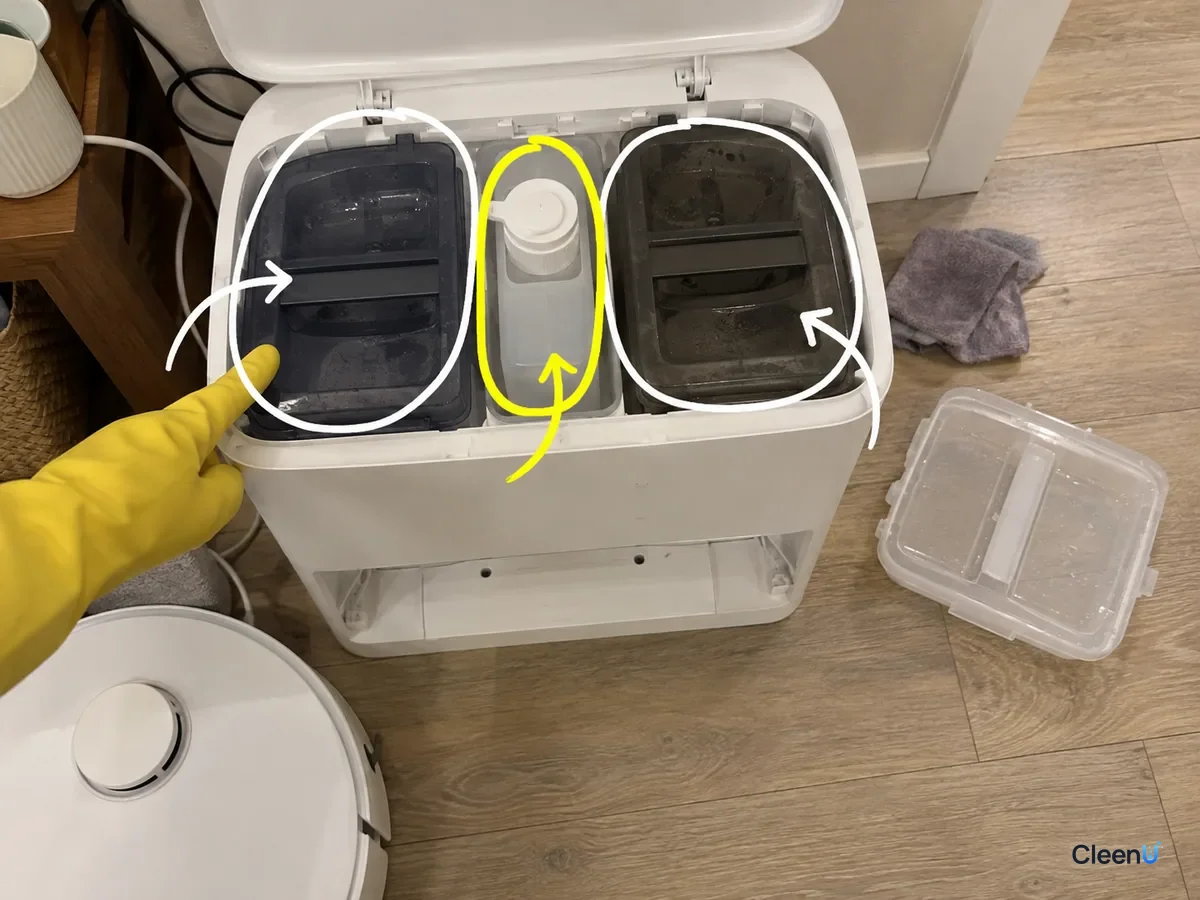
Why adding a little water can make concentrate thicker
This one surprises people. Someone thinks the concentrate in their dosing compartment looks too thick, adds a splash of water to thin it, and the liquid turns into something like jelly. Now nothing comes out at all.
The reason is surfactant phase behavior. In water, surfactant molecules organize themselves. At low concentrations they gather into tiny spheres called micelles, and the solution is thin and clear. At higher concentrations, micelles can stretch into long, tangled rods or stack into ordered sheets and cylinders. These liquid crystal phases behave like a thick gel. Concentrate formulas are usually designed to stay out of that zone so the concentrate itself flows. But somewhere between concentrate and fully diluted solution, there may be a concentration that lands right in the gel zone, and a little water can push the concentrate into it.
The same thing happens at the outlet. Solution left on the dispensing outlet and the end of the intake tube slowly loses water, its concentration climbs, it may pass through a gel stage, and it finally dries into a hard crust. That crust can block the outlet, and it can also block a bottle's air vent, which makes the vacuum problem above worse.
What that means in practice:
- Put only concentrate in an auto-dosing compartment. Don't dilute it there.
- If you see white, tacky buildup around the outlet or vent, soften it with a cloth soaked in warm water (warm to the touch, not hot) and wipe it off. Don't pry at it with anything hard.
- If a compartment will sit unused, empty, rinse, and dry it so residue can't slowly concentrate inside.
For full troubleshooting, see Robot vacuum auto-dosing not dispensing? and New solution not being used or detected by the dock.
Different Eufy models, different ways to add solution
Auto-mixing models like the S1 and S1 Pro. The dock draws from the Eufy solution bottle at 1:100, mixes, and fills the robot. The bottle is a closed design, and there's no need to open or modify it: a modified bottle's venting and seal aren't controlled, which makes dosing harder to keep accurate. The simpler way to switch is to turn off automatic solution adding in the app and dilute your solution in the station's clean water tank. Adding solution to the clean tank while auto-mixing is still on doubles the dose, and floors tend to feel tacky once they dry. If your model's manual says otherwise, follow the manual.
Models with a clean water tank and no auto-mixing. That includes many RoboVac mop models, with the tank on the robot, and some docks with a clean tank in the station. Mix solution into the clean water tank at the right ratio, and the robot feeds it to the mop. You control the concentration completely, so measuring is the step that matters most.
Models with a refillable solution compartment. If your dock has a solution compartment you can fill yourself (check the manual), either method works: fill the compartment as the manual directs and let the dock dose it, or leave the compartment alone and dilute about 1:50 to 1:100 in the clean water tank. We've tested CleenU Robot Mop Cleaning Solution both ways on Eufy. Pick one; never use both at once.
Whichever setup you have, never put solution in the dirty water tank.
How much to add, by water volume
CleenU Robot Mop Cleaning Solution dilutes at about 1:50 to 1:100. The weak end, 1:100, matches the S1 series' design ratio. By water volume:
Dose by water volume (about 1:50 to 1:100)
- 0.25 L (about 8.5 oz)
- about 2.5–5 mL
- 0.5 L (about 17 oz)
- about 5–10 mL
- 1 L (about 34 oz)
- about 10–20 mL
- 3 L (about 101 oz)
- about 30–60 mL
A robot's onboard tank is small, so a few milliliters throws the ratio off a lot. Always use the measuring cap or a small marked cup, not a free pour from the bottle. Use the low end for everyday living room dust and the high end, or a second pass, for greasy footprints near the entry or under the dining table.
Why lean low on vinyl plank? Rigid-core vinyl plank, often sold as SPC (stone plastic composite), has a dense core of stone powder and PVC under a wear layer, often with an embossed wood grain. The plank itself barely absorbs water, but the embossing holds a thin water film, and whatever's dissolved in that film dries in the grain. Too much solution leaves residue in the texture, and the floor looks dull and gray and feels draggy underfoot. A neutral formula is gentle on the wear layer, but less is still better. The planks click together at the seams, so don't run the water flow at maximum. For floor-specific settings, see Robot mop settings for tile and vinyl plank.
Step-by-step
From identifying your model to everyday refills
Figure out which kind of Eufy you have
Check the manual or the dock. A slot for a Eufy solution bottle and an automatic solution setting in the app mean an auto-mixing model. A clean water tank alone means you dose the tank. A refillable solution compartment means you can fill it per the manual or dilute into the clean tank instead, one or the other. When in doubt, use the fill location your manual names.
On auto-mixing models, check dosing before you switch
Keep the Eufy bottle on S1-series docks unmodified. If dosing seems low, use Eufy's check: mark the level, run a full station tank, and see whether it dropped about 28 mL.
Caution:Before switching to a third-party solution, confirm you can turn off automatic solution adding, then dose the clean tank instead so the two don't stack.
Empty and rinse the clean water tank
Take out the clean tank, pour out old water, and rinse the inside. Check the bottom and outlet for slimy film and wipe it off with a soft cloth.
Add water first, then measured solution
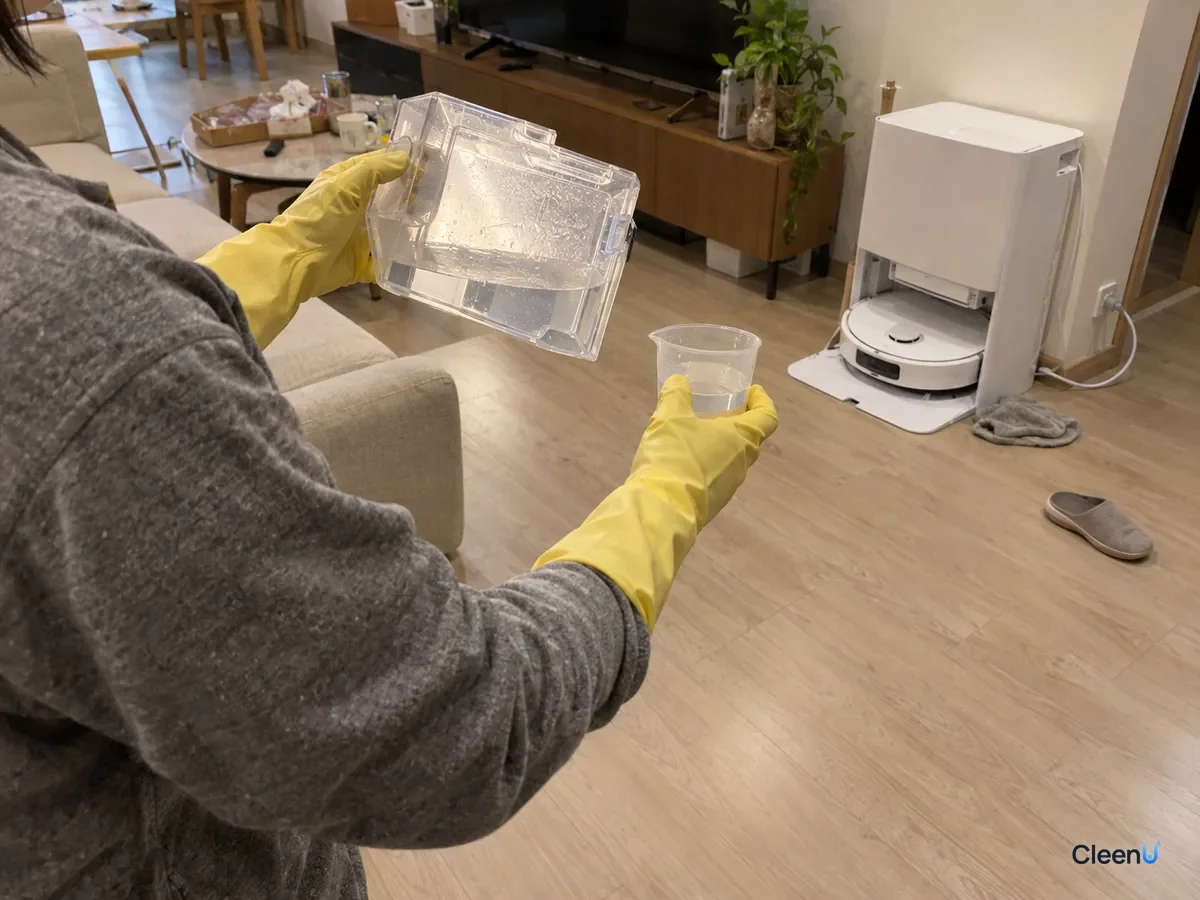
Fill with as much water as you need, then measure solution with the cap at about 1:50 to 1:100, for example 5–10 mL for 0.5 L (17 oz) or 30–60 mL for 3 L. Swirl gently; don't shake hard.
Caution:Never put solution in the dirty tank, and never add water to an auto-dosing compartment.
Mop one section of the living room and check three things
Run a high-traffic area first. Then check for a layer of foam in the dirty tank, look across the dry vinyl at a low angle for gray, dull grain, and walk on it barefoot to feel for drag or tackiness.
Adjust, and keep an eye on it in winter
If the floor looks dull or feels draggy, use less. If everything looks good, keep that ratio. In cold weather, check whether the concentrate has thickened; if so, bring the bottle back to room temperature before using it. Use mixed water the same day.
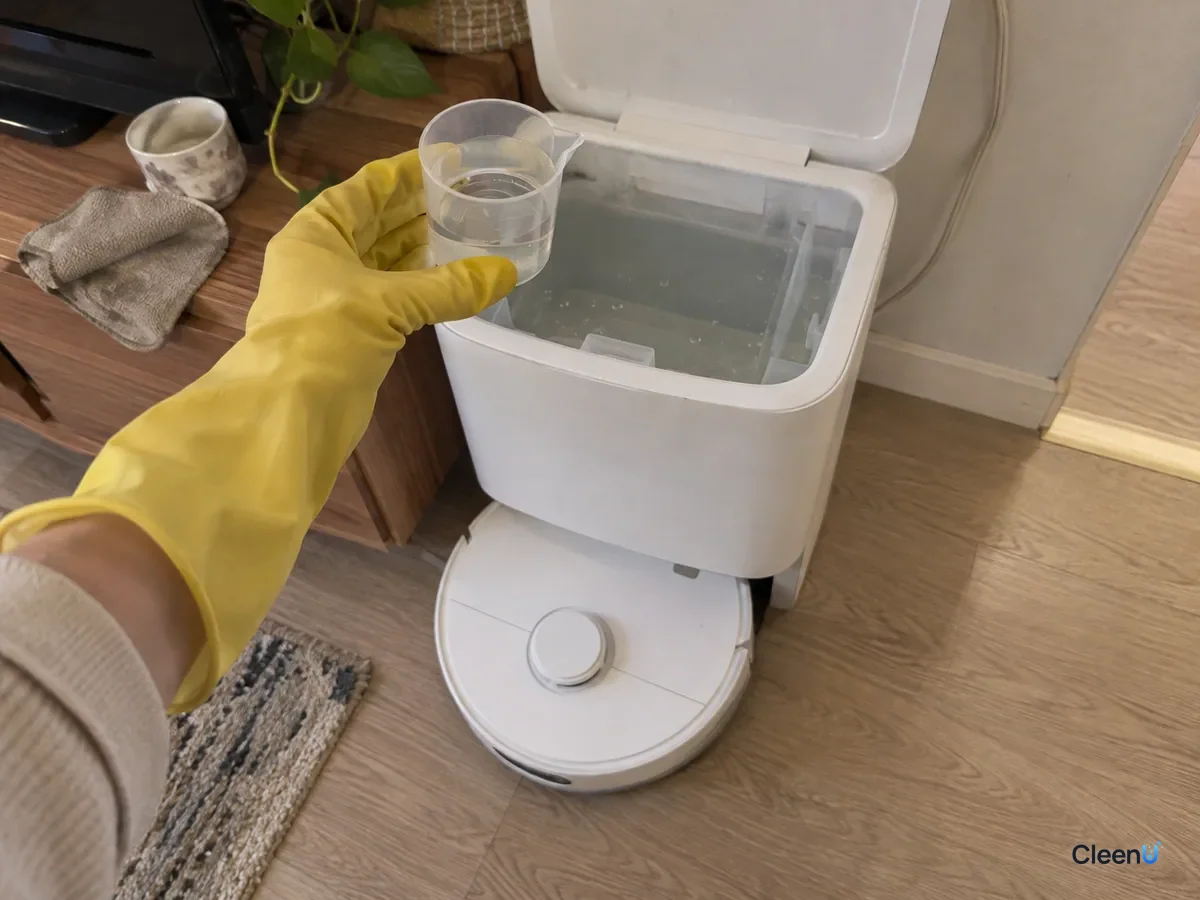
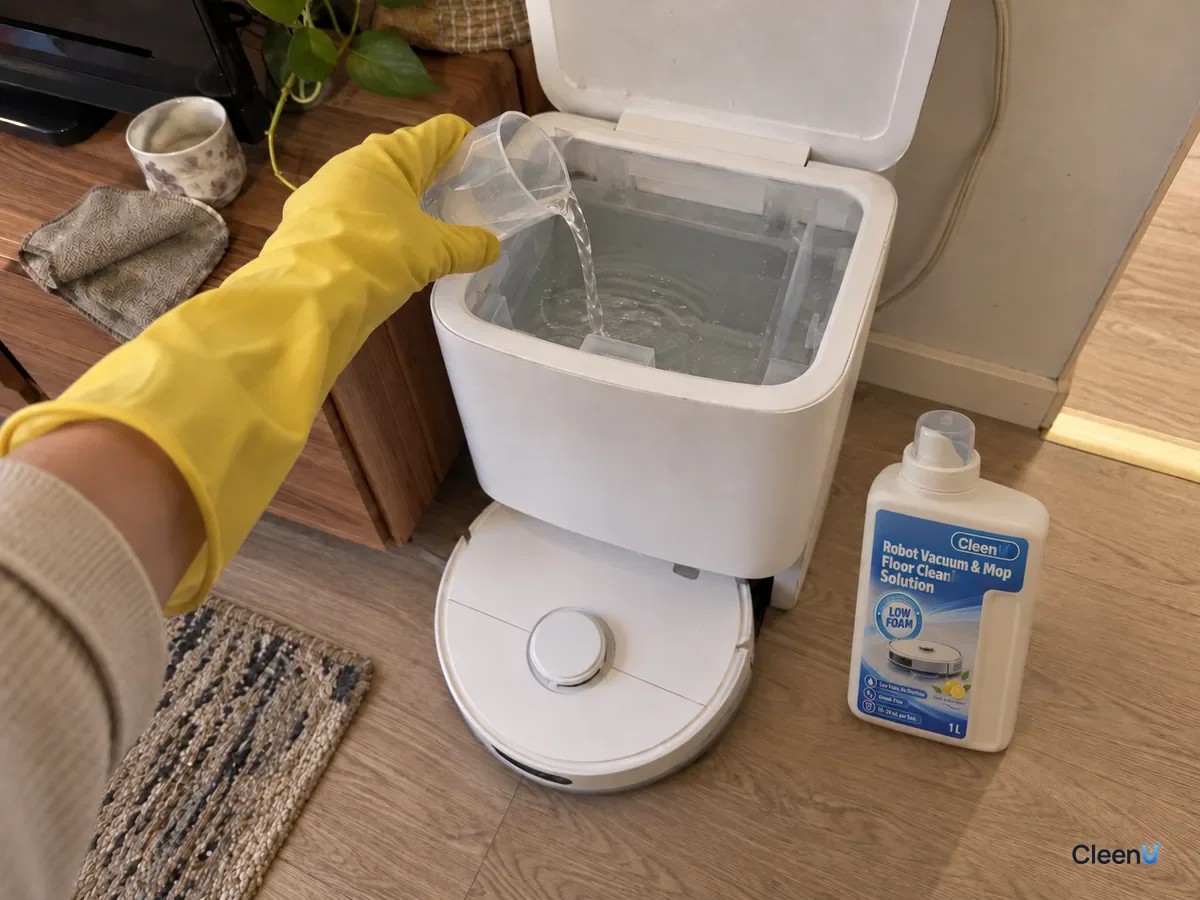
Foam, dull floors, or low dosing? Adjust in this order
A layer of foam in the dirty tank, or vinyl plank that dries gray, dull, or draggy, means too much solution is reaching the floor. Auto-dosing that runs low usually comes from a vacuum in the bottle, concentrate thickened by cold, or a dried ring on the outlet. Step one: empty the clean tank, rinse it, and clean the filter and mop. Step two: soften any white film on the outlet or vent with a warm, damp cloth and wipe it off, and bring the concentrate back to room temperature. Step three: remix at the low end and mop one section of the living room to check.
How to check flow and residue at home
Warm-and-cold pour test. Pour a little concentrate into two clean small cups. Leave one at room temperature and put the other in the refrigerator, not the freezer, for half an hour. Then pour each into the measuring cap and compare. You want both to pour smoothly, with the cold one just a bit slower. If the chilled sample turns noticeably thick, clings, or strings, it may under-dose from an auto-dosing compartment in winter. For solution that has actually frozen, see Is robot mop solution still good after freezing?
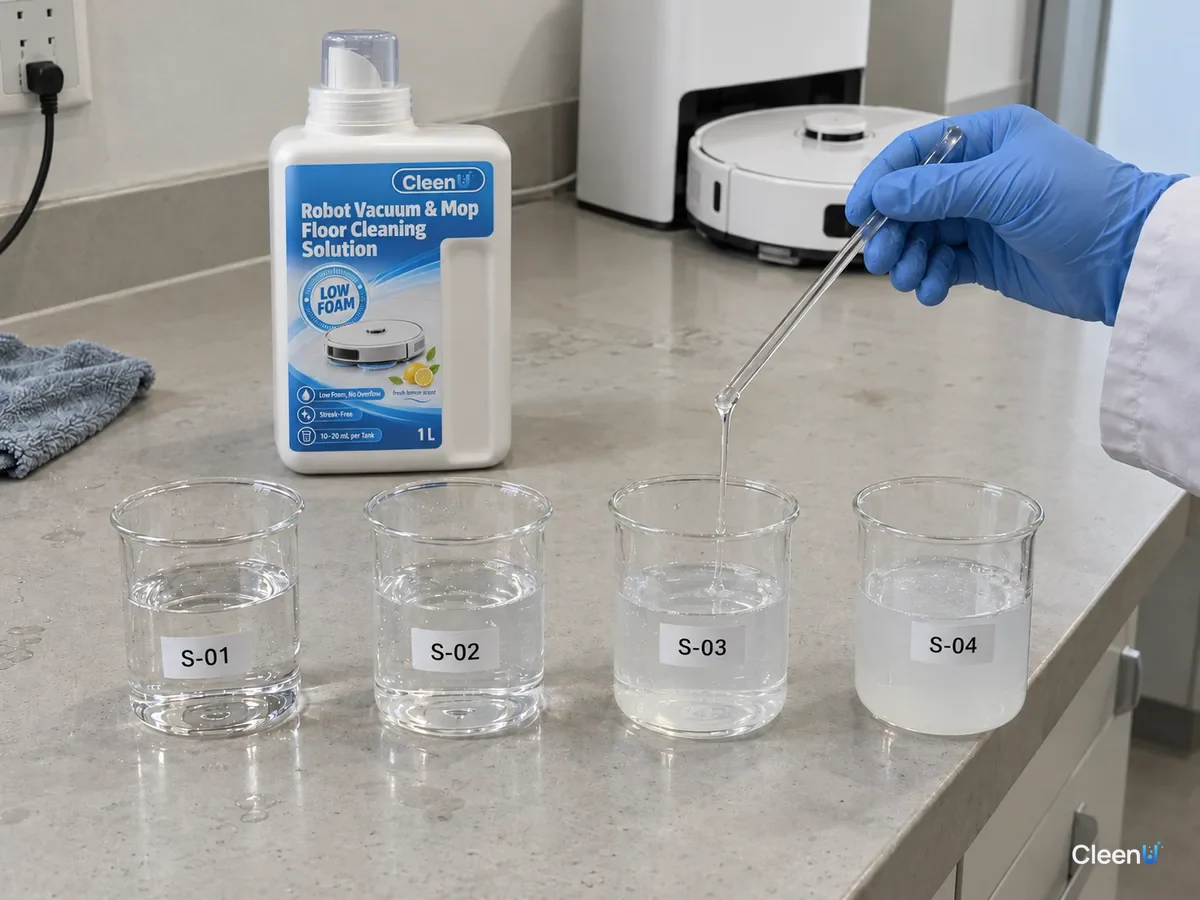
Step-dilution test for gelling. Put about 10 mL of concentrate in a clear cup, add water a few drops at a time, and stir after each addition. It should keep getting thinner. If a small amount of water makes it thicker or jelly-like, the product passes through a gel zone as it's diluted. Keep it out of auto-dosing compartments, and when dosing a clean tank, add water first so it never sits at that in-between strength.
Vinyl grain residue test. In an out-of-the-way corner, wipe one patch with working solution and one with plain water. Once dry, crouch down and look across the grain at a low angle. If you can't tell them apart, you're fine.
Once a solution passes all three, run it on one section of the living room and check the dirty tank and the floor. At that point you can switch with confidence.
What that looks like in a bottle: CleenU as an example
To see those criteria in an actual product, take CleenU Robot Mop Cleaning Solution: a neutral concentrate, pH 6.5–7.5 as a concentrate, built on low-foam nonionic surfactants with a defoamer. It's solvent-free and contains no optical brighteners, wax, chlorine, particles, quats, or phenols. Its viscosity is designed for dock auto-dosing compartments, and most docks with one draw it without trouble. It dilutes about 1:50 to 1:100; 10 to 20 mL per fill is usually enough, so one bottle covers roughly 50 to 100 fills. The standard version has a lemon scent, and the Pet Homes version is fragrance-free and uses a cyclodextrin-based odor neutralizer for pet odors. For Eufy owners, no particles or wax keeps the filter and mop clean, low foam suits the dirty tank and roller-mop rinsing, and low viscosity supports accurate auto-dosing.
It's a cleaning solution that lifts dust film, footprints, and everyday soil, not a disinfectant. It works with most Eufy RoboVac models and most robot mops and wet-dry vacuums from Roborock, iRobot (Roomba Combo, Braava), Ecovacs Deebot, Dreame, Narwal, Shark HydroVac, Tineco, and Bissell CrossWave. CleenU is not affiliated with these brands; brand names are used only to describe compatibility.
If you want a low-foam, neutral, free-flowing concentrate for your Eufy, take a look at our Robot Vacuum & Mop Floor Cleaning Solution.
Switching cleaning solution in a Eufy: common questions
Can I use a third-party cleaning solution in my Eufy robot vacuum?
Yes, if you pick the right one: a low-foam, neutral, particle-free, free-flowing concentrate, diluted about 1:50 to 1:100 in the clean water tank. Leave S1-series bottles unmodified; if your dock has a refillable solution compartment, you can fill that per the manual instead, one or the other.
Can I refill the Eufy S1 Pro solution bottle with another solution?
No need; dosing the clean water tank is simpler. Turn off automatic solution adding in the app and dilute about 1:50 to 1:100 in the station's clean tank. The bottle is a closed design, and a modified one's venting and seal aren't controlled.
How much solution goes in a Eufy clean water tank?
For CleenU Robot Mop Cleaning Solution, about 1:50 to 1:100: 5–10 mL per 0.5 L (17 oz) or 10–20 mL per liter. Always measure for a robot's small onboard tank.
My Eufy dock has a refillable solution compartment. Compartment or clean tank?
Either works, but pick one: fill the compartment with concentrate as the manual directs, without adding water, or dilute about 1:50 to 1:100 in the clean water tank. We've tested CleenU Robot Mop Cleaning Solution both ways on Eufy; never use both at once.
My Eufy S1 Pro barely seems to use any solution. Is that normal?
Check it Eufy's way: mark the level, run a full station tank of about 2,800 mL, and look for a drop of about 28 mL. If it's well short, follow Eufy's guidance or contact support.
The concentrate in the dosing compartment looks thick. Can I add some water?
Don't. Some concentrates turn thicker or gel when a little water is added, which makes dispensing worse. Use concentrate only, and if it's thick from cold, let it warm up indoors.
My dock is in a cold room and dosing dropped in winter. Why?
Most concentrates thicken as they cool, so the dosing pump draws less. Move the dock or the bottle somewhere warmer and dosing should recover.
How do I clean a white crust off the dispensing outlet?
Lay a cloth soaked in warm water on it until the crust softens, then wipe it off. Don't pry it. Wipe the outlet now and then so residue doesn't build up again.
My vinyl plank floor looks dull and gray after mopping. How do I fix it?
Drop to the low end first; most often it's too much solution settling into the embossed grain. Compare with one plain-water pass, and choose a wax-free, rinse-clean, low-foam formula.
Can I put disinfectant in a Eufy robot vacuum?
Don't. Chlorine and quat-based products can harden rubber parts, add residue, and make the filter and mop harder to clean. Disinfect specific spots by hand.
How long can mixed solution stay in the clean tank?
Use it the same day. Diluted solution can't protect itself, so it can sour or turn slimy. Empty, rinse, and mix fresh next time.
Which Eufy models does CleenU Robot Mop Cleaning Solution work with?
It works with most Eufy RoboVac models. On models whose dock bottle isn't refillable, such as the S1 series, dilute it about 1:50 to 1:100 in the clean water tank; if the dock has a refillable solution compartment, you can fill that per the manual instead. Use one, not both.
How should I store the solution after opening?
Cap it tightly and keep it somewhere cool, out of direct sun, and away from freezing. Unopened, it keeps for 24 months. Don't leave it on a porch that drops below freezing.
For more on where solution goes, see Where to put cleaning solution in a robot vacuum. To compare brand-name and universal solutions, see Brand-name vs. universal robot mop cleaning solution.
You can use a third-party solution in a Eufy if you match it to your model. S1-series docks auto-mix from a Eufy solution bottle at 1:100; to switch, turn off auto-adding and use the clean tank rather than modifying the bottle. On models with a clean water tank, a third-party solution goes in that tank at about 1:50 to 1:100, measured carefully for small onboard tanks. If the dock has a refillable solution compartment, you can fill that per the manual instead; use one or the other, never both. Eufy's own troubleshooting shows that auto-dosing depends on bottle venting and viscosity, so beyond low foam, neutral pH, and no particles, check how a solution flows: no clinging, no thickening when diluted, no stiffening in the cold. Mop one section of the living room first, check the dirty tank and the vinyl grain, and if both look right, make it your routine.