
How-to
Xiaomi Robot Vacuum Cleaning Solution: Do You Have to Use Xiaomi's?
Direct answer
Yes. Most Xiaomi and Mijia robot mops can use a third-party cleaning solution. The key is picking the right one and adding it the right way: a low-foam, neutral, particle-free, wax-free concentrate mixed into the clean water tank at about 1:50 to 1:100. Test one room first.
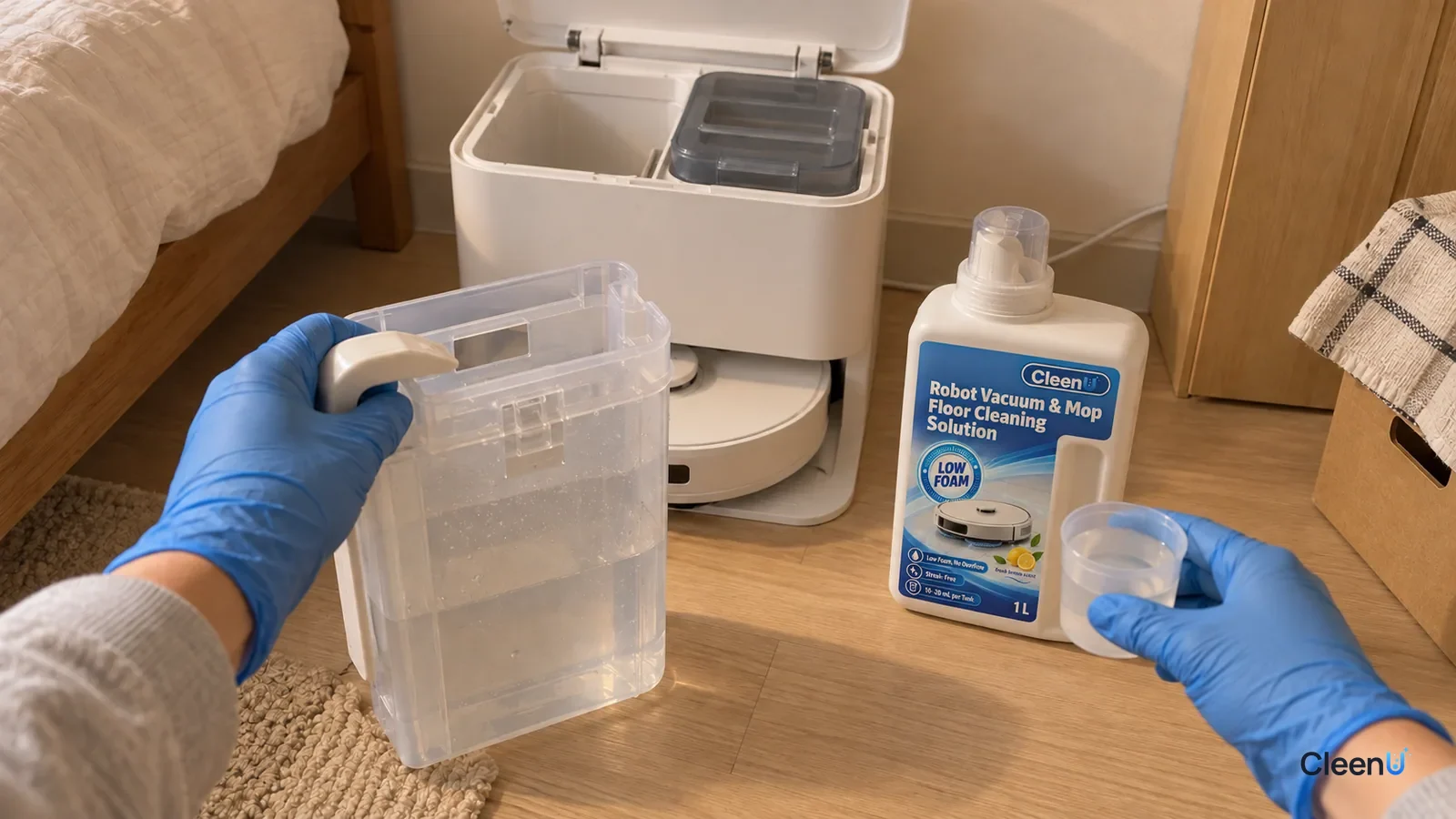
Do you have to use Xiaomi's own cleaning solution? No. In a robot mop, cleaning solution has a simple job: it wets the mop pad along with the water, lifts footprints, grease marks, and dull film from the floor, and then leaves with the dirty water when the dock washes the pad. As long as the formula suits that water path, a third-party formula does the same work just as well. What deserves your attention is choosing a formula that fits the machine, adding it in the right place, and mixing it at the right strength.
Choosing comes down to four things: low foam, neutral pH, no particles or wax, and a formula that dries without leaving a crust. Mixing comes down to one ratio: about 1:50 to 1:100, usually 10 to 20 mL per fill, with the label on your bottle having the final say. Checking takes one step: mop one room you use often, then look at the dirty-tank foam, the water flow to the pad, and how the dry floor feels. Below we walk through Xiaomi's water paths, hard water, foam, and dosing in that order.
Where it goes: the clean tank or the auto-dosing compartment
Xiaomi and Mijia make a lot of robot mops, but there are two basic places solution goes.
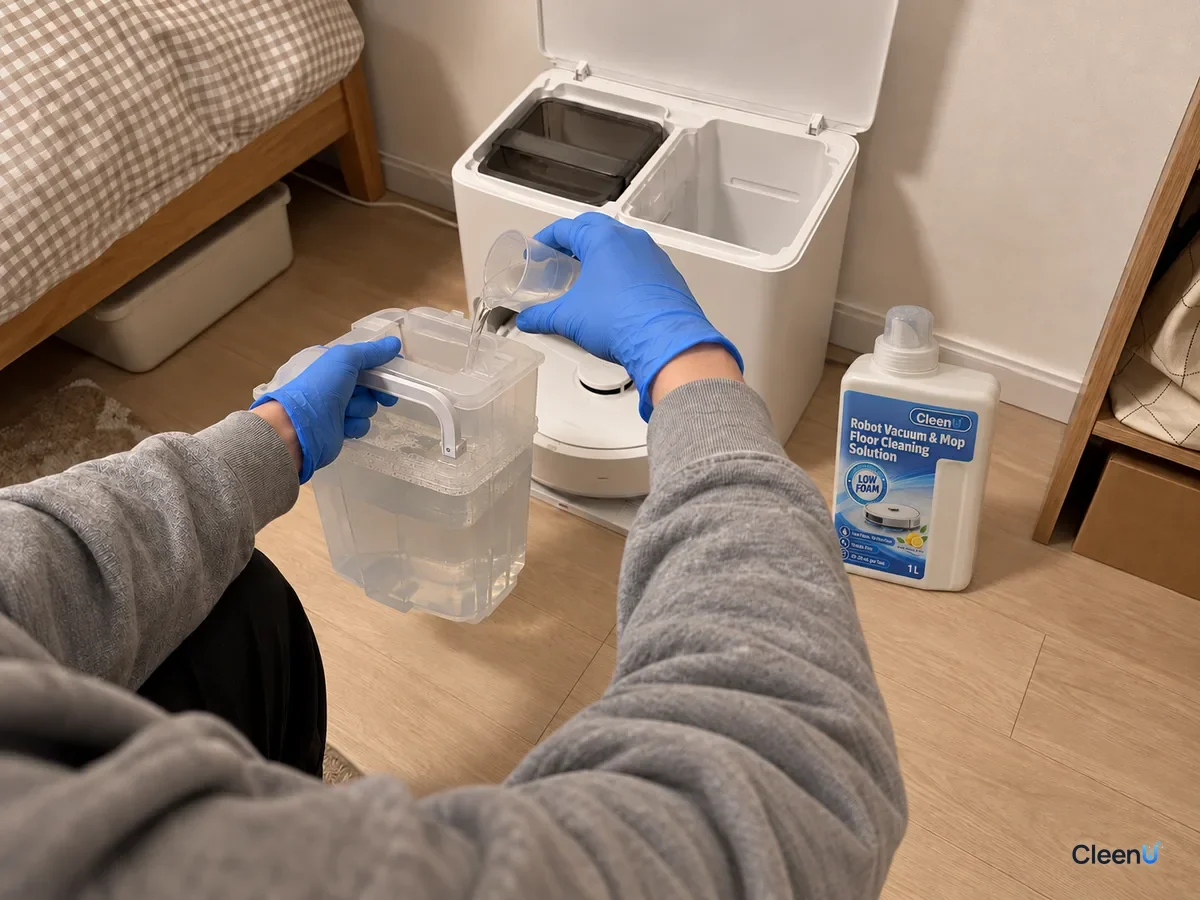
Hand-mixed in the clean water tank. On most all-in-one docks, the clean tank sits in the dock and holds about 3 to 4 L (roughly 1 gallon). Fill it with room-temperature water, pour in solution by ratio, and swirl gently. This is the most common setup and the easiest one to dose accurately.
An auto-dosing compartment. Some docks have a small separate compartment under the lid marked for detergent. When the dock washes the pad or refills the robot, it draws concentrate from there at the level you set and blends it into the water. On these models, add concentrate to the compartment as the manual describes, or turn auto-dosing off and mix by hand in the clean tank instead. Pick one; never dose in both places.
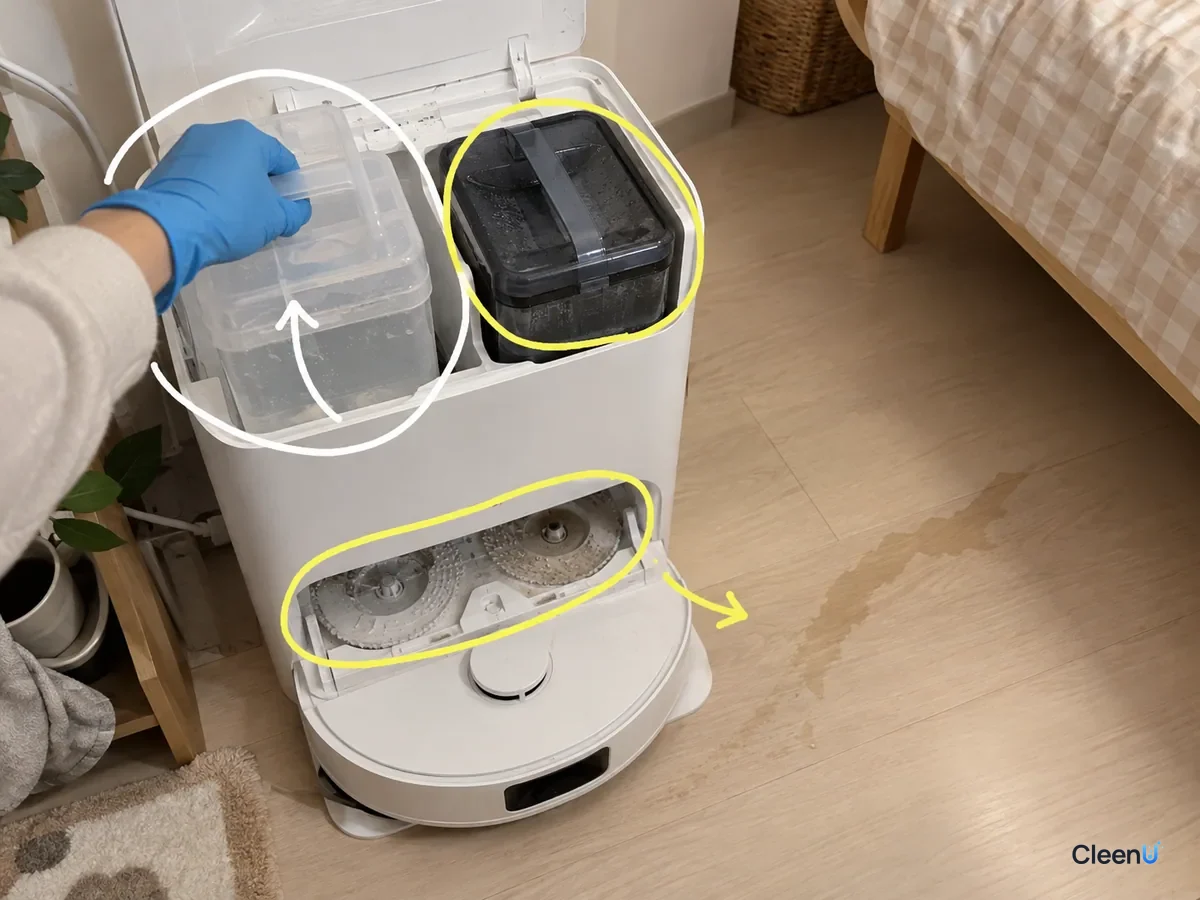
Either way, nothing goes in the dirty water tank. If you're not sure which part is which, open the dock lid and match it against the parts diagram in your manual.
Where does it go in your Xiaomi? Three quick checks
- Open the dock lid and find the clean water tank (usually marked with a water icon or a blue lid) and the dirty tank, and make sure you know which is which.
- Look for a small separate compartment marked for detergent, and check the app for an "auto-dispense detergent" setting or something like it. If you find one, your dock auto-doses.
- Open the manual's water tank or consumables section and note where solution goes and any recommended ratio or dosing level. Go by the location your manual gives.
Two water paths: onboard tank vs. all-in-one dock
How solution travels once it's in the machine tells you what the formula needs to handle.
Onboard-tank robots. The tank rides on the robot, and a small pump or valve drips water onto the mop pad. The path is short and the outlets are tiny, which is exactly why a particle-free, wax-free solution that dries without a crust, mixed by ratio, keeps water flowing smoothly.
All-in-one docks. The clean and dirty tanks live in the dock. Take the Robot Vacuum 6 Max FAQ as an example: the clean tank holds about 4 L (about 1 gallon); the dock's instant heater warms water to wash the mop pads, with a peak of about 185°F (85°C); dirty water is pulled back into the dirty tank; then PTC hot air dries the pads at up to 122°F (50°C), on by default, for 2, 3, or 4 hours as set in the app. The 5 Pro FAQ lists mop washing up to 176°F (80°C) and drying in as little as about 2 hours. Auto-dosing docks add one more branch: concentrate metered from a compartment into the wash or refill water.
Both designs share one rule: room-temperature water only. The 6 Max and 5 Pro FAQs say not to pour hot water into the clean tank, and the 6 Max FAQ notes it can warp the tank; the dock heats water itself. Mix any solution with room-temperature tap water too.
Hard water: scale and cleaning solution are separate jobs
Hard tap water carries a lot of calcium and magnesium, and a heated dock makes that more noticeable. When water containing calcium bicarbonate is heated, it breaks down into calcium carbonate, which doesn't dissolve well and settles on heaters and inside tubing as scale. The 6 Max FAQ explains that the white beads in the clean tank filter are an anti-scale agent there to protect the heater.
A floor cleaner isn't a descaler and won't dissolve scale in the heater. What it can influence is a different hard-water problem on the floor: calcium and magnesium can combine with some anionic surfactants to form insoluble "lime soap," which dries as a white haze on dark floors. Floor cleaner makers commonly handle this two ways: building on nonionic surfactants that hardness doesn't bother much, and adding chelating agents that tie up calcium and magnesium before they reach the surfactant. More in Hard water and robot mop floor spots: what chelating agents do.
Two practical takeaways. If floors look white after mopping in a hard-water area, check the dose and the water first, as in White spots after robot mopping, and don't add vinegar or citric acid to the tank to "descale while you mop." The 5 Pro FAQ lists strong acids among the causes of corrosion, and acid is hard on rubber and metal parts. And leave heater scale to the dock's anti-scale design and the maintenance steps in your manual.
Why low foam and a measured ratio: the chemistry
The four things to look for and the ratio to mix at come from the same chemistry.
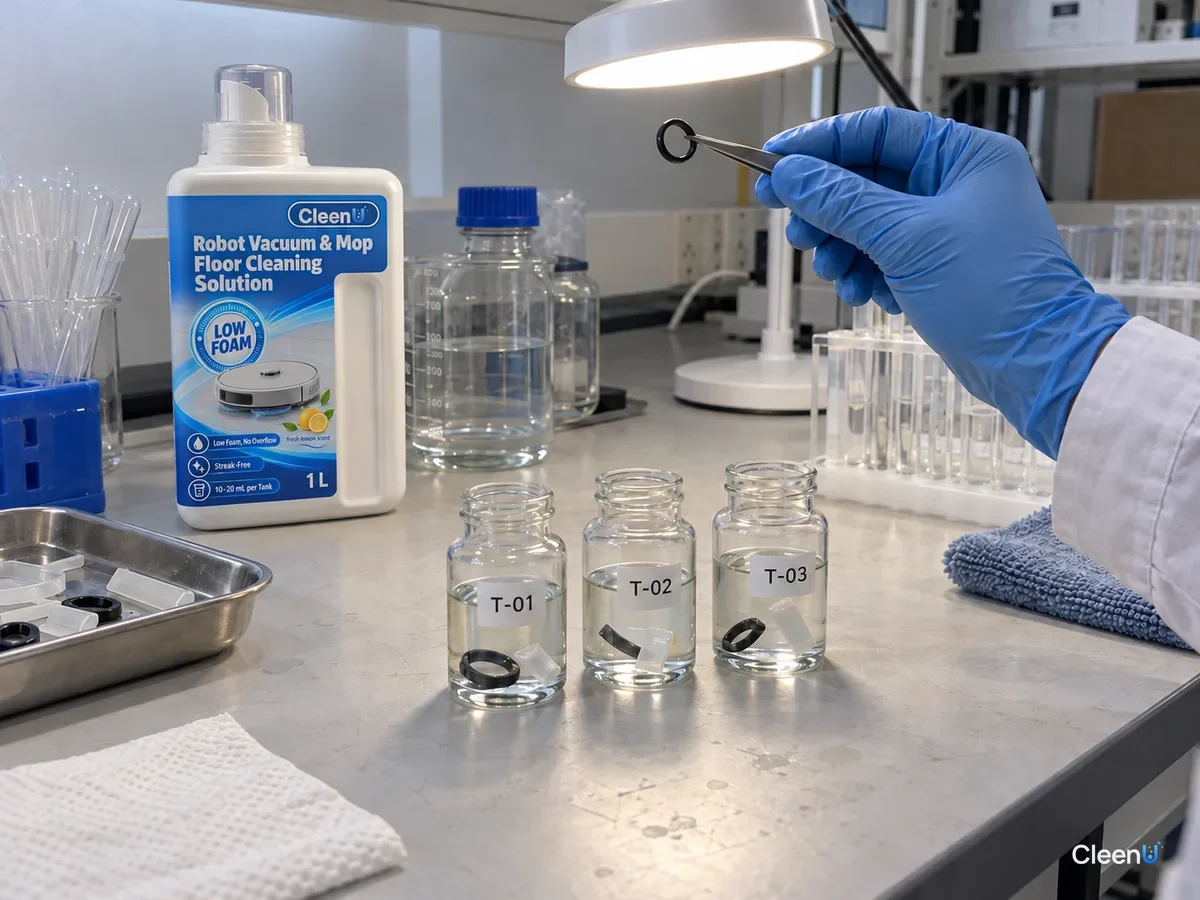
Strength decides how solution behaves in tiny outlets. At low concentration, surfactant molecules float around individually. As concentration rises they cluster into micelles, and at much higher levels some surfactants pass into thick gel or liquid-crystal phases. Narrow outlets, valve openings, and dosing ports see liquid evaporate and concentrate again and again. Working solution mixed at about 1:50 to 1:100 is very dilute and nowhere near that thick range, and a particle-free, wax-free formula doesn't leave a crust even where it dries, so water keeps flowing.
Low foam keeps mop washing smooth. When the dock washes the mop, water in the tray is churned by the scraper and pad, then pumped back into the dirty tank. A low-foam formula makes little foam and breaks it quickly, so the pump pulls back water rather than an air-liquid mix, and the dirty compartment and its small filter stay cleaner. Low foam comes from low-foaming nonionic surfactants setting the baseline, with a small amount of defoamer as backup. See Why robot mop cleaning solution has to be low-foam.
Neutral pH is easy on materials. A neutral formula, around pH 6.5 to 7.5 as a concentrate, is gentle on plastic tanks, rubber seals, and sealed wood floors. It's strong acids and alkalis that belong nowhere near the water path.
Lifted pads still carry solution. Many robot mops lift or avoid their pads on rugs, but a lifted pad is still soaked with working solution. Mix by ratio and stay at the low end, and rug edges and thresholds stay free of tacky marks. For mixed floors, see Robot mops and rugs.
A measured, low-foam mix: what happens in the water path
- Mixed at about 1:50 to 1:100, the surfactant level sits far below the range where solutions thicken
- Even where solution dries at outlets and valves, a particle-free, wax-free formula leaves no crust
- During mop washing, low-foam formulas make little foam and break it fast, so dirty water is recovered smoothly
- Neutral pH is gentle on plastics, rubber parts, and sealed floors
- Staying at the low end keeps residue and foam to a minimum
How much solution? Dose by tank size
Whichever bottle you use, follow its label, not the old product's ratio. Take CleenU Robot Mop Cleaning Solution as an example: it dilutes at about 1:50 to 1:100, and 10 to 20 mL per fill is usually enough. By tank size:
Dose by clean tank size (about 1:50 to 1:100)
- 0.5 L (17 oz)
- About 5 to 10 mL (1 to 2 tsp)
- 1 L (33.8 oz)
- About 10 to 20 mL (2 to 4 tsp)
- 2 L (68 oz)
- About 20 to 40 mL (4 to 8 tsp)
- 4 L (about 1 gal)
- About 40 to 80 mL (1.4 to 2.7 fl oz)
Start at the low end. For greasy kitchen footprints or a floor that hasn't been mopped in a while, go higher or simply run a second pass. Measure by the label ratio on your bottle. Ratios from different brands aren't comparable, because concentrates differ in active content; compare the dry floor and the dirty-tank foam instead.
How often should you add it? Mix a fresh dose each time you refill the clean tank and let it get used up. Diluted solution is less protected against spoilage, and a mix that sits for days is a common cause of a musty clean tank. See Robot vacuum clean water tank smells musty?
Testing a cleaning solution at home
Shake test. Put 500 mL (about 17 oz) of water in a clear bottle, add 5 to 10 mL of solution, shake 10 times, and let it sit. Thin foam that fades quickly is what you want for a dock; compare with dish soap at the same strength and the difference is obvious. Full method: A simple shake test for robot mop cleaning solution foam.
White plate test. Mix working solution with your own tap water, wipe a patch onto a white plate or dark glass, and wipe plain tap water beside it. Once dry, if the two patches look about the same, the mix dries clean in your water; if the solution patch is clearly whiter or hazier, drop to the low end of the ratio and try again.
One-room trial. Mop one room, then check three things: the dirty-tank foam is thin, water flows normally to the pad, and the dry floor feels clean, not tacky, under the back of your hand. If all three look right, lock in that dose for everyday use.
Adding solution to the clean tank, step by step
Switching a Xiaomi robot mop to a new cleaning solution
Confirm where it goes
Use the manual and the dock's parts to find the clean water tank. On auto-dosing docks, decide whether you'll use the compartment or hand-mix in the clean tank; pick one.
Empty and rinse the clean tank
Pour out any water mixed with the old product and rinse before adding the new one. Don't mix products.
Add room-temperature tap water
Fill to the level you need and note the marking. No hot water; the dock heats water itself.
Add solution by ratio
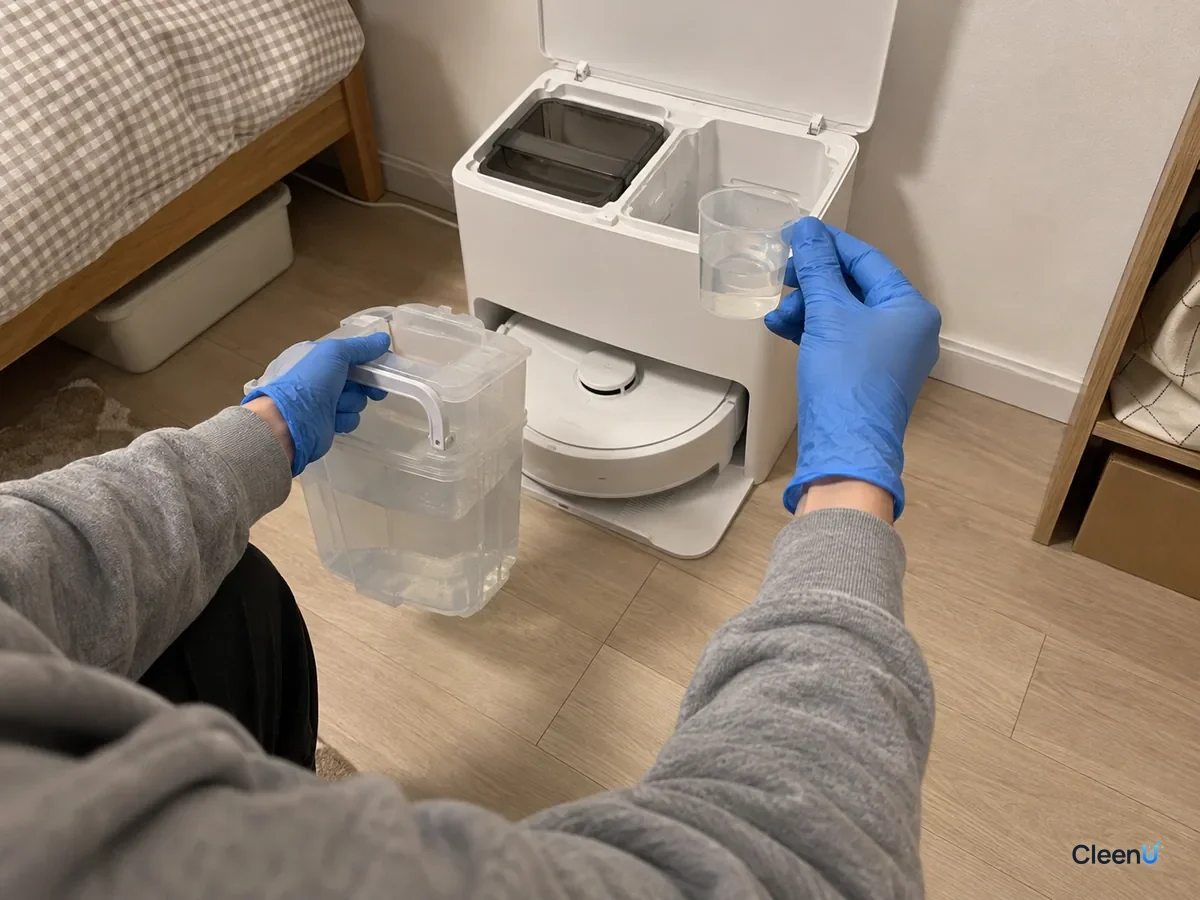
At about 1:50 to 1:100, that's 10 to 20 mL per liter, or 40 to 80 mL for a 4 L tank. Start low. Water first, then solution, and swirl gently.
Caution:On auto-dosing docks, never dose in two places. If you mix in the clean tank, turn auto-dosing off in the app.
Run one room first
Mop one room, then check foam in the dirty tank, water flow to the pad, and how the dry floor feels.
Adjust, then make it routine
If there's more foam than you'd like or the floor feels tacky, move toward the low end of the ratio. If everything looks right, mix that dose fresh at each refill.
Keep cleaner out of maintenance
Wash the dust bin and filter with water only, don't scrub the filter, and dry fully. Wipe sensors and charging contacts with a dry soft cloth. Empty and clean the dirty tank after mop washing and drying.
After dosing and mopping, check these
- Solution goes in one place only: the clean-water tank or the auto-dosing compartment
- You measured by tank size and the label ratio instead of pouring by eye
- The dirty-water tank has no heavy foam, and the floor isn't tacky once dry
- With a new solution, you mopped one room before the whole home
- Leftover mix was emptied and the tank rinsed with clean water
Results not quite right? What to adjust
- Too much solution. This is the most common one, especially pouring by eye or using a big-tank dose in a small tank. Measure with the cup and drop to the low end.
- Dosing in two places. An auto-dosing compartment that's still active plus solution in the clean tank doubles the strength. Pick one.
- Old product in the tank. Leftover dish soap or floor polish makes foam and tackiness more noticeable. Rinse with clean water first.
- Hard water. White haze that isn't sticky usually points to the water. Troubleshoot hardness; don't add vinegar.
- Dirty pads or filters. Saturated pads and a clogged dirty-side filter cause poor cleaning and foam at the same time. Clean them per the manual, and lower the mopping water flow in the app if needed.
Choosing an approach for your home
Pick the approach that fits your model and home
- All-in-one dock, hand-mixed clean tank
- A low-foam, neutral concentrate at about 1:50 to 1:100 in the clean tank
- Dock with an auto-dosing compartment
- Concentrate in the compartment as the manual describes, or turn auto-dosing off and mix in the clean tank; pick one
- Onboard-tank robot mop
- A particle-free, wax-free formula that dries without a crust, at the low end of the ratio
- Cats or dogs at home
- A fragrance-free, low-foam pet formula; keep pets off until the floor is dry
- Hard water and dark floors
- Low end of the dose; check water hardness first; no vinegar
Two things that surprise most owners
More solution doesn't clean better. Past a certain concentration, surfactants stop lifting more soil, while residue and foam keep rising. Mixing at the label ratio puts you where the solution does the most for the least.
Hot water doesn't help your mix. It can warp the clean tank, and all-in-one docks heat the wash water themselves.
Choosing a third-party formula
What can replace Xiaomi robot vacuum detergent? A robot mop cleaning solution that meets the criteria above:
- A third-party formula: choose a low-foam, neutral, particle-free, wax-free concentrate that dries without a crust, and measure it by ratio. Each fill takes only 10 to a few dozen milliliters, so cost and results are easy to control.
- Not as substitutes: dish soap (too much foam), vinegar or citric acid (hard on rubber parts in the water path), bleach (corrosive and rough on floors), rubbing alcohol, and homemade mixes.
CleenU Robot Mop Cleaning Solution: neutral, low-foam, added per your manual
Take CleenU Robot Mop Cleaning Solution as an example. It's a neutral concentrate, pH 6.5 to 7.5, built on low-foaming nonionic surfactants with a defoamer, and it contains no particles, no wax, and no chlorine. Each 1 L (33.8 oz) bottle has a measuring cap; dilute about 1:50 to 1:100, and 10 to 20 mL per fill is usually enough. It's for tile, vinyl, laminate, and sealed hardwood, not unsealed wood, waxed floors, or carpet. It's a cleaner for footprints, greasy marks, and dull film, not a disinfectant, and we make no germ-killing claims.
It has been compatibility-tested on most Xiaomi and Mijia robot mop models. Add it as your manual describes, usually diluted in the clean water tank. CleenU is not affiliated with Xiaomi or Mijia; the names are used only to describe compatibility. If your model's manual says otherwise, follow the manual.
If you want a low-foam, neutral concentrate for your Xiaomi robot mop, take a look at Robot Mop Cleaning Solution.
Sources for the Xiaomi dock details: Xiaomi global support FAQs for the 5 Pro and 6 Max. Checked October 2026.
Questions owners ask about cleaning solution in a Xiaomi robot vacuum
Can you use a third-party solution in a Xiaomi robot?
Yes, on most models. Choose a low-foam, neutral, particle-free, wax-free concentrate, mix it into the clean water tank at about 1:50 to 1:100, start at the low end, and test one room first.
Do I have to use Xiaomi cleaning solution?
No. Xiaomi's formula and a suitable third-party one do the same job. What matters is low foam, neutral pH, no particles, a formula that dries without a crust, and mixing by ratio.
Where does cleaning solution go in a Xiaomi robot vacuum?
In the clean water tank or the auto-dosing compartment, as your manual describes. When mixing by hand, add room-temperature water first, then solution, and swirl gently. Never in the dirty tank.
How much cleaning solution should I add to a Xiaomi robot vacuum?
Follow the label of the product you're using. For CleenU, that's about 1:50 to 1:100: 10 to 20 mL per liter, 40 to 80 mL for a 4 L tank, starting low.
How do I use a Mijia auto-dosing compartment?
Add concentrate to the compartment as the manual describes and let the dock dose it by level, or turn auto-dosing off and mix by hand in the clean tank. Use one or the other, not both.
Can I fill the clean tank with hot water?
No. Xiaomi's FAQs say hot water can warp the clean tank. The dock heats the mop-washing water itself.
Water flow to the mop pad has dropped. What should I do?
Clean the outlets and clean-tank filter first, then check your dose. Flush the water path with clean water, move to the low end of the ratio, and use a particle-free formula that dries without a crust.
There's a lot of foam in the dirty tank. How do I fix it?
Switch to a low-foam formula at the low end of the ratio. Also clean the dirty compartment filter, lower the mopping water flow in the app, and rinse out the old product before switching.
Should I add vinegar or descaler for hard water?
No. Acid can corrode the water path and age rubber parts. Handle heater scale per the manual, and check dose and water hardness if floors look white.
Can I wash the dust bin and filter with cleaning solution?
No. Xiaomi's FAQs say water only, no detergent, and dry them completely before reinstalling. Wipe sensors and charging contacts with a dry soft cloth.
Can mixed solution sit in the tank for a few days?
Better not. Mix fresh at each refill and let it get used up; diluted solution left for days is a common cause of a musty tank.
What should pet owners use?
A fragrance-free, low-foam, neutral formula. CleenU's pet-home formula has no added fragrance and uses cyclodextrin-based odor control; keep pets off the floor until it's dry.
You can switch your Xiaomi robot mop to a third-party cleaning solution; what matters is choosing well and adding it right. Pick a low-foam, neutral, particle-free, wax-free concentrate that dries without a crust. Add it to the clean tank or the auto-dosing compartment as your manual describes, never both. Mix at about 1:50 to 1:100, start at the low end, mix fresh at each refill, and use room-temperature water. Run one room first, check the dirty-tank foam, the mop's water flow, and the dry floor, and then make that dose your routine.