
Comparison
Cheap Robot Mop Cleaning Solution: Why Cost per Run Matters More Than Bottle Price
Direct answer
Low-priced solutions often cut costs by cutting active ingredients, so you add more and mop more, and the bottle runs out faster. Work out cost per run as bottle price divided by real uses, then look at how clean the floors get and how it treats the machine. That's what shows the true value.
How to choose
-
Two products list similar dilution ratios but very different prices
Choose Work out cost per run first, and check that both are low-foam and wax-free
If the ratio is the same, the cheaper one may really be better value, as long as it cleans at the label dose without foaming.
-
The cheap one needs "a little extra to work," or doesn't state a dilution ratio
Choose A product with a clear ratio that cleans at the label dose
Doubling the real dose doubles the cost per run and brings residue and foam.
-
The cheap one is ready-to-use and the pricier one is a concentrate
Choose Convert both to cost per run before comparing
Ready-to-use takes a full dose each time, while a concentrate makes dozens of times its volume in working solution. Bottle price alone badly misleads.
-
Your robot is under warranty and the manual limits you to the maker's solution
Choose Use the maker's solution for now
Saving a little on solution isn't worth a warranty dispute.
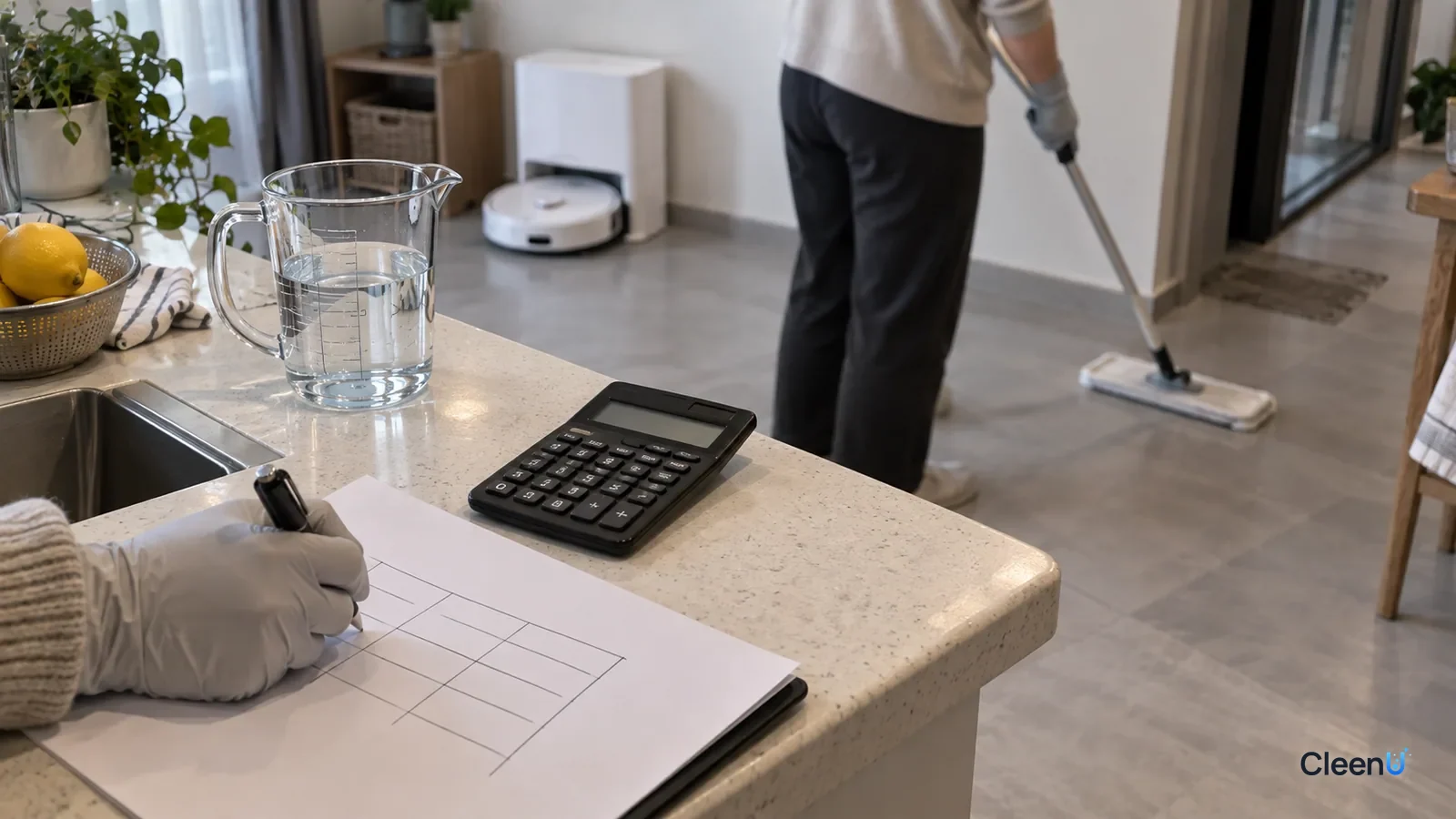
When people shop for robot mop cleaning solution, price is usually the first thing they see. Same liter, half the price, so why not buy the cheap one? A few weeks later the cheap bottle is empty, the floor still shows footprints and the dirty tank is full of foam.
The problem isn't that it's cheap. It's that we're comparing the wrong thing. The question isn't what a bottle costs, but what each mopping run costs, whether it actually cleans, and whether it causes trouble for the machine.
What is "active content," and where does a low price come from?
In a bottle of cleaner, the ingredients doing the work are surfactants and other functional ingredients. Most of the rest is water. The industry often describes the working part as active or solids content: what's left after all the water evaporates.
At the same volume, a high-active product still delivers enough surfactant after dilution to wet and emulsify greasy footprints. A low-active product diluted at the same ratio leaves too little surfactant in the working solution, and the prints stay.
Raw material cost sits mostly in those functional ingredients. The most direct way to cut cost is to use less of them and more water. The label may list the same ratio as a competitor, but the product underperforms, so people add more.
A low price can also come from:
Swapping a low-foam nonionic system for cheap, high-foam anionic surfactants, which clean fast but foam too much for robot mops.
Cutting the defoamer or stabilizers, or using a cheaper preservative system, so the product separates or spoils sooner.
Heavy fragrance to mask weak cleaning: strong scent after mopping, more residue on the floor.
Skipping device compatibility and stability testing.
Looking thick and sudsy doesn't mean it works
When people size up a cleaner, they instinctively check two things: is it thick, and does it foam when you shake it? Both instincts are easy for low-cost products to exploit.
Thickness can be manufactured. Formulas built on anionic surfactants thicken noticeably with a pinch of ordinary salt, one of the cheapest thickening tricks there is. The liquid pours slow and clings to the bottle and looks concentrated, but that doesn't mean it's high in active ingredients. Meanwhile, robot mop concentrates are often deliberately kept thin so they flow through tiny lines and dosing compartments. Looking like water doesn't make them weak.
Suds can be manufactured. High-foam surfactants and foam boosters are inexpensive, and a shaken bottle full of suds feels powerful. But foam has no direct link to cleaning power, and in a robot mop it's a liability: false "tank full" alerts, overflow and floor residue.
Scent can be manufactured. A heavier dose of fragrance makes the house smell strongly after mopping, which feels clean, and can hide residue and pad odor.
So judge a robot mop solution not by thickness, suds or scent, but by three things: does it clean at the label dose, does the floor dry without tackiness, and does the machine stay free of foam and clogs. For why low-foam formulas don't give up cleaning power, see does low-foam mean weaker cleaning.
How to work out cost per run
Cost per run = bottle price ÷ number of runs the bottle gives you
Number of runs = bottle volume ÷ amount you actually use each time
Here's how the math works (numbers are just for illustration):
A 1-liter concentrate whose label says 10 to 20 mL per fill gives about 50 to 100 runs.
Another 1-liter product that calls for 40 mL per fill gives about 25 runs, and if it really takes 60 mL to clean, only a dozen or so.
Even at half the bottle price, the second one costs more per run.
CleenU Robot Vacuum Cleaning Solution, for example, comes as a 1-liter concentrate with a measuring cap and dilutes at about 1:50 to 1:100. At 10 to 20 mL per fill, or about 10 to 20 mL for a 1-liter tank, one bottle lasts roughly 50 to 100 runs. You can run the same math on any product. For concentrate vs ready-to-use in detail, see concentrate vs ready-to-use robot mop cleaning solution.
Low-cost solution vs a purpose-made concentrate, side by side
| What to compare | Low-priced, low-active product | Purpose-made concentrate designed for low dosing |
|---|---|---|
| Bottle price | Low | Higher |
| Results at label dose | Often doesn't clean, so you add more | Cleans everyday greasy footprints at the label dose |
| Real dose per run | Often above the label | At the label, erring low |
| Cost per run | Often higher once real use is counted | Usually steadier per run |
| Foam | Can run high, triggering false "tank full" alerts | Low-foam with a defoamer |
| Residue | Extra dosing leaves more, floors turn tacky | Little residue at label strength |
| Stability | May separate or spoil | Formulated for stability |
| Machine impact | Higher risk of clogs, foam and crystals | Designed with lines and dosing compartments in mind |
Hidden costs that outweigh the liquid
Extra passes. When it doesn't clean, you run the robot again, using more power, water and time and wearing out pads and brushes faster.
Residue from overdosing. Floors turn tacky or slick, and you need water-only passes to lift it.
Maintenance and faults. High-foam products trip false "tank full" alerts; thick or unstable ones clog outlet holes and dosing compartments. All of that takes time to clean, and sometimes a repair.
Pads that smell and wear out sooner. Grease the solution didn't remove stays in the fibers, and pads go gray and smelly faster.
Added up, these hidden costs often exceed the price gap between two bottles.
How to tell whether a solution is really good value
Read the label. Does it say it's for robot mops and low-foam? Does it give a clear ratio or dose per fill? Does it list where it shouldn't be used?
Do the math. Divide bottle price by the number of runs at the label dose.
Test it. Dose at the low end and mop a dirty area like the kitchen or entry. Did the greasy prints come up? How much foam is in the dirty tank? Is the floor tacky underfoot?
Check stability. After some time on the shelf, is it still clear and even, with no separation, sediment or odor?
A product that cleans at the label dose, foams little, leaves little residue and keeps well is the real bargain.
CleenU Robot Vacuum Cleaning Solution is a neutral, low-foam concentrate at pH 6.5 to 7.5 with low-foam nonionic surfactants and a defoamer, no wax, no chlorine and no particles, and a 24-month unopened shelf life. It works in most robot mops from Roborock, iRobot (Roomba Combo and Braava), Ecovacs Deebot, Dreame and Narwal, and in floor washers such as Tineco. Add it to the clean water tank or the dock's designated detergent compartment as your manual directs. CleenU isn't affiliated with these brands; the names only indicate compatibility.
Are bigger bottles and refills better value?
The same product often comes in 1 L, 2 L or refill packs. Per run, bigger is usually cheaper, but check two things.
Shelf life and how fast you'll use it. At about 10 to 20 mL per fill, a liter gives roughly 50 to 100 runs, or about one to three months of daily mopping. A very large pack sitting open too long loses some stability and preservation.
Storage. Big containers take space, and stored in a garage or on a porch with big temperature swings, they're more likely to spoil.
Choosing a size you'll finish within a few months of opening is more practical than always buying the biggest.
This article is part of the Robot Vacuum Cleaning Solution & Maintenance Guide, which covers the full maintenance schedule and links to every troubleshooting guide.
Common questions about cheap robot mop cleaning solution
Is cheap robot mop solution always bad?
No. A low bottle price doesn't mean poor quality. What matters is whether it cleans at the label dose, stays low-foam and low-residue, and states a clear ratio. Work out cost per run before deciding.
How can I tell whether a solution's active content is high?
You can't measure it precisely at home, so judge by results at the label dose. If it removes the same greasy prints at the stated dose, the active content is usually adequate; if it takes double, it's probably low.
If I add more of the cheap solution, will it catch up?
It may close part of the cleaning gap, but foam and residue rise too, cost per run climbs, and you may get tacky floors and false "tank full" alerts.
Which is cheaper, ready-to-use or concentrate?
Concentrate is usually cheaper per run because one bottle makes dozens of times its volume. Convert both to cost per run to compare.
Are bigger bottles better value?
Per run they may be, but check the shelf life and storage after opening. A bottle that sits too long may separate or spoil.
Is the maker's solution just a brand premium?
Not entirely. It's the closest match to the machine and may carry testing and support costs. After the warranty, compare on compatibility and cost per run.
Another brand says 1:200. Is that cheaper than 1:50 to 1:100?
Not by the ratio alone. A thinner ratio only works if the concentrate has enough active content; if 1:200 leaves the floor dirty, you add more or run extra passes and the real cost goes up. Mop once at each product's recommended rate, then compare bottle price divided by the uses you actually get.
How long does a 1 L bottle of robot mop solution last?
Compare milliliters per fill, not just the ratio on the label. A 1:50 to 1:100 product needs about 10 to 20 mL for a 1 L tank, while ready-to-use products or ones that call for 40 mL or more per fill empty a bottle much faster. Convert both to mL per fill, then compare the price.
For a robot mop solution with a clear cost per run that cleans at the label dose and won't foam up your machine, try the 1-liter concentrate: Robot Vacuum Cleaning Solution.
Cheap robot mop cleaning solution often ends up costing more because its active content is low. It doesn't clean at the label dose, so you add more and mop more, the bottle empties fast, and foam, residue and clogs add hidden costs. Don't compare bottle prices. Divide the price by the real number of runs, then check whether it cleans at the label dose, stays low-foam and low-residue, and keeps well. The product that handles everyday greasy footprints at the label dose is the real bargain.