
Comparison
Can You Use Regular Floor Cleaner in a Robot Mop?
Direct answer
Usually not. Most cleaners made for hand mopping foam too much, and some contain wax. In a robot, that means false tank-full alerts, clogged outlets and a sticky or slippery film. Only low-foam products labeled for robot mops or wet-dry floor washers belong in the tank.
How to choose
-
You mop with a robot, use an auto-dosing dock, or run the robot every day
Choose A robot mop cleaning solution
It is low-foam and low-residue, built for the pump, outlets and recovery system, and needs no rinse.
-
You mop by hand, use a spray mop, or spot-clean spills
Choose A regular floor cleaner
Use it the way it was designed, sprayed on the floor or the mop head, with you controlling the amount and the wiping.
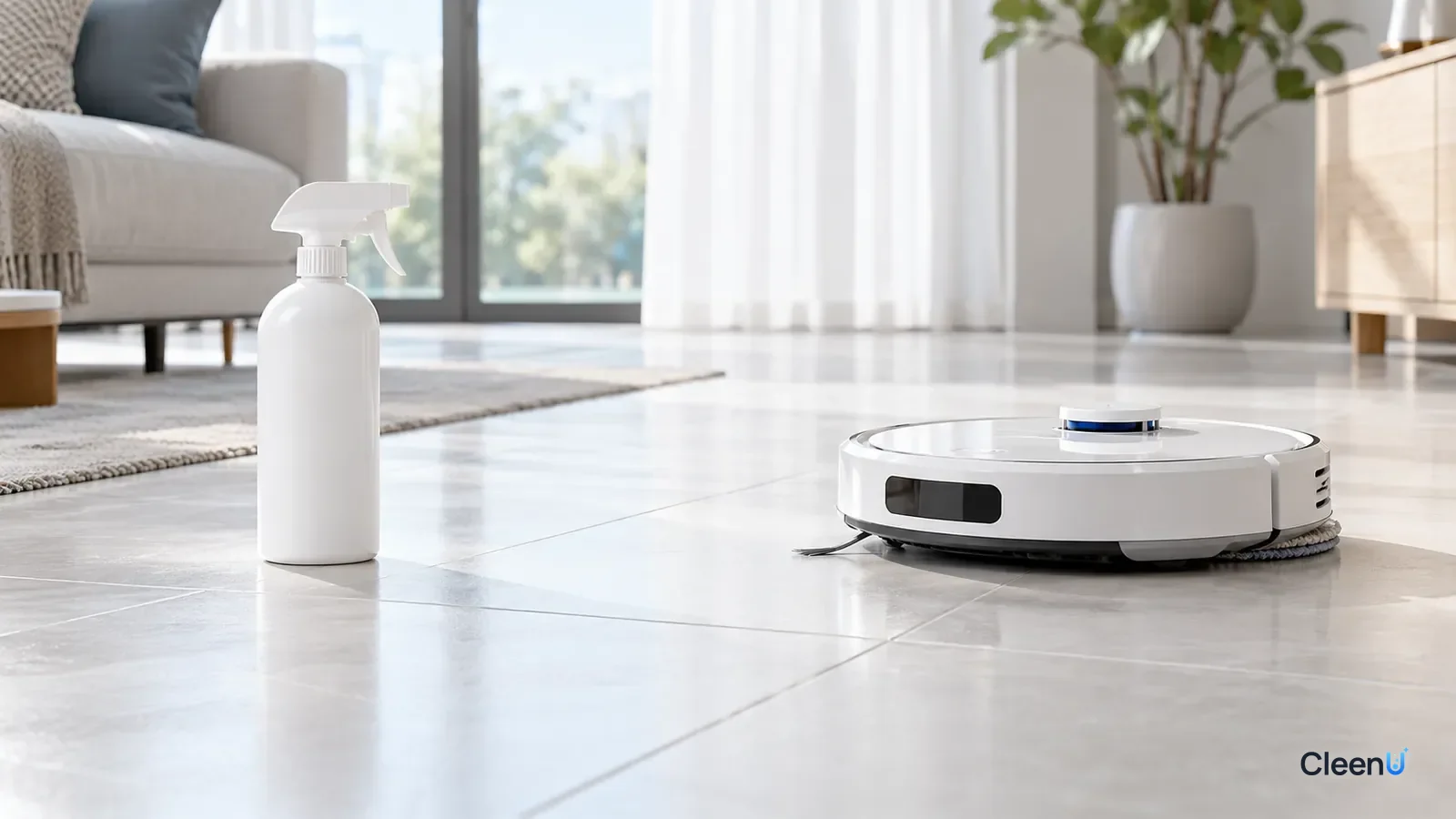
You already have a bottle of floor cleaner under the sink, and now there is a robot mop in the house. It is natural to wonder whether you can just pour it into the tank, since both are made for mopping. The answer depends on whether that bottle was made for a machine. The two products look interchangeable, but they are formulated for very different jobs.
Who each cleaner is designed for
Floor cleaners for hand mopping are designed for people. When you mop, you can see the suds, change the water, rinse and go over the floor with a dry mop. Those formulas can tolerate some foam, and some use it on purpose so the product feels like it is working. Some also add wax, oil soap or conditioning agents to leave floors looking shinier.
Robot mop cleaning solutions are designed for machines. A robot cannot see foam. Its pump keeps agitating the liquid, its water outlets are pinhole-sized, its dirty tank relies on a sensor to know when it is full, and nobody follows behind it with a rinse. So the formula has to be low-foam, non-clogging and low-residue, need no rinse, and be gentle on the tank plastics and seals.
CleenU Robot Vacuum Cleaning Solution, for example, uses low-foam nonionic surfactants with a defoamer, has a neutral pH of 6.5–7.5, and contains no wax, no chlorine and no particles. You add 10 to 20 mL to the clean tank, and it works through the normal mopping cycle with no rinse afterward.
It works in most robot mops from Roborock, iRobot (Roomba Combo and Braava), Ecovacs, Dreame and Narwal, and in Tineco-type washers. If the manual requires the maker's own solution or the robot is under warranty, follow the manual first. CleenU isn't affiliated with any of these brands.
Regular floor cleaner vs robot mop cleaning solution, point by point
| What to compare | Regular floor cleaner (hand mopping) | Robot mop cleaning solution |
|---|---|---|
| Designed for | Hand mopping, spray mops, spot cleaning | Tanks and water lines of robot mops and floor washers |
| Foam | Many are moderately to highly sudsy | Low-foam, often with a defoamer |
| Shine or care agents | Some contain wax, oil soap or polish | Usually wax-free to avoid buildup |
| Residue | Can rely on a rinse or dry mop | Must be low-residue with no rinse |
| Dosing | Eyeballed or sprayed by hand | Measured to the tank volume |
| Effect on the machine | Can cause foam alerts, clogs and deposits | Built around the pump, outlets and sensors |
| Best for | Hand mopping, spot cleaning | Daily robot mopping and auto-dosing |
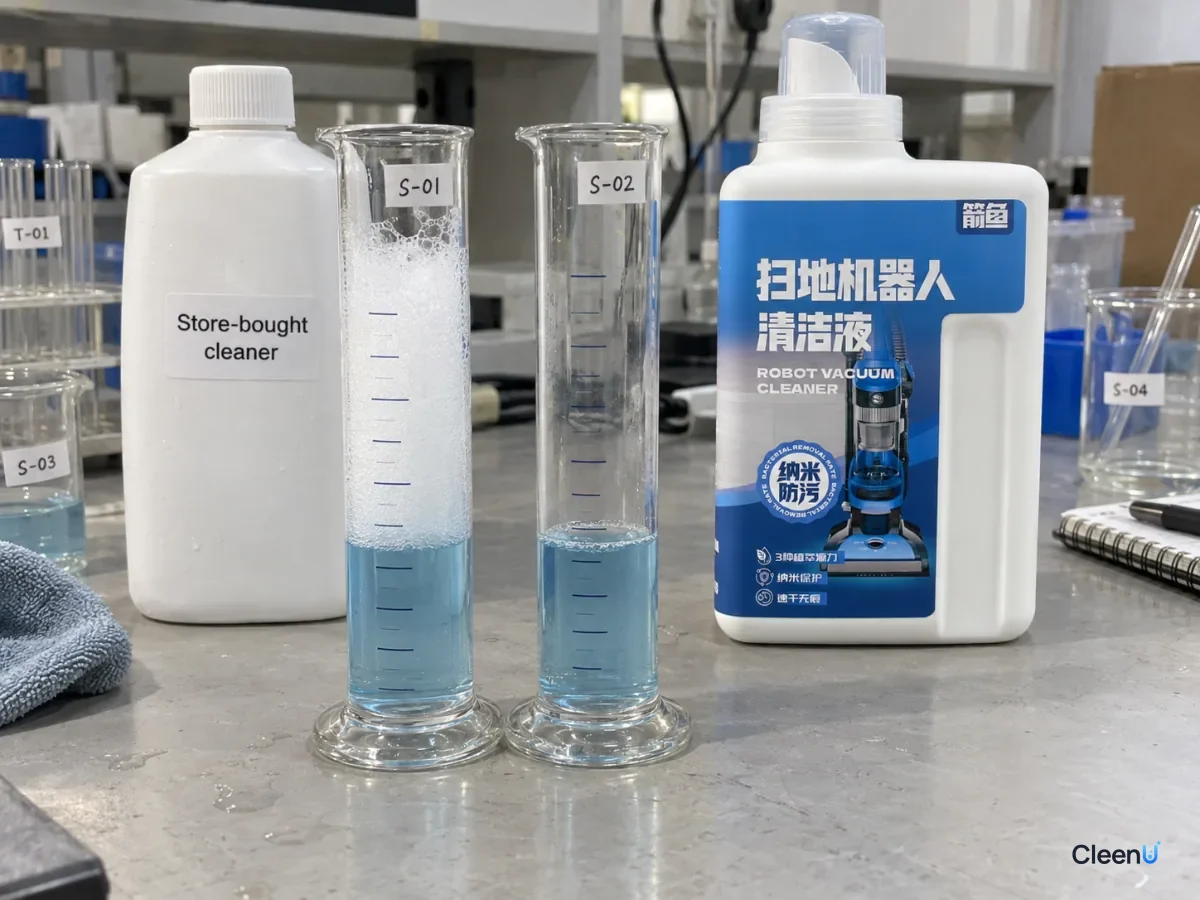
What happens when you put regular floor cleaner in a robot
Foam is usually the first problem. The pump and the recovery system churn a sudsy formula into a lot of foam. The foam reaches the level sensor in the dirty tank, and the robot reports the tank is full when it is only half full. Foam can also squeeze out of the tank's seams and dry inside the dock.
Floor problems come next. A robot mops in a single pass, and whatever liquid it leaves behind simply air-dries. Hand-mopping products set their strength and residue on the assumption that you will rinse or dry-mop afterward. In a robot, all of that residue stays on the floor, and it dries tacky and streaky. If the product contains wax or polish, each run adds another layer, so floors get slicker over time. That is not just about how the floor feels; it raises the risk of slips for kids and older adults.
Over the long run, the robot itself can suffer. Some cleaners carry strong solvents or fragrance that can swell or harden certain plastics and rubber seals. Thick liquids or products with particles can dry into deposits in the outlets and lines, so less water reaches the pad and it stays dry. Also, some manufacturers' warranties exclude damage caused by unapproved liquids, so it is worth reading yours before you experiment.
How a robot solution cuts grease without the foam
A common worry is that less foam must mean weaker cleaning. In fact, foaming and cleaning depend on two different properties.
A surfactant molecule has one end that is attracted to water and one end that is attracted to oil. During mopping, the oil-loving end works its way into the skin oil and grease in a footprint, while the water-loving end faces the water. Together they surround the oil and disperse it into the water so the pad can pick it up. That process, emulsifying and dispersing, is the actual cleaning. Foam is something else. It forms when surfactant molecules line up at the boundary between air and water and trap air bubbles, and it has little to do with removing soil.
Dish soap and many hand-mopping floor cleaners rely on anionic surfactants that foam readily, which gives a rich lather and a satisfying "it's working" feel. Robot mop solutions lean on low-foam nonionic surfactants instead. They emulsify grease just as well, but the foam they make at the air-water boundary is sparse and collapses quickly. A small amount of defoamer knocks down any bubbles that do form. The result lifts greasy footprints without piling foam into the pump and dirty tank.
How a low-foam robot solution removes grease
- Surfactants wet the floor and work into oily film and skin oil
- The oil is emulsified and dispersed into the water
- The pad picks up the oily water and the dock pulls it into the dirty tank
- A defoamer breaks up any bubbles that form
- A low-residue formula dries without a film, so no rinse is needed
Common floor-cleaner ingredients, and what they do inside a robot
Regular floor cleaners are designed for a bucket and a mop. Their formulas include ingredients that help with hand mopping but work against a robot.
High-foaming anionic surfactants such as LAS and AES: when you mop by hand, foam signals that the cleaner is working and causes no trouble. Inside a robot, the pump, dock and dirty tank whip it up again and again, triggering false "dirty tank full" alerts.
Shine and care ingredients: some "extra shine" products add wax, acrylic polymers or silicone that dry into a film. Used by hand every few days, that's manageable. Mopped by a robot every day, the film keeps thickening, and floors turn slippery and blotchy.
Heavier fragrance and solubilizers: to leave a lasting scent, these cleaners use more fragrance, and fragrance is oily, so it needs solubilizers to stay dissolved in water. Both add dried residue.
Thickeners: some products are thickened to look concentrated. A thick liquid clings to and clogs the robot's tiny water outlets and auto-dosing lines more easily.
More alkaline formulas: some heavy-duty floor cleaners run at a higher pH, which over long contact is less gentle on wood finishes and on the rubber parts inside the robot than a neutral formula.
None of these are "bad" ingredients on their own; they're just in the wrong setting. Robot mop solutions make the opposite trade-offs: low-foam nonionic surfactants plus a defoamer, no wax or film formers, low solids, near-neutral pH and no particles. CleenU Robot Vacuum Cleaning Solution follows exactly that approach: low-foam nonionic surfactants with a defoamer, pH 6.5 to 7.5, no particles, no wax and no chlorine.
Why diluting it more doesn't fix the problem
It's tempting to think: if a regular floor cleaner foams too much, just add more water.
The trouble is that a product's tendency to foam depends mainly on the type of surfactant, not the concentration. High-foaming anionic surfactants still foam under vigorous agitation even when very dilute, just a bit less. And by the time you've diluted it enough that foam stops being a problem, its grease-cutting power has usually dropped close to plain water. Shine ingredients are the same: diluting just makes each day's film thinner, and it still builds up with daily mopping.
So switching to a low-foam formula designed for robot mops is a more fundamental fix than watering down a regular cleaner.
When a regular floor cleaner is OK in a robot
Brand and price are not the test. Check the label and the formula instead. Only consider putting a product in the robot if all of these are true:
The label says it is for robot mops, vacuum-mop combos or wet-dry floor washers, not just floors in general.
It is low-foam. Try a quick check: mix it at its use ratio in a clear bottle and shake hard for ten seconds. Foam that collapses quickly is fine. Tall foam that lingers is not.
It has no wax, oil soap or shine agents, and needs no rinse.
Your robot's manual does not restrict you to water or the manufacturer's own solution.
Regular floor cleaners still do their own job well. CleenU Floor Cleaner, for instance, is a neutral no-rinse formula meant to be sprayed on the floor or a mop pad by hand, for everyday footprints and dust on tile, luxury vinyl plank, laminate and sealed hardwood. It was designed for spray mopping, though, so for the robot's tank, a solution labeled for machines is the safer choice.
Which one fits your setup
-
Homes that mop only with a robot
Choose A robot mop cleaning solution
Add 10 to 20 mL per fill and skip the foam alerts and floor residue.
-
Homes where the robot does daily mopping and people handle spot cleaning
Choose Keep both
Robot solution goes in the tank; the hand-mopping cleaner handles entryway and kitchen spots with a spray mop.
-
Homes without a robot, mopping with a flat mop
Choose A regular floor cleaner
Spray-and-mop is convenient; dilute it or spray it on the pad as the label directs.
Already used a regular cleaner? Here is how to recover
If you only used it once or twice and saw no problems, empty the clean tank, rinse it twice and switch to a robot solution.
If you are getting false tank-full alerts or heavy foam, empty and rinse the dirty tank and wipe the level-sensor contacts dry. Empty and rinse the clean tank too. Then run one cycle with plain water to flush leftover cleaner from the lines.
If the floor already feels tacky or slippery, mop it once or twice with plain water to lift the residue, keeping the water level low on wood. Wax buildup may not come off with water alone. In that case, wipe by hand with a diluted neutral cleaner and finish with plain water.
Stop using that cleaner if you see any of these
Stop using the cleaner if, after you add it, the robot keeps reporting a full dirty tank, water barely drips from the outlets, the floor feels noticeably slippery once dry, or the tank seals look swollen or misshapen. Flush the tanks and lines as described above and run with water only.
Written for: Owners who have a hand-mopping floor cleaner and want to know if it can go in the robot, and anyone chasing foam, stickiness or false alerts after moppingNot for: Robots whose manual specifies water only or the manufacturer's own solution, and homes without a robot that mop by hand
For the bottle that goes in your robot, choose a low-foam, wax-free, no-rinse formula like our Robot Vacuum Cleaning Solution.
For hand mopping and spray mops, see CleenU Floor Cleaner. For which tank to use and how much to add, read where cleaning solution goes in a robot vacuum and how much solution to add.
This article is part of the Robot Vacuum Cleaning Solution & Maintenance Guide, which covers the full maintenance schedule and links to every troubleshooting guide.
Can the floor cleaner you already own go in your robot?
My floor cleaner says "low foam." Can it go in my robot?
Do the shake test, then check whether the label mentions robot mops or floor washers and whether it contains wax. Only if all three check out should it go in the tank.
What if I dilute my regular floor cleaner more?
Extra water cuts foam, but it does not remove wax or conditioning agents, so the residue problem remains and cleaning is no longer predictable. A robot solution is the safer choice.
Can robot mop cleaning solution be used for hand mopping?
Yes. Dilute it to the label ratio and mop by hand; its low-foam formula leaves little residue. The reverse, putting a hand-mopping cleaner in the robot, is what causes trouble.
Will one use of regular cleaner break my robot?
A single use rarely does, but repeated use can lead to false alerts, outlet deposits and aging seals. If you see problems, flush the system and switch back.
What about dish soap?
Skip it. Dish soap is a high-foam formula and one of the most common causes of foam alerts and filmy floors.
Can I put a hardwood floor cleaner in my robot mop?
Usually not. Many hardwood cleaners contain oils or wax that can clog nozzles and leave a slippery film. For sealed wood floors, use a low-foam, wax-free solution made for robot mops, set a low water flow and let the floor dry quickly.
Regular floor cleaners are made for people mopping by hand. Robot mop cleaning solutions are made for a machine's water system and its single, no-rinse pass. Foam, wax and residue are why most hand-mopping products do not belong in a robot's tank. Use a low-foam solution labeled for robots in the machine, and keep your regular floor cleaner for hand mopping and spot cleaning.