
Formulation Science
Why Robot Mop Cleaning Solution Has to Be Low-Foam
Direct answer
Foam trips the dirty tank's level sensor, fills the tank, makes the pump pull air, leaves residue in the lines and pads, and can spill into the airflow path. Low-foam formulas use surfactants that don't foam much, plus a defoamer, to keep foam down while still cleaning.
The path foam takes through a robot mop
- Clean tank: pouring and sloshing create a few bubbles, which the pump pulls along with the water.
- Pump and outlet holes: bubbles make the pump draw air, so water sputters out and the pads wet unevenly.
- Pads and floor: surfactant-laden water squeezed through the pad over and over forms fine foam that stays in the fibers.
- Dock wash tray: high-speed scrubbing of the pads is the biggest foam generator of all.
- Dirty tank: foam is pumped in with the wastewater, piles up, touches the level contacts, triggers a false full alert and can spill into the airflow path.
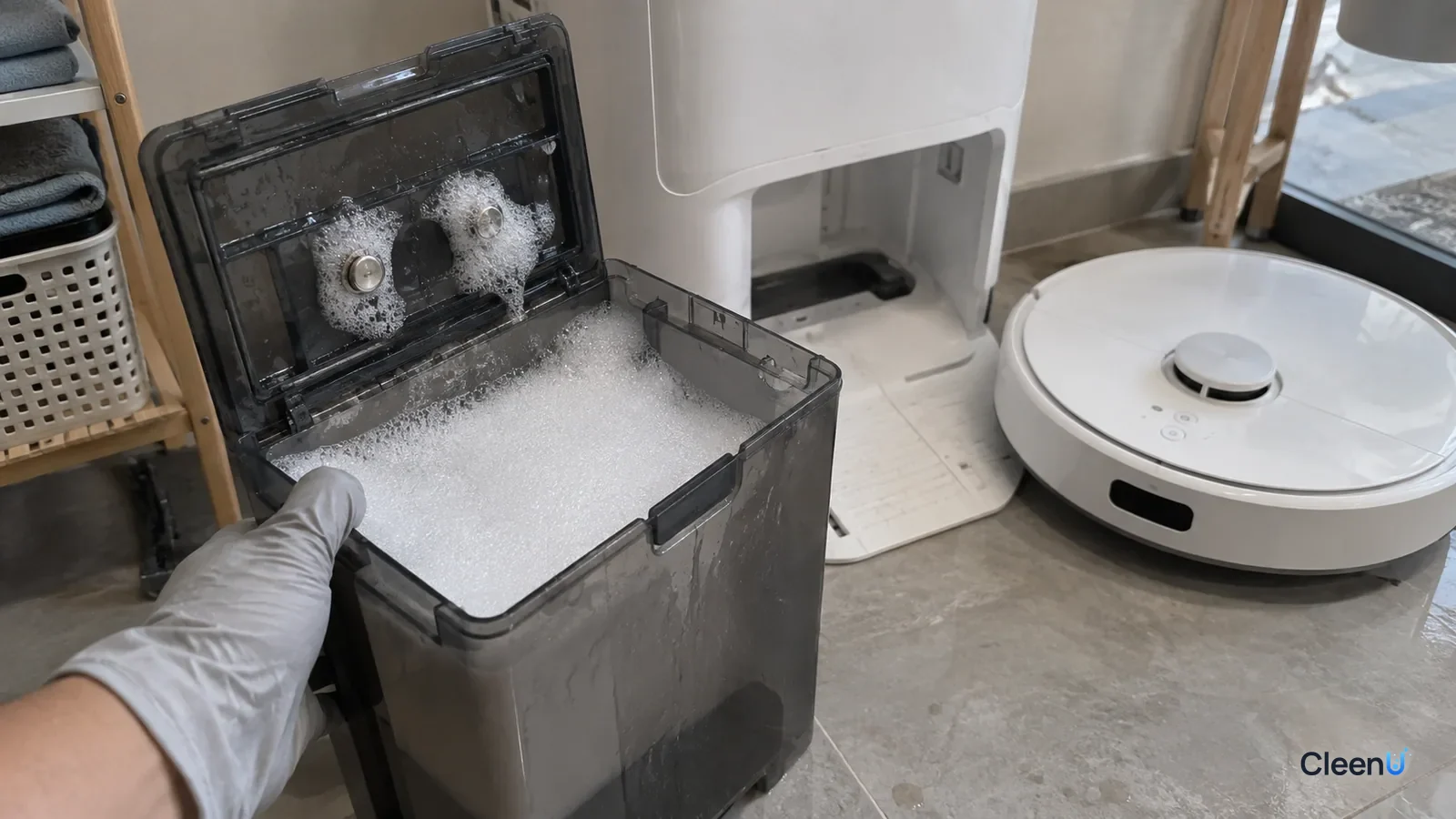
When you mop by hand, a few suds in the bucket don't matter. Put the same liquid in a robot mop and the dock may throw errors and spill foam out of the dirty tank. That's not because robots are fussy. It's because the way they work magnifies every downside of foam.
To see why robot mop solution has to be low-foam, follow where foam goes inside the machine.
Why does foam fool the sensors?
Many self-cleaning docks detect a full dirty tank with two metal electrodes. When wastewater rises to the electrodes, it connects them and conducts, and the dock knows the tank is full.
The trouble is that foam is air wrapped in liquid films, and those films are water carrying salts and surfactant, so they conduct. When foam piles up to the electrodes, the liquid may be nowhere near full, but the wet foam bridges the electrodes, and the dock reports a full tank and stops washing pads or mopping.
Other sensing methods, such as optical or pressure sensors, get confused too: a foam layer scatters light and blurs where the liquid surface really is. With a lot of foam, false alerts are almost inevitable. For troubleshooting, see a "dirty tank full" alert when the tank isn't full.
How does foam affect the water path?
The pump draws air. A robot's small pump is designed to move liquid. With lots of bubbles mixed in, air in the pump chamber cuts efficiency, and water sputters out so the pads go wet, then dry.
Outlet holes get coated. When bubbles burst, the surfactant in their films concentrates and dries near the openings, slowly narrowing the holes.
Foam in the dosing compartment. Pouring too fast, or a foamy liquid, leaves a layer of foam that confuses level sensing, and the metering pump may pull air and dose inaccurately.
The dirty tank's suction path. Docks usually pull wastewater from the wash tray into the dirty tank with airflow. Foam is bulky and light, so it's easily carried past baffles into the airflow path and fan, which over time can affect the fan and motor.
Foam also hurts cleaning
Many people think suds mean clean. In a robot mop it's the reverse.
Foam makes the pad skate. A layer of foam between pad and floor lowers friction and weakens the pad's scrubbing on soil.
Foam carries soil back. When bubbles collapse, the soil they held settles back on the pad and wash tray, so the dock can't wash the pads clean.
Foam signals too much surfactant. Visible foaming often means overdosing or a high-foam formula, which also leaves more residue, so floors dry tacky or slippery.
Why do some liquids foam so much from a few drops?
How stable foam is depends on how strong its films are. High-foam anionic surfactants, the kind in dish soap and shampoo, pack tightly and neatly into the films, making them elastic. When a film stretches thin, surfactant rushes in from nearby to patch it (the Marangoni effect), so foam lasts. Add a foam booster and it lasts even longer.
That's why even a few drops of dish soap can whip up half a tank of foam under the dock's scrubbing. For more, see can you put dish soap in a robot mop.
Why is foam in the dirty tank more stubborn than in the clean tank?
Some people notice that a solution barely foams in the clean tank but leaves a layer of foam in the dirty tank. The reason is that wastewater picks up things that work against you.
Proteins. Skin flakes, drool, milk and food scraps washed off the floor contain proteins, which are surface-active on their own. They settle into bubble films and make them sturdier. Beer foam and whipped egg whites last because of proteins.
Fatty acid salts. Under mildly alkaline conditions, some kitchen grease reacts with minerals and alkaline ingredients in the water to form soap-like compounds that also stabilize foam.
Fine particles. Dust particles caught in bubble films can slow drainage and help foam last longer.
More agitation. Scrubbing the pads in the wash tray and pumping wastewater into the dirty tank keep folding air into the liquid.
So foam can't be judged only by shaking clean diluted solution. What matters is how it behaves with dirty water and dock scrubbing. That's also why formulas include a defoamer: it has to control the solution's own foam and cope with the foam stabilizers that wastewater brings along.
For users, emptying and rinsing the dirty tank after every run, rather than letting wastewater and foam sit, also cuts foam and false alerts.
How do low-foam formulas keep foam down?
Low-foam nonionic surfactants. Examples include low-ethoxylate alcohol ethoxylates and EO/PO block copolymers. They pack loosely into bubble films, which lose elasticity and break easily, but they still wet and emulsify at the boundary between grease and floor.
Defoamers. Defoamer molecules have very low surface tension and dissolve poorly in water, so they spread fast over bubble films, thin them locally and burst them. Some exist as tiny droplets that enter a film and form a bridge across it, and the film ruptures there.
Controlled concentration. The higher the surfactant concentration, the stronger the tendency to foam. A formula designed for low dosing works at a concentration that's enough and foams less.
The type of defoamer matters. Silicone defoamers are very efficient, but silicone left on floors can make them slippery and affect sheen, so floor products choose type and amount carefully.
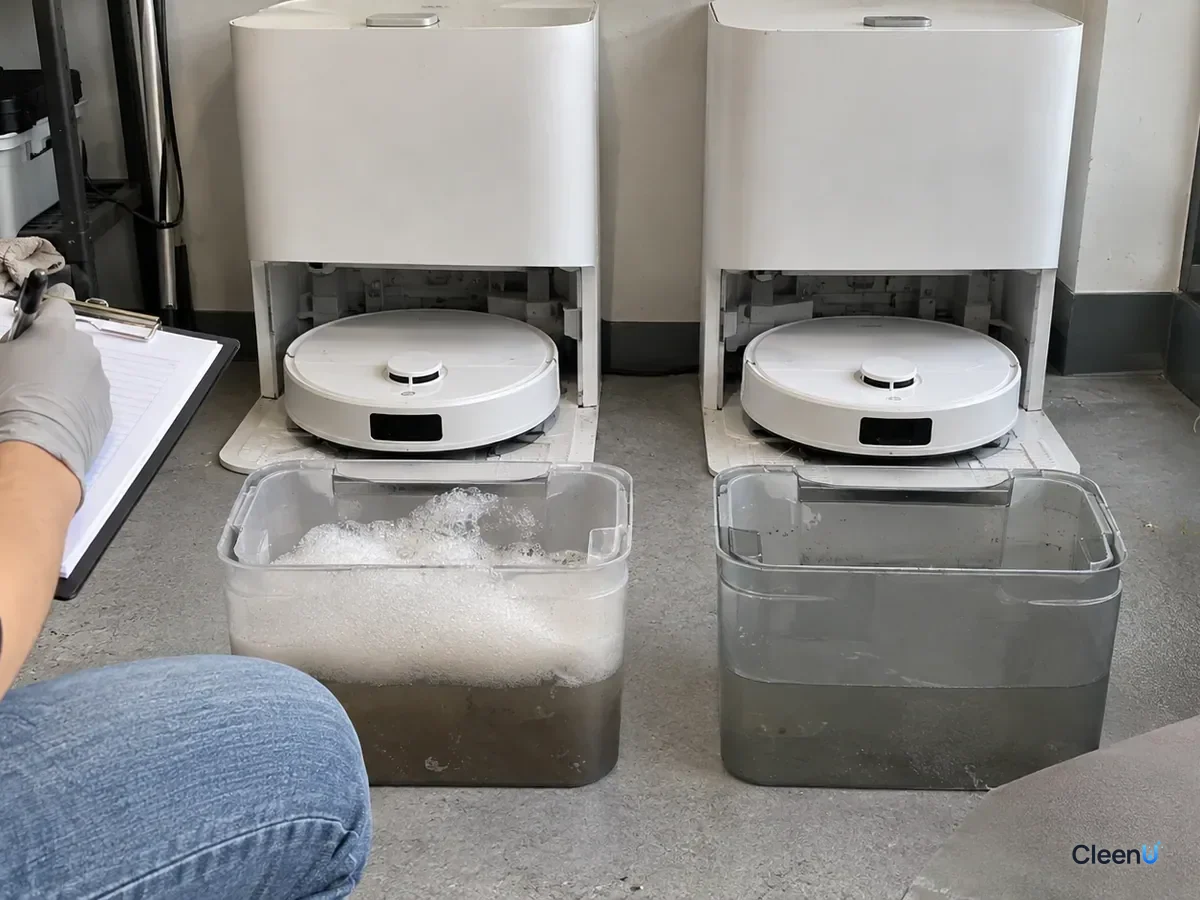
How users can avoid foam problems
Use only a low-foam solution labeled for robot mops.
Dose at the label ratio, erring low. Double the concentration and foam often more than doubles.
Add water first, then solution, and swirl gently rather than shaking hard.
Don't mix in other cleaners, and never add dish soap, laundry detergent or body wash.
Rinse the clean tank and dosing compartment before switching products.
Glance at the dirty tank the first time you use a new product. To check ahead of time, try a shake test at home; see a simple shake test for robot mop cleaning solution foam.
CleenU Robot Vacuum Cleaning Solution is a neutral, low-foam concentrate at pH 6.5 to 7.5 with low-foam nonionic surfactants and a defoamer, no wax, no chlorine and no particles. It dilutes at about 1:50 to 1:100; 10 to 20 mL per fill is usually enough. It works in most robot mops from Roborock, iRobot (Roomba Combo and Braava), Ecovacs Deebot, Dreame and Narwal, and in floor washers such as Tineco. Add it to the clean water tank or the dock's designated detergent compartment as your manual directs. CleenU isn't affiliated with these brands; the names only indicate compatibility.
How factories test foam during development
Labs commonly measure foam two ways.
Shake methods: a set volume of diluted solution at a set strength goes into a graduated cylinder, is shaken a fixed number of times with a fixed motion, and foam height is recorded at the start and after a few minutes to gauge foaming and collapse.
Pour methods: liquid falls from a set height onto a pool of the same liquid, and foam height is tracked over time, closer to what happens when liquid is pumped or poured.
For robot mop solution, lab methods are only the first step. What matters more is adding "dirty water" conditions: mix simulated floor soil such as oils, proteins and dust into the diluted solution, because in a real dirty tank those make foam more stable. Then comes the real machine, with the dock washing pads over and over while you watch dirty tank foam and level sensing. Only a formula that passes all three levels can be called low-foam in the machine.
This article is part of the Robot Vacuum Cleaning Solution & Maintenance Guide, which covers the full maintenance schedule and links to every troubleshooting guide.
Common questions about why robot mop solution must be low-foam
Does a robot without a dock still need low-foam solution?
Yes. There's no dirty tank alert to trip, but foam still makes the pump draw air, wets the pads unevenly and leaves residue on pads and floors.
If the foam stays in the dirty tank, does it hurt the robot?
Once in a while it's mostly false alerts. Heavy foam over time can spill into the airflow path and affect the fan and motor, and it makes the tank harder to clean.
My dirty tank is full of foam. What do I do?
Stop the robot, empty and rinse the dirty tank and dry the contacts. Refill the clean tank and use less of a low-foam robot solution, or run once with plain water first.
Why is there a little foam even with a robot solution?
Low-foam doesn't mean zero foam. A little foam that disappears quickly is normal. Foam that piles up usually means too much solution or mixing with another liquid.
Can I add a defoamer to the tank myself?
Better not. Store-bought defoamers are usually silicone, which can leave floors slick and cling inside the lines. Switching to a low-foam robot solution and dosing correctly is safer.
Does hot water make more foam?
Some formulas foam differently as temperature changes. Most robot manuals call for room-temperature water, so follow yours.
Will foam clog the dock filter?
Yes, the filter and dirty-water tank are usually the first places foam causes trouble. Foam carries grime onto the filter, slows drainage, and can trigger false water-level alerts. Switch to a low-foam robot mop solution, dose it by the label, and rinse the filter and dirty tank regularly.
Can I put laundry detergent in my robot mop tank?
No. Laundry detergent is built for a washing machine full of water and a rinse cycle. It is high-foaming, and some versions add thickeners and fragrance, so the dock scrubbing whips it into foam and the floor can feel sticky. Use a low-foam solution labeled for robot mops instead.
For a low-foam robot mop solution that won't pile up in the dock or trip the sensors, try Robot Vacuum Cleaning Solution.
Robot mop cleaning solution has to be low-foam because foam causes trouble all along the machine's water path. It makes the pump draw air and wet the pads unevenly, lingers in the pads and makes them skate, gets multiplied in the dock's wash tray, piles into the dirty tank, bridges the level electrodes and triggers false full alerts, and can spill into the airflow path. Low-foam formulas use loosely packing nonionic surfactants, add the right defoamer and are designed for low dosing, so foam stays down while wetting and emulsifying stay strong. For users, a low-foam robot solution at the label ratio, never mixed, avoids nearly every foam problem.