
How-to
Robot Mops and Rugs: Keeping Carpets Dry in Mixed-Floor Homes
Direct answer
Turn on carpet detection and pad lifting so the robot raises its pads on rugs. If your robot can't lift its pads, set rugs as no-mop zones, or remove the pads and run vacuuming and mopping separately. Don't let a wet pad sit on a rug's edge, and never use robot mop solution on carpet.
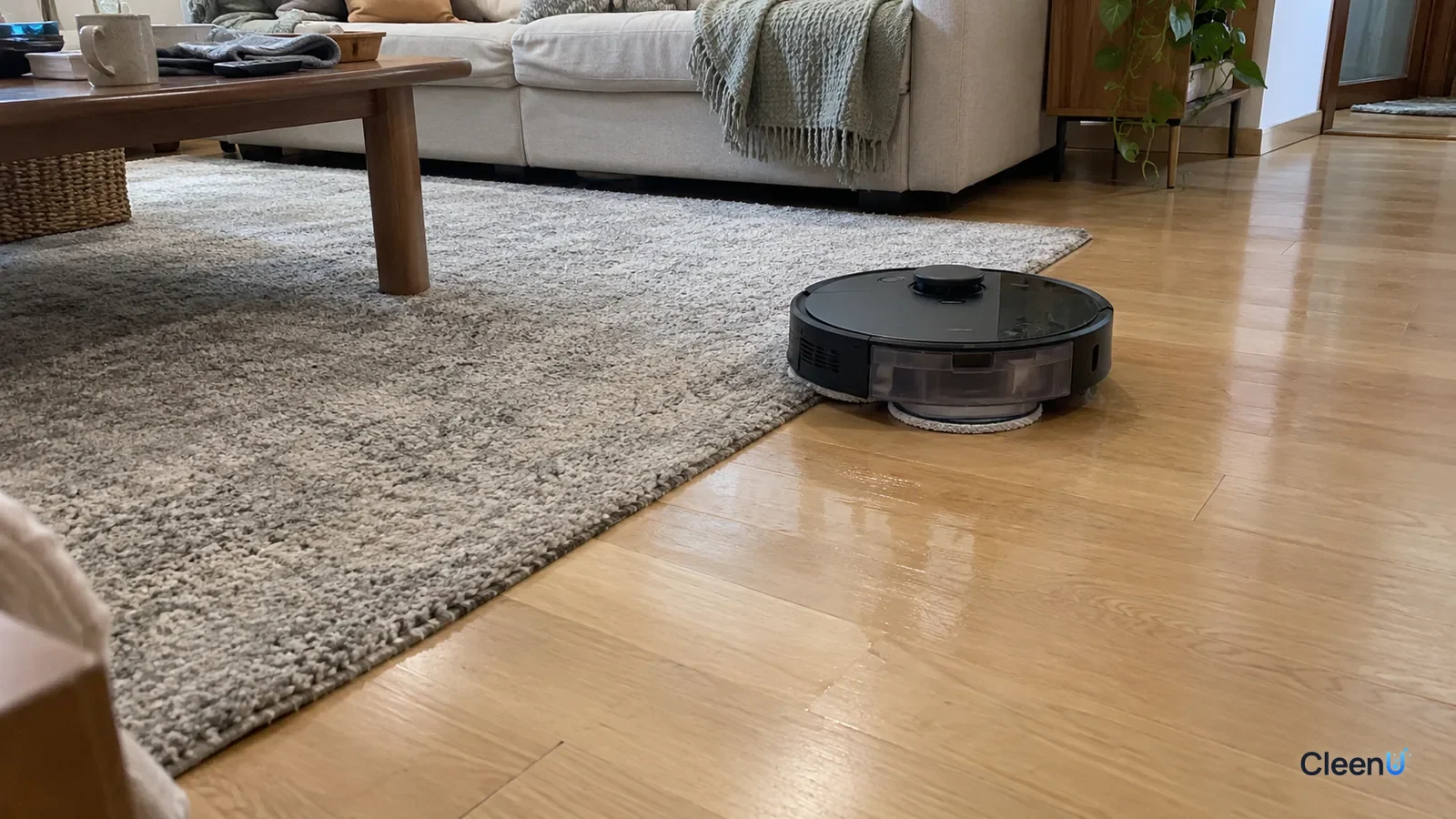
Most homes have mixed floors: an area rug on the living room hardwood, a runner by the bed, a mat by the door, a big play rug in the kids' room. For vacuuming, rugs are a robot's strength. For mopping, they're a headache: the pad presses onto the rug, the edge gets soaked, a shag rug soaks up water and stays wet for hours, and it starts to smell musty.
Fortunately, most robot mops today have features for rugs. With the right settings, vacuuming and mopping each stay in their lane: dry rugs, clean hard floors.
What happens when a wet pad gets on a rug?
The rug absorbs water. Carpet fibers have lots of gaps, and capillary action draws water from the pad in, where it's slow to dry, especially in shag, wool and rugs with a latex backing.
The rug turns moldy and smelly. The damp base, backing and the floor underneath stay airless for a long time, which invites bacteria and mold, musty smells and spots.
Dirty water soaks in. Water from the pad carries dust and grease, and once it soaks into the rug it leaves ring-shaped stains harder to clean than ordinary dust.
Cleaner residue. Robot mop solution is designed for hard floors. Left in carpet fibers, it makes them stiff and tacky and quicker to attract dirt. CleenU Robot Vacuum Cleaning Solution is explicitly not for carpet.
The wood underneath gets damp. Water at the rug's edge slowly works under it, and the airless floor beneath is more likely to cup or darken.
Common robot "rug features"
Names vary by brand and model, but the usual ones are:
Carpet detection: sensors (ultrasonic, optical, or changes in motor load) tell the robot it's on carpet.
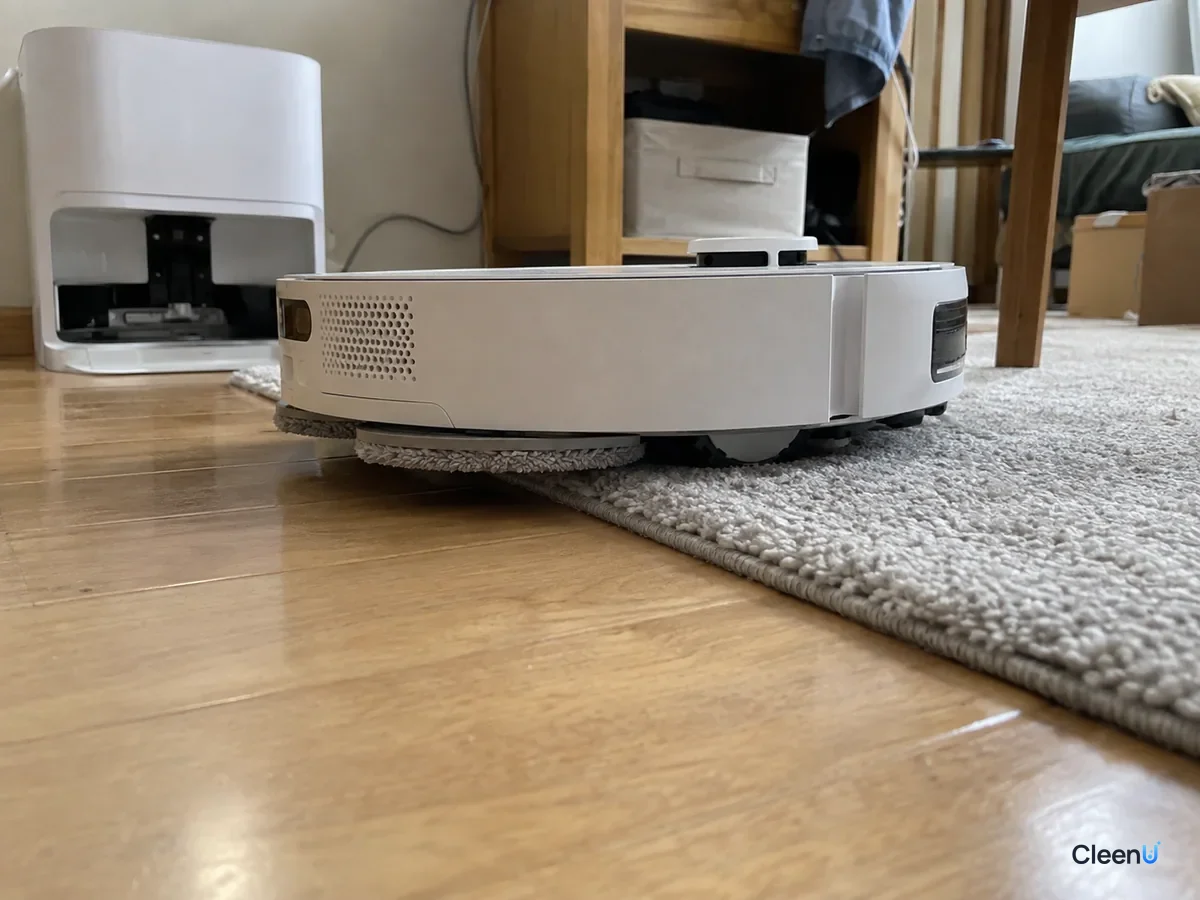
Pad lifting: once it detects carpet, the robot lifts its pads a few millimeters off the surface and keeps vacuuming.
Automatic pad removal: the robot returns to the dock to drop its pads before vacuuming rugs, then picks them up again to mop hard floors.
Carpet avoidance: in mop mode, the robot detects rugs and drives around them.
Carpet boost: suction increases automatically on carpet for a deeper clean.
Figure out which of these your robot supports before setting things up. Feature names and where to find them are in your manual and app.
How does carpet detection "see" a rug?
Knowing how detection works explains why some rugs get missed.
Ultrasonic detection: a sensor under the robot sends sound pulses downward. Hard floors reflect them strongly, while carpet fibers absorb and scatter some of the sound, so the echo weakens and the robot knows it's on carpet. Very thin, firm, flat mats echo much like hard floor and can be missed.
Motor load detection: the brush roll meets more resistance on carpet, so motor current rises. The change is obvious on shag and small on thin mats.
Optical detection: a camera or optical sensor reads surface texture and color. Dark or busy patterned rugs are sometimes misread, and dark rugs can even trigger cliff sensors as if they were a drop.
So when detection is unreliable, the dependable fix is to mark rugs by hand on the map or set no-mop zones rather than relying fully on automatic detection.
Setting up your robot for rugs
Six steps from detection to zoning
Turn on carpet detection and confirm it works
Enable carpet detection in the app and let the robot run once. Check that the map marks your rugs correctly. Dark or very thin rugs sometimes aren't detected and need to be marked by hand.
Turn on pad lifting or automatic pad removal
If your robot lifts its pads, enable lifting on carpet. If it can drop its pads at the dock, set it to remove them before vacuuming rugs. Lift height is limited, so shag rugs are better handled with removal or avoidance.
Set rugs as no-mop or avoidance zones
If your robot can't lift its pads, draw no-mop zones around rugs on the map. The robot will skip them when mopping and vacuum them as usual.
Caution:Make the zone a bit bigger than the rug so the pads don't brush fringe or curled edges.
Run vacuuming and mopping separately
Run a vacuum-only pass first to clean the whole house including rugs, then a mop-only pass on hard floors. Both get the right treatment.
Handle door mats and bath mats separately
Door mats and bath mats are damp to begin with and light enough to get pushed or tangled. Make them no-go zones, clean them by hand and air them out regularly.
Check rug edges after mopping
For the first few runs, feel the rug edges for dampness and look for wipe marks. If you find any, enlarge the no-mop zone or switch to avoidance or pad removal.
Settings by rug type
Low-pile and thin rugs: pad lifting is usually enough; a few millimeters keeps the pads off the surface.
Shag and thick rugs: lift height may not clear the pile, so pads can still press into it. Automatic pad removal or carpet avoidance is safest.
Small mats and fringed rugs: easy to pull into the brush roll, and fringe wraps around side brushes. Make them no-go zones and clean by hand.
Absorbent door mats and bath mats: already damp, so keep the robot off them with a no-go zone.
Play mats: PE or XPE foam mats have textured surfaces the pads may push around, and they don't need wet mopping. Make them no-mop zones and wipe them by hand with a wrung-out damp cloth.
Leave rug cleaning to vacuuming and carpet products
Robot mop cleaning solution is designed for hard floors such as tile, vinyl plank, laminate and sealed hardwood, not carpet. Keep rugs clean with vacuuming, and treat spots like spilled drinks or pet accidents with a carpet cleaner made for the job, then blot and let dry. For pet accidents, see can a robot mop clean up pet urine.
On the hard floors, the robot mops as usual. CleenU Robot Vacuum Cleaning Solution, for example, is a neutral, low-foam concentrate at pH 6.5 to 7.5 with low-foam nonionic surfactants and a defoamer, no wax, no chlorine and no particles. It dilutes at about 1:50 to 1:100; 10 to 20 mL per fill is usually enough, and it's made for tile, vinyl plank, laminate and sealed hardwood. It works in most robot mops from Roborock, iRobot (Roomba Combo and Braava), Ecovacs Deebot, Dreame and Narwal, and in floor washers such as Tineco. Add it to the clean water tank or the dock's designated detergent compartment as your manual directs. CleenU isn't affiliated with these brands; the names only indicate compatibility.
Don't forget the wood under the rug
Wood under a rug gets no light or airflow. If the rug's edge keeps getting brushed by a wet pad, water slowly works underneath, and that floor is more likely to darken or cup.
Lift the rug now and then to check the floor and keep it dry.
Use a breathable rug pad underneath, not a plastic one that traps moisture.
Keep water flow moderate when mopping, especially on the hard floor around rugs. For hardwood settings, see can you use a robot mop on hardwood floors.
Before mopping mixed floors, check these
- Carpet detection is on, and rugs are marked correctly on the map
- Pad lifting, pad removal or avoidance is set to match each rug type
- No-mop zones extend a bit past each rug to cover fringe and edges
- Door mats, bath mats and play mats are set as no-go zones
- Cords, socks and small toys are picked up off the floor
- Water level is set for the hard floor type and isn't high around rugs
Caring for rugs alongside your robot
A robot's everyday job on rugs is vacuuming. To keep rugs clean, pair it with a few habits.
Turn on carpet boost so suction increases automatically on rugs, and set an extra vacuum pass on shag.
Clear hair from the brush roll regularly. Rug fibers and hair tangle it fastest, and a wrapped brush loses suction.
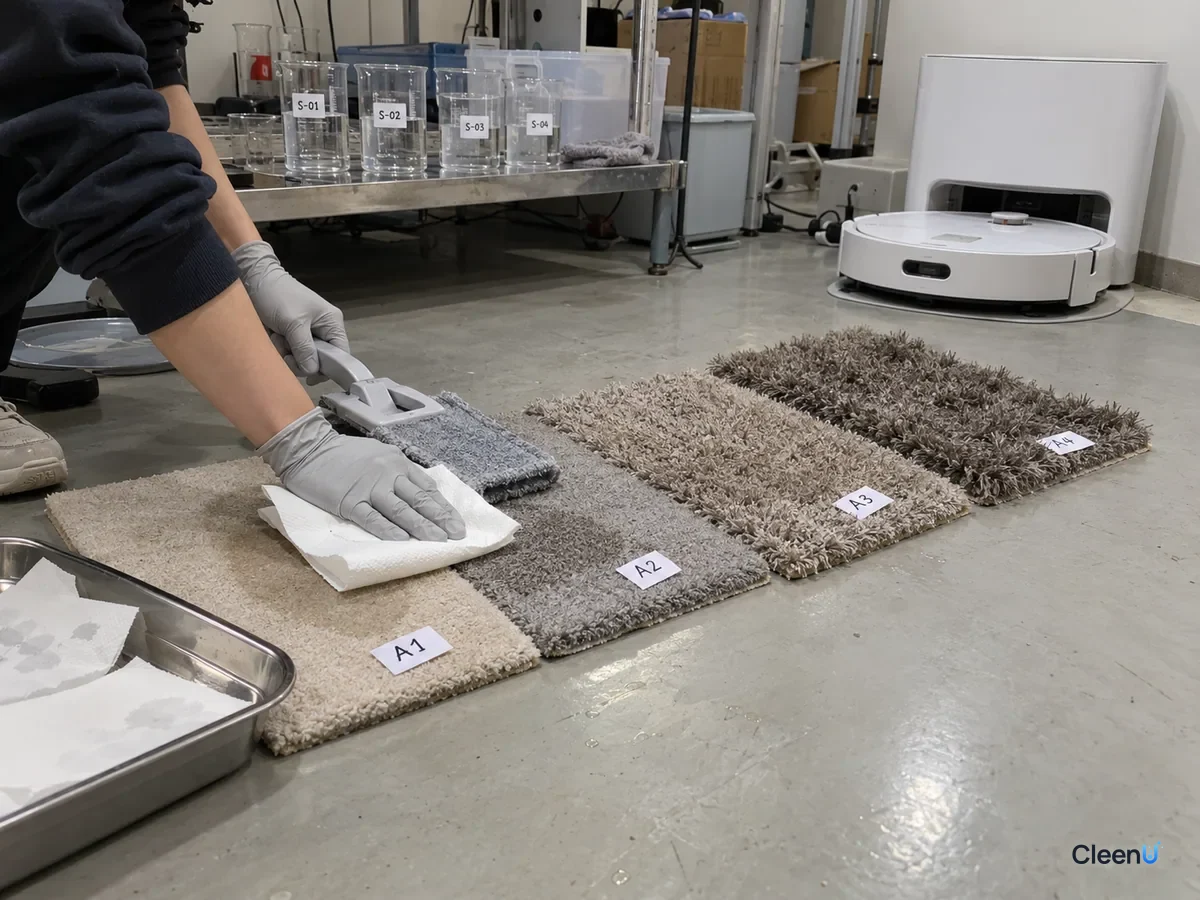
Treat spots by hand with a carpet cleaner, spraying, waiting and blotting as directed. Don't use a mop pad or robot mop solution.
Air out and shake rugs now and then, or have them professionally cleaned, and let the robot handle daily upkeep.
Rug edges, fringe and your robot
Rug edges curl and lift, and the robot can get stuck climbing on or off or flip an edge over. Secure edges with rug grippers or double-sided rug tape. For long fringe, include it in the no-go zone in the app or tuck it under the rug. Small adjustments like these help the robot run smoothly in mixed-floor homes and keep wet pads off the rug.
This article is part of the Robot Vacuum Cleaning Solution & Maintenance Guide, which covers the full maintenance schedule and links to every troubleshooting guide.
Common questions about rugs and robot mopping
Will my robot mop get my rugs wet?
It can, if carpet detection and pad lifting are off and there are no no-mop zones. Turning those features on or setting zones keeps wet pads off your rugs.
My pads lift on carpet. Can a shag rug still get wet?
It can. Lift height is limited and deep pile may still touch the pads. For shag, use automatic pad removal or carpet avoidance.
My robot can't lift its pads. What should I do?
Set rugs as no-mop zones, or separate the jobs: run a vacuum-only pass first, then mop hard floors only.
Can I use robot mop solution on carpet?
No. It's designed for hard floors and leaves carpet fibers stiff and tacky. Use a carpet cleaner for rug stains.
A pad soaked my rug's edge. What now?
Blot with a dry towel, run a fan or dehumidifier to speed drying, and lift the rug to dry if needed. Treat any dirty water marks with a carpet cleaner.
My robot doesn't detect my dark rug. What can I do?
Mark the rug area by hand in the app, or simply set it as a no-mop zone.
Can I clean an area rug with a floor washer and robot mop solution?
No. Low-foam robot mop solution is made for hard floors, and rug fibers hold water and residue, so they dry slowly and can start to smell. Use a carpet cleaner and a machine made for rugs, and set your robot or floor washer to skip rug zones.
In mixed-floor homes, for a neutral, low-foam, wax-free robot mop solution for the hard floors, try Robot Vacuum Cleaning Solution.
In homes with rugs and hard floors, the key to robot mopping is keeping wet pads away from rugs. Turn on carpet detection and pad lifting if your robot has them, and use automatic pad removal or avoidance for shag rugs. If your robot can't lift its pads, set no-mop zones a bit bigger than each rug, or run vacuuming and mopping separately. Make door mats, bath mats and play mats no-go zones and clean them by hand. Use robot mop solution only on hard floors, keep rugs clean with vacuuming and carpet products, and check the wood under rugs for moisture now and then.