
OEM/ODM
Planning a Private Label Pet Products Line: Urine, Litter Box, Bowl, or Wipes First?
Direct answer
Split pet-home cleaning into scenarios, then score each direction on demand, repurchase frequency, room to differentiate, and compliance difficulty. Most first launches work best with two or three SKUs, such as an enzyme urine cleaner plus a litter box or bowl cleaner, with wipes and a robot mop formula in round two.
Six steps from product selection to first launch
-
Define scenarios and channels
Decide whether you serve cats, dogs, or both, which market and channel you sell in, and your target price range, then list candidate directions.
-
Score and pick the first SKUs
Weight the four factors by channel, score each candidate with written evidence, and choose two or three first-launch products.
-
Free samples
Start from existing CleenU pet formulas or sample to your target. Scent is selectable.
About 3 days
-
Sample testing and series alignment
Test at home while the factory runs stability, preservative, and packaging checks; lock the series scent, bottle formats, label layout, and claim wording.
-
Finalize labels and listings
Check directions, do-not-use lists, and claims for each SKU. SDS, TDS, and COA are provided per project after you inquire.
-
Production and round two
Production runs through five quality checkpoints with batch traceability. After launch, plan round two from reviews and repurchase patterns.
About 7 calendar days after packaging and labels are approved
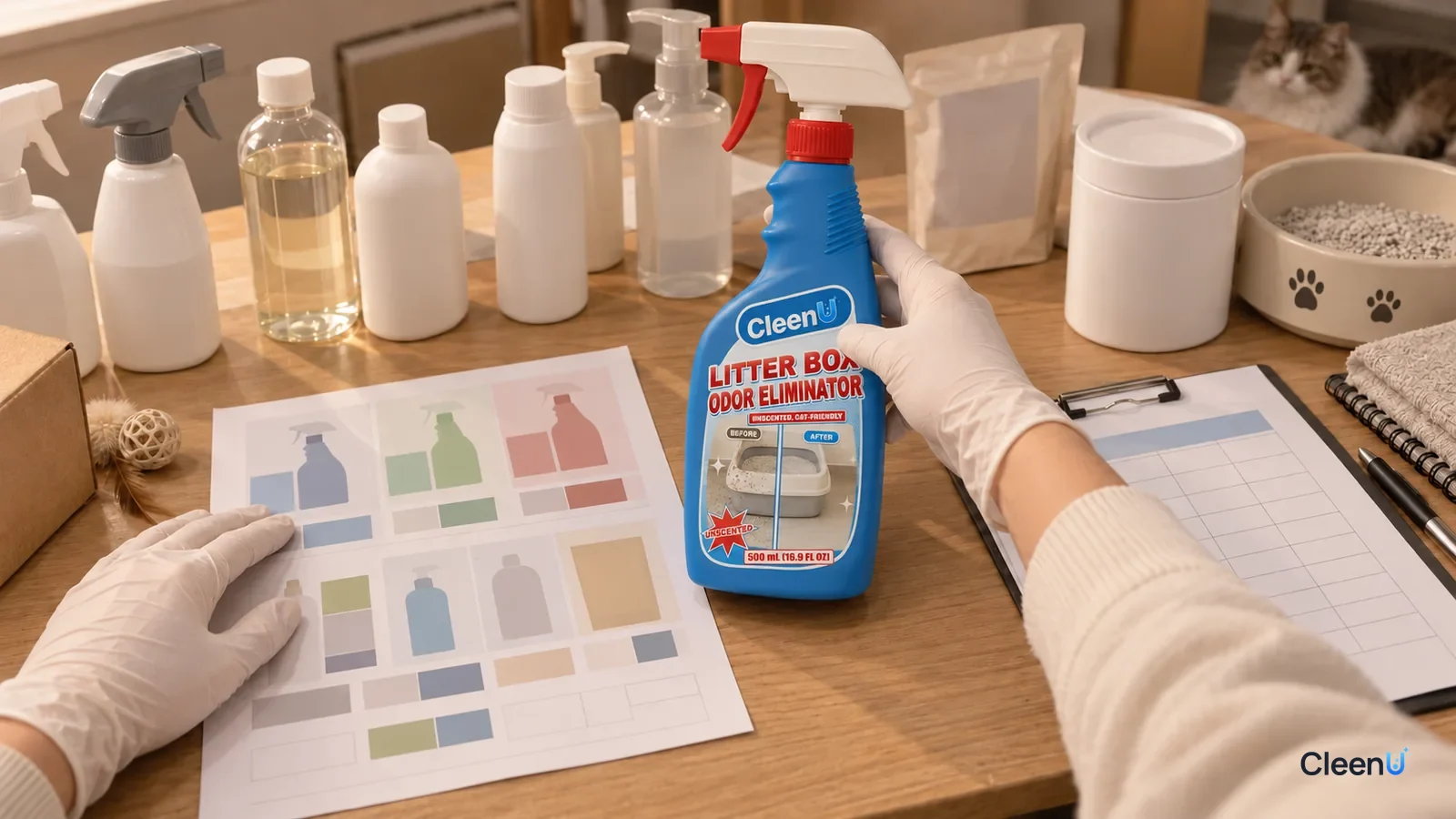
When brands start a private label pet products line, the instinct is to launch everything at once: urine cleaner, odor spray, litter box deodorizer, kennel cleaner, bowl cleaner, wipes. Six or seven SKUs, each with its own 500-bottle minimum, listing, photos, and ad budget. Usually one or two take off and the rest tie up cash. A steadier approach is to break pet-home cleaning into scenarios, score every direction with the same yardstick, launch two or three products, and grow the line once those work.
This guide is for pet brands, Amazon and Shopify sellers, and pet-channel distributors. It covers product types, first-launch scoring, series consistency, robot mop pairing, and MOQ pacing. Examples come from the CleenU pet line already on the market. They're directions to discuss, not the only options, and we don't share sales or customer data.
Where the mess comes from: seven scenarios, seven needs
Pet cleaning isn't one category. It's a set of scenarios, each with different soils, surfaces, and habits, which is why one bottle rarely handles them all.
- Urine: urine soaks into carpet, mattresses, and couches. Bacteria turn urea into ammonia, cat urine's felinine breaks down into sulfur-containing odor compounds over time, and protein and salt residues stay behind. Customers need something that saturates and lifts residue out.
- Room and fabric odor: no visible stain, just smell built up in beds, couches, and curtains. Customers want a spray that doesn't leave water marks or a heavy scent.
- Litter box: urine and feces sit in the litter, scratches in the box hold residue, and odor rises even after scooping. Customers need a light daily deodorizer plus a deep clean when the litter is changed.
- Crates and gear: crates, carriers, playpens, and toys pick up drool, food, and waste residue. They need spraying, scrubbing or wiping, rinsing, and full drying.
- Bowls: food bits and saliva leave a slick layer on bowl walls that needs scrubbing and rinsing every day.
- Body cleanup: paws after walks, muzzles, and muddy fur need a wipe, not a bath.
- Floors: paw prints, hair, drool spots, and everyday dust, which a robot mop can handle day to day.
Seven scenarios and matching product directions
- Urine
- Enzyme Pet Stain & Odor Remover; Mattress Stain & Odor Cleaner for mattresses
- Room and fabric odor
- Pet Odor Eliminator
- Litter box
- Litter Box Odor Eliminator
- Crates and gear
- Pet Cage & Kennel Cleaner
- Bowls
- Pet Bowl Cleaner
- Body cleanup
- Pet Cleaning Wipes
- Floors
- Robot Mop Cleaning Solution for pet homes
Taken together, the table also answers the question "what pet cleaning products are there?": roughly these seven types. The next step isn't building all seven. It's deciding which to build first.
Why one bottle can't do it all
Brands often ask for a single "pet everything cleaner" for urine, litter boxes, crates, and bowls. From a formulation standpoint, we don't recommend it. "Pet smell" needs different mechanisms in different places, and merging them weakens every use.
Urine needs source removal. CleenU Enzyme Pet Stain & Odor Remover combines protease, lipase, and amylase with nonionic surfactants. The enzymes break protein- and fat-based odor sources into smaller, more soluble pieces, the surfactants carry them out of the fiber, and the user saturates, waits 10 to 15 minutes, and blots. That takes volume and dwell time, which is wrong for a food bowl.
Litter boxes need odor capture. CleenU Litter Box Odor Eliminator adds cyclodextrin and zinc ricinoleate to an enzyme blend. Cyclodextrin is a ring-shaped molecule whose cavity can hold some odor molecules; zinc ricinoleate binds some sulfur- and nitrogen-containing odor compounds. It goes on as 3 to 5 light mists over the litter after scooping and must not clump the litter, so it has to be a fine mist.
Bowls need easy rinsing. CleenU Pet Bowl Cleaner uses an alkyl polyglucoside surfactant made from food-grade raw materials, with sodium citrate and cyclodextrin, no fragrance, and no dye. One or two pumps go on a sponge, and the bowl gets rinsed under running water. "Food-grade" describes the raw material grade only. The bowl still gets rinsed before the pet uses it, and the product is a cleaner, not a disinfectant.
Body cleanup needs something mild enough to wipe directly. CleenU Pet Cleaning Wipes use a mild amphoteric surfactant with aloe extract and deionized water, alcohol-free and fragrance-free, at pH 5.5 to 7.0. They aren't for inside the eyes, ear canals, wounds, or red, irritated skin.
Floors need low foam and low residue for machines. CleenU Robot Mop Cleaning Solution for pet homes is a neutral concentrate at pH 6.5 to 7.5. It is fragrance-free (no added fragrance), relies on cyclodextrin-type odor control, and contains no solvents or optical brighteners.
Five ways a product can deal with pet odor
- Source removal: enzymes break down protein and fat residue and surfactants lift it out, for urine and fabric stains
- Inclusion: cyclodextrin holds some odor molecules in its cavity, for litter boxes, crates, and fabric surfaces
- Chemical capture: zinc ricinoleate binds some sulfur- and nitrogen-containing odor compounds, often paired with cyclodextrin for litter boxes
- Physical removal: surfactants plus scrubbing and rinsing carry away residue and slick buildup, for bowls, crates, and floors
- Masking: fragrance covers odor quickly but leaves the source, so pet urine products rarely rely on it
A sensible pet line is a set of focused products, each owning one scenario, sharing one series language. Not one bottle for everything.
Picking the first SKUs: a four-factor score
Score each candidate from 1 to 5 on four factors, higher meaning a better first launch. Here's what each factor measures and where the evidence comes from.
Demand: how many people are looking. Search data is the most direct evidence. For the U.S., a third-party keyword tool (DataForSEO, estimated U.S. monthly searches, September 2026) shows roughly 110,000 for "cat urine enzyme cleaner," 12,100 for "pet odor eliminator," 4,400 for "kennel odor eliminator," and 1,600 for "litter box deodorizer." If you also sell in China, Baidu's autocomplete does the same job: in early October 2026, the query for pet odor removal returned 74 suggested questions, 18 about concerns and 20 about choosing a product. Read these numbers with three caveats. They're estimates that vary between tools. One need has many phrasings, so group related terms. And search volume shows that people are asking, not that they'll buy from you. Some directions, such as pet bowl cleaner, barely register in general keyword tools. That's information too: shoppers may search the problem ("why is my dog's water bowl slimy") or add the product while browsing a marketplace, so check in-platform search suggestions, review counts, and Q&A instead.
Repurchase frequency: how soon customers buy again. You don't need sales data; each product's directions for use tell you. Litter box deodorizer gets a few mists after every scoop, so it's used most often. Bowl cleaner takes one or two pumps a day. Wipes get used after every walk. A robot mop solution uses about 2 to 4 teaspoons (10 to 20 mL) per fill, so a 33.8 fl oz (1 L) bottle covers about 50 to 100 fills and follows the robot's schedule. An enzyme urine cleaner is accident-driven: busy during puppy training, with senior pets, or in multi-cat homes, slow everywhere else. High-frequency products suit refills and subscriptions; low-frequency ones lean on new customers.
Room to differentiate: can you stand apart. Read competitors' negative reviews. Enzyme urine cleaner is one of the most crowded pet cleaning directions. If complaints center on fixable details like scent, results, and leaks, your opening is in fragrance-free formulas, the right sprayer, and clearer directions: real, but narrow. Pet bowl cleaner is wide open, but you'll spend effort teaching customers why bowls need their own cleaner.
Compliance difficulty: where the risky sentence hides. Higher scores mean easier to get right. Every direction has a tempting wrong claim. Kennel cleaners get pitched as disinfecting, which in the U.S. requires EPA registration. Litter box and urine products get "destroys odor-causing bacteria," also a registration-triggering claim. Bowl cleaners drift toward "food-safe" or "no rinse," when the accurate statement is food-grade raw materials and a full rinse. Wipes are the hardest: claims to treat or prevent disease can make them an unapproved animal drug in FDA's eyes, and wipes add preservation and nonwoven testing on top. These U.S. points were checked in October 2026; confirm against current official text with a compliance advisor.
Turning scores into a decision. Weight the factors by channel. Amazon sellers who live on search traffic weight demand and compliance. Shopify brands built on subscriptions weight repurchase and differentiation. Distributors selling to pet stores weight repurchase and shelf efficiency. Set weights, calculate, and the top two or three are your first-launch candidates. Write down the evidence behind every score so the team debates evidence, not gut feel.
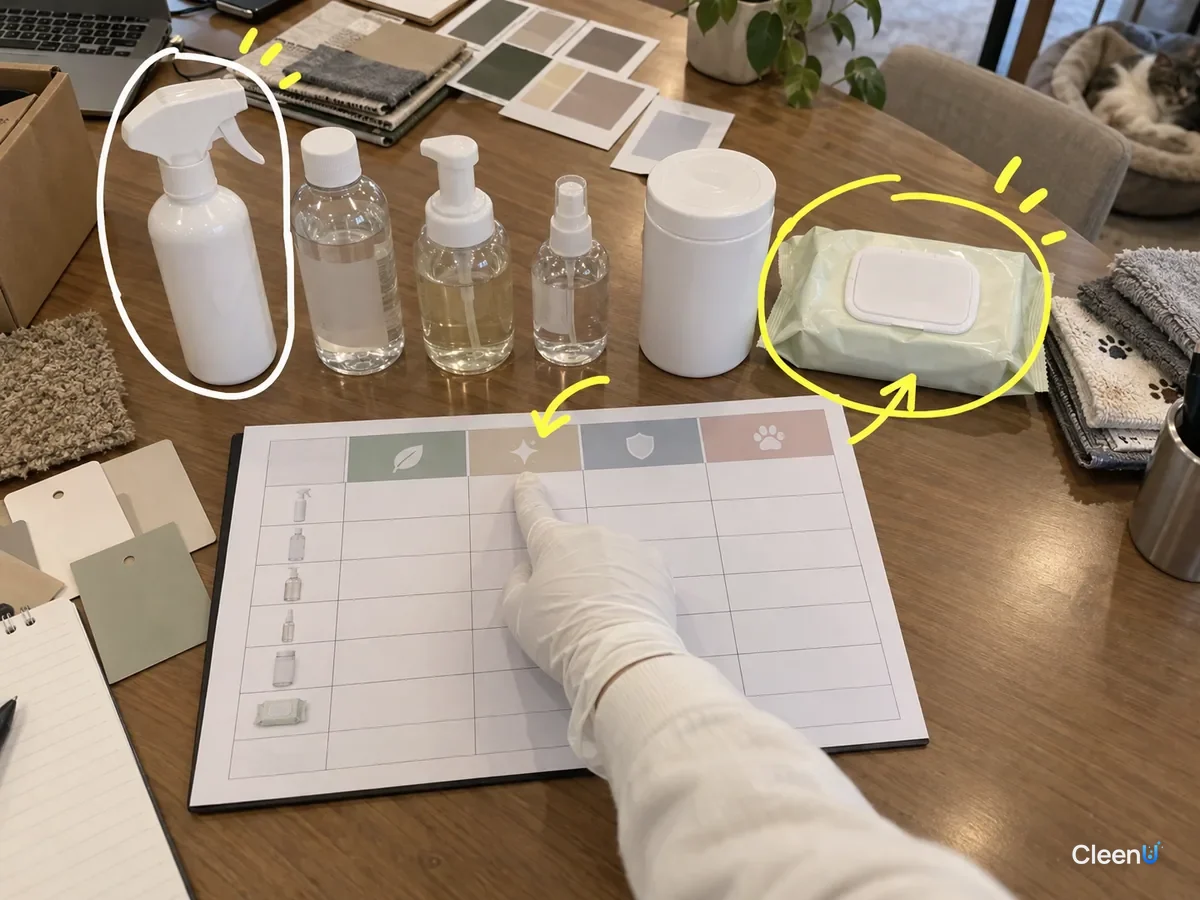
The counterintuitive part: the biggest search term isn't always the best first product
Ranked by demand alone, the enzyme urine cleaner wins easily, which tempts brands to launch it alone. Put all four factors together and the picture shifts. Urine cleaner has high demand, little room to stand out, and accident-driven repurchase, and a new brand needs real ad spend to surface in crowded results. A litter box deodorizer has far less search volume, but it's used daily, repurchases steadily, and customers notice details like fragrance-free, fine mist, and not clumping the litter, which makes it easier to earn good reviews.
So our usual advice is "one product to acquire, one to retain." Let a urine cleaner capture search traffic, and let a litter box deodorizer or bowl cleaner keep customers coming back. The table below shows common starting combinations by channel. They illustrate the selection logic, not sales promises.
Common first-launch combinations by channel
- Amazon seller relying on search
- Enzyme urine cleaner to acquire, litter box deodorizer to retain
- Shopify brand built on subscriptions
- Litter box deodorizer, bowl cleaner, and wipes as three consumables
- Pet stores and distributors
- Kennel cleaner, bowl cleaner, and wipes, chosen for shelf and repurchase
- Robot vacuum or smart-home brand
- Pet-home robot mop solution, plus an enzyme urine cleaner for accidents
- Cat-focused brand
- Litter box deodorizer and enzyme urine cleaner around cat urine and the litter box
Keeping the line consistent: scent, packaging, and design
Even with two or three SKUs, design them as a series from day one. Otherwise round two arrives with mismatched bottles, scents, and label layouts, and customers can't tell the products belong together.
Scent. Make fragrance-free the baseline. CleenU Enzyme Pet Stain & Odor Remover, Litter Box Odor Eliminator, Pet Cage & Kennel Cleaner, Pet Bowl Cleaner, Pet Cleaning Wipes, and the pet-home robot mop solution are all fragrance-free. If you want one scented product, give it the room-freshening slot: CleenU Pet Odor Eliminator has a fresh linen scent, and Mattress Stain & Odor Cleaner has a light scent with a fragrance-free option. Core products like urine and litter box cleaners then get judged on performance, not perfume. Define "fragrance-free" the same way across the line: no added fragrance.
Packaging. Let the use decide the format, then unify the look. Urine and kennel products need saturation, so they use higher-output trigger bottles. Litter box and mattress products need a light mist. Bowl cleaner goes on a sponge, so a pump bottle works better. Wipes come in an 80-count resealable pack. The robot mop solution is a 33.8 fl oz (1 L) concentrate with a measuring cap. Sprayers and shapes can differ while bottle color, label position, fonts, and icons stay consistent. Every spray bottle can take an inner seal under the cap, with drop and leak tests on the final packaging.
Design and labels. A practical approach: give each scenario an accent color or icon, keep the main brand block identical, and let customers spot "the litter box one" at a glance. Put three pieces of information in the same place with the same wording on every label: where to use it; how to use it, meaning how many sprays, how long to wait, whether to rinse; and where not to use it plus when pets can return, for example "Keep pets away during use and until the area is completely dry." Keep claims uniform too: cleaning, stain removal, odor removal, and specific "free of" statements, with no germ-killing, non-toxic, or pet-safe language. For more on scent decisions, see fragrance-free, light scent, or pet formula.
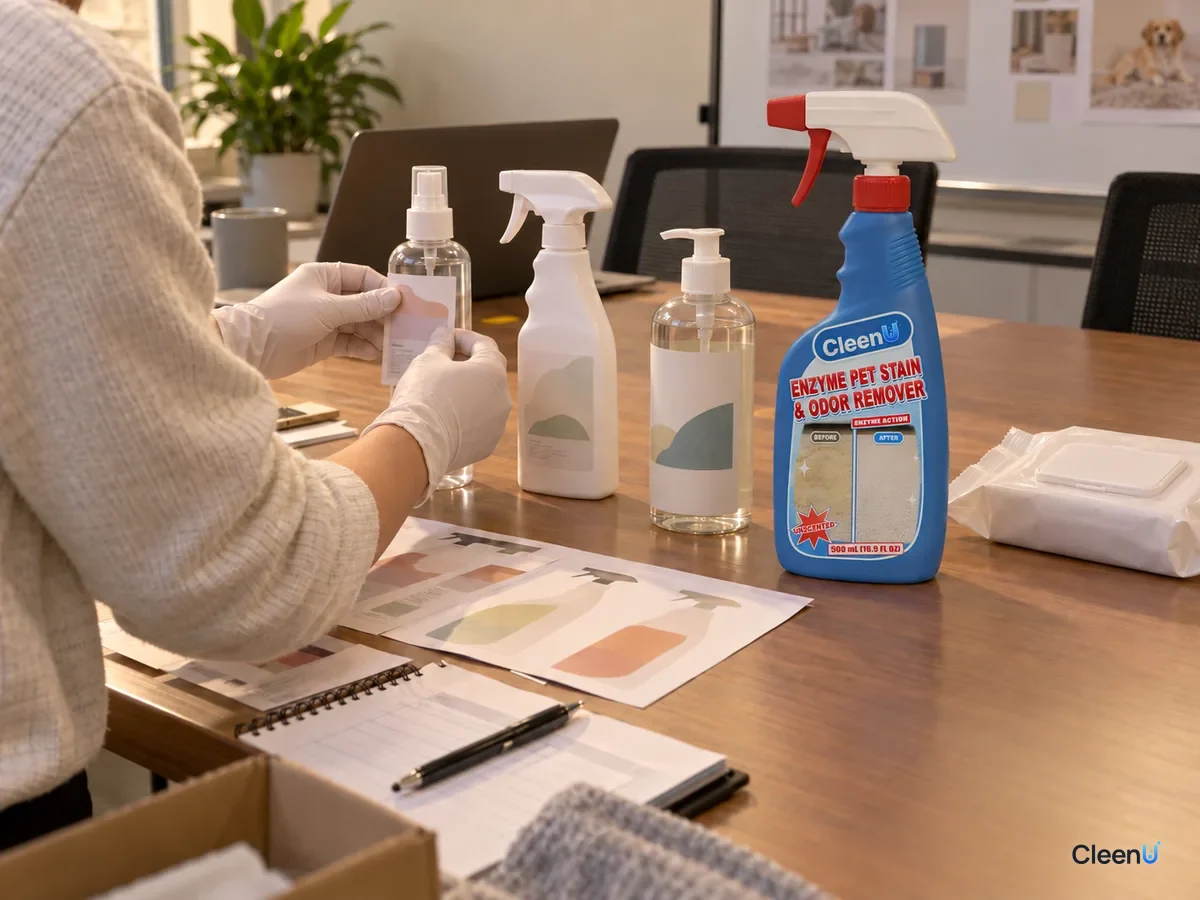
Pairing with a pet-home robot mop solution
Floors are where pet cleaning products and robot mops naturally meet. The CleenU pet-home robot mop solution comes in a 33.8 fl oz (1 L) bottle, diluted about 1:50 to 1:100; 2 to 4 teaspoons (10 to 20 mL) per fill is usually enough. Whether a concentrate goes far enough depends on active content divided by the dilution ratio. Many products carry about 2% active surfactant, which leaves about 0.01% in the tank at 1:200 and about 0.004% at 1:500. CleenU carries 15%, so at 1:100 the tank still holds about 0.15%, about 15 times the 1:200 mix and nearly 40 times the 1:500 one. Shoppers who measure to the label get a clean floor, which keeps "didn't work, had to pour more" reviews down. It has been compatibility-tested on most models from Roborock, iRobot (Roomba Combo and Braava), Ecovacs Deebot, Dreame, Narwal, Xiaomi, Shark, and Eufy, and on wet-dry vacuums such as Tineco and Bissell CrossWave. Add it to the clean water tank or the designated solution compartment per the manual, never the dirty water tank. If your model's manual says otherwise, follow the manual. CleenU is not affiliated with these brands; names are used only to describe compatibility.
The key to pairing is explaining who does what, not bundling for its own sake. The robot mop solution handles everyday floors: paw prints, drool spots, and the dusty film after shedding. Urine and feces accidents shouldn't go under a robot mop, which spreads the mess and drags it into the brush roll. Clean up by hand, treat with an enzyme urine cleaner, let it dry, then resume the robot's schedule; see can a robot mop clean up pet urine. When both product pages point to each other, a customer buying one understands what the other solves. For the difference between pet and regular formulas, see pet-home vs regular robot mop cleaning solution.
Home checks and factory testing for a whole line
Each product gets its own sample testing. A line adds one more question: does the series work when it's all used in the same home?
What your team can check at home. Use the first-round samples in a real pet home for two weeks. Treat an old carpet scrap with the urine sample, then rewet it or warm it with a hair dryer the next day and smell whether odor returns. Mist the litter box product as directed and check whether the litter clumps or the cat avoids the box. Scrub and rinse a bowl with the bowl cleaner, run a finger along the wall for slickness, and smell for residue. Wipe a dog's paws and check whether the fur feels sticky. After the robot mop runs, walk the dry floor in socks and check for tackiness. If a pet avoids an area, licks constantly, or shows red skin, stop using the product and see a veterinarian.
Factory testing at the series level. A pet line usually needs the checks below, listed as methods and pass criteria, not results. CleenU can arrange the stability, preservative challenge, material, and packaging checks for your project:
Series-level checks for a pet cleaning line
- Every SKU: appearance, pH, odor, and viscosity against the approved sample, plus stability comparisons for enzyme products
- Preservative challenge: spray bottles pumped again and again after opening, and high-water-content wipes opened repeatedly, each need their own validation
- Wipes: liquid-to-fabric ratio and release, pack seal and moisture loss, and compatibility between the nonwoven and the lotion
- Material compatibility: white-cloth colorfastness rubs, wipe tests on plastic litter boxes and crates, and foam and residue checks for the robot mop solution
- Packaging: output and spray pattern for each sprayer, inner seal, drop and leak tests
- Series claims: line-by-line review of every label and listing for germ, non-toxic, and pet-safe language
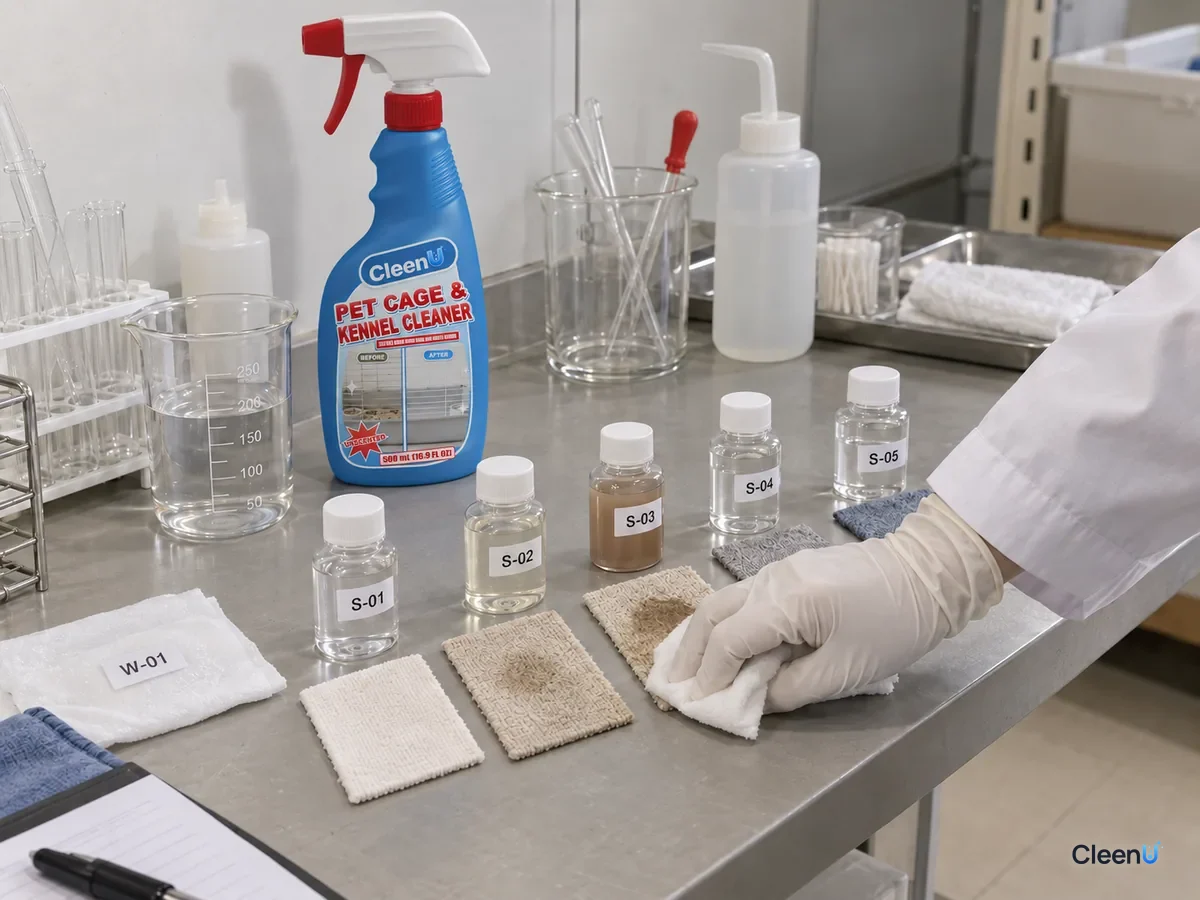
Pacing MOQ and samples
MOQ and lead time
The MOQ for private label and OEM is 500 bottles per SKU; for pet wipes, MOQ depends on pack size and format. Free samples take about 3 days, and production takes about 7 calendar days after packaging and labels are approved. Final terms come with a formal quote.
MOQ is per SKU, so the number of first-launch products sets your cash outlay: three SKUs means three 500-bottle minimums, three labels, three listings, and three photo sets. That's another reason to start small. Not every SKU needs a new formula, either. Products that keep an existing formula and change only branding and label sample fast with little risk. A SKU that needs a new formula base gets its own development timeline and testing so it doesn't hold up the rest of the series.
Every batch passes five quality checkpoints: incoming materials, weighing verification before batching, in-process check before filling, first-piece and patrol checks during filling, and finished-goods inspection. Batch codes trace back to raw-material lots and production records, so if one SKU draws a complaint, it can be traced to that SKU and batch.
The line launched but isn't selling: likely causes
Roughly from most to least likely:
- Too many SKUs, too little focus. Every listing, photo set, and ad budget is thin, and nothing breaks through. Cut back to two or three and do them well.
- The biggest but most crowded direction, with no repurchase product. New customers cost a lot and leave after one bottle. Add a high-frequency consumable.
- The series doesn't look like a series. Different bottles, colors, and labels mean little cross-selling. Unify the design and cross-link product pages.
- Unclear directions lead to "didn't work" reviews: a urine product that doesn't say saturate and wait, a litter box spray that doesn't say mist lightly. Put key directions on the front label and main image.
- A claim crossed the line. One "kills germs" can pull the whole store into review. Keep claims uniform across the line.
- The pet's problem is medical or behavioral. Repeated accidents, frequent vomiting, or red, irritated skin call for a veterinarian; cleaners only handle the aftermath. Saying so on the listing heads off unfair reviews.
Costs and trade-offs: when to add a SKU and when to wait
- Add: one first-round product has steady reviews and clear repurchase, and customer questions keep raising another scenario, like urine cleaner buyers asking how to fix litter box odor.
- Wait: nothing in round one has worked yet, but the plan already includes SKUs four and five. Each one is another 500-bottle minimum, label, and listing.
- Be careful: wipes and bowl cleaners need more compliance and validation work, so they're better once your team knows the claim boundaries, not as the first product.
- Skip: a product added to look complete, with no demand evidence and no clear difference.
Pause and adjust if any of these apply
The first-round plan has more than four SKUs, or the only demand evidence is "it feels like people want it"; any label or listing in the series says kills germs, antibacterial, non-toxic, pet safe, food-safe, or no rinse; wipes copy mentions treating or preventing skin conditions or fighting infection; the robot mop formula makes compatibility claims without "most models" or suggests running the robot over urine or feces; or scent, label layout, and direction wording aren't unified across the line. Go back to product selection and claim review before sampling and printing.
How existing formulas fit together into a line
Mapped onto formulas, the directions already covered in the CleenU pet range are Enzyme Pet Stain & Odor Remover, Pet Odor Eliminator, Mattress Stain & Odor Cleaner, Litter Box Odor Eliminator, Pet Cage & Kennel Cleaner, Pet Cleaning Wipes, Pet Bowl Cleaner, and Robot Mop Cleaning Solution for pet homes. By the mechanisms described above, they fall into three groups: products that go after the urine source (the enzyme stain remover and the mattress spray); products that mainly trap and capture odor (the odor eliminator and litter box deodorizer); and products that rely on mild surfactants plus wiping or rinsing to carry residue away (bowls, wipes, crates, and floors). Pick at most one product per group for the first round, so no two SKUs work the same way and compete for the same searches; add from another group later.
Questions brands ask about building a pet cleaning line
What is the MOQ for private label pet products?
CleenU's MOQ is 500 bottles per SKU for private label and OEM; pet wipes depend on pack size and format. Free samples take about 3 days, and production takes about 7 calendar days after packaging and labels are approved.
How many SKUs should a pet cleaning line launch with?
Two or three is usually steadier: one to capture search demand and one or two to drive repurchase. More SKUs spread the MOQ, label, listing, and ad budget thinner.
Can pet wipes and sprays be private labeled together?
Yes, in the same series, but wipes need their own preservative, liquid-to-fabric, and pack-seal validation, can't make treatment or disease-prevention claims, and have an MOQ set by pack size and format.
Can one pet cleaner cover every scenario?
No, we don't recommend an all-in-one. Urine needs saturation and dwell time, litter boxes need a light mist, and bowls need easy rinsing; merging them weakens each use.
Where do I find demand data?
For the U.S., use estimated monthly searches from a keyword tool; for China, Baidu autocomplete and in-platform suggestions; then add review counts and Q&A. Use estimates to rank priorities, not to forecast sales.
How do I judge repurchase without sales data?
Work it out from the directions. Litter box deodorizer is used after every scoop, bowl cleaner daily, wipes after every walk, and urine cleaner only when accidents happen.
Should every product in the line be fragrance-free?
Urine, litter box, crate, bowl, and wipes products work best fragrance-free. If you want one scented product, give it the room-freshening slot and explain that scent and odor removal are different jobs.
Can a pet bowl cleaner be called food-grade?
You can say it uses food-grade raw materials, such as a food-grade alkyl polyglucoside, but not food-safe or no rinse. Bowls still get rinsed under running water before use.
Can a kennel cleaner claim to disinfect?
No. CleenU Pet Cage & Kennel Cleaner is a cleaner and doesn't replace disinfection a veterinarian recommends; in the U.S., disinfecting claims require EPA registration.
Which robots does the pet-home robot mop solution work with?
It has been compatibility-tested on most models from Roborock, iRobot, Ecovacs, Dreame, Narwal, Xiaomi, Shark, and Eufy, plus Tineco and Bissell wet-dry vacuums. Add it as the manual directs.
Does every first-round SKU need a new formula?
No. SKUs that keep an existing formula and change only branding sample fast with little risk; a SKU that needs a new formula base gets its own timeline.
When is the right time to add a second round?
When one first-round product has steady reviews and repurchase, and customer questions keep pointing to another scenario.
Build a pet cleaning line by splitting needs into seven scenarios: urine, room odor, litter box, crates, bowls, body cleanup, and floors. Each needs a different mechanism, so one bottle for everything weakens every use. Score first-launch candidates on demand, repurchase frequency, room to differentiate, and compliance difficulty, weight them by channel, and record the evidence behind each score. Most brands do best with two or three SKUs: one to capture search, one or two to drive repurchase. Unify scent, label layout, and claim wording from day one, with fragrance-free as the baseline and claims limited to cleaning, stain removal, odor removal, and specific "free of" statements. Let a pet-home robot mop solution handle everyday floors while a urine cleaner handles accidents. CleenU can start from the existing CleenU pet line, with a 500-bottle MOQ per SKU, free samples in about 3 days, and production in about 7 calendar days after packaging and labels are approved.
Once your channel, market, and two or three candidates are set, start with a free urine-product sample (about 3 days; MOQ 500 bottles per SKU; production about 7 calendar days after packaging and labels are approved). Take a look at our Enzyme Pet Stain & Odor Remover.
Sources
- DataForSEO keyword estimates, U.S. monthly search volume (September 2026)
- EPA, "Determining If a Cleaning Product Is a Pesticide Under FIFRA" (accessed Oct 2026)
- FDA, CPG Sec. 653.100 "Animal Grooming Aids" (accessed Oct 2026)