
OEM/ODM
Why Private-Label Robot Mop Cleaning Solution Samples Keep Failing on Foam and Residue
Direct answer
Samples usually go back and forth because the target machines, sales channel and dilution ratio weren't locked at the start, so nobody shares a pass/fail standard for foam and residue. Set those first, then the low-foam formula, ratio, scent and packaging, and test every sample on the target machines the same way.
Private-label robot mop cleaning solution, from brief to production
-
Brief
Confirm your target market and channel (Amazon, Shopify, TikTok Shop, retail, robot brand accessories), the robot mop and floor washer brands and models you most want to support, your target users (general households or pet homes), and the ratio and pack size you have in mind. CleenU works with you to turn this into a short brief that every sample is judged against.
-
Formula and samples
Starting from our proven neutral, low-foam formula, we adjust scent, odor control and strength to your brief. Free samples ship in 3–5 days, with a suggested dilution ratio and test method so you can test on your own machines under the same conditions.
3–5 days
-
Machine testing
Test on your target models at the label ratio: foam height in the dirty tank and whether it triggers a false full alert, how the floor feels and looks after several consecutive days, and whether outlet holes and auto-dosing compartments stay clear. When both sides use the same method and record sheet, results are comparable.
-
Packaging and label approval
Confirm the bottle, size, measuring cap, label copy and shipping carton. The ratio, compatible devices and exclusions on the label should match the test conditions so shoppers don't dose it wrong.
-
Production and delivery
Once packaging and labels are approved, bulk production is scheduled when the order is confirmed. Final timing follows the formal quote and order confirmation.
Scheduled with the order
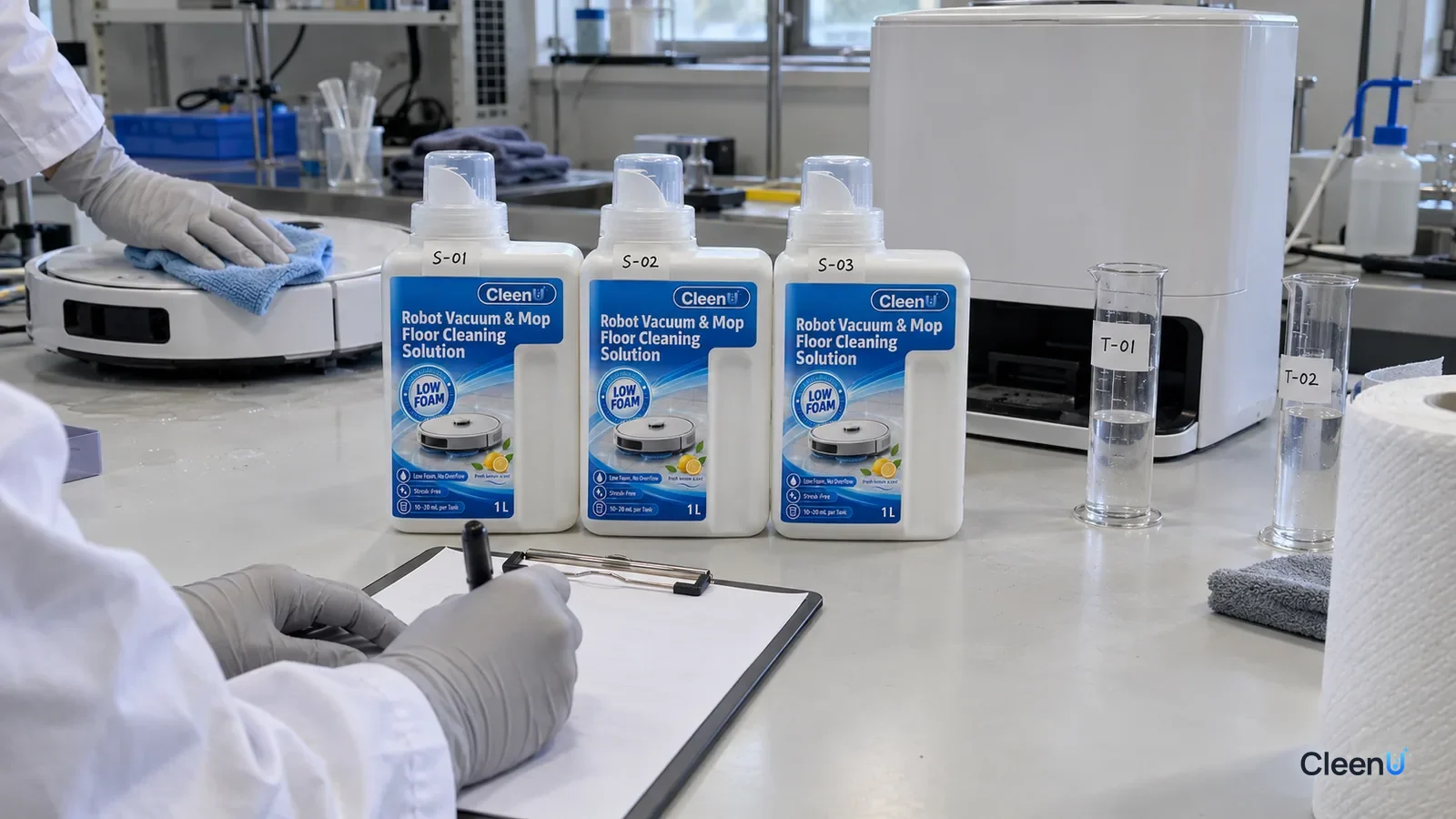
Robot mop cleaning solution is one of the faster-growing household cleaning categories. Robot mops and cordless floor washers keep spreading, and brands selling on Amazon, Shopify and TikTok Shop, retailers, and robot makers' accessory lines are all looking for the right solution. Brands new to the category often hit the same wall: sample after sample comes back with "still too much foam" or "the floor feels a little tacky," and by round three or four nothing is final.
The formula usually isn't the problem. The problem is that a few deciding conditions weren't pinned down when the project started. Unlike a general floor cleaner, a robot mop solution can only be judged in a specific machine, at a specific dose, on a specific floor. This article explains, from the manufacturer's side, why samples keep bouncing and how to get each round closer to final.
Why do robot mop solution samples bounce so often?
With a general floor cleaner, people use a mop and bucket. A little more or less foam barely matters, and they can always rinse. A robot mop solution works under much tighter conditions.
Foam has to be close to nonexistent inside the machine. Self-cleaning docks wash pads with high-speed spinning and scraping, pump the dirty water into a waste tank, and often sense the water level with two metal contacts. Foam holds water and conducts electricity, so when it reaches the contacts the dock reports a full tank. A formula that barely foams when you shake it in a beaker can fill half a dirty tank in a dock.
Residue has to be low enough to stack up daily without getting tacky. A robot mops the same floor every day and never rinses, so residue accumulates. One run looks fine; a week later the floor is tacky or slick. That delayed problem is the most common surprise in sample testing.
The liquid has to flow through tiny lines. Outlet holes and auto-dosing compartments have narrow passages, and anything too thick, with particles or with wax, can coat, dry and clog.
Machines vary a lot. Tank size, water delivery, how hard the dock scrubs the pads, and whether there's auto-dosing all differ by brand and model. A sample that performs well in one robot can foam noticeably in another.
So repeated revisions usually mean there's no shared standard. The brand tests on the robot it happens to own at the dose it's used to, the factory tests with its lab method, and "too much foam" or "some residue" means different things on each side.
How does a formula balance foam and residue?
Most robot mop solutions are built around low-foam nonionic surfactants. Their water-loving end carries no charge, so they aren't sensitive to water hardness. Choosing low-foam types such as low-ethoxylate alcohol ethoxylates or EO/PO block copolymers, and pairing them with a defoamer, balances cleaning power against foam.
A few common trade-offs:
Cleaning power vs foam. High-foam anionic surfactants cut grease fast and cost little, but foam is exactly what robot mops can't tolerate. Low-foam systems need more careful blending to hold cleaning power at the same concentration.
Type of defoamer. Silicone defoamers work very efficiently, but silicone left on floors can add slip and affect sheen. Non-silicone defoamers are kinder to floors; their strength and staying power have to be tuned through the blend.
Concentration and solids. A concentrate diluted at 1:50 to 1:100 is very dilute in use, and the better its solids content is controlled, the less residue stacks up day to day. The more concentrated the formula, the more the ratio matters, and the ratio on the label has to match the ratio used in testing.
Fragrance and odor control. Fragrance needs solubilizers to stay dissolved in water, and the stronger the scent, the more solubilizer, which affects both residue and foam. Pet-home versions often add cyclodextrin-based odor control, which also has to go through foam and residue testing.
There's no single right answer to these trade-offs. It depends on who you're selling to, which machines they own and what ratio you plan to print on the label. Settle those, and the formula has a clear direction.
From brief to production in five steps
Five ways to cut down on sample rounds
Set a short list of target machines. Name the three to five brands and models you most want to support, including at least one with an auto-dosing compartment. Concentrate testing there and the results mean more.
Set the ratio before you argue about foam. The same formula foams and leaves residue very differently at 1:50 and 1:100. Decide the ratio you'll print, and run every test at that ratio.
Use one test method. Agree on what to measure, how and what counts as a pass: foam height in the dirty tank, whether a false full alert triggers, how the floor feels and looks after several days, and whether outlet holes clog. If each side tests its own way, the conclusions won't line up.
Change one variable at a time. Adjust scent, odor control and strength all at once, and you can't tell which caused a problem. Change one or two things per round and you'll finalize faster.
Build delayed problems into the test window. Residue buildup and coating in the lines don't show up in a single run. Watch the same floor and machine over several consecutive days.
What you can customize
MOQ and lead time
MOQ starts at 500 bottles. Free samples ship in 3–5 days. After packaging and labels are approved, bulk orders are scheduled when the order is confirmed. Final pricing, MOQ and lead time follow the formal quote and order confirmation. SDS and other documents are provided per project after inquiry.
CleenU robot mop cleaning solution: base specifications
- Type
- Neutral, low-foam concentrated robot mop cleaning solution
- pH
- 6.5 to 7.5 (25°C)
- Formula
- Low-foam nonionic surfactants with defoamer; no particles, no wax, no chlorine
- Dilution
- About 1:50 to 1:100; 10 to 20 mL per fill is usually enough
- Floors
- Tile, vinyl plank, laminate, sealed hardwood
- Not for
- Machines whose manual prohibits additives; unsealed or waxed wood; carpet
- Default pack
- 1 L concentrate with measuring cap
- Shelf life
- 24 months unopened
How to write compatibility claims without creating problems
Robot mop solution listings and labels usually need to say which machines the product works with. That's where trouble starts.
Don't make an unqualified "universal fit" claim. Machines differ in design and manual requirements. Some prohibit additives, and some limit you to the maker's own solution during the warranty.
State the brands you've tested or confirmed, qualified with "most models" and "follow your manual." CleenU Robot Vacuum Cleaning Solution, for example, works in most robot mops from Roborock, iRobot (Roomba Combo and Braava), Ecovacs Deebot, Dreame and Narwal, and in floor washers such as Tineco, added to the clean water tank or the dock's designated detergent compartment as the manual directs. CleenU isn't affiliated with these brands; the names only indicate compatibility.
Say where it goes and how much. It goes in the clean water tank or the designated compartment, never the dirty tank, at about 1:50 to 1:100, usually 10 to 20 mL per fill.
List where it doesn't belong: machines whose manual prohibits additives, mixing with other cleaners or disinfectants, overdosing, unsealed or waxed wood, and carpet.
Clear instructions mean shoppers use it right and customer service tickets drop. For the consumer side of the decision, see brand-name vs universal robot vacuum cleaning solution, and for why foam trips dock sensors, see a "dirty tank full" alert when the tank isn't full.
This article is part of the Robot Vacuum Cleaning Solution & Maintenance Guide, which covers the full maintenance schedule and links to every troubleshooting guide.
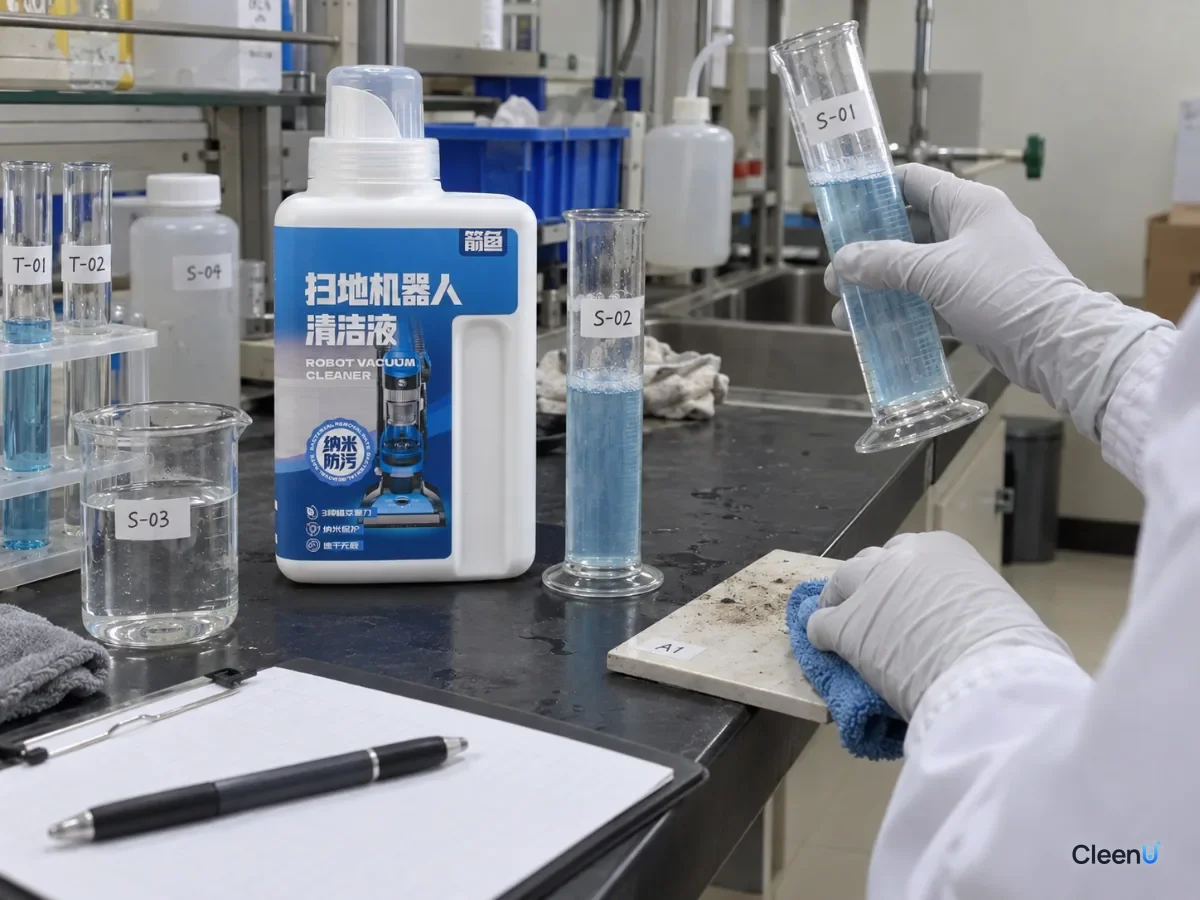
What brands ask about private-label robot mop cleaning solution
How many sample rounds does it usually take?
When the brief and test method are set up front, one or two rounds is typical. Projects that bounce more usually changed target machines, ratio or pass/fail criteria midway.
Can you make a fragrance-free robot mop solution?
Yes. Choose lemon, light lemon, fragrance-free or another scent. After a change, we recommend re-running foam and residue checks.
Can our label claim a universal fit?
We don't recommend it. List the confirmed brands with "most models, follow your manual," and state the exclusions to avoid misuse and returns.
What are the MOQ and lead time?
MOQ starts at 500 bottles, free samples take 3–5 days, and bulk orders are scheduled after packaging and labels are approved, subject to the formal quote and order confirmation.
How is the pet-home version different?
It adds cyclodextrin-based odor control to the neutral, low-foam base, with no added fragrance, aimed at paw prints, drool marks and pet odor. pH and dilution ratio are the same.
What should we include in an inquiry?
Your target market and channel, the main machines to support, the pack size and ratio you want, scent preference and an estimated first-order quantity.
What dilution ratio should a private-label robot mop solution use?
Set it by the target robots and floors, not by the highest ratio a competitor prints. Higher dilution lowers cost per fill but leaves less cleaning margin. Our finished formula runs at about 1:50 to 1:100, 10 to 20 mL per fill; sample at your chosen ratio and check foam, residue, and flow on the actual robots.
Which surfactants keep a robot mop solution low-foam?
Nonionic surfactants paired with a defoamer are the usual base, because they clean at a neutral pH without building much foam in a small tank. Our robot mop formula uses that approach at pH 6.5–7.5. The exact blend is tuned during sampling against your target robots and floor types.
To build your own brand of robot mop solution quickly on a proven neutral, low-foam formula, start with the CleenU Robot Vacuum Cleaning Solution.
When private-label robot mop cleaning solution samples keep bouncing on foam and residue, the cause is usually that target machines, dilution ratio and test method weren't aligned at the start. Lock the channel and machines first, then the ratio, formula version, scent and packaging. Test every sample on the target machines the same way, change one or two variables per round, and include several days of residue observation. CleenU offers a proven neutral, low-foam formula, free samples in 3–5 days and bulk production scheduled when the order is confirmed. Send us your target market, machines, pack size and estimated quantity, and we'll start on the first sample.