
How-to
Robot Mopping Tile and Luxury Vinyl Plank: Settings That Matter
Direct answer
Tile can handle a medium water setting; the goal is keeping water out of the grout and avoiding white spots. Vinyl plank (LVP, SPC) has a waterproof surface, but its seams shouldn't stay damp, so use medium-low water and a low-residue, neutral solution. Skip wax and shine products on both.
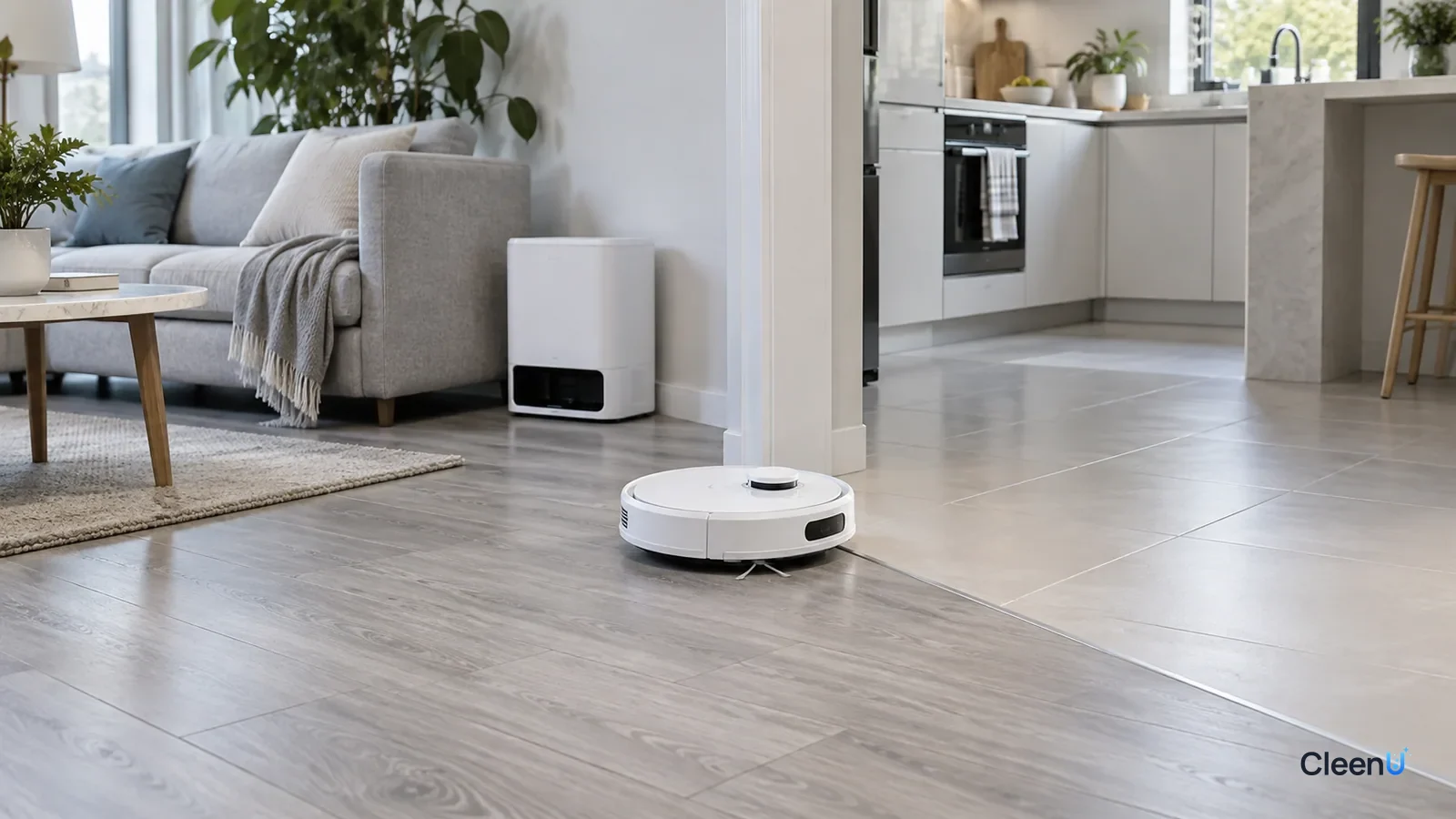
Tile and luxury vinyl plank are the two "easy care" floors you'll find in most homes today. They handle water, resist wear and don't cost a fortune. Plenty of homes have vinyl plank or wood-look tile in the living areas and ceramic or porcelain tile in the kitchen, bathroom and laundry room, so one robot run covers several surfaces.
They really are easier than hardwood, but each has its own quirks. Tile's trouble spots are dark grout, white haze and water spots. Vinyl plank's are seams that stay wet and a surface that turns tacky or slippery. Set the robot up right and a daily pass keeps both looking good. Set it up wrong and the floors get streakier and stickier every week.
How are these floors built differently?
Ceramic and porcelain tile are fired at high temperature from clay, feldspar and quartz. The surface is usually glazed or polished. A glazed surface is dense and absorbs almost nothing, so dirt can't soak in. Grout is another story. Most grout is cement-based and full of tiny pores, which makes it the spot on a tile floor where soil and water collect.
Polished and high-gloss tile shows every footprint and water spot under the lights. Matte and textured tile has a fine surface texture that traps soil, so the pad needs some scrubbing action.
Rigid-core vinyl plank, often sold as SPC, is extruded from stone powder (mostly calcium carbonate) and PVC. A printed wood or stone film goes on top, then a clear wear layer, often with a UV-cured coating. Flexible luxury vinyl (LVT/LVP) is a similar PVC product that's softer underfoot. Both are waterproof through the plank, but they click together, and the seams still have hairline gaps.
So the weak points sit in different places: grout for tile, seams and surface coating for vinyl plank.
Why does the same robot perform differently on tile and vinyl?
One useful way to describe how liquid spreads on a floor is the contact angle, the angle a water droplet's edge makes with the surface. A low contact angle means water spreads into a thin, even film. A high one means it pulls up into beads.
Glazed tile is fairly water-friendly, so plain water spreads out and the floor tends to dry evenly. The grout is the exception: it's porous cement, so it soaks water in and dries last.
The wear layer and UV coating on vinyl plank are polymers that lean water-repellent. Plain water sits at a higher contact angle, breaking into tiny beads and lines that dry into dotted or streaky water marks. Surfactants in a cleaning solution lower that contact angle so the water spreads into an even film. That's why a small dose of solution often makes vinyl plank dry more evenly with fewer marks.
The same logic cuts the other way: extra surfactant leaves a film that shows most on smooth coatings. So on vinyl, the rule is a little solution and controlled water. On tile, the focus is grout pooling and minerals in the water.
Set up the robot room by room
Living room vinyl, kitchen tile and the bathroom doorway, set up separately
Living room vinyl plank
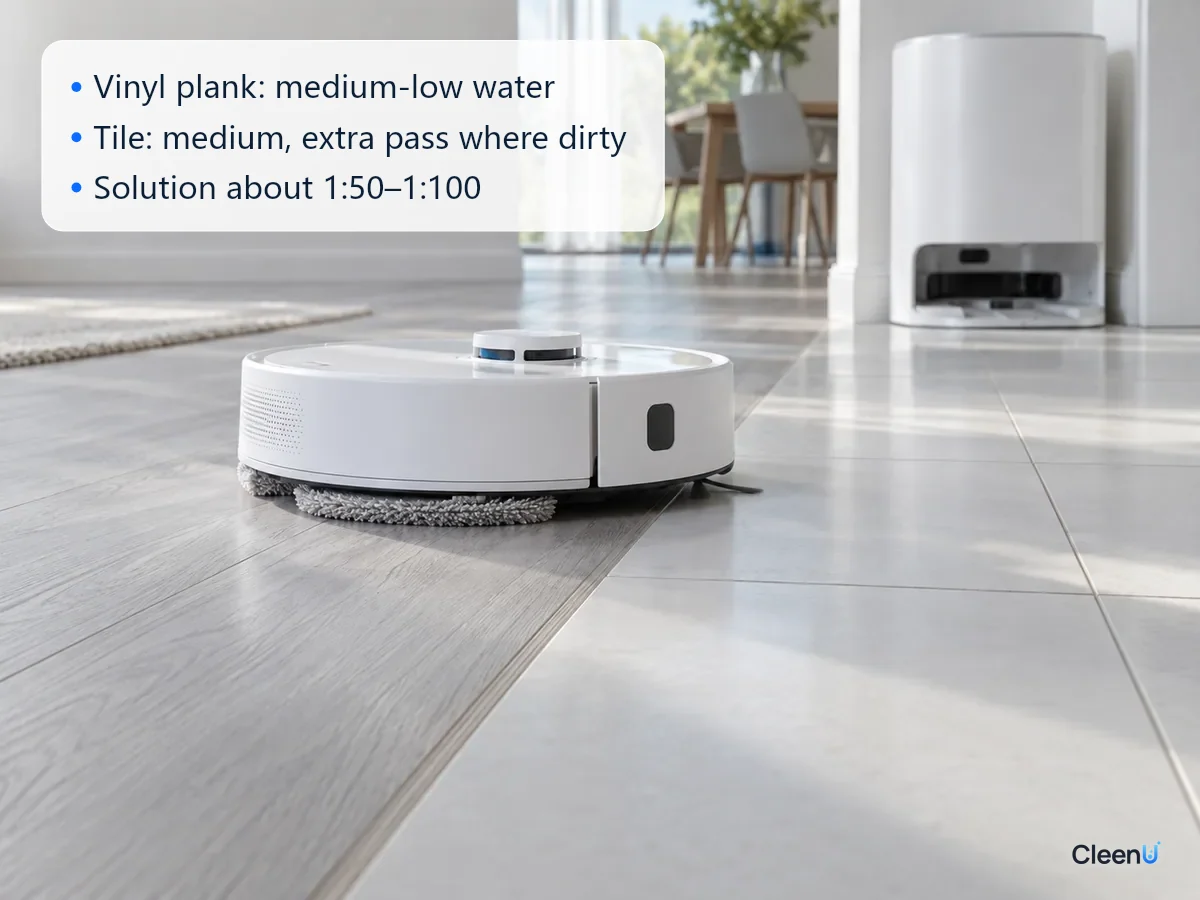
Set water flow to medium-low
The plank surface won't absorb water, but the seams shouldn't stay damp. On medium-low, the floor should dry within a minute or two with no water line along the seams.
Caution:Rooms with radiant heat dry fast enough for medium. In humid weather, go one step lower.
Use a neutral, low-residue, wax-free solution
The wear layer and UV coating are very smooth, so extra solution leaves the floor tacky, slippery or streaky. CleenU Robot Vacuum Cleaning Solution dilutes at about 1:50 to 1:100; 10 to 20 mL per fill is usually enough. Less is better than more.
Kitchen tile
Use medium water and add a pass where it's dirty
Tile doesn't mind water, and kitchens collect greasy footprints. Medium flow works. Mark the areas in front of the stove, fridge and sink as spots for an extra pass instead of turning up water for the whole house.
Caution:Wipe up big grease spills and food splatters by hand before the robot runs.
Brush the grout by hand now and then
A robot pad can't press into grout lines, so buildup there doesn't come out with robot mopping alone. Every week or two, brush the grout with a soft brush and diluted solution, then let the robot mop it dry.
Bathroom and patio doorways
Make wet zones no-mop areas or handle them separately
Bathroom and patio doorways collect puddles, hair and grit that a robot will carry into other rooms. Set them as no-mop zones and clean them by hand first, or have the robot mop them last and wash the pads afterward.
Whole house
Check for white haze and streaks afterward
After the first few runs, look at the tile and plank in side light. White haze usually means minerals in the water or too much solution. Streaks usually mean dirty pads or too much solution. Use the checks below to adjust.
Why does vinyl plank get tacky or slippery?
The wear layer and UV coating on vinyl plank form a very smooth polymer film with almost no pores. The smoother and less absorbent a surface is, the more completely any cleaner residue stays sitting on top of it.
When the water evaporates, surfactants and other non-volatile ingredients stay on the floor. At the right dose, that film is so thin you can't feel it. Overdose and it thickens, and one of two things happens. It turns tacky, pulling moisture from the air and grabbing dust and pet hair. Or it turns slippery, forming a lubricating layer between your socks and the floor that lowers friction.
That's why wax and shine products are a bad fit for vinyl plank. Wax doesn't come off easily with the next mopping on such a smooth surface, so it builds up layer by layer: shiny at first, then tacky, dull and slick. If your floor keeps getting more slippery, see why floors get slippery after robot mopping.
Why does tile end up with white spots?
White haze or spots on tile after mopping usually have one of two causes.
Minerals in the water. Tap water carries dissolved calcium and magnesium. As it evaporates, those minerals stay behind as carbonate deposits, which show up as white spots. They're most obvious in hard-water areas and on dark polished tile.
Too much solution. At high concentration, the residue left after the water evaporates shows up as haze on glossy tile.
To tell them apart, wipe a spot with a damp cloth and a little white vinegar. If it comes off and stays off, it's mineral scale. If plain water removes it but it comes back after the next run, it's excess solution. For more on hard-water spots, see white spots after robot mopping.
Use vinegar only for hand-wiping spots on the tile surface. Never put it in the robot's tank, and keep it off cement grout and natural stone.
What to look for after mopping
Check these after a run
- Water lines or dark edges along the vinyl plank seams
- White haze or streaks on glossy tile or plank in side light
- Tackiness or slipperiness when you walk barefoot
- Grout that looks darker than it did last week
- A lot of foam in the dirty water tank
Water lines on plank seams mean the water level should drop one step. A tacky or slippery floor means you should cut the solution and run a water-only pass or two. White spots on tile mean you should figure out whether it's scale or residue. Darker grout means it's time to brush it by hand. Lots of foam in the dirty tank means you should check for a high-foam product or an overdose.
What to look for in a solution for tile and vinyl
Low foam, because the robot and dock churn the mix and high-foam products can trigger false "tank full" alerts.
Neutral or near-neutral pH, because strong alkaline cleaners can dull some vinyl coatings and age cement grout faster, and strong acids eat into grout and aren't kind to some glazes.
No wax or shine enhancers, so nothing builds up on smooth surfaces.
Low residue, because a robot won't follow up with a rinse pass.
CleenU Robot Vacuum Cleaning Solution is a neutral, low-foam concentrate at pH 6.5 to 7.5, made with low-foam nonionic surfactants and a defoamer, with no wax, no chlorine and no particles. It's made for tile, vinyl plank, laminate and sealed hardwood. It works in most robot mops from Roborock, iRobot (Roomba Combo and Braava), Ecovacs Deebot, Dreame and Narwal, and in floor washers such as Tineco. Add it to the clean water tank or the dock's designated detergent compartment as your manual directs. CleenU isn't affiliated with these brands; the names only indicate compatibility.
Natural stone, textured tile and flexible vinyl
Marble and terrazzo are mostly calcium carbonate, which acids etch and long-term moisture doesn't help. A robot can mop them on low water with a neutral solution. Never use vinegar or citric acid products on them.
Textured and matte tile traps soil in its surface. Medium water works, with extra passes on dirty areas. Keep pads clean; a dirty pad presses soil deeper into the texture.
Flexible vinyl (LVT/LVP) is softer than rigid-core plank and scratches more easily from grit. Vacuum before mopping and clean the robot's underside and pads regularly so the pad doesn't drag sand across the floor.
For everyday care across floor types, see how to clean every type of floor.
This article is part of the Robot Vacuum Cleaning Solution & Maintenance Guide, which covers the full maintenance schedule and links to every troubleshooting guide.
Common questions about robot mopping tile and vinyl plank
Can a robot mop vinyl plank every day?
Yes. Use medium-low water and a small dose of solution. If the floor dries within a minute or two and the seams show no water lines, you're fine.
Can I run tile on the highest water setting?
Not for the whole house. More water means more pooling in the grout and more visible spots. Medium flow plus an extra pass on dirty areas works better.
My vinyl plank is slippery after mopping. Is the floor the problem?
Usually it's cleaner residue, especially from overdosing or wax-based products. Cut the dose or run a few water-only passes, and it normally goes back to normal.
Can a robot mop clean dark grout?
No. The pad can't reach into the grout lines. Buildup and mildew there need a brush by hand; the robot can keep up with it afterward.
Can I use the same solution on tile and vinyl?
Yes. A neutral, low-foam, wax-free robot mop cleaning solution works on both, so you don't need to switch.
The kitchen tile is greasy. Should I add more solution?
No. More solution means more residue and foam. Wipe up heavy grease by hand and have the robot make an extra pass there.
Can I use a robot mop solution on marble or natural stone?
Only after you confirm the stone is sealed and the product is neutral. Marble and limestone etch with acids, and harsh alkaline cleaners can dull the surface. A neutral robot solution at a low dose is the safer starting point; test a hidden spot and keep the water level low.
Can I put tile cleaner in my robot mop?
Not for routine runs. Tile and grout cleaners tend to be more alkaline or foamier and are made for hand scrubbing, so they can clog outlet holes and leave a slippery film on vinyl plank. Use a neutral, low-foam robot solution and treat dirty grout by hand.
For homes with tile and vinyl plank, if you want one neutral, low-foam, wax-free robot mop solution that won't leave a film on smooth floors, try Robot Vacuum Cleaning Solution.
Tile and vinyl plank are both easy floors, but their weak spots differ: grout and white spots on tile, seams and surface residue on vinyl. Run tile on medium water, add passes where it's dirty and brush the grout now and then. Run vinyl plank on medium-low so it dries within a minute or two. On both, use a neutral, low-foam, wax-free robot mop cleaning solution at the low end of the label. If floors turn tacky, slippery or spotty, cut the dose first, then figure out whether it's scale or residue.