
Q&A
Do You Need to Rinse With Plain Water After Robot Mopping With Cleaning Solution?
Direct answer
Usually not. With a low-residue, neutral robot mop solution used at the label ratio, everyday mopping doesn't need a plain-water rinse. Rinse if you overdosed, the dry floor feels tacky or looks hazy, you used a disinfectant, or a baby crawls or a pet licks there.
Should you rinse? Quick reference
Yes
- Rinse when you overdosed, the dry floor feels tacky or looks hazy, or you just used a disinfectant or another cleaner
No
- No rinse needed for everyday mopping with a low-foam, neutral, low-residue solution at the label ratio that dries clean
It depends
- Baby crawling areas, spots pets lick, and dark polished floors: check after drying, and rinse if you want extra margin
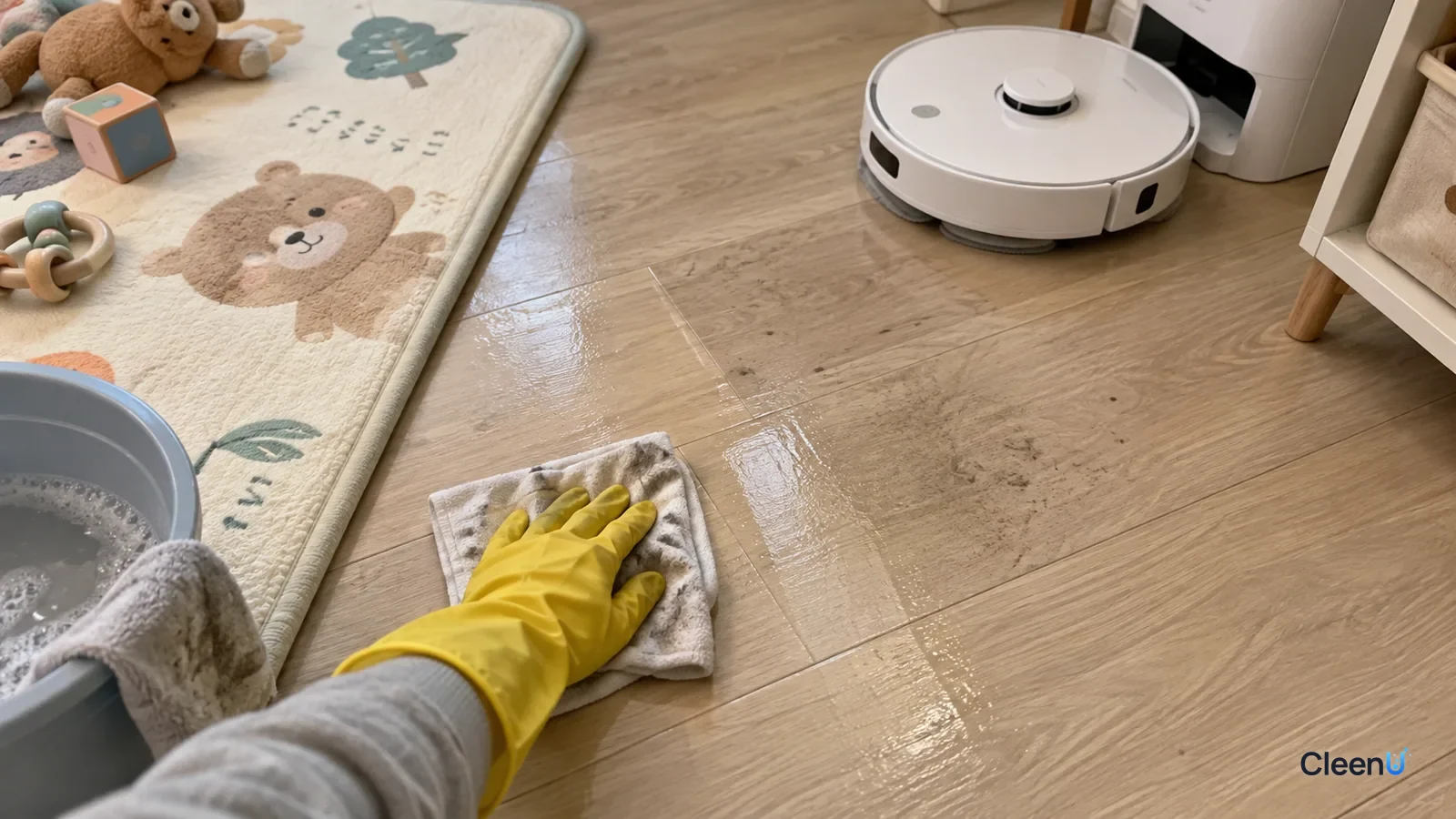
Short answer: if you're using a low-foam, neutral, low-residue robot mop solution and mixing it at the label ratio, you generally don't need a second pass with plain water. These solutions are designed for robot mops, which have no rinse step, so at the right dilution they leave very little behind. The floor dries without feeling tacky or looking hazy.
A plain-water pass is worth it in a few situations. One, you added too much, and the dry floor feels tacky or draggy, or dark and polished floors show a haze. Two, you used a disinfectant or another cleaner on the floor around the same time, so there may be ingredients on it that shouldn't stay. Three, it's an area where a baby crawls and puts hands in their mouth, or where a pet likes to lick the floor. The real question isn't whether you used solution. It's how much stayed on the floor and what it is.
What actually stays on the floor after robot mopping
Robot mopping differs from mopping by hand in one important way. With a mop and bucket, you mop, rinse the mop, and mop again, and rinsing the mop works as a partial rinse of the floor. A robot mop lays down solution, wipes, and leaves a thin film of water that dries by evaporation. The dock washes the mop pad, but nothing rinses the floor.
So what stays behind follows a simple relationship:
How floor residue forms
- The mop leaves a thin film of water on the floor
- That film carries dissolved solution and a little soil the pad didn't pick up
- Water evaporates; anything that doesn't evaporate stays on the floor
- Residue is roughly working-solution strength times how much water film is left
- Double the strength or turn up the water flow, and residue goes up with it
That tells you two things. First, mixing at the label ratio is the most effective way to control residue. CleenU Robot Mop Cleaning Solution dilutes about 1:50 to 1:100, and 10 to 20 mL per fill is usually enough. At that strength the surfactants do their job; adding more barely improves cleaning but adds residue in proportion. Second, water flow matters. A high flow setting leaves a thicker film that dries slowly and leaves more behind. Light wood floors shouldn't get much water anyway, so a lower flow setting helps both the floor and residue.
What does a plain-water pass actually do? It redissolves the residue, dilutes it again, and lets the pad pick up part of it. Each extra water pass dilutes what's left once more. On an overdosed floor, one or two passes make a clear difference. If residue was already minimal, another pass doesn't make the floor "cleaner." It just uses more water and battery.
Why some residue won't come off with one water pass
Not all residue behaves the same. Some wipes away with water; some survives several passes. The difference is how tightly it holds onto the floor.
A few terms that explain residue
- Rinsability
- How easily a dried residue redissolves in water and gets carried away. Easy-rinsing ingredients come back into solution with one water pass.
- Surface adsorption
- Molecules sticking to the floor's surface. The stronger the adsorption, the harder the residue is to rinse off.
- Surface charge
- Many common floor surfaces carry a slight negative charge when wet, so positively charged ingredients get held there as a thin, stubborn film.
- Calcium soap
- An insoluble product formed when some anionic surfactants meet the calcium and magnesium in hard water; it dries as a whitish, draggy layer.
With those in mind, common residues fall into three groups.
Easy-rinsing nonionic surfactant residue. Robot mop solutions commonly use low-foam nonionic surfactants. They carry no charge, hold onto floors weakly, and redissolve easily when wet. Even if you occasionally overdose, one or two water passes usually fix it. That's why everyday use at the label ratio doesn't call for a rinse.
Strongly adsorbed cationic residue. Many disinfecting floor cleaners contain cationic ingredients such as quats. They're positively charged and cling to negatively charged floor surfaces, forming a thin film water has trouble removing. That film can feel draggy or slick, and it's what a baby's hands or a pet's tongue would touch. If you've used one of these products, follow its label for rinsing or wiping. It's also one reason we advise against putting disinfectant in a robot's water tank; see Can you put vinegar, bleach, or disinfectant in a robot mop tank?
Ingredients designed to stay. Floor wax, shine boosters, and film-forming polymers are meant to leave a protective or glossy layer, so water can't remove them. If one ends up in a robot by mistake, floors get stickier and streakier with every run. That calls for the product's own removal instructions or advice from the flooring maker, not more water.
One more case gets misread: hard water leaves its own white marks. Calcium and magnesium stay behind when tap water evaporates, showing as faint white rings on dark floors. Rinsing again with the same hard water can make them more visible, not less. See White marks after robot mopping in hard-water areas.
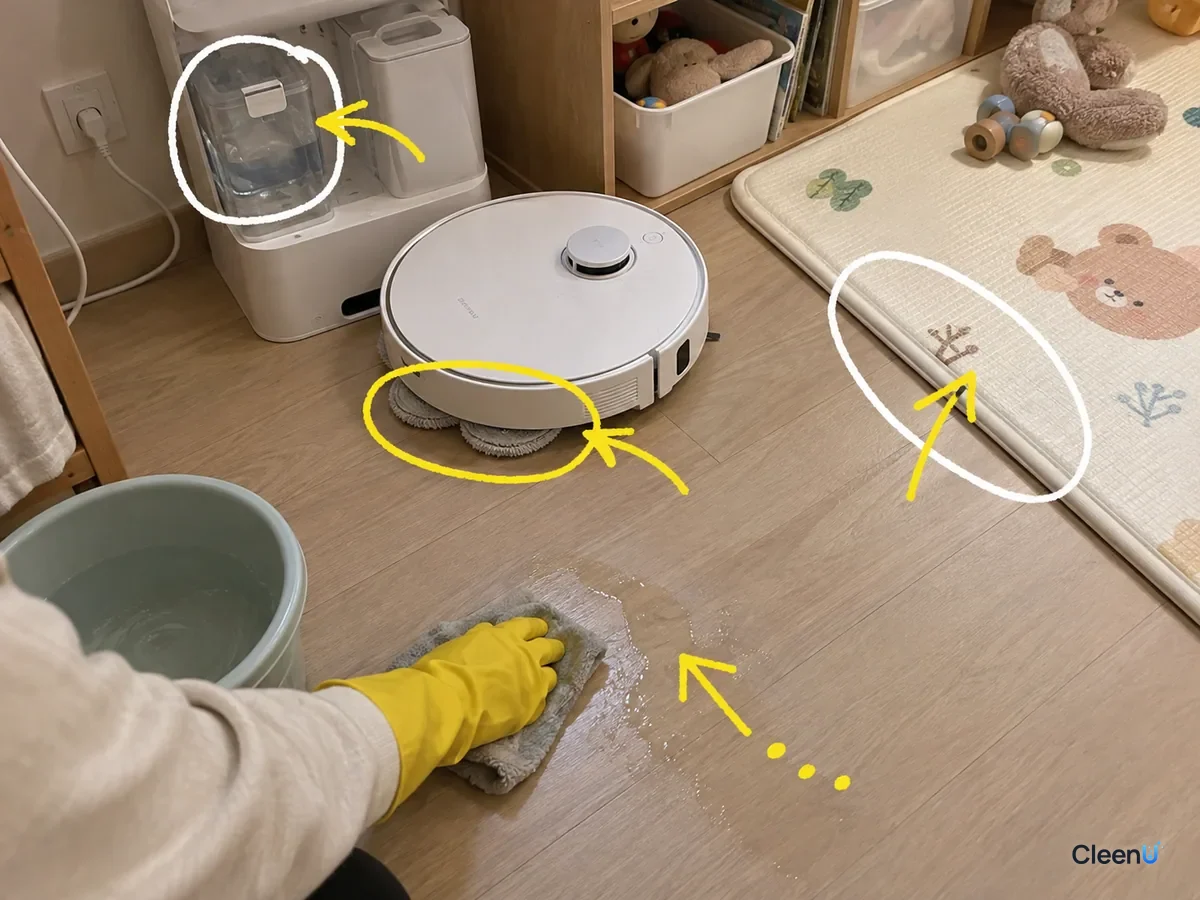
Crawling babies and licking pets: why these spots deserve a rinse
Even at the label ratio with little residue, areas where a baby crawls or a pet licks deserve a second thought. The issue isn't that the solution is harmful. It's how contact happens.
Adults touch the floor with their feet. A crawling baby puts palms and knees flat on it, then puts hands in their mouth. Pets are similar: dogs lick crumbs off the floor and cats lick their paws. In those spots, residue that's already small is worth making smaller for peace of mind.
You have two good options:
- Dose at the low end. A nursery or a baby's play corner usually gets light dust. Mix at about 1:100, set water flow to low or medium, and run the palm, side-light, and sock checks once it's dry.
- Solution, then a water pass. When there's more food residue or grease, or you've just cleaned up a spill, mop with solution first and follow with plain water.
Either way, wait until the floor is completely dry before the baby crawls or the pet comes back. Light wood dries fairly fast at a low flow setting, faster with a window open or the AC running, and slower on humid days or in winter with windows shut.
The play mat itself is separate. Mats vary, so clean yours by its own instructions. Before the robot mops, pick the mat up or block it off with a no-go zone in the app, so the pad doesn't push water under the edges. Wood that stays under a damp mat can discolor or cup. For more, see Robot mopping with a crawling baby and My dog licks the floor. What should I do after robot mopping?
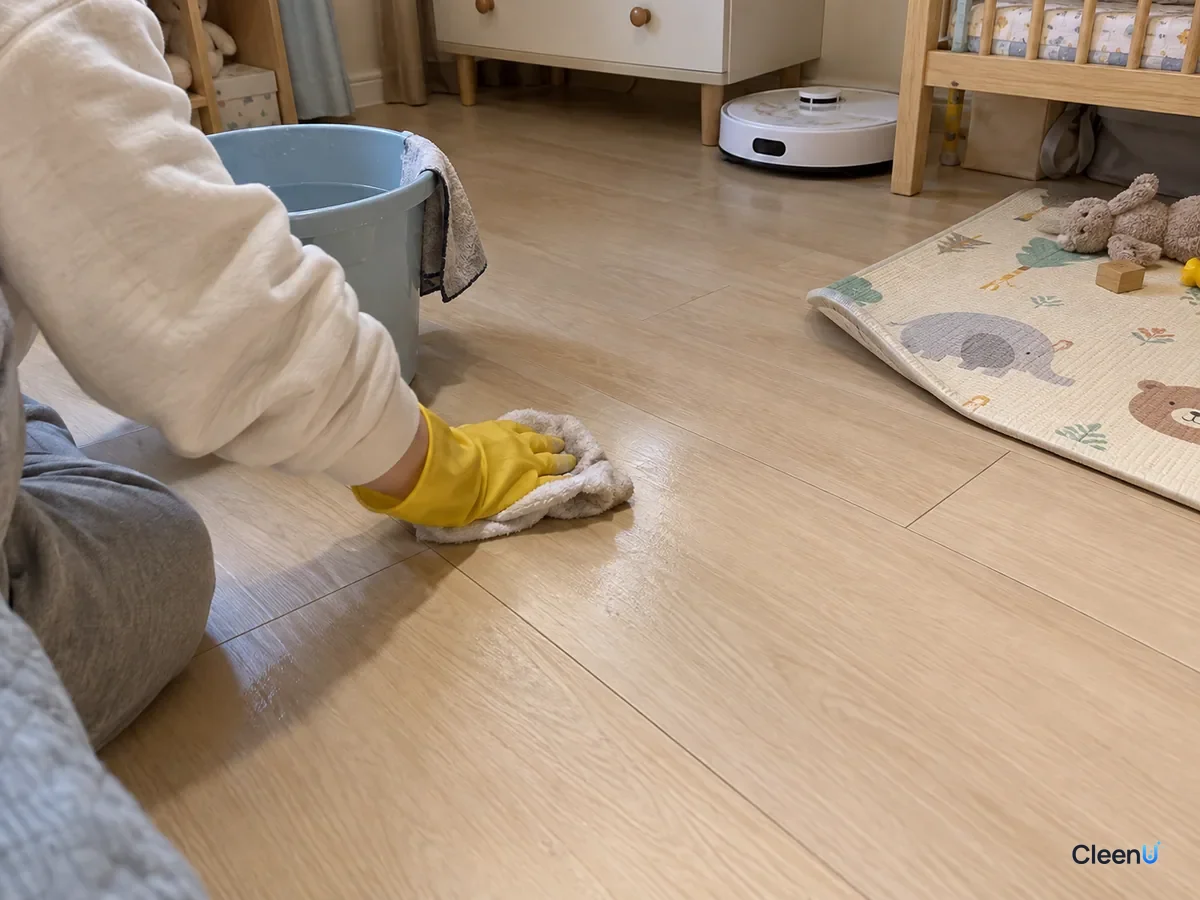
How to run a plain-water pass with your robot
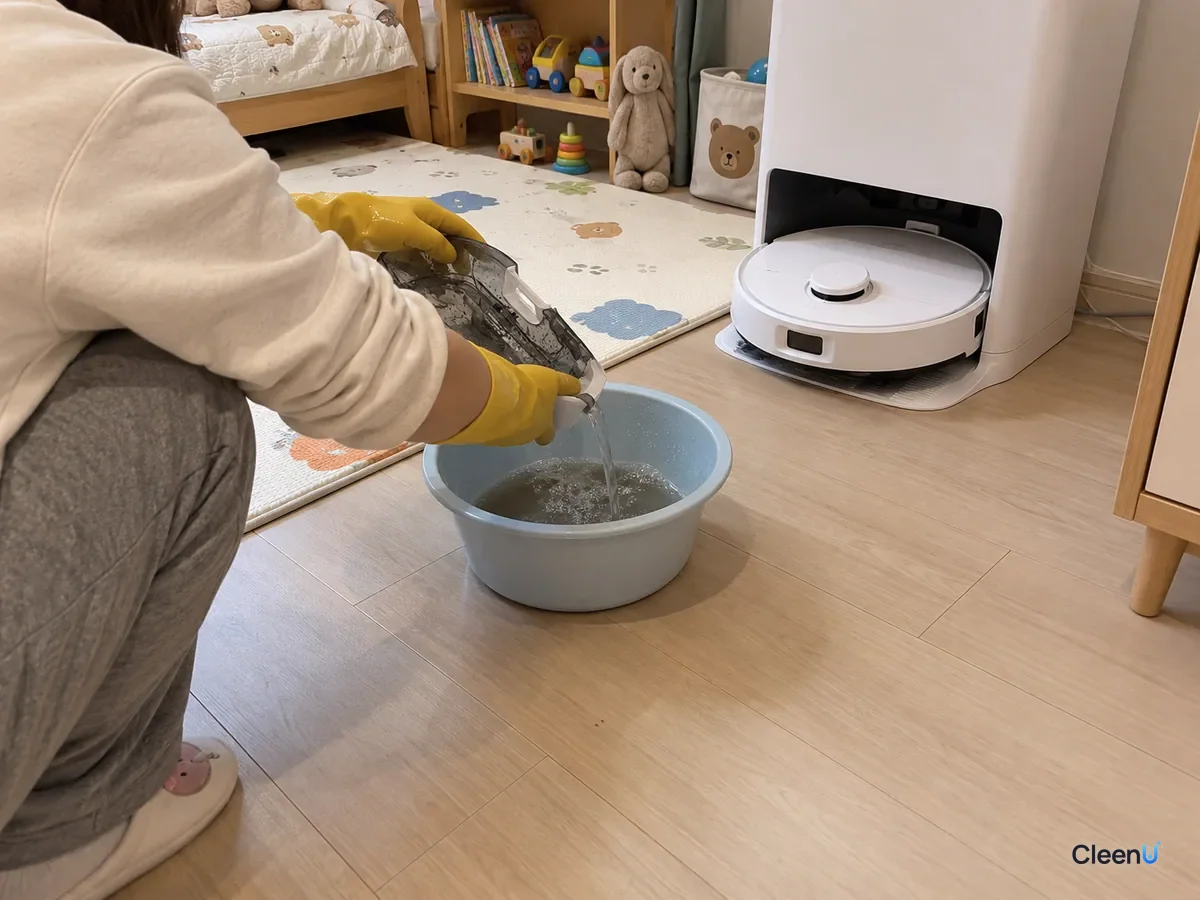
People who try this run into a snag: the clean tank still holds diluted solution, and the pads are still damp with it. Mopping again right away just lays down a weaker solution. So clear the solution out of the water path first. There are two setups.
Models where you mix solution into the clean tank:
- Pour out what's left in the clean tank, rinse it, and refill with plain water.
- Have the dock wash the pads once (most apps let you start a mop wash by hand) to rinse solution out of them.
- Select only the room you want to rinse, such as the nursery, and set water flow to low or medium.
- Let the dock wash and dry the pads as usual. Add solution again at the label ratio before your next regular run.
Docks with an auto-dosing compartment:
- Turn off the auto-dosing setting in the app for now.
- Start a mop wash by hand to rinse solution out of the pads.
- Select only the room you want to rinse and set flow to low or medium.
- Turn auto-dosing back on afterward.
If you want the nursery to get a water pass every time, plan it like this. If you mix solution into the clean tank, mop the whole house at the label ratio first, then switch to plain water for a second pass in the nursery. If your dock auto-doses and the app supports per-room settings, add a separate water-only pass for the nursery. Whether per-room settings exist depends on your model's app.
How do you know it worked? Once the floor is fully dry, slide your palm slowly across the wood and feel for drag or tackiness. Look across it toward a lamp or window for haze or streaks. Walk across it in socks and check for slipperiness. If all three are fine, residue is handled.
A quick home test: does your solution need a rinse?
Instead of rinsing every time, spend 15 minutes finding out how much your solution actually leaves at the label ratio.
Three-patch comparison. Use a dark tile, black glass, or a dark plate, since dark surfaces show residue far better than light wood. With a clean cloth, wipe three small patches: plain water, solution at the label ratio, and solution at double strength. Keep pressure and wetness about the same, and let them air-dry.
Check three ways once dry. Look at each patch in side light for a hazy or rainbow film. Slide a fingertip across each and feel for drag or tackiness. Then put a drop of water on each and watch it. On a surface with surfactant residue, the drop spreads out flatter and faster; on a clean surface it spreads less readily.
If the label-ratio patch looks and feels close to the water patch while the double-strength patch is clearly hazy and draggy, that solution is low-residue at the right dose. Skip routine rinsing and just don't overdose. If even the label-ratio patch is clearly hazy or tacky, the product leaves more behind, and switching to a low-foam, neutral, low-residue robot mop solution is the easier fix.
You can add one more step, a rewet check: wipe the double-strength patch once with a damp cloth and see whether the residue lifts right away. An easy-rinsing formula recovers with one water pass even if you occasionally overdose, which matters more at home than chasing "zero residue." This test only gives a rough read on residue.
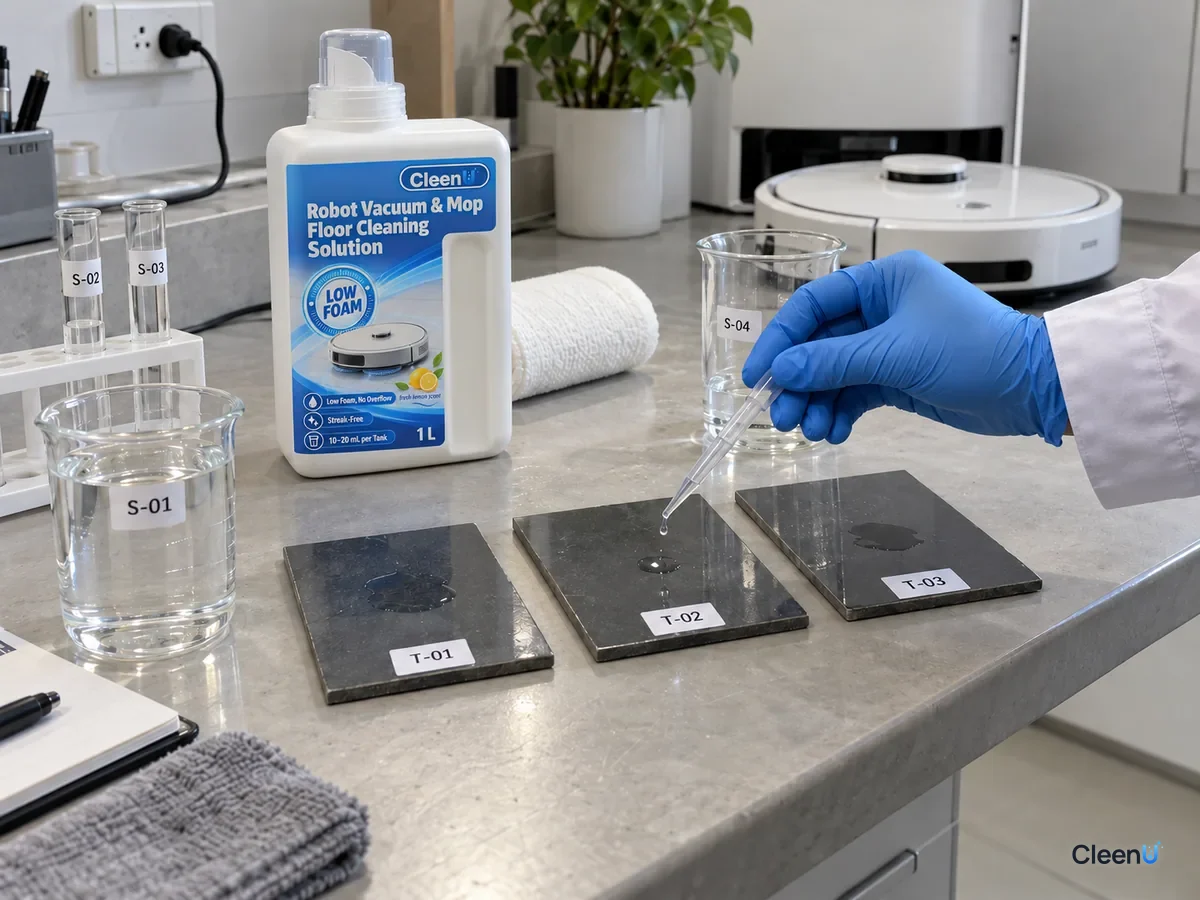
CleenU Robot Mop Cleaning Solution: made for machines that don't rinse
Robot mops don't rinse, so their solution has to be designed from the start to leave little behind and let that little come off easily. CleenU Robot Mop Cleaning Solution is a neutral concentrate, pH 6.5–7.5 as a concentrate, built on low-foam nonionic surfactants with a defoamer. It's solvent-free and contains no optical brighteners, wax, chlorine, particles, quats, or phenols. It dilutes about 1:50 to 1:100, and 10 to 20 mL per fill is usually enough. Each 1 L (about 34 oz) bottle comes with a measuring cap so you can dose to a mark instead of guessing. It has a lemon scent. If your home is sensitive to scent, dose at the low end (about 1:100), air out the room while and after mopping, and wait until the floor is fully dry before the baby crawls.
It's a cleaning solution for dust film, milk spills, food bits, and footprints. It isn't a disinfectant, and we don't claim it kills germs. It works with most models from Roborock, Ecovacs Deebot, Dreame, Narwal, Tineco, iRobot Roomba Combo and Braava, Shark, Eufy, and Bissell. Add it to the clean water tank or the dock's designated compartment as your manual directs; on Narwal models, use the clean water tank. If your model's manual says otherwise, follow the manual. CleenU is not affiliated with these brands; names are used only to describe compatibility.
If you have a baby and want a low-residue solution that's easy to dose by the mark, take a look at our Robot Vacuum & Mop Floor Cleaning Solution.
Pause mopping the nursery and check if you see any of these
Pause if a baby's palms, knees, or the skin around the mouth turns red or breaks out after crawling on a mopped floor; floors stay tacky or slick even at the label ratio; a film or smell remains after two plain-water passes; or wood seams whiten, cup, or let water in. Make a plain-water pass, wash the play mat and toys separately, check your dose and whether the product is neutral, low-residue, and quat-free, talk to your pediatrician about any skin reaction and keep the solution's packaging for reference, and contact the flooring maker about any floor changes.
Rinsing after robot mopping: common questions
Do I need to rinse with plain water every time I use robot mop solution?
No. With a low-foam, neutral, low-residue solution at the label ratio, a floor that dries without tackiness or haze doesn't need a rinse. Rinse only after overdosing or when it feels tacky or looks hazy.
How can I tell if solution residue is on my floor?
Once the floor is fully dry, slide your palm across it for drag, look for haze in side light, and walk on it in socks. If all three are fine, residue is minimal.
I added too much and the floor feels sticky. What now?
Pour out the mixed water, refill with plain water, wash the pads once, and make one or two water passes on low or medium flow. Next time, measure with the cap and stay at the low end.
Can I use cleaning solution in a room where my baby crawls?
Yes. Choose a neutral, low-residue solution without quats or phenols, dose at the low end (about 1:100), and air out the room. For extra margin, follow with a water pass, and wait until the floor is fully dry before the baby crawls.
Will a plain-water pass make my floor cleaner?
Only if residue built up. A water pass dilutes what's already there, so on a floor mopped at the right ratio it mostly uses more water and battery.
Why does my floor still feel draggy after rinsing off a disinfecting floor cleaner?
Many disinfecting products contain cationic ingredients such as quats that cling to floors and resist water. Follow that product's label for rinsing or wiping, and repeat if needed.
Rinsing leaves white marks in my hard-water area. What should I do?
Those are likely minerals from the water, not solution. Rinse with purified water, or buff dark areas with a dry cloth after the water pass.
How do I run a water-only pass on an auto-dosing dock?
Turn off auto-dosing in the app, start a mop wash by hand, then clean only the room you need. Turn auto-dosing back on when you're done.
My dog licks the floor. Should I rinse after mopping?
In spots your dog licks, a water pass adds margin; let the floor dry before the dog comes back. Use a fragrance-free solution without quats or phenols at the label ratio.
My light wood floor looks whitish or hazy after mopping. Is it residue or the floor?
Make one plain-water pass on low flow first to find out. If the haze disappears, it was residue or too much solution; if it stays, it may be hard-water marks or a change in the floor's finish, so check with the flooring maker.
What water flow should I use for a rinse pass?
Low to medium is enough. The goal is to redissolve and pick up a thin layer of residue; more water just pools in wood seams and slows drying.
Is regular floor cleaner or robot mop solution more likely to need a rinse?
Regular floor cleaner, in most cases. Many are made for hand mopping and foam more, leave more residue, or include shine agents. Robot mop solution is built for no-rinse use and leaves less at the right ratio.
More reading: Sticky floors after robot mopping, Streaks and water marks after robot mopping, Hazy wood floors after robot mopping, and Scented or fragrance-free robot mop solution?
Robot mops don't rinse, so floor residue is roughly working-solution strength times the water film left behind. With a low-foam, neutral, low-residue solution at the label ratio, everyday mopping doesn't need a plain-water pass. Rinse after overdosing, when the dry floor feels tacky or looks hazy, after a disinfectant, and in spots where a baby crawls or a pet licks. Before a water pass, dump the mixed water and wash the pads, turn off auto-dosing if you have it, keep flow low to medium, and wait until the floor is fully dry before the baby or pets come back.