
Troubleshooting
Swirl Marks After Robot Mopping: Causes and Fixes
Direct answer
Swirl marks trace the path of the spinning pads. When the pads are dirty, the solution is overdosed or the floor dries slowly, that path stays on the floor. Cut the dose, wash the pads, lower the water level and ventilate so the floor dries fast, and the swirls fade noticeably.
Check these first
- When they show: only while the floor is half dry and fading once it's fully dry, or still there after drying?
- Color: white haze, or gray and dull?
- Pads: gray, dark or stiff when you take them off, or one spot much dirtier than the rest?
- Solution: added extra lately, or switched products?
- Water level: set on the high side, with floors slow to dry?
- Floor: dark, glossy tile or vinyl plank, which show marks most?
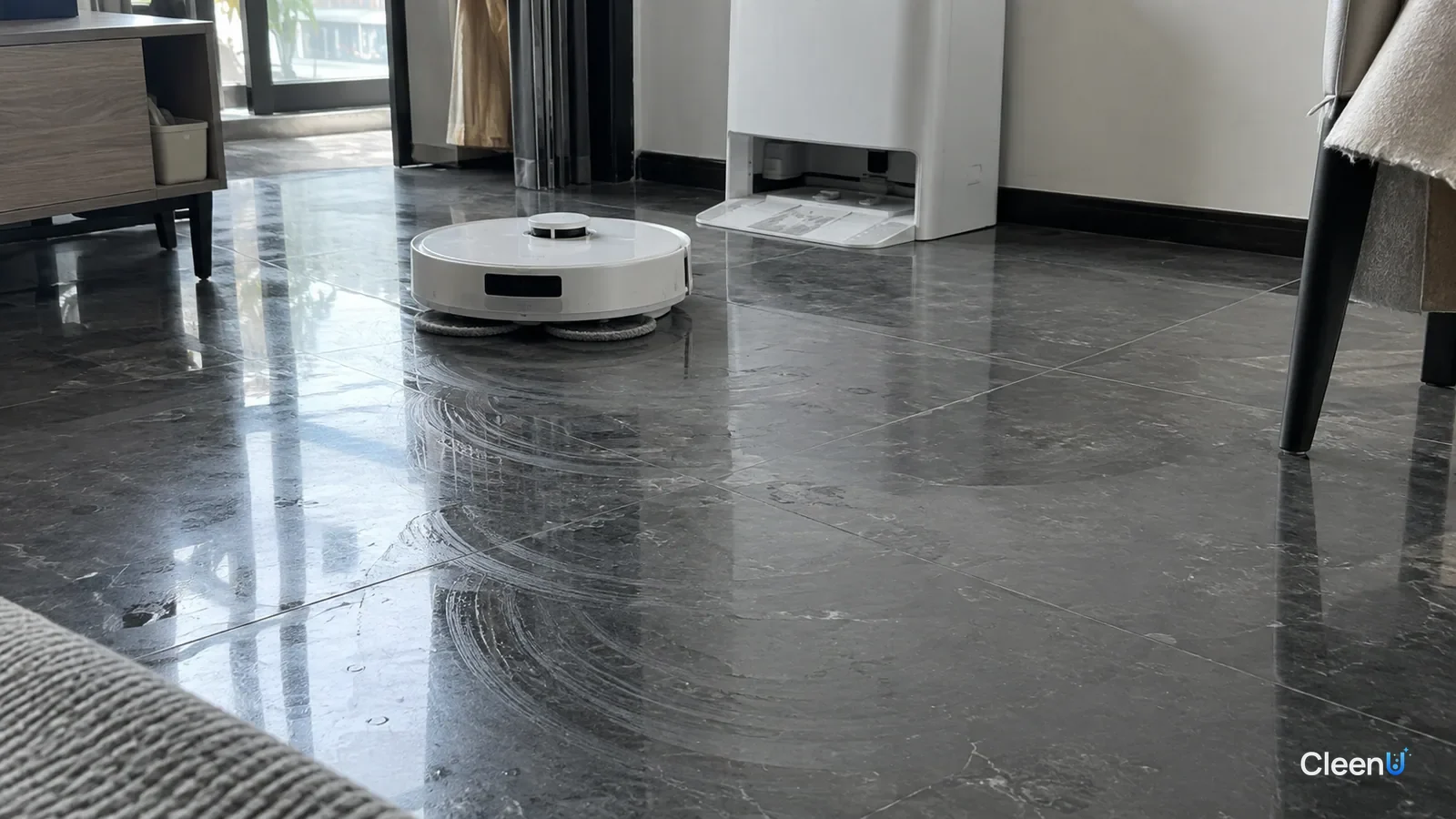
Shine a light across dark tile or glossy vinyl plank and there they are: arcs and circles, as if someone drew rings all over the floor. Many owners of robot mops with spinning pads see this, especially while the floor is half dry right after mopping.
Those rings are the spinning pads' signature. Here's why they stay, and how to make them go away.
How do swirl marks form?
A robot mop with spinning pads has two round pads underneath that rotate fast as the robot moves. The water and soil on the pads get spun out onto the floor in overlapping arcs.
Whether marks remain once the floor dries depends on what's in that water film.
Clean water evaporates with almost no trace, at most a very faint scale in hard-water areas.
Water with residue: the surfactants and other non-volatile ingredients in the solution leave an extremely thin film at the label ratio. Overdose and that residue follows the pads' spin into rings of haze.
Dirty water: when the pads are dirty, soil in the fibers comes out with the water and gets laid down along the arcs as gray rings.
Too much water, slow drying: a thick film dries slowly, and as it evaporates, what's in it migrates toward the edges and concentrates there, sharpening the ring edges.
Pressure isn't even across a spinning pad, either; the edge presses differently from the center. And a stiff or matted patch on a pad draws an especially clear ring on the floor.
White rings and gray rings have different causes
White, hazy rings are usually cleaner residue or hard-water scale. Wipe with a cloth dampened with plain water. If it comes off, it's usually too much solution. If plain water won't remove it but diluted vinegar does (on tile only), it's usually hard-water scale. For more, see white spots after robot mopping.
Gray, dull rings are usually dirty pads, or greasy film on the floor being smeared around. Hand wash the pads and clean greasy areas by hand first.
Common causes of swirl marks and what to do
| Cause | What you see | Fix | Prevention |
|---|---|---|---|
| Too much solution | Hazy white rings that plain water removes; floor slightly tacky | Run the robot once or twice with plain water | Measure by the cap at the label ratio, erring low |
| Dirty or stiff pads | Gray rings; pads look dark or matted | Hand wash in warm water with laundry detergent; replace worn pads | Clean the dock regularly and hand wash pads weekly |
| Water level too high | Rings strongest while half dry; floor slow to dry | Lower the water level | Floors should dry within a minute or two |
| Hard water | White ring edges that water won't remove | Wipe tile by hand with diluted vinegar | Lower water; use distilled water if the manual allows |
| Greasy film | Gray arcs in the kitchen and entry | Wipe grease by hand first, then let the robot mop | Set the kitchen as a priority zone for an extra pass |
| Poor ventilation or high humidity | Slow drying; rings linger | Open windows or run a dehumidifier before mopping | In humid weather, lower water and mop less often |
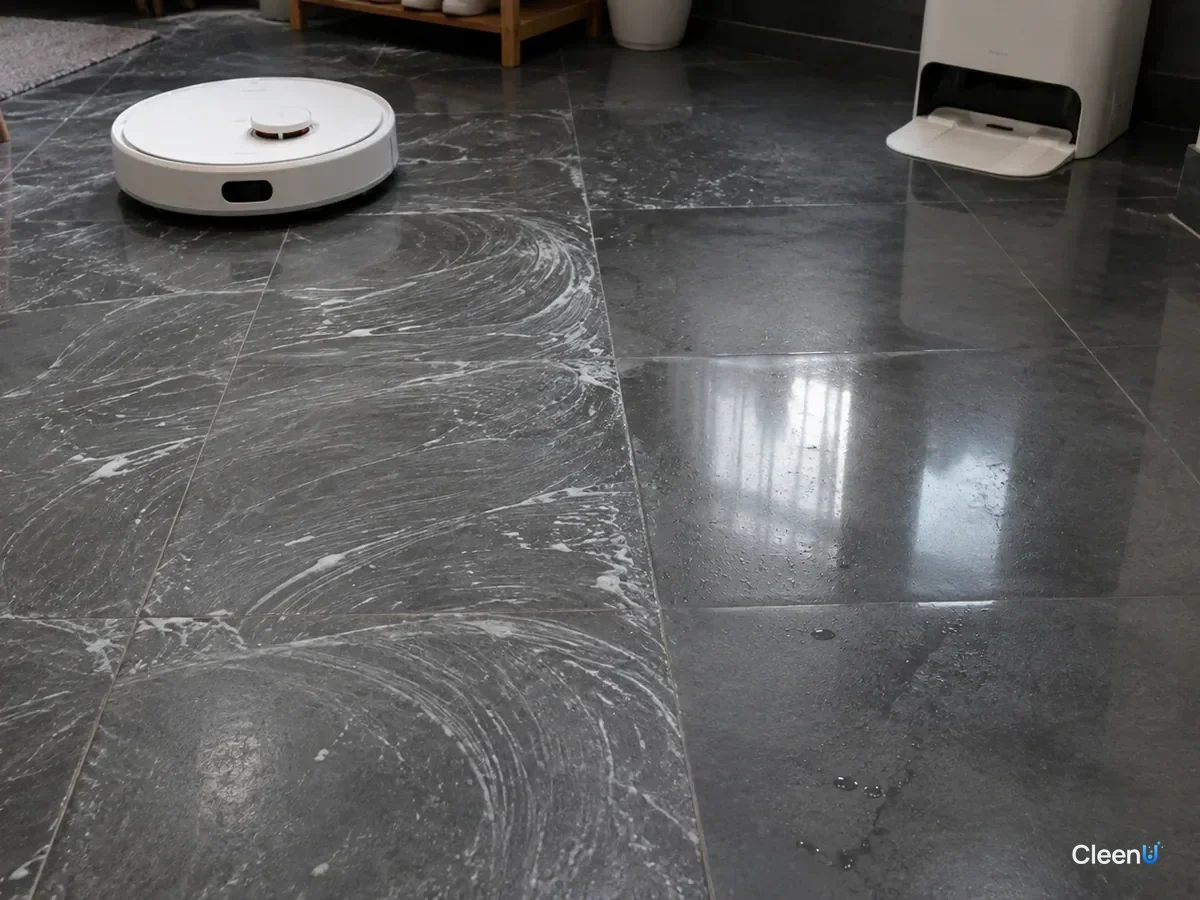
Adjust in this order and the swirls fade
Wash the pads first. Take them off and hand wash in warm water with a little laundry detergent, rinsing until the water runs clear with no suds, then dry and reattach. Replace pads that are stiff, matted or clearly worn per the manual. For washing tips, see how to clean smelly robot mop pads.
Then cut the solution. Dose at the low end of the label, about 10 mL for a 1-liter tank. If the floor already has residue, run a water-only pass or two first.
Then adjust the water. Set it to the lowest level that still cleans, so the film is thinner and dries faster.
Finally, improve drying. Open windows or run the AC or a dehumidifier while mopping. The faster the floor dries, the less chance rings have to form.
If your robot lifts its pads and spins in place, or dries the pads after each run, those features help too: pads don't keep drawing circles where the robot pauses, and they start the next run cleaner.
Pad speed and pressure matter too
Spinning pads lift soil through friction as they turn. Faster rotation and more downward pressure clean harder, but they also fling more water off the pad edges, so the arcs show more. Some models let you adjust mopping intensity or pad pressure in the app.
For everyday upkeep, use standard or lower intensity for a thinner, more even film and fewer rings.
For dirty areas like the kitchen and entry, set a higher intensity or an extra pass, then follow with a standard pass to smooth out the marks the heavy pass left.
Pads that are uneven in thickness or wear put different pressure on the floor, so one side leaves more obvious marks. Replace both pads together rather than pairing a new one with an old one.
Some models swing the pads outward or speed them up along edges and in turns, so rings are often denser there. If swirls show only in certain corners, lower the water or set light mopping for those areas.
Why are dark, glossy floors the worst?
Glossy floors reflect light like a mirror, so any extremely thin, uneven residue makes the reflection uneven, and side light turns that into bands of light and dark rings. Dark floors add contrast, so white residue and scale stand out.
The same amount of residue barely shows on light matte tile and looks like rings everywhere on black polished tile. Homes with dark, glossy floors need a low-residue solution and careful dosing more than anyone.
Choosing a solution that won't leave swirls
Low residue: designed for low concentration, so floors dry clean and never tacky at the label ratio.
No wax or shine enhancers: they build a film that stacks up along the pads' spin, making rings more obvious.
Low foam: foam makes pads skate, and bubbles lifted by the spinning pad leave marks when they pop.
CleenU Robot Vacuum Cleaning Solution, for example, is a neutral, low-foam concentrate at pH 6.5 to 7.5 with low-foam nonionic surfactants and a defoamer, no wax, no chlorine and no particles. It dilutes at about 1:50 to 1:100; 10 to 20 mL per fill is usually enough. It works in most robot mops from Roborock, iRobot (Roomba Combo and Braava), Ecovacs Deebot, Dreame and Narwal, and in floor washers such as Tineco. Add it to the clean water tank or the dock's designated detergent compartment as your manual directs. CleenU isn't affiliated with these brands; the names only indicate compatibility. For other streak problems, see robot mop leaving streaks.
Stop and check if you see these
Scratches or dull spots where the rings are, which can mean grit trapped in the pads; a complete circle that always appears in the same spot, which can mean the pads didn't lift while the robot paused there; or pads spinning with a noise or at uneven speed. Pause mopping, check the pads and pad mounts, and contact support if needed.
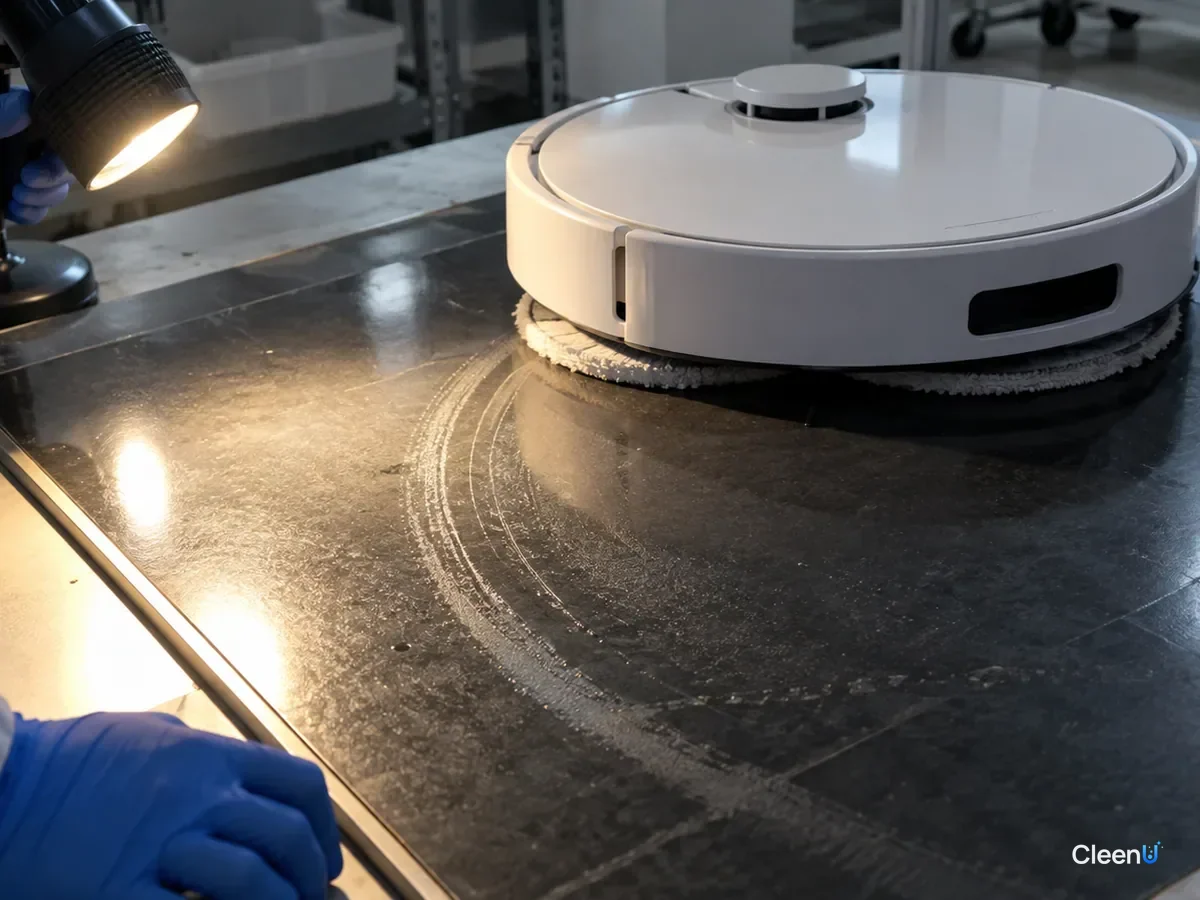
Why do brand-new pads leave swirls?
New pads can actually leave more marks.
New fibers may carry sizing or finishing agents from manufacturing, which the first mop run washes out and spreads across the floor as a thin film.
New pads haven't fully "opened up" for absorption, so water pools on the pad surface and the film is thicker.
A new pad paired with an old one presses and absorbs differently, so one side marks more.
Wash new pads in warm water with a little laundry detergent, rinse and dry them before use, and replace both at once. Run the first mop or two with plain water, then add solution at the label ratio.
The floor itself can magnify swirls
Floors that have been waxed or treated with shine products: the pad partly dissolves and redistributes the old wax, leaving obvious rings. Strip the old wax first rather than mopping over it.
Polished tile with fine scratches: scratches show up in side light as arcs alongside any residue.
Newly installed floors: leftover grout haze or construction film needs a proper post-construction clean first.
Figuring out whether it's the mopping or the floor keeps you from fixing the wrong thing.
This article is part of the Robot Vacuum Cleaning Solution & Maintenance Guide, which covers the full maintenance schedule and links to every troubleshooting guide.
Common questions about swirl marks after robot mopping
Will swirl marks disappear once the floor dries?
If they're just water, yes. Rings from solution residue, dirt or hard-water scale stay after drying and need a lower dose, clean pads or hand cleaning.
Why do only my dark tiles show swirls?
Dark, glossy floors reflect strongly and show high contrast. The same residue on light matte tile is barely visible.
Do swirl marks mean the solution is bad?
Usually not. White rings that plain water removes just mean too much solution; gray rings usually mean dirty pads.
Can I add a floor shine product to the tank to hide the rings?
No. Shine agents and wax build film layer by layer, which makes rings worse and floors slipperier over time.
How often should I wash the pads to prevent swirls?
Besides the dock's washing, hand wash them weekly and replace them when they get stiff or matted.
Will a lower water level still clean well?
For everyday mopping, yes. Setting dirty areas as priority zones for an extra pass works better than more water.
Why does my floor feel sticky after robot mopping?
Too much solution is the usual cause, followed by dirty pads. Run one or two passes with plain water to lift the residue, then measure the solution with the cap and go light. Wash the pads thoroughly. If the floor is still tacky once dry, check whether another cleaner was mixed into the tank.
Can I add vinegar to the tank to stop white rings?
Not to the tank. White rings that water won't remove are usually hard-water minerals, so wipe them off tile by hand with diluted vinegar. Vinegar sitting in the tank and lines can affect seals, and acid should not go on natural stone. Then lower the water flow, and switch to distilled water if your manual allows.
For dark, glossy floors, if you want a low-residue, wax-free robot mop solution that's less likely to leave swirls, try Robot Vacuum Cleaning Solution.
Swirl marks after robot mopping are the spinning pads leaving what's in the water film along their path: hazy white rings from too much solution, gray rings from dirty pads, sharper ring edges from too much water and slow drying, and white scale rings from hard water. Adjust in order: wash the pads, cut the solution to the low end, lower the water level, then improve ventilation so the floor dries fast. Dark, glossy floors are the most sensitive, so choose a low-residue, wax-free, low-foam robot solution and dose sparingly.