

Product and application illustrations. Follow the product label and written use guidance.
CleenU product solution
Ceramic Glass Cooktop Cleaner
Softens burnt-on rings · Scrapes clean · Private label
Brown rings and burnt-on boil-overs on your glass or induction cooktop? Once it’s cool, spray, wait 2–3 minutes, push them off with a cooktop scraper held low, then buff with microfiber for a clear black glass finish. Private label from 500 bottles.
- Grease on pan bottoms heats again and again over the burner zone, oxidizing and polymerizing into brown rings. Boiled-over soup, milk, and sugar carbonize on the hot glass into black crust. They bond tightly to the surface, and dry scrubbing just scuffs it. This cleaner works in at the edges, its mild alkalinity softens the polymerized grease, and surfactants loosen the carbon, so after a few minutes a scraper pushes it off.
- Ceramic glass handles heat but not hard abrasion. Use a cooktop scraper with the blade nearly flat, around 30 degrees, and skip steel wool and rough scouring pads. Wipe away loosened residue with microfiber, then buff dry for a clear black finish with no haze.
- MOQ
- 500 bottles
- Free samples
- 3–5 days
- Bulk lead time
- Scheduled with the order

Product value
What does Ceramic Glass Cooktop Cleaner clean?
Ceramic Glass Cooktop Cleaner removes burnt-on grease rings, boil-over marks, and everyday grease from ceramic glass radiant and induction cooktops.
View product detailsProduct summary
- Product type
- Mildly alkaline cooktop cleaning spray
- Intended use
- Burnt grease rings, boil-over crust, and everyday grease on ceramic glass cooktops
- Formula
- Mild alkaline builders with nonionic surfactants and a little glycol ether solvent, pH 8.5–10.0; no abrasives, so it won’t scratch glass; ready to use.
- For
- Cleaning product brands, cookware and appliance-accessory brands, supermarket and household-care channels, ecommerce sellers

Before & after
Before and after (use illustration)
Before: brown rings around the burner zones, black boil-over crust near the edge, and a hazy look in side light. After: sprayed, left to soften, scraped, and buffed, the rings and crust are gone and the black glass is clear enough to reflect.
- Before: brown rings around the burners and black burnt-on spots
- After: rings and spots gone, clear black glass
- A low-angle scraper leaves no scratches

How it works
How Burnt Marks Come Off
Cooktop marks are heat-polymerized grease plus carbonized sugar and protein, held to the glass by the grease polymer. The cleaner works in at the edges and cracks; mild alkalinity partly hydrolyzes and softens the polymer, and surfactants reduce the bond between carbon particles and glass. Once that layer loosens, the shear from a flat-held scraper lifts the crust in one piece without grinding on the glass.
- Penetrate edges
- Soften polymerized grease
- Loosen carbon
- Scraper lift
- Buff

Usage guidance
Use guidance
- Let the cooktop cool fully after use and wipe off loose crumbs.
- Spray rings and burnt marks and wait 2 to 3 minutes; lay a damp paper towel over thick crust to keep it wet.
- Scrape with a cooktop scraper held flat, wipe with microfiber, and buff dry.
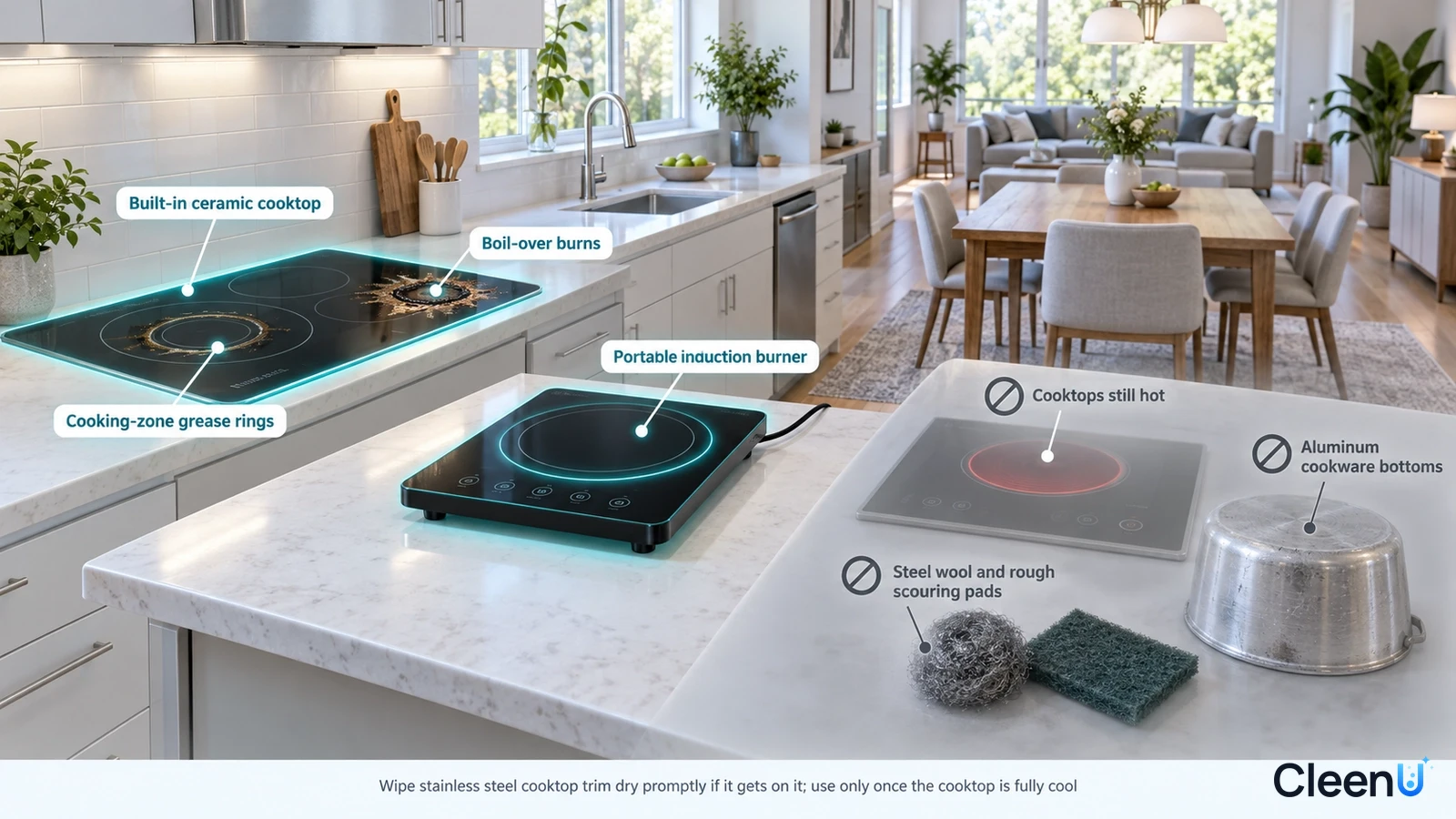
Before you use it
Important notes
- Not for: Hot cooktops
- Not for: Steel wool and rough scouring pads
- Not for: Aluminum pan bottoms
- Not for: Prolonged contact with stainless trim (wipe dry after)
- Test first for special materials, special equipment, or sensitive scenarios.
Product comparison
How to choose a Ceramic Glass Cooktop Cleaner
Rings and burnt marks on ceramic glass hobs: Ceramic Glass Cooktop Cleaner. Stainless gas hobs and grates: Kitchen Cleaner & Degreaser. Baked grease on oven door glass: Oven Glass Cleaner.
View product comparison
| Decision point | Ceramic Glass Cooktop Cleaner | Dish soap and steel wool |
|---|---|---|
| Burnt rings | Softened, then scraped | Ground off with effort |
| On glass | No abrasives, no scratches | Steel wool scratches |
| Finish | Clear, no haze | Scratches and haze |
| Tools | Cooktop scraper and microfiber | Steel wool |
Where Ceramic Glass Cooktop Cleaner stands out
Those Rings Are Oil and Sugar Baked Into Crust
Grease on pan bottoms heats again and again over the burner zone, oxidizing and polymerizing into brown rings. Boiled-over soup, milk, and sugar carbonize on the hot glass into black crust. They bond tightly to the surface, and dry scrubbing just scuffs it. This cleaner works in at the edges, its mild alkalinity softens the polymerized grease, and surfactants loosen the carbon, so after a few minutes a scraper pushes it off.
Scrape Flat, No Scratches in the Glass
Ceramic glass handles heat but not hard abrasion. Use a cooktop scraper with the blade nearly flat, around 30 degrees, and skip steel wool and rough scouring pads. Wipe away loosened residue with microfiber, then buff dry for a clear black finish with no haze.
Who it's for, where it's used, and when not to use it
For
End-use scenarios
When not to use it
Product Specifications and Custom Options
Key product details and custom options for your project.
Product specifications
Product type, cleaning scope, and format.
| Product type | Mildly alkaline cooktop cleaning spray |
| Surfaces | Ceramic glass cooktops, radiant and induction hob surfaces |
| Use scenarios | After cooking each day; After a boil-over; Weekly deep clean |
| Target soils | Burnt grease rings, boil-over crust, and everyday grease on ceramic glass cooktops |
| Directions | Ready to use, no dilution; on a cool cooktop, 2–3 min dwell before wiping |
| Not for | Hot cooktops; Steel wool and rough scouring pads; Aluminum pan bottoms; Prolonged contact with stainless trim (wipe dry after) |
| Size and packaging | 500 mL trigger spray bottle |
| pH | pH 8.5–10.0 at 25°C |
| Scent | Fresh lemon scent |
| Shelf life and storage | 24 months unopened; keep tightly closed in a cool, dry, well-ventilated place. Protect from heat, direct sunlight, and freezing |
B2B custom options
Private label, packaging, MOQ, samples, and delivery.
| OEM/ODM and private label | From product direction and sample review to packaging, production, and delivery for your Ceramic Glass Cooktop Cleaner project. |
| Packaging and labels | Mist trigger / foam trigger, fill size, labels, and retail sets can be customized |
| Case pack | 12 × 500 mL per case |
| MOQ | 500 bottles |
| Sample time | Free sample: 3–5 days |
| Bulk lead time | Scheduled with the order after packaging and label approval |
| Documents | SDS/MSDS, TDS, and batch COA provided per project on inquiry |
OEM/ODM project process
Move from product direction and sample review to packaging, production, and delivery for Ceramic Glass Cooktop Cleaner.
Define the format
Decide spray alone, spray plus scraper kit, or an added cream version for heavy marks.
Free sample
A free sample is usually ready in 3–5 days for project review.
Packaging and labels
Set fill size, trigger type, label language, the warnings your market requires, and use-on-cool-surface and no-steel-wool instructions.
Bulk delivery
Standard MOQ is 500 bottles; bulk orders are scheduled after packaging and labels are approved.
Why choose CleenU for Ceramic Glass Cooktop Cleaner?
From product positioning and samples to packaging and repeat supply, CleenU supports OEM/ODM projects built around Ceramic Glass Cooktop Cleaner.
Burnt-mark removal without scratching
The spray relies on chemical softening with no abrasives; a cream version can include ultra-fine polish. We set the direction by your users’ habits.
Spray and kits
The 500 mL spray with a scraper and microfiber cloth is the most common online bundle. Mist or foam trigger available.
Sample reviews with clear criteria
Review samples on your ceramic glass panels with burnt rings and crust against clear points: softening time, scraper passes, clarity after buffing, and scratching.
Lemon fresh or unscented
Kitchen products lean lemon or citrus; unscented is also available.
Labels and documents
We supply bilingual labels, SDS/MSDS, TDS, and batch COAs, with use-on-cool-surface and no-steel-wool instructions on the label, and can arrange third-party testing for your market.
Consistent supply and reorders
Each batch is retained and ships with a COA, so reorders match in color, scent, and feel.
Packaging and labeling options
Plan packaging format, label language, and shelf presentation around Ceramic Glass Cooktop Cleaner and your target channel.
Show packaging and label options
Packaging options
Core size: 500 mL trigger spray bottle. Also available: 1 L household refill, channel case packs, and ecommerce bundles with a cooktop scraper and microfiber cloth. Mist trigger or foam trigger options, with labels and cartons made to your brand.
Supporting Documents and Materials
Purchasers usually confirm whether the materials are complete before formal cooperation. Preparing documents in advance helps with quoting, sampling, and channel review.
Show available documents
Project documents
When you inquire, we provide SDS/MSDS, a TDS, batch COAs, label directions, and packaging files for your project.
Related products, solutions, and articles
Explore related cleaning products, application guidance, and OEM/ODM resources for Ceramic Glass Cooktop Cleaner.
Frequently asked questions (FAQ)
Find practical answers about Ceramic Glass Cooktop Cleaner, private label, samples, MOQ, documents, and delivery.
How to use
How do I get brown rings off my glass cooktop?
They form as grease on pan bottoms oxidizes and polymerizes over the burner zone. On a cool cooktop, spray, wait 2 to 3 minutes, scrape with the blade held flat, and buff with microfiber.
Can I use steel wool?
No. Steel wool and rough pads leave fine scratches that make the glass hazy over time. Use a cooktop scraper and microfiber.
Can I use it while the cooktop is warm?
No, wait until it’s cool. The exception is sugary spills: scrape jam or syrup off while the surface is warm but not hot, because cooled sugar bonds harder and can pit the glass.
What's the best way to clean a glass cooktop?
Let the cooktop cool fully, spray, and wait 2–3 minutes. Wipe everyday grease with a soft cloth or non-scratch sponge, and ease off baked-on rings and boil-over crust with a cooktop razor scraper held at about 30°. Finish by wiping off the residue with a damp cloth and buffing dry so no streaks or haze remain.
Surfaces and common questions
Will the scraper scratch the glass?
Held nearly flat, around 30 degrees, it’s safe, especially once the crust has softened. Don’t stand the blade up or dig with the corner.
Why is there a white haze after cleaning?
Usually leftover cleaner or water spots from minerals. A final buff with a dry microfiber cloth clears it.
Does it work on induction cooktops?
Yes. Induction and radiant hobs both use ceramic glass, so the method is the same. Make sure the power is off and the surface is cool.
There’s still a faint ring after scraping.
Usually the residue wasn’t fully softened. Spray again, wait the full 3 minutes, and push with the scraper at about 30°. A faint remaining mark may be metal left by an aluminum pan; buff it a few times with this and microfiber.
Do I need to use it after every meal?
No—for daily cleanup, wipe off spatters with a damp cloth once the top is cool. Use this for boil-overs, burnt spots, and rings, plus a weekly clean to keep the glass clear.
What kind of scraper should I use?
A single-edge cooktop scraper with a straight, undamaged blade, held low and pushed in one direction. Nicked blades and utility knives can scratch the glass.
Can I use it on a gas stove?
On a tempered-glass gas cooktop surface, yes, the same way: spray, wait, wipe. Cast-iron grates and aluminum or brass burner caps aren't covered; aluminum can darken in alkaline cleaners, so treat those parts separately with a kitchen degreaser.
Can I use it on a stainless steel stovetop or trim?
A little on the trim is fine; wipe it off with a damp cloth and dry it promptly rather than letting it sit. For an all-stainless stovetop, a stainless steel cleaner wiped and buffed along the grain is the better choice and less likely to streak.
Buying and private label
What should we decide first for a private-label ceramic glass cooktop cleaner?
Three things: spray alone or a kit with a scraper, lemon or unscented, and whether you also want a cream version with fine polish for heavy marks. Cooktop care sells best as a kit.
What are the sample, MOQ, and lead-time terms?
Free samples are usually ready in 3–5 days. Standard MOQ is 500 bottles, and bulk orders are scheduled after packaging and labels are approved.
What can be customized?
All of it: formula direction, scent, fill size (500 mL spray, 1 L refill, and more), mist or foam trigger, label design and language, and ecommerce bundles with a cooktop scraper and microfiber cloth.
Can we test samples first?
Yes, we ship samples first. Test them on ceramic glass panels with burnt rings and crust like the ones your customers handle, and record softening time, scraper passes, clarity after buffing, and scratching. That tells you more than a before-and-after photo.
Which documents can you provide?
We provide SDS/MSDS, a TDS, and batch COAs, plus bilingual label content for your target market. They aren’t posted publicly; we send them per project on inquiry.
How is private-label pricing quoted?
Pricing is tiered by packaging, trigger or cap, label, and order quantity, starting at the 500-bottle MOQ. Send your target quantity, fill size, and packaging needs, and we’ll quote unit prices by volume tier with sample and lead-time details.
Launching your own Ceramic Glass Cooktop Cleaner?
Send us your market, single bottle or kit, scent, and estimated volume. We will work through formula and kit packaging with you.