
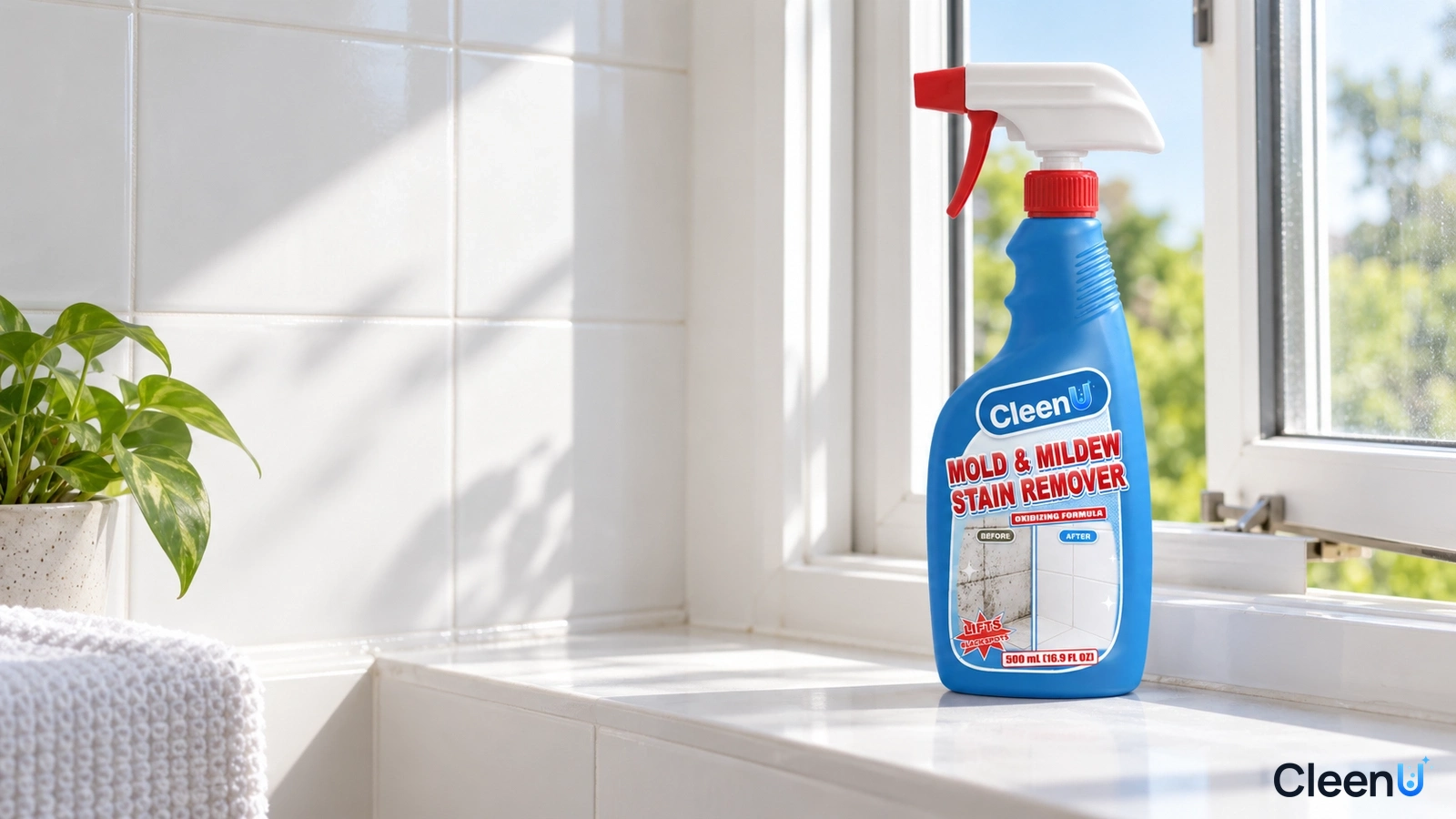
Product and application illustrations. Follow the product label and written use guidance.
CleenU product solution
Mold & Mildew Stain Remover
Oxidizing formula · Lifts black spots · Private label
A row of black spots on the shower caulk and dark grout corners? Open a window, run the fan, spray, and wait 10–15 minutes (30 for stubborn spots); rinse once the color fades—no hard scrubbing. Never mix with acids or ammonia; private label from 500 bottles.
- Bathrooms stay damp, so mold spores land on silicone, grout, and sealant and feed on soap scum and skin cells. Their hyphae grow into porous grout and soft silicone and produce dark pigment. Surface growth wipes away, but color embedded in the material won’t. The hypochlorite in this cleaner is a strong oxidizer that penetrates the surface layer and breaks the color-bearing structure of the pigment, so black spots fade.
- Oxidative fading takes time: wait 10 to 15 minutes, 30 for stubborn stains, with ventilation. Scrubbing just wipes the product away and roughens silicone. Once the color fades, rinse or wipe with a damp cloth. Never combine chlorine products with acidic cleaners such as descalers or toilet bowl cleaners, or with ammonia; they release toxic gas. If you use both, rinse thoroughly and leave time in between.
- MOQ
- 500 bottles
- Free samples
- 3–5 days
- Bulk lead time
- Scheduled with the order

Product value
What does Mold & Mildew Stain Remover clean?
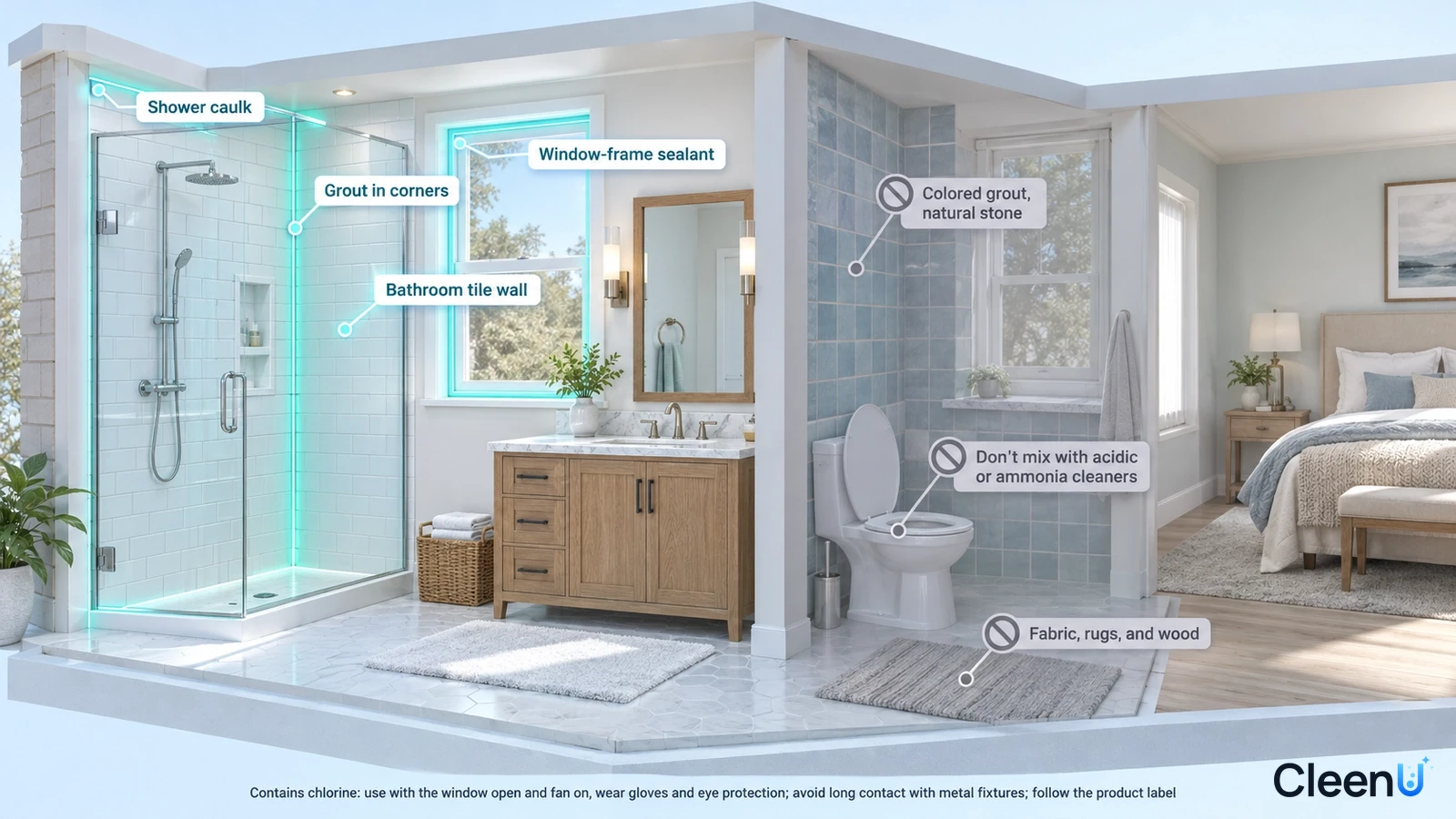
Mold & Mildew Stain Remover fades black mold stains on bathroom tile, grout, shower silicone, and window sealant.
View product detailsProduct summary
- Product type
- Chlorine-based mold and mildew stain spray
- Intended use
- Black mold and mildew stains on grout, shower silicone, and window sealant
- Formula
- Sodium hypochlorite with alkaline stabilizer and chlorine-stable surfactant, pH 11.5–13.0; ready to use.
- For
- Cleaning product brands, hardware and home-improvement retail, property and janitorial buyers, ecommerce sellers
Before & after
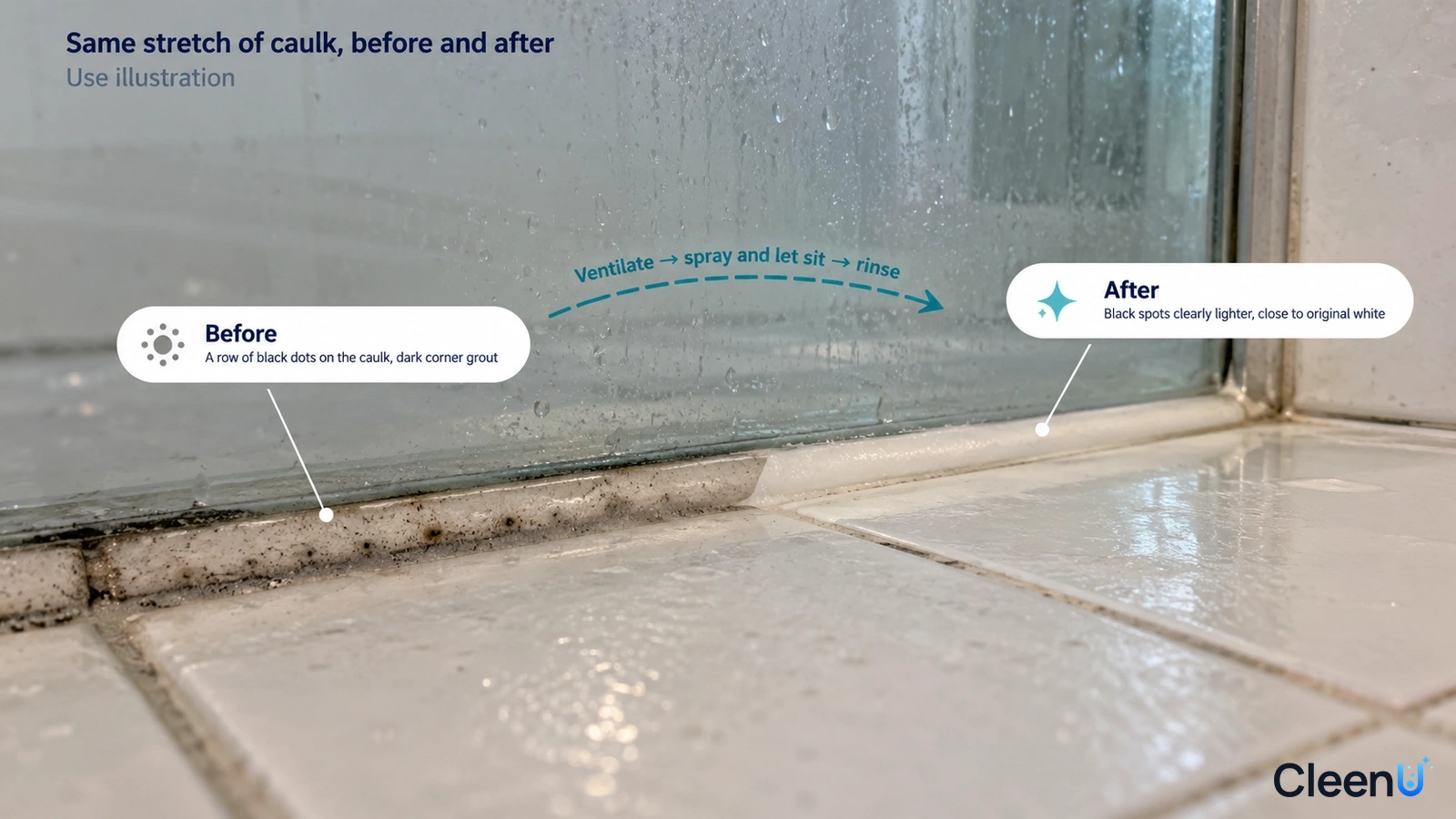
Before and after (use illustration)
Before: the white silicone between the glass and tile carries a continuous row of black mold spots, with more in the grout corner. After: sprayed, left 20 minutes, and rinsed, the black spots have faded markedly and the silicone and corner are close to their original white.
- Before: a row of black mold spots on white caulk and dark grout corners
- After: the spots are clearly faded, close to white again
- Rinse after the dwell—no hard scrubbing
How it works
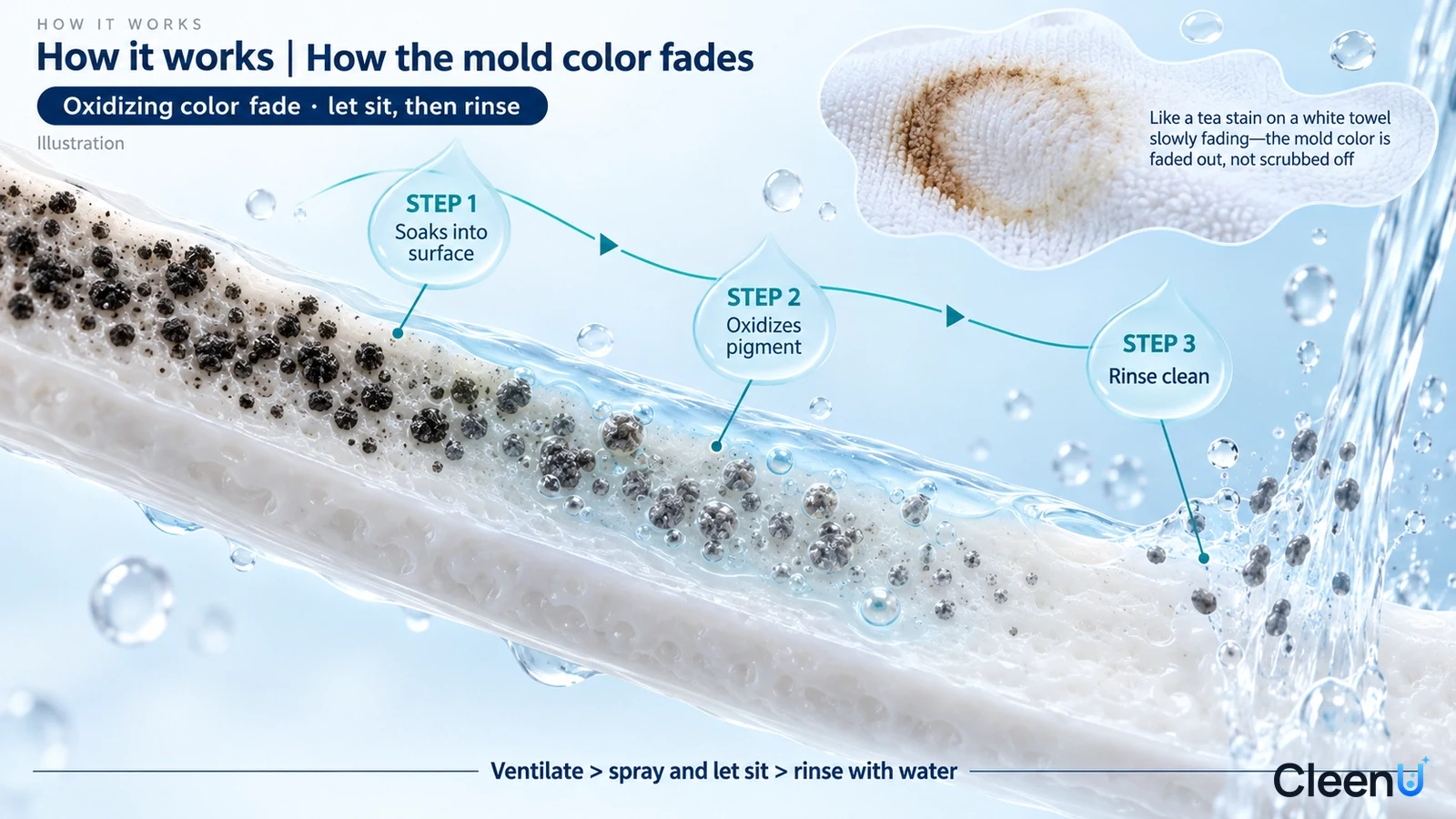
How Mold Stain Color Fades
Mold stains are dark from melanin and other pigments embedded in the surface of grout and silicone. Sodium hypochlorite forms hypochlorous acid and hypochlorite ion in water, both strong oxidizers that break the conjugated double bonds in pigment molecules so they stop absorbing light and fade. The alkaline environment keeps the hypochlorite stable, and a little surfactant helps it wet and cling to vertical surfaces. Rinsing carries away the breakdown products and leftover product.
- Hypochlorite penetrates the surface
- Oxidizes color-bearing structures
- Pigment breaks down
- Surfactant spreads it
- Rinse
Usage guidance
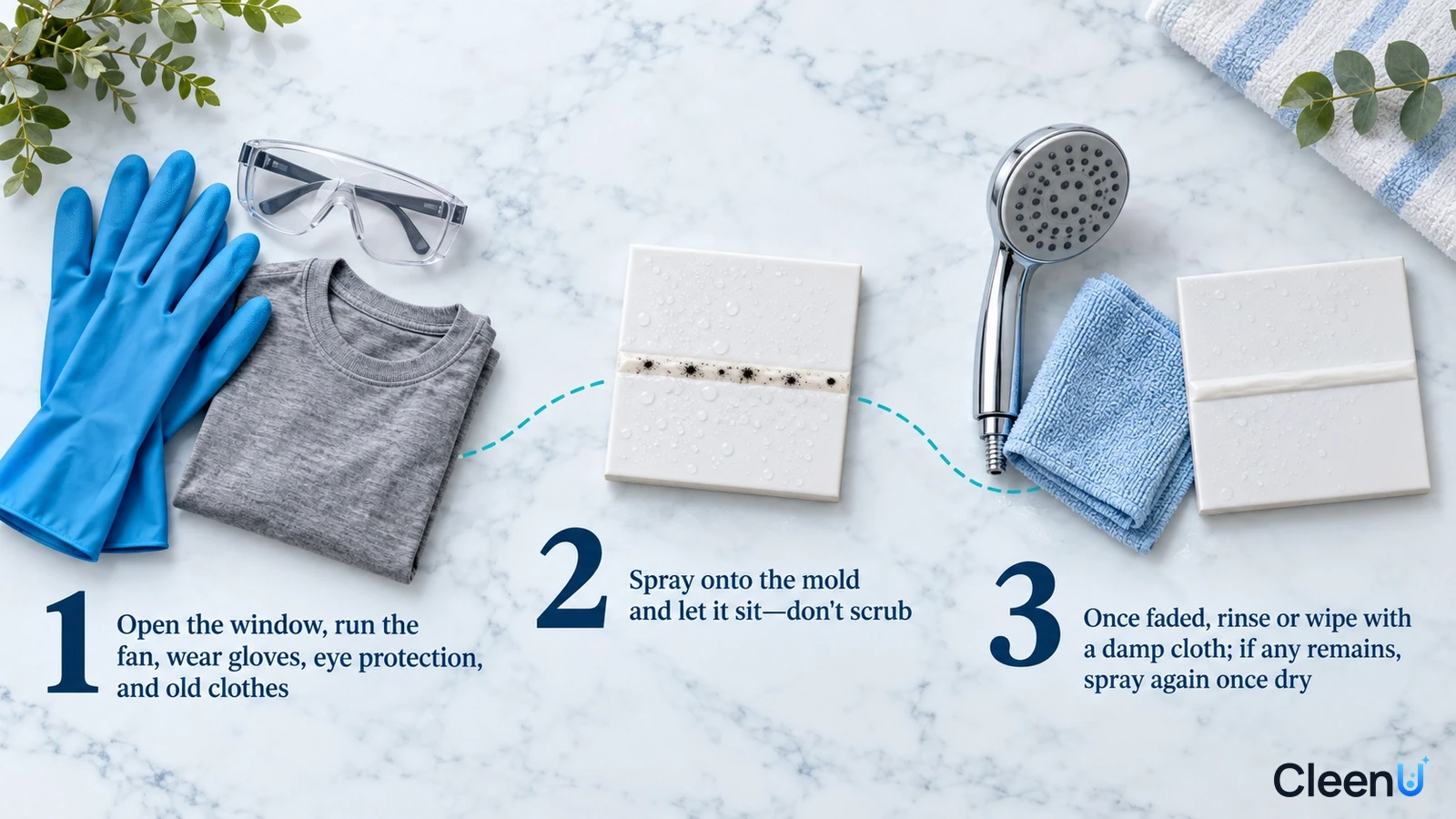
Use guidance
- Open a window, run the fan, wear gloves and goggles, and wear old clothes (it bleaches fabric).
- Spray the stains and wait 10 to 15 minutes, 30 for stubborn ones, without scrubbing.
- Once the color fades, rinse or wipe with a damp cloth; repeat after drying if any stain remains.
Before you use it
Important notes
- Not for: Mixing with acids or ammonia
- Not for: Fabric, carpet, and wood
- Not for: Colored grout
- Not for: Natural stone
- Not for: Long contact with metal fixtures
Product comparison
How to choose a Mold & Mildew Stain Remover
Black mold stains on grout and silicone: Mold & Mildew Stain Remover. Grey or yellow soap scum and grease in grout: Grout Cleaner. Soap scum and scale on tubs and walls: Foaming Tub & Tile Cleaner.
View product comparison
| Decision point | Mold & Mildew Stain Remover | General bathroom cleaner |
|---|---|---|
| Embedded stain pigment | Oxidized and faded | Won’t come off |
| Method | Spray and wait | Repeated scrubbing |
| Silicone | No scrubbing damage | Brushing roughens it |
| Mixing risk | Never with acids or ammonia | Lower |
Where Mold & Mildew Stain Remover stands out
Black Spots Won’t Wipe Off Because the Pigment Is Inside
Bathrooms stay damp, so mold spores land on silicone, grout, and sealant and feed on soap scum and skin cells. Their hyphae grow into porous grout and soft silicone and produce dark pigment. Surface growth wipes away, but color embedded in the material won’t. The hypochlorite in this cleaner is a strong oxidizer that penetrates the surface layer and breaks the color-bearing structure of the pigment, so black spots fade.
Spray and Wait; Don’t Scrub, and Stay Safe
Oxidative fading takes time: wait 10 to 15 minutes, 30 for stubborn stains, with ventilation. Scrubbing just wipes the product away and roughens silicone. Once the color fades, rinse or wipe with a damp cloth. Never combine chlorine products with acidic cleaners such as descalers or toilet bowl cleaners, or with ammonia; they release toxic gas. If you use both, rinse thoroughly and leave time in between.
Who it's for, where it's used, and when not to use it
For
End-use scenarios
When not to use it
Product Specifications and Custom Options
Key product details and custom options for your project.
Product specifications
Product type, cleaning scope, and format.
| Product type | Chlorine-based mold and mildew stain spray |
| Surfaces | Bathroom tile, grout, shower silicone, and window sealant |
| Use scenarios | Shower silicone; Grout corners; Window sealant |
| Target soils | Black mold and mildew stains on grout, shower silicone, and window sealant |
| Directions | Ready to use, no dilution; 10–15 min dwell, 30 on stubborn stains, then rinse |
| Not for | Mixing with acids or ammonia; Fabric, carpet, and wood; Colored grout; Natural stone; Long contact with metal fixtures; Unventilated enclosed spaces |
| Size and packaging | 500 mL trigger spray bottle |
| pH | pH 11.5–13.0 at 25°C |
| Scent | Unscented |
| Shelf life and storage | 24 months unopened; keep tightly closed in a cool, dry, well-ventilated place. Protect from heat, direct sunlight, and freezing |
B2B custom options
Private label, packaging, MOQ, samples, and delivery.
| OEM/ODM and private label | From product direction and sample review to packaging, production, and delivery for your Mold & Mildew Stain Remover project. |
| Packaging and labels | Mist trigger / foam trigger, fill size, labels, and retail sets can be customized |
| Case pack | 12 × 500 mL per case |
| MOQ | 500 bottles |
| Sample time | Free sample: 3–5 days |
| Bulk lead time | Scheduled with the order after packaging and label approval |
| Documents | SDS/MSDS, TDS, and batch COA provided per project on inquiry |
OEM/ODM project process
Move from product direction and sample review to packaging, production, and delivery for Mold & Mildew Stain Remover.
Define chlorine level and format
Set the available chlorine level and choose spray, foam, or gel.
Free sample
A free sample is usually ready in 3–5 days for project review.
Packaging and labels
Set fill size, trigger type, label language, the warnings your market requires, and never-mix, ventilate, and bleaching warnings, plus market-specific claim limits.
Bulk delivery
Standard MOQ is 500 bottles; bulk orders are scheduled after packaging and labels are approved.
Why choose CleenU for Mold & Mildew Stain Remover?
From product positioning and samples to packaging and repeat supply, CleenU supports OEM/ODM projects built around Mold & Mildew Stain Remover.
Fading speed balanced with odor
More available chlorine fades faster but smells stronger and is harder on materials; stabilizers extend shelf life.
Chlorine-resistant trigger or gel bottle
Chlorine needs resistant triggers and bottles; a gel nozzle targets silicone beads.
Sample reviews with clear criteria
Review samples on your mold-stained silicone strips and white-grout tile panels against clear points: stain fading speed, effect on silicone and white grout, and available-chlorine stability.
Unscented
Chlorine products usually carry no fragrance so the chlorine smell isn’t masked.
Labels and documents
We supply bilingual labels, SDS/MSDS, TDS, and batch COAs, with never-mix, ventilate, and bleaching warnings, plus market-specific claim limits on the label, and can arrange third-party testing for your market.
Consistent supply and reorders
Each batch is retained and ships with a COA, so reorders match in color, scent, and feel.
Packaging and labeling options
Plan packaging format, label language, and shelf presentation around Mold & Mildew Stain Remover and your target channel.
Show packaging and label options
Packaging options
Core size: 500 mL trigger spray bottle. Also available: 1 L household refill, channel case packs, and ecommerce bundles with the Grout Cleaner. Mist trigger or foam trigger options, with labels and cartons made to your brand.
Supporting Documents and Materials
Purchasers usually confirm whether the materials are complete before formal cooperation. Preparing documents in advance helps with quoting, sampling, and channel review.
Show available documents
Project documents
When you inquire, we provide SDS/MSDS, a TDS, batch COAs, label directions, and packaging files for your project.
Related products, solutions, and articles
Explore related cleaning products, application guidance, and OEM/ODM resources for Mold & Mildew Stain Remover.
Frequently asked questions (FAQ)
Find practical answers about Mold & Mildew Stain Remover, private label, samples, MOQ, documents, and delivery.
How to use
Can it fully remove black spots on silicone?
Most fade markedly. Where mold has grown deep or the silicone is aged and cracked, some color may remain, and replacing the silicone is the complete fix.
Why can’t I use it with toilet bowl cleaner, vinegar, or ammonia?
Toilet bowl cleaners, descalers, and vinegar are acidic, and mixing them with chlorine releases chlorine gas. Ammonia-based glass cleaners mixed with chlorine form chloramine vapors. Both harm your airways, so use them separately, rinse thoroughly in between, and keep the room ventilated.
Do I need to scrub?
No, and it’s better not to. Just spray and wait; scrubbing wipes off the product and roughens silicone.
There’s still a light grey mark after 30 minutes.
The mold has grown into the caulk. Rinse, let it dry, and do one more round. If a grey mark remains after two, cut out and recaulk—surface cleaners can’t reach deep inside.
What protection should I use?
Wear gloves and goggles, open a window, run the exhaust fan, and step out while it works. Keep it off clothes and towels—it will bleach them.
Surfaces and common questions
Can I use it on colored grout?
Not recommended; chlorine lightens colored and dark grout. Test a hidden spot if you must.
Does it kill mold or just remove the stain?
It’s made to remove mold stain color from tile, grout, and caulk; it isn’t sold as a mold killer or disinfectant. If spots keep coming back in the same place, moisture is feeding them, so fix ventilation and seals. Where disinfection is required, use a registered disinfectant.
How do I stop mold coming back?
Run the fan or open a window for 30 minutes after showers, squeegee walls and glass, and remove soap scum regularly so mold has no moisture or food.
Can I use it on a moldy ceiling?
Yes, but don’t spray overhead. Apply with a dampened sponge or cloth, wear goggles and gloves, and ventilate. Test painted ceilings in a corner first to avoid fading.
Vinegar or bleach: which is better for mold stains?
For black mold stains on grout and caulk, use a chlorine (bleach-based) product. Sodium hypochlorite oxidizes the dark pigment, so stains fade fast; vinegar is a mild acid that barely lightens this kind of staining and works better on hard-water film. Never mix them or use one right after the other, because acid plus chlorine releases chlorine gas. Rinse with water and ventilate before switching.
Can I use it on painted walls or drywall?
On painted bathroom walls, yes, as a spot treatment. Test a hidden corner, then apply with a dampened cloth instead of spraying the wall. On unpainted drywall, wallpaper, or walls where mold keeps returning, don’t rely on a surface cleaner: recurring spots usually mean moisture inside the wall, so find the leak or fix ventilation first. For mold covering more than about 10 square feet, the EPA suggests calling a professional.
Can I use it on clothes, carpet, or my washer’s door seal?
Not on clothes or carpet; it’s a chlorine spray and will bleach them. For mold and musty odor on a front-load washer’s door seal, run a washing machine cleaner through a tub-clean cycle instead. If you’ve already sprayed this product on the seal, wipe it with clean water and run an empty rinse cycle before using an acidic washer cleaner, and never use the two together.
Buying and private label
What should we decide first for a private-label mold & mildew stain remover?
Three things: available chlorine level (sets fading speed and odor), spray, foam, or gel (gel clings to silicone longer), and your market’s labeling rules, since chlorine products carry specific warnings and claim rules everywhere. Mold stain removal is a high-demand bathroom niche; claim stain removal only, not disinfection.
What are the sample, MOQ, and lead-time terms?
Free samples are usually ready in 3–5 days. Standard MOQ is 500 bottles, and bulk orders are scheduled after packaging and labels are approved.
What can be customized?
All of it: formula direction, scent, fill size (500 mL spray, 1 L refill, and more), mist or foam trigger, label design and language, and ecommerce bundles with the Grout Cleaner.
Can we test samples first?
Yes, we ship samples first. Test them on mold-stained silicone strips and white-grout tile panels like the ones your customers handle, and record stain fading speed, effect on silicone and white grout, and available-chlorine stability. That tells you more than a before-and-after photo.
Which documents can you provide?
We provide SDS/MSDS, a TDS, and batch COAs, plus bilingual label content for your target market. They aren’t posted publicly; we send them per project on inquiry.
How is private-label pricing quoted?
Pricing is tiered by packaging, trigger or cap, label, and order quantity, starting at the 500-bottle MOQ. Send your target quantity, fill size, and packaging needs, and we’ll quote unit prices by volume tier with sample and lead-time details.
Launching your own Mold & Mildew Stain Remover?
Send us your market, format, chlorine target, and estimated volume. We will work through formula and warning labels with you.