

Product and application illustrations. Follow the product label and written use guidance.
CleenU product solution
Pool Scale Preventer
Keeps calcium in solution · Clean waterline · Private label
Hard-water pool with a white scale line on the tile and scale on the heater and salt cell? Adjust pH to 7.2–7.6, dose 100 mL per 10 m³, and circulate 24 hours—calcium stays in the water, not on the walls. Private label from 500 bottles.
- Pools evaporate daily; water leaves and calcium and magnesium stay, while top-up water brings more, so hardness keeps climbing. At the waterline, constant wetting and drying lets calcium carbonate crystallize on the tile ring by ring, and heaters and salt cells, with high temperature and locally high pH, scale even faster. A scale preventer grabs the calcium and magnesium before they can crystallize and keeps them in the water.
- Once waterline scale forms, it takes acid cleaners and hard scrubbing, and scaled salt cells have to come out for an acid soak. Regular dosing by volume, with pH held at 7.2–7.6 and alkalinity in range, slows scaling dramatically. Remove existing heavy scale first, then maintain with the preventer.
- MOQ
- 500 bottles
- Free samples
- 3–5 days
- Bulk lead time
- Scheduled with the order

Product value
Where do you use Pool Scale Preventer?
Pool Scale Preventer keeps calcium and magnesium from scaling tile waterlines, filtration, heaters, and salt chlorine generator cells.
View product detailsProduct summary
- Product type
- Pool water sequestering scale preventer
- Intended use
- Waterline scale, heater and salt-cell scale, and cloudiness in hard-water pools
- Formula
- Phosphonate-type sequestrant with dispersant, pH 6.0–8.0; unscented, dye-free; dosed by volume.
- For
- Pool supply brands, pool service companies, hotels and community properties, ecommerce sellers

Before & after
Before and after (use illustration)
Illustration: in a hard-water pool, after cleaning the waterline, the untreated side shows a clear white crust within a month, while the side maintained with regular dosing stays clean over the same period (illustrative image).
- Before: the untreated side shows white scale at the waterline within a month
- After: the regularly dosed side keeps a clean waterline
- Less scale on the heater and salt cell

How it works
How Calcium and Magnesium Stay in the Water
Phosphonate-type sequestrants form soluble complexes with calcium and magnesium even at low concentration and adsorb onto freshly forming calcium carbonate nuclei, disrupting the lattice and stopping crystal growth (the threshold effect). Dispersants keep any micro-particles suspended so circulation carries them to the filter. The minerals stay in the water instead of depositing on waterlines, heaters, and cells.
- Dose by volume
- Sequestrants bind calcium and magnesium
- Crystal growth blocked
- Micro-crystals dispersed
- Filtered out

Usage guidance
Use guidance
- Test hardness, pH, and alkalinity and adjust pH to 7.2–7.6.
- Dose 100 mL per 10 m³ initially, diluted in a bucket of pool water and poured around the edge.
- Circulate 24 hours; then top up 50 mL per 10 m³ weekly or biweekly, recalculating after heavy top-ups or water changes.
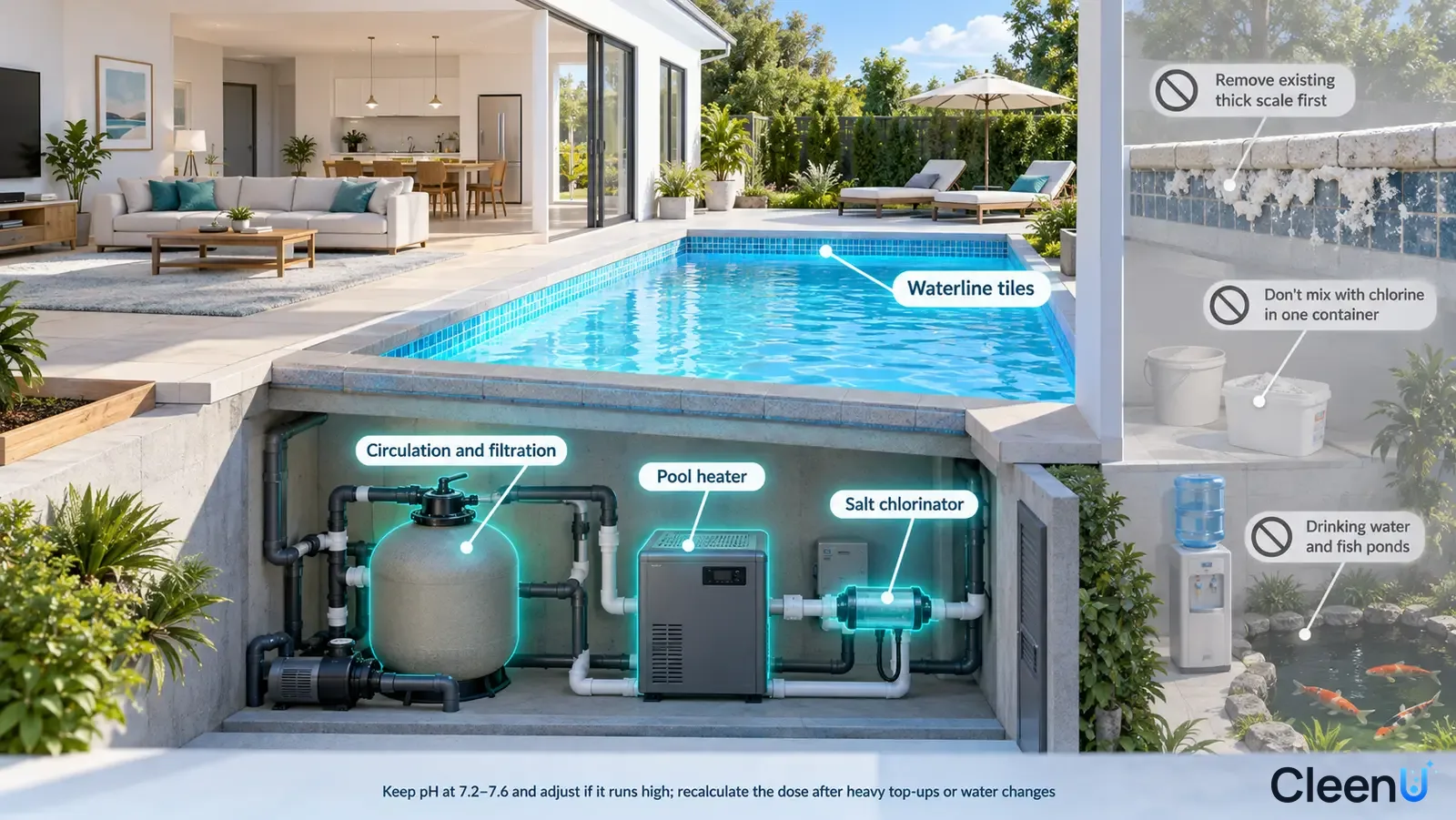
Before you use it
Important notes
- Not for: Removing existing heavy scale
- Not for: Mixing with concentrated chlorine in one container
- Not for: Drinking water and fish ponds
- Not for: Leaving high pH uncorrected
- Test first for special materials, special equipment, or sensitive scenarios.
Product comparison
How to choose a Pool Scale Preventer
Preventing scale in pool water: Pool Scale Preventer. Algae in ponds and features: Pond Algae Control. Existing scale on faucets and sinks: Faucet & Sink Scale Remover.
View product comparison
| Decision point | Pool Scale Preventer | Scrubbing the waterline |
|---|---|---|
| Approach | Prevents in the water | Removes after it forms |
| Heater and salt cell | Protected too | Not addressed |
| Effort | Measure and pour | Repeated scrubbing |
| Clarity | Less cloudiness | No change |
Where Pool Scale Preventer stands out
Waterline Scale Comes From Evaporation
Pools evaporate daily; water leaves and calcium and magnesium stay, while top-up water brings more, so hardness keeps climbing. At the waterline, constant wetting and drying lets calcium carbonate crystallize on the tile ring by ring, and heaters and salt cells, with high temperature and locally high pH, scale even faster. A scale preventer grabs the calcium and magnesium before they can crystallize and keeps them in the water.
Prevention Beats Removal
Once waterline scale forms, it takes acid cleaners and hard scrubbing, and scaled salt cells have to come out for an acid soak. Regular dosing by volume, with pH held at 7.2–7.6 and alkalinity in range, slows scaling dramatically. Remove existing heavy scale first, then maintain with the preventer.
Who it's for, where it's used, and when not to use it
For
End-use scenarios
When not to use it
Product Specifications and Custom Options
Key product details and custom options for your project.
Product specifications
Product type, cleaning scope, and format.
| Product type | Pool water sequestering scale preventer |
| Surfaces | Pool water, tile waterlines, circulation and filtration, heaters, and salt chlorine generators |
| Use scenarios | Hard-water home pools; Saltwater pools; Hotel and community pools |
| What it treats | Waterline scale, heater and salt-cell scale, and cloudiness in hard-water pools |
| Directions | Dose by volume: 100 mL per 10 m³ initially, 50 mL per 10 m³ for maintenance; circulate 24 h after dosing; top up weekly or biweekly |
| Not for | Removing existing heavy scale; Mixing with concentrated chlorine in one container; Drinking water and fish ponds; Leaving high pH uncorrected |
| Size and packaging | 500 mL measuring-cap grip bottle |
| pH | pH 6.0–8.0 at 25°C |
| Scent | Unscented |
| Shelf life and storage | 24 months unopened; keep tightly closed in a cool, dry, well-ventilated place. Protect from heat, direct sunlight, and freezing |
B2B custom options
Private label, packaging, MOQ, samples, and delivery.
| OEM/ODM and private label | From product direction and sample review to packaging, production, and delivery for your Pool Scale Preventer project. |
| Packaging and labels | Graduated dosing cap, fill size, labels, and retail sets can be customized |
| Case pack | 12 × 500 mL per case |
| MOQ | 500 bottles |
| Sample time | Free sample: 3–5 days |
| Bulk lead time | Scheduled with the order after packaging and label approval |
| Documents | SDS/MSDS, TDS, and batch COA provided per project on inquiry |
OEM/ODM project process
Move from product direction and sample review to packaging, production, and delivery for Pool Scale Preventer.
Confirm water and pool types
Check hardness levels and saltwater pool share in your market.
Free sample
A free sample is usually ready in 3–5 days for project review.
Packaging and labels
Set fill size, dosing cap, label language, the warnings your market requires, and dose-by-volume, don’t-mix-with-concentrated-chlorine, and won’t-remove-existing-scale instructions.
Bulk delivery
Standard MOQ is 500 bottles; bulk orders are scheduled after packaging and labels are approved. Pool products peak in spring and summer, so sample and stock in winter.
Why choose CleenU for Pool Scale Preventer?
From product positioning and samples to packaging and repeat supply, CleenU supports OEM/ODM projects built around Pool Scale Preventer.
Scale control and compatibility
Type and dose set performance and must stay compatible with chlorine, salt systems, and common chemicals.
Dosing bottle
A graduated bottle for dosing by volume; 5 L for commercial.
Sample reviews with clear criteria
Review samples on your high-hardness simulated pool water against clear points: scale inhibition, effect on clarity, and compatibility with chlorine and salt systems.
Unscented
No fragrance or dye in water treatments.
Labels and documents
We supply bilingual labels, SDS/MSDS, TDS, and batch COAs, with dose-by-volume, don’t-mix-with-concentrated-chlorine, and won’t-remove-existing-scale instructions on the label, and can arrange third-party testing for your market.
Consistent supply and reorders
Each batch is retained and ships with a COA, so reorders match in color, scent, and feel.
Packaging and labeling options
Plan packaging format, label language, and shelf presentation around Pool Scale Preventer and your target channel.
Show packaging and label options
Packaging options
Core size: 500 mL measuring-cap grip bottle. Also available: 1 L household refill, channel case packs, and ecommerce bundles with test strips. Graduated dosing cap options, with labels and cartons made to your brand.
Supporting Documents and Materials
Purchasers usually confirm whether the materials are complete before formal cooperation. Preparing documents in advance helps with quoting, sampling, and channel review.
Show available documents
Project documents
When you inquire, we provide SDS/MSDS, a TDS, batch COAs, label directions, and packaging files for your project.
Related products, solutions, and articles
Explore related cleaning products, application guidance, and OEM/ODM resources for Pool Scale Preventer.
Frequently asked questions (FAQ)
Find practical answers about Pool Scale Preventer, private label, samples, MOQ, documents, and delivery.
How to use
How do I prevent white scale at the waterline?
Clean off existing scale, keep pH at 7.2–7.6, and dose the preventer by volume weekly or biweekly; scaling slows dramatically.
Will it remove existing scale?
No. It prevents scale; remove existing buildup with an acid cleaner or professional service first.
Can I use it in a saltwater pool?
Yes, and it’s especially useful: it reduces salt-cell scaling and stretches cleaning intervals.
What causes scale in a pool?
Calcium in the water drops out as calcium carbonate when pH and alkalinity run high, and it sticks to waterline tile, pool walls, and heaters. Warm water, heavy evaporation, and topping up with hard water all speed it up, and salt-cell plates scale fastest because the pH right at their surface runs higher. Keeping pH at 7.2–7.6, not letting alkalinity climb, and dosing a scale preventer is the easiest way to stay ahead of it.
Surfaces and common questions
Is it OK with chlorine?
Yes in the same pool, but never mixed in one container; add them separately a few hours apart.
How do I calculate pool volume?
Length × width × average depth in meters = cubic meters; for example, 10 × 4 × 1.5 m = 60 m³.
How often should I add it?
Maintenance dose weekly or biweekly, and re-dose by volume after big top-ups, water changes, or storms.
Do I still need it after refilling with fresh water?
Yes—fresh water carries calcium and magnesium too. Balance pH and hardness after filling, dose the initial amount, then switch to maintenance.
The water is already cloudy. Did I underdose?
Test pH and alkalinity first—high pH is the most common cause. Bring pH back to 7.2–7.6, then dose as directed. A scale preventer doesn’t replace water balance.
Can I use it in spas and hot tubs?
Yes—scale the dose to the actual volume. Small, hot, fast-evaporating water scales more easily, so add weekly and test pH often.
Does a scale preventer lower calcium hardness?
No. It keeps calcium held in solution so it doesn't come out as scale, and your hardness reading stays about the same. If hardness itself is too high, partially drain and refill with softer water, then re-dose the preventer for the new volume.
Is the white crust at the waterline scale or something else?
If it's white or grayish, rough, and won't scrape off, it's most likely calcium scale; a drop of acidic cleaner will fizz on it. Slimy green, black, or brown spots are algae, which need chlorine and brushing, not a scale preventer.
Buying and private label
What should we decide first for a private-label pool scale preventer?
Three things: water hardness and pool types in your market (saltwater pools are a strong fit), sizes (500 mL to 5 L), and channel (pool stores, service companies, ecommerce). Pool chemicals carry registration or labeling rules in some markets, so check before launch.
What are the sample, MOQ, and lead-time terms?
Free samples are usually ready in 3–5 days. Standard MOQ is 500 bottles, and bulk orders are scheduled after packaging and labels are approved.
What can be customized?
All of it: formula direction, scent, fill size (500 mL, 1 L, 5 L, and more), graduated bottle, squeeze-dose chamber, label design and language, and ecommerce bundles with test strips.
Can we test samples first?
Yes, we ship samples first. Test them on high-hardness simulated pool water like the ones your customers handle, and record scale inhibition, effect on clarity, and compatibility with chlorine and salt systems. That tells you more than a before-and-after photo.
Which documents can you provide?
We provide SDS/MSDS, a TDS, and batch COAs, plus bilingual label content for your target market. They aren’t posted publicly; we send them per project on inquiry.
How is private-label pricing quoted?
Pricing is tiered by packaging, cap type, label, and order quantity, starting at the 500-bottle MOQ. Send your target quantity, fill size, and packaging needs, and we’ll quote unit prices by volume tier with sample and lead-time details.
Launching your own Pool Scale Preventer?
Send us your market, pool types, sizes, and estimated volume. We will work through formula and labeling with you.