

Product and application illustrations. Follow the product label and written use guidance.
CleenU product solution
Pond Algae Control
Clears green water · Dose by volume · Private label
A green garden pond where you can’t see the bottom or your koi? Dilute 10–20 mL per 1,000 L of water, pour it around the edge, keep the pump and filter running, and the water clears noticeably in 7–14 days. Private label from 500 bottles.
- Fish waste, leftover food, and decaying leaves release nitrogen and phosphorus, which is fertilizer for algae. With strong summer light and warm water, suspended algae multiply and the water turns green, while string algae hangs from walls and rocks like hair. The treatment controls growth, but lasting clarity also needs lighter feeding, leaf removal, good filtration, and some shade.
- With water treatments, dose is everything. Measure length, width, and average depth, estimate volume (L × W × D × 1,000 = liters), and use 10 to 20 mL per 1,000 L. Dilute in a bucket of pond water, pour around the edge, and keep the pump running so it spreads evenly. Dying algae consume oxygen, so in hot weather add aeration and split the dose.
- MOQ
- 500 bottles
- Free samples
- 3–5 days
- Bulk lead time
- Scheduled with the order

Product value
Where do you use Pond Algae Control?
Pond Algae Control manages the suspended algae that turn pond water green and the string algae on walls in garden fish ponds, water features, fountains, and water gardens.
View product detailsProduct summary
- Product type
- Pond water algae control treatment
- Intended use
- Green-water algae and string algae in garden ponds, water features, and fountains
- Formula
- Pond algae control active with dispersant, pH 6.5–8.0; unscented, dye-free; dose 10–20 mL per 1,000 L.
- For
- Aquatic and garden brands, water-feature and landscaping contractors, garden channels, ecommerce sellers

Before & after
Before and after (use illustration)
Before: a roughly 3,000 L garden pond is deep green, the bottom and koi invisible, with string algae on the walls. After: dosed by volume with filtration running, the water is clearly transparent within two weeks, with rocks on the bottom and fish visible (illustrative image).
- Before: green water, no view of the bottom or the koi, string algae on the walls
- After: noticeably clearer water after two weeks, fish and stones visible
- Dose by volume and keep the filter running
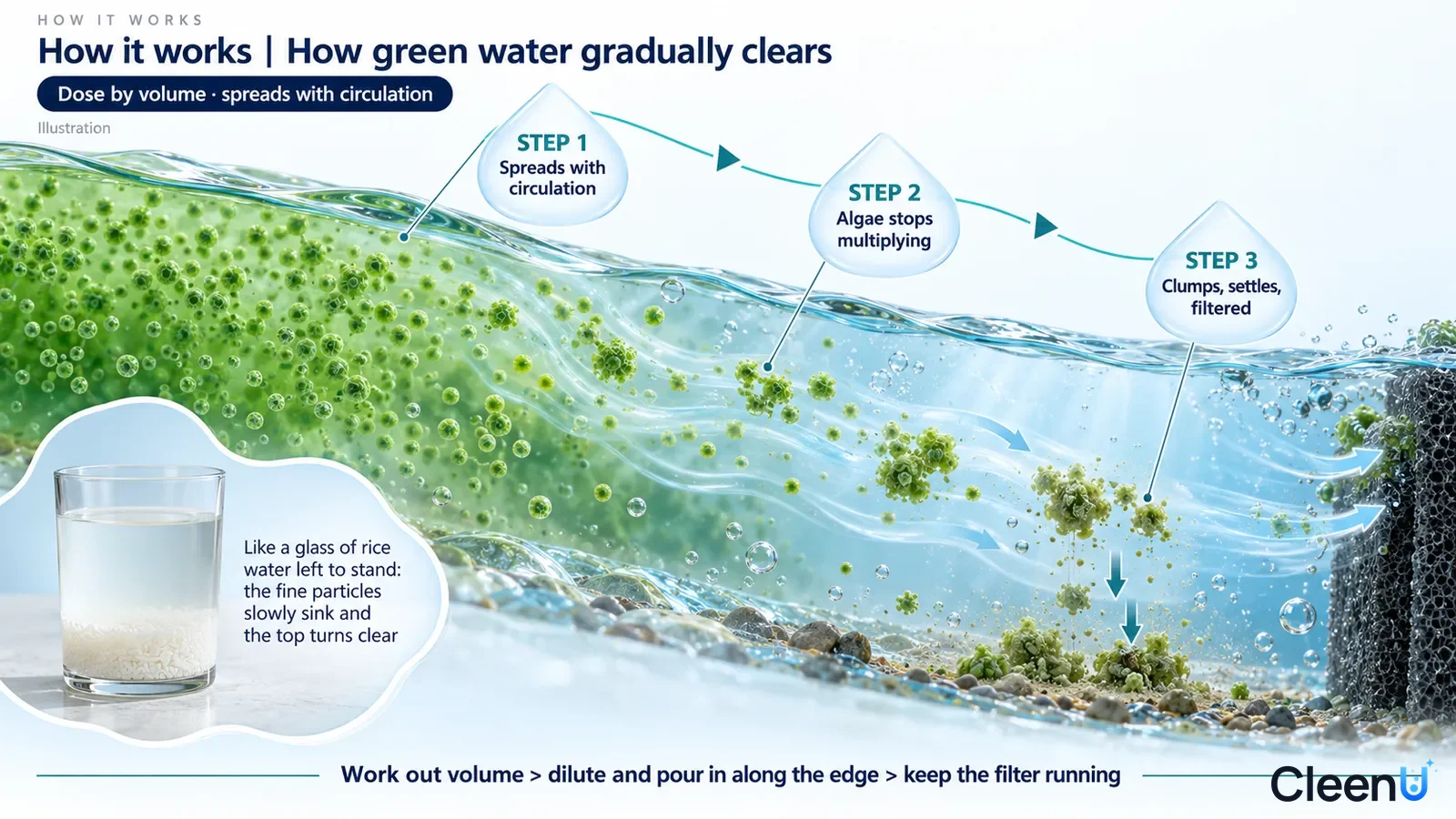
How it works
How the Water Clears
The active spreads through the whole pond with circulation and acts on algae cells, suppressing photosynthesis and cell division so suspended algae stop multiplying, clump, and settle, while string algae loses vigor and detaches from walls. The filter traps dead algae or it settles for removal, and regular maintenance doses stop regrowth early.
- Dose by volume
- Circulation spreads it
- Algae photosynthesis and growth suppressed
- Dead algae settle and are filtered
- Maintenance dosing prevents return

Usage guidance
Use guidance
- Estimate volume: length × width × average depth in meters × 1,000 = liters.
- Measure 10 to 20 mL per 1,000 L, dilute in a bucket of pond water, and pour evenly around the edge.
- Keep the pump and filter running; expect results in 7 to 14 days, top up every 2 to 4 weeks, and remove settled algae.

Before you use it
Important notes
- Not for: Overdosing
- Not for: Drinking water, pools, and irrigation sources
- Not for: Single large doses in hot, low-oxygen conditions
- Not for: Combining with other water treatments at the same time
- Test first for special materials, special equipment, or sensitive scenarios.
Product comparison
How to choose a Pond Algae Control
Algae in pond and feature water: Pond Algae Control. Algae stains on stones and patios around the pond: Outdoor Algae Stain Remover (never add to water). Pool scale: Pool Scale Preventer.
View product comparison
| Decision point | Pond Algae Control | Water changes |
|---|---|---|
| Duration | Ongoing with maintenance | Green again in days |
| Effect on fish | Gentle at label dose | Big changes stress fish |
| String algae | Gradually detaches | No effect |
| Effort | Measure and pour | Pumping and refilling |
Where Pond Algae Control stands out
Green Water Is Fed by Sunlight and Nutrients
Fish waste, leftover food, and decaying leaves release nitrogen and phosphorus, which is fertilizer for algae. With strong summer light and warm water, suspended algae multiply and the water turns green, while string algae hangs from walls and rocks like hair. The treatment controls growth, but lasting clarity also needs lighter feeding, leaf removal, good filtration, and some shade.
Dose by Volume, Not by Feel
With water treatments, dose is everything. Measure length, width, and average depth, estimate volume (L × W × D × 1,000 = liters), and use 10 to 20 mL per 1,000 L. Dilute in a bucket of pond water, pour around the edge, and keep the pump running so it spreads evenly. Dying algae consume oxygen, so in hot weather add aeration and split the dose.
Who it's for, where it's used, and when not to use it
For
End-use scenarios
When not to use it
Product Specifications and Custom Options
Key product details and custom options for your project.
Product specifications
Product type, cleaning scope, and format.
| Product type | Pond water algae control treatment |
| Surfaces | Garden fish ponds, ornamental water features, fountains, and water gardens |
| Use scenarios | Spring start-up; Summer maintenance; Hotel and campus water features |
| What it treats | Green-water algae and string algae in garden ponds, water features, and fountains |
| Directions | Dose by volume: 10–20 mL per 1,000 L of water; run circulation after dosing; results in 7–14 days; top up every 2–4 weeks |
| Not for | Overdosing; Drinking water, pools, and irrigation sources; Single large doses in hot, low-oxygen conditions; Combining with other water treatments at the same time |
| Size and packaging | 500 mL measuring-cap grip bottle |
| pH | pH 6.5–8.0 at 25°C |
| Scent | Unscented |
| Shelf life and storage | 24 months unopened; keep tightly closed in a cool, dry, well-ventilated place. Protect from heat, direct sunlight, and freezing |
B2B custom options
Private label, packaging, MOQ, samples, and delivery.
| OEM/ODM and private label | From product direction and sample review to packaging, production, and delivery for your Pond Algae Control project. |
| Packaging and labels | Graduated dosing cap, fill size, labels, and retail sets can be customized |
| Case pack | 12 × 500 mL per case |
| MOQ | 500 bottles |
| Sample time | Free sample: 3–5 days |
| Bulk lead time | Scheduled with the order after packaging and label approval |
| Documents | SDS/MSDS, TDS, and batch COA provided per project on inquiry |
OEM/ODM project process
Move from product direction and sample review to packaging, production, and delivery for Pond Algae Control.
Confirm market and registration
Check your market’s registration rules and permitted actives.
Free sample
A free sample is usually ready in 3–5 days for project review.
Packaging and labels
Set fill size, dosing cap, label language, the warnings your market requires, and dose-by-volume, aerate-in-heat, and not-for-drinking-water-or-pools instructions plus registration details.
Bulk delivery
Standard MOQ is 500 bottles; bulk orders are scheduled after packaging and labels are approved. Pond algae products peak in spring and summer; prepare samples and registration in winter.
Why choose CleenU for Pond Algae Control?
From product positioning and samples to packaging and repeat supply, CleenU supports OEM/ODM projects built around Pond Algae Control.
Efficacy balanced with fish safety
Active and dose balance algae control against safety for fish and plants.
Dosing bottle
A graduated bottle or squeeze-dose chamber makes precise dosing easy.
Sample reviews with clear criteria
Review samples on your test tanks with ornamental fish and aquatic plants against clear points: time to clear green water, string algae control, and effect on fish and plants.
Unscented
No fragrance or dye in water treatments.
Labels and documents
We supply bilingual labels, SDS/MSDS, TDS, and batch COAs, with dose-by-volume, aerate-in-heat, and not-for-drinking-water-or-pools instructions plus registration details on the label, and can arrange third-party testing for your market.
Consistent supply and reorders
Each batch is retained and ships with a COA, so reorders match in color, scent, and feel.
Packaging and labeling options
Plan packaging format, label language, and shelf presentation around Pond Algae Control and your target channel.
Show packaging and label options
Packaging options
Core size: 500 mL measuring-cap grip bottle. Also available: 1 L household refill, channel case packs, and ecommerce bundles with test strips and pond bacteria. Graduated dosing cap options, with labels and cartons made to your brand.
Supporting Documents and Materials
Purchasers usually confirm whether the materials are complete before formal cooperation. Preparing documents in advance helps with quoting, sampling, and channel review.
Show available documents
Project documents
When you inquire, we provide SDS/MSDS, a TDS, batch COAs, label directions, and packaging files for your project.
Related products, solutions, and articles
Explore related cleaning products, application guidance, and OEM/ODM resources for Pond Algae Control.
Frequently asked questions (FAQ)
Find practical answers about Pond Algae Control, private label, samples, MOQ, documents, and delivery.
How to use
My pond is green. What do I do?
Estimate volume, dose 20 mL per 1,000 L, keep the filter running, and it should clear noticeably in 7 to 14 days. Cut back feeding and remove leaves too.
How do I use it in a pond with koi or goldfish?
Dose strictly by the label and your pond volume, and never overdose. In hot weather, add aeration and split the dose; for the first treatment start low and watch the fish before completing the label dose. If fish show any distress, stop and change part of the water.
How do I work out pond volume?
Length × width × average depth in meters × 1,000 = liters. For example, 3 × 2 × 0.8 m ≈ 4,800 L.
What's the fastest way to clear algae from a pond?
Dose correctly for your real volume, keep the water circulating, and remove what feeds the algae—adding extra product won't make it faster. Use 10–20 mL per 1,000 L and expect results in about 7 to 14 days. Overdosing is outside the label directions, so don't double up if the water is still green after a few days.
How do I treat algae in a small pond?
Measure the volume carefully first, because small ponds are the easiest to overdose. Length × width × average depth in meters × 1,000 gives liters; then dose 10–20 mL per 1,000 L with the pump running. In hot weather, split the dose instead of adding it all at once.
Surfaces and common questions
Why add aeration after treating?
Dying algae use up oxygen as they decompose, and warm water holds less to begin with, so run an air pump or fountain.
Will it affect pond plants?
At label dose, common pond plants are little affected; watch newly planted ones.
How often should I dose?
Every 2 to 4 weeks at maintenance dose after the first treatment, and recalculate after water changes or heavy rain.
Dead algae is floating on the surface. Should I remove it?
Yes. Net out floating or settled dead algae and rinse the filter media so it doesn’t decay, use up oxygen, and cloud the water again.
What should I watch for in hot weather?
Warm water holds less oxygen, so split the dose over two or three days and run an air pump. Dose in the early morning or evening rather than midday.
Can I use it in fountains and small water features?
Yes—calculate the volume carefully and dose accordingly. Fishless features can use the upper end of the range, with the pump running.
How do I keep algae from coming back in my pond?
Re-dose on a schedule and cut off the nutrients. After the first treatment, add a maintenance dose every 2 to 4 weeks and recalculate after water changes or heavy rain. Net out dead algae, rinse the filter media, feed less, and clear leaves, since decaying material feeds the next bloom.
Buying and private label
What should we decide first for a private-label pond algae control?
Three things: your market’s registration requirements for pond algae products (most require one), format (liquid dosing bottle or slow-release block), and channel (aquatic and garden stores or ecommerce). Water treatments must be registered locally before sale.
What are the sample, MOQ, and lead-time terms?
Free samples are usually ready in 3–5 days. Standard MOQ is 500 bottles, and bulk orders are scheduled after packaging and labels are approved.
What can be customized?
All of it: formula direction, scent, fill size (500 mL measuring-cap grip bottle, 1 L refill, and more), graduated bottle, squeeze-dose chamber, slow-release blocks, label design and language, and ecommerce bundles with test strips and pond bacteria.
Can we test samples first?
Yes, we ship samples first. Test them on test tanks with ornamental fish and aquatic plants like the ones your customers handle, and record time to clear green water, string algae control, and effect on fish and plants. That tells you more than a before-and-after photo.
Which documents can you provide?
We provide SDS/MSDS, a TDS, and batch COAs, plus bilingual label content for your target market. They aren’t posted publicly; we send them per project on inquiry.
How is private-label pricing quoted?
Pricing is tiered by packaging, cap type, label, and order quantity, starting at the 500-bottle MOQ. Send your target quantity, fill size, and packaging needs, and we’ll quote unit prices by volume tier with sample and lead-time details.
Launching your own Pond Algae Control?
Send us your market, format, registration status, and estimated volume. We will work through formula, registration support, and packaging with you.