

Product and application illustrations. Follow the product label and written use guidance.
CleenU product solution
Rice Cooker Pot Cleaner
Gentle on nonstick · Soaks off stuck rice and scorch · Private label
Stuck-on rice film and a scorched ring in the inner pot, and a sour smell from the lid gasket? Soak the pot in warm water 10 minutes, spray, wipe with a soft sponge, and rinse; remove and spray-wash the lid and gasket, then dry before refitting. Near-neutral formula protects nonstick. Factory-direct private label.
- Most rice cooker and pressure cooker pots are nonstick. Starch sticks to the bottom and sides, scorched rice is worse, and scrubbing with steel wool or abrasive paste quickly scratches and peels the coating. This near-neutral cleaner works after a warm soak softens the rice, with surfactants and sodium citrate lifting starch and grease so a soft sponge does the job.
- A sour cooker smell usually comes from rice water and condensation trapped in the lid liner, steam vent, and gasket. Remove what comes off, spray-wash, and dry before refitting. Never submerge the cooker body or heating plate; wipe them with a damp cloth, and dry the pot before putting it back so the plate stays dry.
- MOQ
- 500 bottles
- Free samples
- Free samples in 3–5 days
- Bulk lead time
- Scheduled with the order after packaging and labels are approved

Product value
What pots is it for?
CleenU Rice Cooker Pot Cleaner cleans inner pots without harming nonstick.
View product detailsProduct summary
- Product type
- Rice cooker nonstick pot cleaner
- Core use
- Rice film, scorch, grease, and odor on nonstick inner pots, lid liners, steam vents, and gaskets of rice cookers, pressure cookers, and multicookers
- Formula focus
- Mild nonionic surfactants with sodium citrate, pH 6.5–8.0; unscented; ready to use, nonstick-friendly.
- Best for
- Kitchen care brands, Small appliance brands, Ecommerce sellers

Before & after
Before and after (illustration)
Before: a six-month-old rice cooker with a yellowed scorch ring in the nonstick pot and a sour-smelling lid gasket. After: soaked 10 minutes, sprayed, wiped with a soft sponge, and the lid and gasket removed, washed, and dried, the rice film is gone, the coating is intact, and the smell is gone.
- Before: scorch ring, sour gasket
- Warm soak, sprayed, wiped; gasket washed
- Clean pot, intact coating, no smell

How it works
How rice residue softens and lifts
Rice film is mostly gelatinized starch that has retrograded and hardened, with a little protein and fat; scorch is partly carbonized starch. Warm water lets retrograded starch rehydrate and swell, nonionic surfactants wet and emulsify fat, sodium citrate chelates hard-water ions to reduce white calcium-starch spots, and the near-neutral pH is gentle on nonstick.
- Soak 10 minutes warm
- Spray
- Starch rehydrates
- Wipe with soft sponge
- Rinse and dry
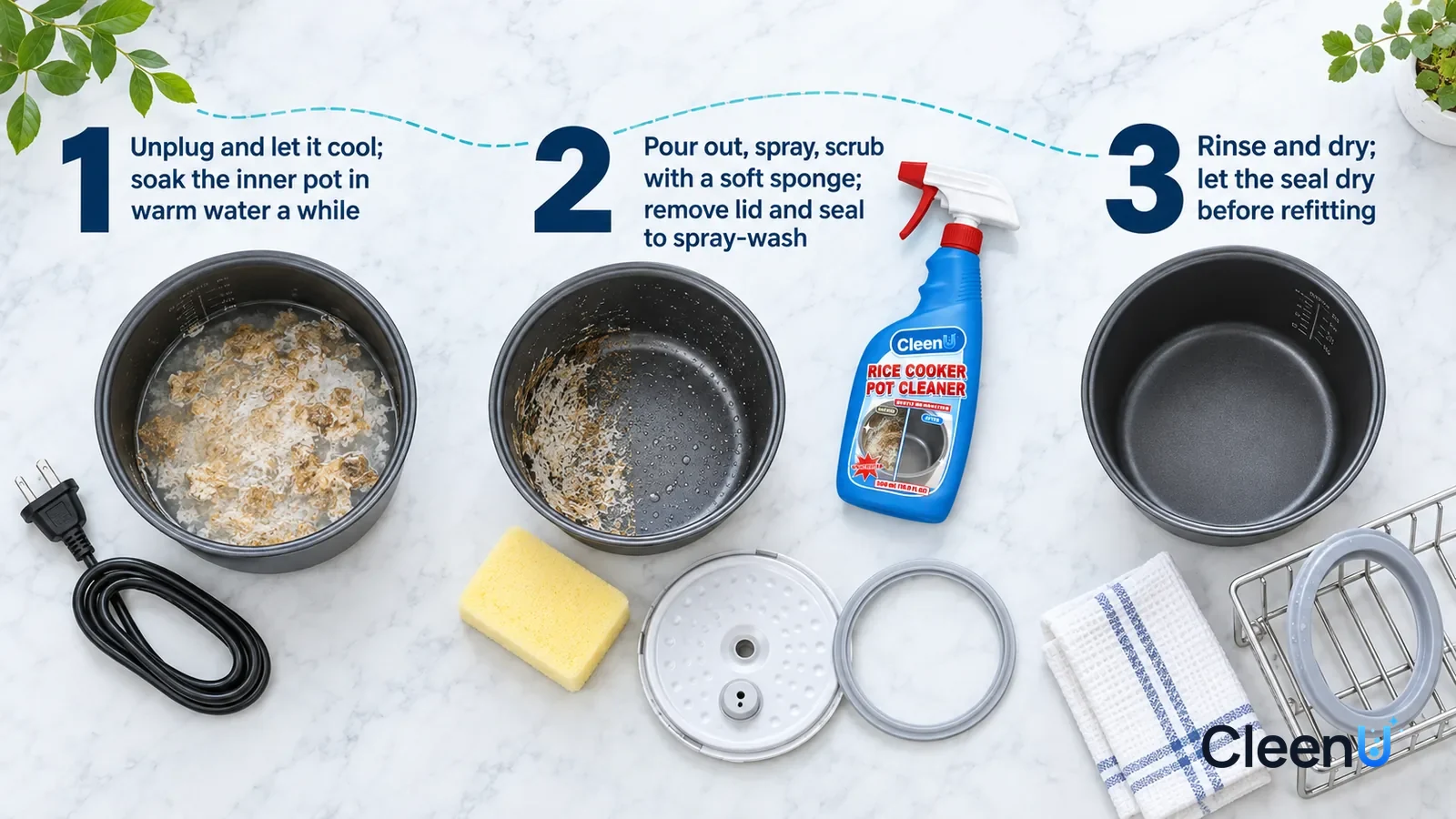
Usage guidance
Use guidance
- Soak the inner pot in warm water for 10 minutes.
- Spray, wipe with a soft sponge, rinse, and dry.
- Remove the lid liner and gasket, spray-wash, and dry before refitting.

Before you use it
Important notes
- Not for: Steel wool and abrasive paste
- Not for: Submerging the cooker body or heating plate
- Not for: Cast iron seasoning
- Not for: Pots with peeling coating
- Test first for special materials, special equipment, or sensitive scenarios.
Product comparison
How to choose a Rice Cooker Pot Cleaner
Use Rice Cooker Pot Cleaner for rice cooker and pressure cooker pots, Kitchen Cleaner for counters, and Steamer Descaler for steamers and steam ovens.
View product comparison
| Decision point | Rice Cooker Pot Cleaner | Steel wool and dish soap |
|---|---|---|
| Nonstick coating | Near-neutral, gentle | Scratches |
| Rice film and scorch | Soak, then wipe | Hard scrubbing |
| Gasket odor | Cleared by washing | Often ignored |
| Hard-water spots | Reduced by citrate | Stay |
Where Rice Cooker Pot Cleaner stands out
Why not steel wool
Most rice cooker and pressure cooker pots are nonstick. Starch sticks to the bottom and sides, scorched rice is worse, and scrubbing with steel wool or abrasive paste quickly scratches and peels the coating. This near-neutral cleaner works after a warm soak softens the rice, with surfactants and sodium citrate lifting starch and grease so a soft sponge does the job.
Lids and gaskets cause the smell
A sour cooker smell usually comes from rice water and condensation trapped in the lid liner, steam vent, and gasket. Remove what comes off, spray-wash, and dry before refitting. Never submerge the cooker body or heating plate; wipe them with a damp cloth, and dry the pot before putting it back so the plate stays dry.
Who it's for, where it's used, and when not to use it
For
End-use scenarios
When not to use it
Product Specifications and Custom Options
Key product details and custom options for your project.
Product specifications
Product type, cleaning scope, and format.
| Product type | Rice cooker nonstick pot cleaner |
| Surfaces | Nonstick inner pots, inner lids, steam vents, and gaskets of rice cookers, electric pressure cookers, and multicookers |
| Applications | Nonstick inner pots, Lids, vents, and gaskets, Multicookers and pressure cookers |
| Main soils | Rice film, scorch, grease, and odor on nonstick inner pots, lid liners, steam vents, and gaskets of rice cookers, pressure cookers, and multicookers |
| How to use | Warm-soak 10 minutes, spray, soft-sponge, rinse; remove and wash lid and gasket, dry |
| Not for / avoid | Steel wool and abrasive paste; Submerging the cooker body or heating plate; Cast iron seasoning; Pots with peeling coating |
| Size & packaging | 500 mL trigger spray bottle |
| pH | pH 6.5–8.0 (25°C) |
| Scent | Unscented |
| Shelf life & storage | 24 months unopened; store sealed in a cool, dry place away from heat, moisture, and freezing |
B2B custom options
Private label, packaging, MOQ, samples, and delivery.
| OEM/ODM & private label | We run Rice Cooker Pot Cleaner private-label projects from positioning and samples to packaging, production, and delivery. |
| Packaging & labels | Fill size, refill, sponge, and labels available |
| Case pack | 12 × 500 mL per case |
| OEM/ODM and private label | Available for project discussion |
| Packaging and labels | Fill size, refill, sponge, and labels available |
| MOQ | 500 bottles |
| Sample time | Free samples in 3–5 days |
| Bulk lead time | Scheduled with the order after packaging and labels are approved |
| Documents | SDS/MSDS, TDS, and batch COA provided with quotes |
OEM/ODM project process
Move from product direction and sample review to packaging, production, and delivery for Rice Cooker Pot Cleaner.
Define the buyer and plan
Choose spray size, whether to include a soft sponge, and whether to supply as an appliance-brand consumable.
Free samples
Free samples are usually ready in 3–5 days for project review.
Packaging and labels
Set fill size, label language, and directions on no steel wool, no submerging the body, and drying gaskets.
Production and delivery
Standard MOQ is 500 bottles; production is scheduled after packaging and labels are approved.
Why choose CleenU for Rice Cooker Pot Cleaner?
From product positioning and samples to packaging and repeat supply, CleenU supports OEM/ODM projects built around Rice Cooker Pot Cleaner.
Nonstick-friendly
Near-neutral and gentle, designed around nonstick pots and silicone gaskets.
Small appliance consumables
Branded cleaning consumables for rice cooker and pressure cooker makers.
Sample testing that means something
We plan sample evaluation on rice cooker and pressure cooker nonstick pots and gaskets: rice film and scorch removal, coating appearance, and odor.
Labels and documents ready
Bilingual label copy, SDS/MSDS, TDS, and batch COAs, with warnings and directions prepared for your target market.
Consistent reorders
Every batch is retained and issued a COA, so reorders match on color, scent, and feel.
Formula discussion
Discuss formula direction based on product positioning, target market, and channel selling points.
Packaging and labeling options
Plan packaging format, label language, and shelf presentation around Rice Cooker Pot Cleaner and your target channel.
Show packaging and label options
Packaging options
Main size: 500 mL trigger spray. Also available: 1 L refill, kits with a soft sponge, and appliance-brand consumable packs, with labels and cartons in your branding.
Supporting Documents and Materials
Purchasers usually confirm whether the materials are complete before formal cooperation. Preparing documents in advance helps with quoting, sampling, and channel review.
Show available documents
Project documents
SDS/MSDS, TDS, batch COA, label directions, and packaging files are provided per project after inquiry.
Related products, solutions, and articles
Explore related cleaning products, application guidance, and OEM/ODM resources for Rice Cooker Pot Cleaner.
Frequently asked questions (FAQ)
Find practical answers about Rice Cooker Pot Cleaner, private label, samples, MOQ, documents, and delivery.
Product, use, and procurement
Why does my rice cooker smell sour?
Usually from rice water left in the inner lid and gasket that ferments. Remove and wash them after each use and the smell won't build up.
Can I keep using a pot with peeling coating?
If the coating is peeling widely, replace the pot. Peeled spots stick and are hard to clean.
How fast can we get samples and a first order?
Free samples ship in 3–5 days. MOQ is 500 bottles, and production is scheduled once packaging and labels are approved.
Product usage questions
How do I use it?
Soak the pot in warm water for 10 minutes, spray, scrub with a soft sponge, and rinse; remove the inner lid and gasket, spray, rinse, and dry before refitting.
When shouldn't I use it?
Never use steel wool or scouring paste on nonstick pots, and never submerge the cooker body or heating plate.
Can I use it on stainless inner pots?
Yes. Soak and wipe stuck rice off with a sponge, then rinse.
What about ceramic pots?
Yes. Avoid knocks, soak, and wipe with a soft sponge.
What if the gasket still smells?
Wash and dry it; replace gaskets that are aged or misshapen.
How often should I wash the lid?
Weekly for the lid liner and vent, more often if you cook porridge a lot.
Can I use it on air fryer baskets?
Yes. Nonstick baskets clean the same way with a soft sponge.
How do I clean the steam vent?
Remove it per the manual, spray-wash, rinse, dry, and refit.
Should I wash a new rice cooker first?
Yes. Wash the pot and lid, then boil and discard one pot of water.
Can it remove yellow stains outside the pot?
Yes. Spray, wait a few minutes, wipe with a soft sponge, and dry before refitting.
How do I get burnt rice off a rice cooker pot?
Soak it first, then wipe; don't scrape. Fill the pot with warm water for 10 minutes, spray, scrub with a soft sponge, and rinse. Repeat the soak if some is left. Skip steel wool and scouring paste on nonstick pots, because scratched coating sticks more and gets harder to clean.
What should I do about mold in my rice cooker?
Focus on removing the rice residue mold grows on; this is a cleaner, not a mold killer or disinfectant. Take out the inner lid, gasket, and steam vent, spray-wash them, rinse, and let them dry fully before refitting. Replace a gasket that is aged or misshapen.
Can I just run my rice cooker with water to clean it?
Not on its own. Boiling water won't reach the rice film in the inner lid, gasket, and steam vent. Wash the pot, remove and wash those parts, then rinse and dry. Running one cycle of plain water and dumping it makes sense after washing a new cooker.
OEM/ODM customization questions
What can we customize?
Formula direction, scent, pack size and format, label design and language, and ecommerce bundles.
What paperwork comes with a private-label order?
Documents such as SDS/MSDS, TDS, COA, and label copy for your target market are prepared per project. We confirm which ones your order includes when we quote.
Launching your own rice cooker cleaner?
Send us your market, sizes, consumable plans, and estimated volume. We'll build it out with you.