

Product and application illustrations. Follow the product label and written use guidance.
CleenU product solution
Rust Remover Spray
Phosphoric acid gel · Leaves a phosphate layer · Private label
Rusty tools, hardware, or bike parts? Brush off loose rust, coat it with gel, wait 5–15 minutes, scrub, rinse, and dry and oil right away to get back to bare metal. Factory-direct private label.
- Rust is iron oxide, porous enough to trap moisture underneath, so it keeps eating inward and gets worse with time. Sanding it off is slow and scuffs the surface. This remover dissolves the oxide with phosphoric acid into something you can rinse away, and a wire brush reveals bare metal.
- After rinsing, a thin phosphate layer slows flash rust, but it isn't long-term protection. Dry the metal and oil or prime it right away; left bare in humidity, flash rust shows up within days. Brands can pair it with a rust-preventive oil as a remove-and-protect kit.
- MOQ
- 500 bottles
- Free samples
- Free samples in 3–5 days
- Bulk lead time
- Scheduled with the order after packaging and labels are approved

Product value
What rust does it remove?
CleenU Rust Remover Spray removes rust from steel tools, hardware, and wrought iron.
View product detailsProduct summary
- Product type
- Phosphoric acid gel rust remover
- Core use
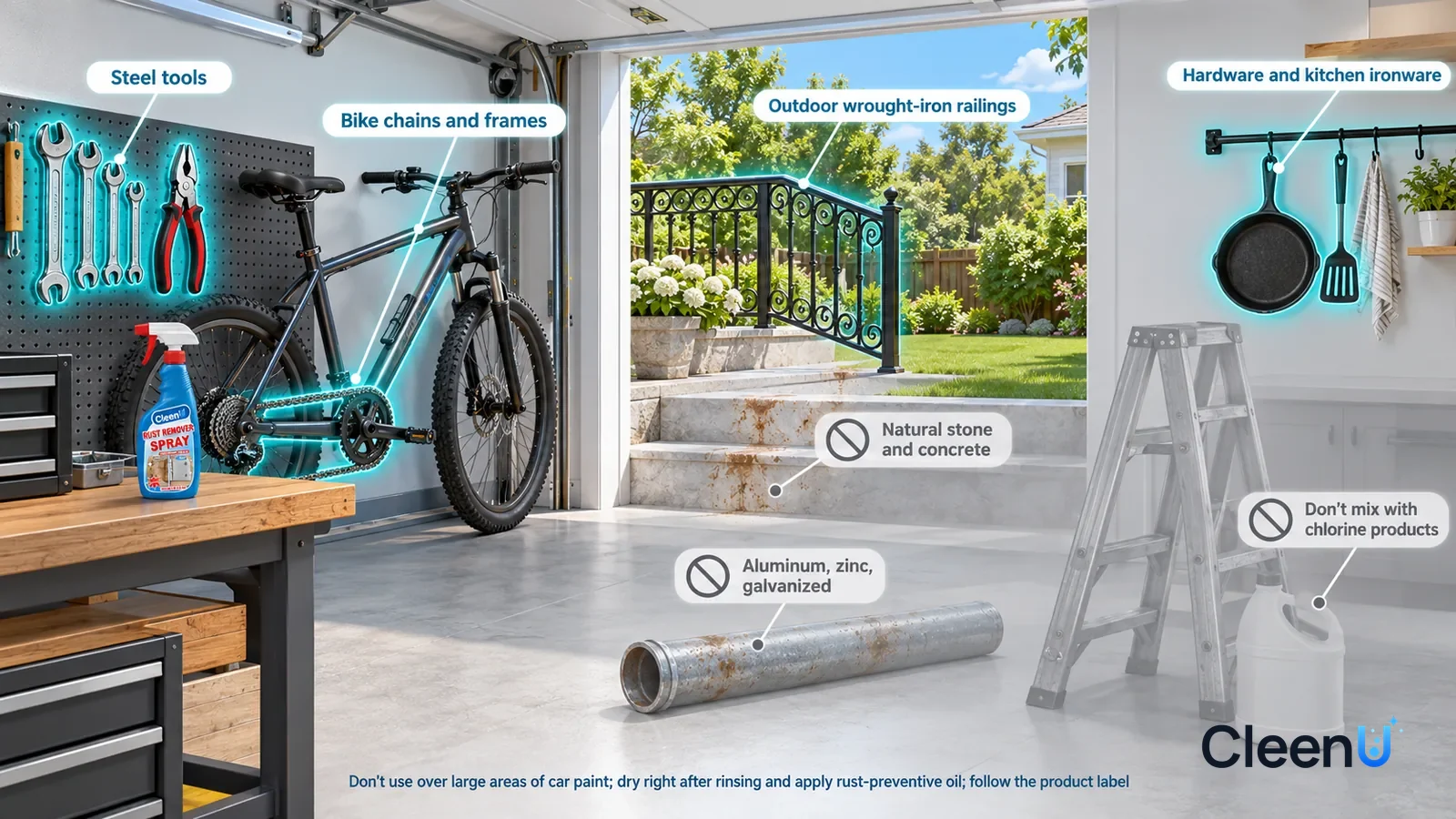
- Rust on steel tools, hardware, bike chains and frames, wrought iron, and chrome
- Formula focus
- Phosphoric acid with inhibitors, thickener, and wetting agent, pH 1.5–2.5; ready-to-use gel, rinses off.
- Best for
- Tool and hardware brands, Car care brands, Building-supply channels, Ecommerce sellers

Before & after
Before and after (illustration)
Before: a steel wrench left in a damp garage is covered in red-brown rust, with black rust in the jaws. After: loose rust brushed off, gel left 15 minutes, scrubbed, and rinsed, the wrench shows gray bare metal and stays clean once dried and oiled.
- Before: red-brown rust, black jaws
- After gel, scrub, rinse: bare metal
- Dried and oiled: no flash rust

How it works
How rust dissolves
Rust is mainly hydrated iron oxide and iron hydroxide, loosely structured. Hydrogen ions from phosphoric acid react with the oxide to form soluble iron phosphate and water, and leave a dense iron phosphate conversion coating on the steel. Thickeners make the gel cling, inhibitors limit attack on the base metal, and water rinses the products away.
- Brush off loose rust
- Coat with gel
- Phosphoric acid dissolves oxide
- Wait 5–15 minutes, wire-brush
- Rinse, dry, and oil

Usage guidance
Use guidance
- Brush off loose rust with a wire brush and coat the rust with gel.
- Wait 5–15 minutes (up to 30 for heavy rust), then scrub with a wire brush or pad.
- Rinse, dry immediately, and apply rust-preventive oil or primer.
Before you use it
Important notes
- Not for: Marble, limestone, other natural stone, and concrete
- Not for: Long contact with aluminum, zinc, or galvanized parts
- Not for: Large areas of car paint
- Not for: Mixing with chlorine products
- Test first for special materials, special equipment, or sensitive scenarios.
Product comparison
How to choose a Rust Remover Spray
Use Rust Remover Spray for rust on steel tools and iron, Stone Rust Stain Remover for rust stains on stone floors and counters, and Stainless Steel Cleaner & Polish for routine stainless care.
View product comparison
| Decision point | Rust Remover Spray | Sanding |
|---|---|---|
| Rust in crevices and texture | Gel gets in and dissolves it | Can't reach |
| Metal surface | No abrasion | Leaves scratches |
| Flash rust | Slowed by phosphate layer | Returns quickly |
| Effort | Let it sit, then scrub | Slow and tiring |
Where Rust Remover Spray stands out
Why rust keeps spreading
Rust is iron oxide, porous enough to trap moisture underneath, so it keeps eating inward and gets worse with time. Sanding it off is slow and scuffs the surface. This remover dissolves the oxide with phosphoric acid into something you can rinse away, and a wire brush reveals bare metal.
Protect it right after
After rinsing, a thin phosphate layer slows flash rust, but it isn't long-term protection. Dry the metal and oil or prime it right away; left bare in humidity, flash rust shows up within days. Brands can pair it with a rust-preventive oil as a remove-and-protect kit.
Who it's for, where it's used, and when not to use it
For
End-use scenarios
When not to use it
Product Specifications and Custom Options
Key product details and custom options for your project.
Product specifications
Product type, cleaning scope, and format.
| Product type | Phosphoric acid gel rust remover |
| Surfaces | Steel tools, hardware, bike chains and frames, wrought iron, cast iron exteriors, and chrome |
| Applications | Rusty garage tools, Wrought iron and railings, Rust spots on bike chains and frames |
| Main soils | Rust on steel tools, hardware, bike chains and frames, wrought iron, and chrome |
| How to use | Brush off loose rust, coat, wait 5–15 minutes, wire-brush, rinse, dry, and oil |
| Not for / avoid | Marble, limestone, other natural stone, and concrete; Long contact with aluminum, zinc, or galvanized parts; Large areas of car paint; Mixing with chlorine products |
| Size & packaging | 500 mL gel trigger bottle |
| pH | pH 1.5–2.5 (25°C) |
| Scent | Unscented |
| Shelf life & storage | 24 months unopened; store sealed in a cool, dry, ventilated place away from heat, sun, and freezing |
B2B custom options
Private label, packaging, MOQ, samples, and delivery.
| OEM/ODM & private label | We run Rust Remover Spray private-label projects from positioning and samples to packaging, production, and delivery. |
| Packaging & labels | Gel or soak, acid strength, fill size, labels, and kits available |
| Case pack | 12 × 500 mL per case |
| OEM/ODM and private label | Available for project discussion |
| Packaging and labels | Gel or soak, acid strength, fill size, labels, and kits available |
| MOQ | 500 bottles |
| Sample time | Free samples in 3–5 days |
| Bulk lead time | Scheduled with the order after packaging and labels are approved |
| Documents | SDS/MSDS, TDS, and batch COA provided with quotes |
OEM/ODM project process
Move from product direction and sample review to packaging, production, and delivery for Rust Remover Spray.
Define the buyer and plan
Choose household or auto and industrial positioning, gel spray or soak, and whether to pair it with rust-preventive oil.
Free samples
Free samples are usually ready in 3–5 days for project review.
Packaging and labels
Set acid strength, fill size, label language, and directions on gloves and eye protection, stone, and oiling afterward.
Production and delivery
Standard MOQ is 500 bottles; production is scheduled after packaging and labels are approved.
Why choose CleenU for Rust Remover Spray?
From product positioning and samples to packaging and repeat supply, CleenU supports OEM/ODM projects built around Rust Remover Spray.
Acid strength tuned to the metal
Steel, cast iron, and chrome tolerate acid differently, so we balance speed against effect on the base metal.
Gel and soak formats
Gel spray for vertical and large parts, soak for tools and small parts; mix by channel.
Sample testing that means something
We plan sample evaluation around nails, tools, and steel panels at different rust levels: removal time, surface condition, and time to flash rust.
Labels and documents ready
Bilingual label copy, SDS/MSDS, TDS, and batch COAs, with warnings and directions prepared for your target market.
Consistent reorders
Every batch is retained and issued a COA, so reorders match on color, scent, and feel.
Formula discussion
Discuss formula direction based on product positioning, target market, and channel selling points.
Packaging and labeling options
Plan packaging format, label language, and shelf presentation around Rust Remover Spray and your target channel.
Show packaging and label options
Packaging options
Main size: 500 mL gel trigger. Also available: 1 L soak, channel case packs, and ecommerce bundles with rust-preventive oil and a wire brush, with labels and cartons in your branding.
Supporting Documents and Materials
Purchasers usually confirm whether the materials are complete before formal cooperation. Preparing documents in advance helps with quoting, sampling, and channel review.
Show available documents
Project documents
SDS/MSDS, TDS, batch COA, label directions, and packaging files are provided per project after inquiry.
Related products, solutions, and articles
Explore related cleaning products, application guidance, and OEM/ODM resources for Rust Remover Spray.
Frequently asked questions (FAQ)
Find practical answers about Rust Remover Spray, private label, samples, MOQ, documents, and delivery.
Product, use, and procurement
How does a rust remover work?
Rust is iron oxide. This formula's phosphoric acid dissolves it into something you can rinse away and leaves a thin phosphate layer on the steel that slows flash rust.
Why a gel spray?
Thin liquids run right off vertical surfaces and out of tool crevices. A gel clings to the rust long enough to work and goes further.
How soon will it rust again?
That depends on what you do next. Rinse, dry, and immediately oil or prime the metal and it stays clean a long time. Leave it bare in humidity and flash rust shows up in days.
What should we decide first for a private-label rust remover?
Market, format, and kit. Household all-purpose or auto and industrial, gel spray or a soak (soaks suit tools and small parts), and whether to pair it with a rust-preventive oil as a remove-and-protect kit.
How fast can we get samples and a first order?
Free samples ship in 3–5 days. MOQ is 500 bottles, and production is scheduled once packaging and labels are approved.
What's the difference between a rust remover and a rust converter?
Choose a remover when you want bare, clean metal; choose a converter only when you plan to paint over rust without removing it. This spray uses phosphoric acid to dissolve iron oxide so you can rinse it away, and it leaves a thin phosphate layer that slows flash rust. A converter turns the rust layer into a paintable base and leaves it in place.
Product usage questions
How do I use it?
Brush off loose rust, coat the rust with gel, wait 5–15 minutes (up to 30 for heavy rust), scrub with a wire brush or pad, rinse, dry immediately, and oil.
What shouldn't I use it on?
Marble, limestone, other natural stone, and concrete will etch, so use a stone rust remover for those. Keep contact short on aluminum, zinc, and galvanized parts, and spot-treat rust on car paint and rinse right away.
Can I use it on rust spots on chrome faucets?
Yes. Dab it on, wipe and rinse within 1–2 minutes, and don't let it sit on the plating.
What precautions should I take?
It's acidic: wear acid-resistant gloves and eye protection, ventilate, and never mix it with chlorine products.
Can I use it on a rusty bike chain?
Yes. Rinse, dry, and always re-lube afterward.
Should I protect metal after derusting?
Yes. Apply rust-preventive oil or paint once dry, or rust will return.
Can I use it on rust stains on marble?
No. Marble is acid-sensitive; use a stone rust remover.
Does rust remover spray really work on heavy rust?
Yes on surface rust and moderate scale; deep pitting is a different job. Brush off loose flakes first so the gel reaches the rust, let it sit up to 30 minutes on heavy rust, scrub, and repeat if needed. Pitted areas will come out clean, but the metal the rust already ate doesn't come back.
Can I use it on stainless steel?
Yes, as a quick spot treatment. Rust spots on stainless are usually surface deposits, so dab the gel on, wipe within 1–2 minutes, rinse, and dry. Test a hidden spot first, and skip the wire brush on brushed or polished finishes.
OEM/ODM customization questions
What can we customize?
Formula direction and acid strength, gel or soak, fill size (500 mL gel spray, 1 L soak, and more), label design and language, and kits with rust-preventive oil and a wire brush.
How should we test samples?
Use nails, tools, and steel panels at different rust levels, and record removal time, surface condition, and time to flash rust after rinsing. That tells you more than a before-and-after photo.
What paperwork comes with a private-label order?
Documents such as SDS/MSDS, TDS, COA, and label copy for your target market are prepared per project. We confirm which ones your order includes when we quote.
Launching your own rust remover?
Send us your market, household or industrial, gel or soak, and estimated volume. We'll build out product and safety copy with you.