
Q&A
Can You Use Limescale Remover on Marble?
Direct answer
No. Marble is mostly calcium carbonate, and acidic products like limescale removers, toilet bowl cleaners, and vinegar react with it and etch dull spots that won't wipe away. For water spots on a marble vanity, use a neutral cleaner labeled for natural stone, and dry the surface after each use.
On a marble countertop, can you use this?
Yes
- A neutral cleaner labeled for natural stone
No
- Limescale removers and faucet descalers: strong acid that can etch a dull spot in minutes
- Toilet bowl cleaner and toilet gel: acidic, and splashes etch the same way
- White vinegar, lemon juice, or soda: weak acids, but they still etch if left on
- Mildly acidic bathroom cleaners: fine on tile and glass, not on marble
It depends
- Granite and quartz: more acid-resistant than marble, but regular acid wears down their sealers, so neutral is still best
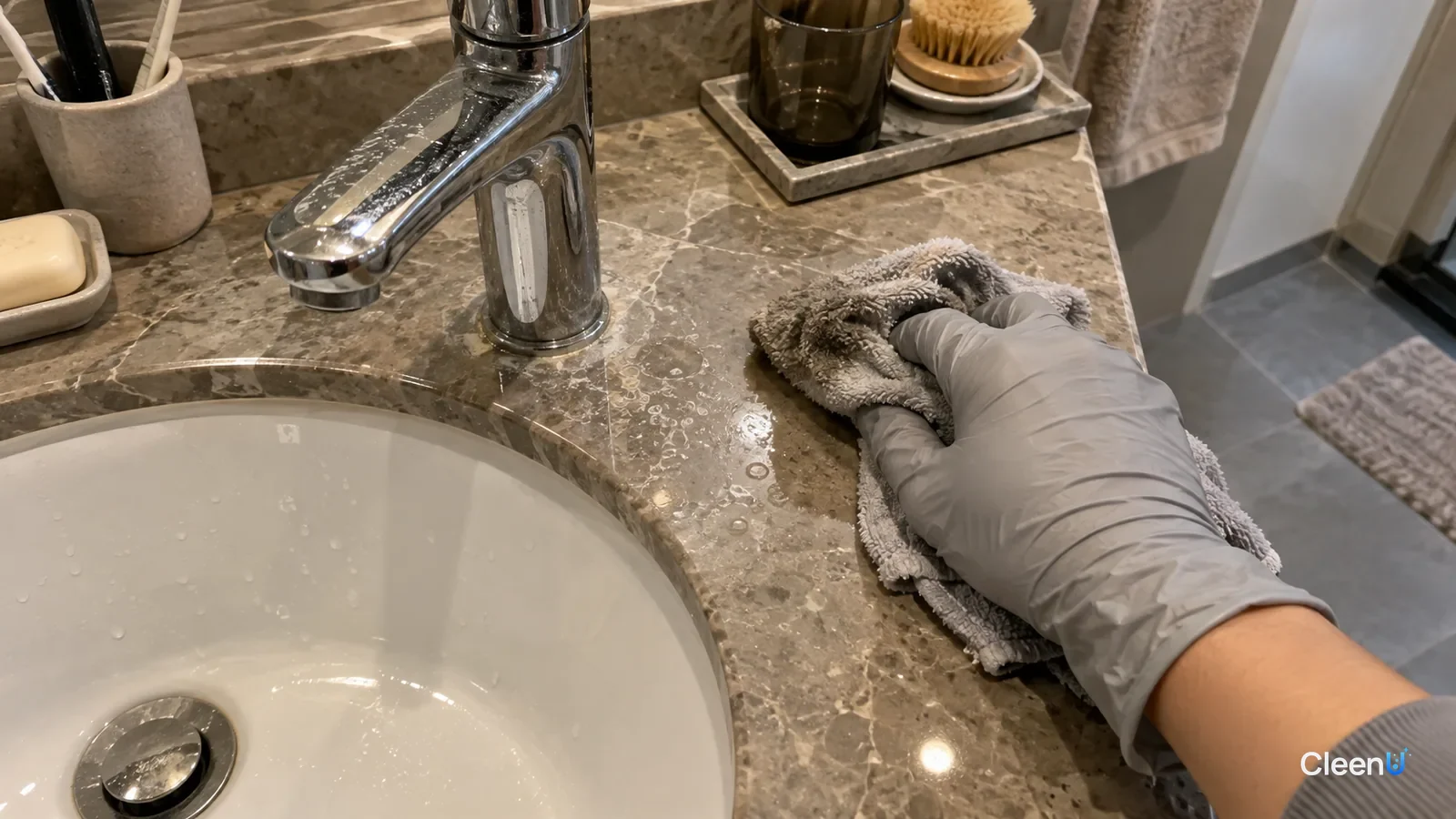
On a marble bathroom vanity, a white ring of water spots eventually forms around the faucet base and the edge of the sink. It's tempting to grab a descaler and spray. The spots disappear, but now there's a pale, dull patch that feels rough, and no amount of wiping removes it.
That's acid eating into the marble. Knowing what marble can't handle lets you remove water spots without damaging the stone.
Why marble and acid don't mix
Marble is limestone transformed by heat and pressure, and it's mostly calcium carbonate, sometimes with magnesium carbonate. That's the same compound as limescale.
Descalers work because their acid reacts with calcium carbonate to form water-soluble calcium salts, water, and carbon dioxide. But acid can't tell scale from countertop. While it dissolves the scale, it dissolves the stone too.
Polished marble is flat and reflects light like a mirror. Once acid dissolves a thin layer, the surface is rough and uneven, light scatters, and you see a dull, pale, or darkened mark. In the stone trade that's called etching. It's physical damage that cleaners and wax can't hide; only professional honing and polishing restore it.
Limestone, travertine, and terrazzo with marble chips have the same weakness. Quartz and granite are more acid-resistant, but they're usually sealed, and regular acid use breaks down the sealer and makes them stain more easily.
How to handle water spots on marble
White spots on a vanity are mostly minerals left as water evaporates, plus soap, toothpaste, and face wash residue. The approach is no acid; rely on surfactants, a chelating agent, and drying the surface.
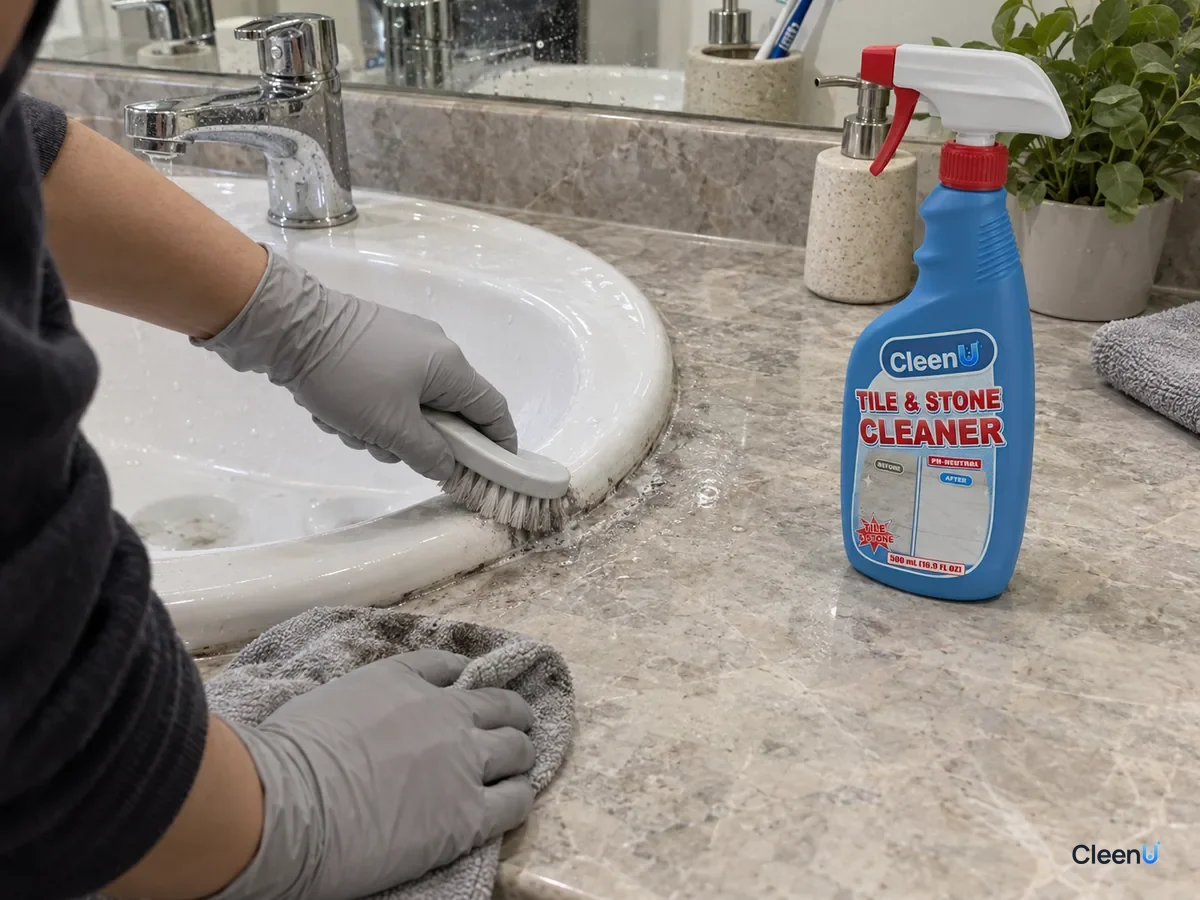
Take CleenU Tile & Stone Cleaner as an example. It's a pH-neutral daily tile and stone cleaner, pH 7.0 to 8.5 as supplied, made with nonionic surfactants and a chelating agent, with no acids, no chlorine, and no abrasives, ready to spray and wipe. The surfactants emulsify soap, face wash, and skin oil residue; the chelating agent binds calcium and magnesium, helping lift light, fresh water spots and reducing new marks. With no acid, it doesn't react with calcium carbonate.
It's made for tile, marble, granite, quartz, terrazzo, and other sealed hard surfaces. It isn't a treatment for rust or oil stains in stone and shouldn't be alternated with acidic cleaners.
To be clear, a neutral cleaner works on fresh, light water spots but has limited effect on heavy, long-standing buildup. Don't reach for acid in that case. Call a stone care professional, who'll use stone-specific methods.
Day-to-day care for a marble vanity
After using the sink, wipe the counter dry, especially around the faucet and sink rim. It's the single best way to prevent water spots.
Wipe the counter daily or every other day with neutral stone cleaner sprayed onto a cloth.
Wipe up toothpaste, face wash, and makeup right away, and set shampoo and body wash bottles on a tray.
When descaling the faucet or sink, cover the surrounding marble with a towel, apply descaler to a cloth to treat only the faucet, and rinse and dry immediately so nothing drips onto the stone. For descaling fixtures, see How to clean a bathroom.
Store toilet bowl cleaner, acidic bathroom cleaners, and descalers away from the marble so leaks and drips can't reach it.
White ring, dark spot, or dull patch: figure out which one you have
Anything that looks "white" or "off" on a marble vanity comes from at least three different sources, and each one needs a different response.
The first is mineral and soap buildup sitting on the surface. The area around a faucet gets wet constantly. As water evaporates, it leaves calcium and magnesium behind, and those combine with fatty acids from bar soap and face wash to form soap scum. This kind of mark sits on top of the stone. A fingernail drags across it and it feels chalky or gritty. Wipe it with a cloth dampened with neutral cleaner and the white fades a bit with each pass. This one is cleanable.
The second is a water or oil mark that has soaked into the stone. Marble has tiny pores, and skin care products, oils, or colored liquids can wick in and leave a darker patch. It feels just as smooth as the stone around it, and wiping barely changes it. Some water marks fade on their own as the stone dries out over a few days. This isn't surface grime, so scrubbing won't help. Deep stains are a job for a stone care professional, who typically uses a poultice to draw them out.
The third is etching, which sits below the surface. Tilt your head and look across it toward a light. The patch has lost its mirror-like reflection, often in the exact shape of a drip or splash, and it feels slightly rougher than the polished stone next to it. Etching isn't dirt, and no cleaner will remove it.
A simple test helps: put a drop of plain water on the mark and compare how it reflects light against the surrounding stone. Surface buildup looks less different after each wipe. Etching and absorbed stains look exactly the same no matter how many times you wipe.
The right way to wipe marble with a neutral cleaner
Spray the cloth, not the counter. Puddles on the counter run along the sink rim and into seams, and damp stone backing and caulk lines tend to show water marks over time.
Do the open surface first and the faucet base last. Soap marks and fingerprints on the open counter come off with one pass in a single direction. The ring around the faucet is the thickest buildup, so hold the damp cloth against it for a little while. That gives the surfactants time to wet and soften the soap scum and lets the chelating agent bind the calcium in it. Then work around the faucet base with a soft cloth or soft-bristle brush. Skip steel wool and the rough side of a scrub sponge. They leave fine scratches in polished marble, and scratched areas reflect light poorly, so the counter looks dirty even when it's clean.
Drying is the finish, not an extra. Use a dry microfiber cloth to pick up every bit of water on the counter and around the faucet. A chelating agent helps reduce new water marks, but a puddle left to evaporate will still leave minerals behind.
"It's sealed, so acid is fine" is a myth
Most marble vanities get a penetrating sealer when they're installed. That sealer reduces how much water and oil the stone absorbs, which helps prevent dark stains. It does not put an acid-proof film on top. Acid still reaches the calcium carbonate directly, so a sealed marble counter etches from descaler or vinegar just like an unsealed one. Sealers also wear down over time and with cleaning. To check, put a few drops of water on the stone. If they soak in quickly and darken the marble, the sealer is weakening and it's worth asking a stone care professional to reseal.
Honed marble, the matte finish, doesn't reflect light the way polished marble does, so etching is harder to see. The damage still happens, the surface stains more easily afterward, and acid is still off-limits.
If acid gets on it by accident
Rinse with plenty of water right away and blot dry. The faster you act, the less etching.
Etching that's already formed won't clean away. Light etching can be treated with a marble polishing powder per its directions; for larger or more noticeable marks, call a stone care professional to hone and polish.
How to tell if your counter is marble
The most reliable way is to ask your contractor or check the purchase records. Clues: natural marble has irregular veining that differs from slab to slab, and it's softer than granite, so a light scratch with a knife in a hidden spot leaves a mark more easily (don't test anywhere visible). When in doubt, treat it as marble and use only neutral products.
For marble floors, see How to clean every type of floor.
Stop if you see this
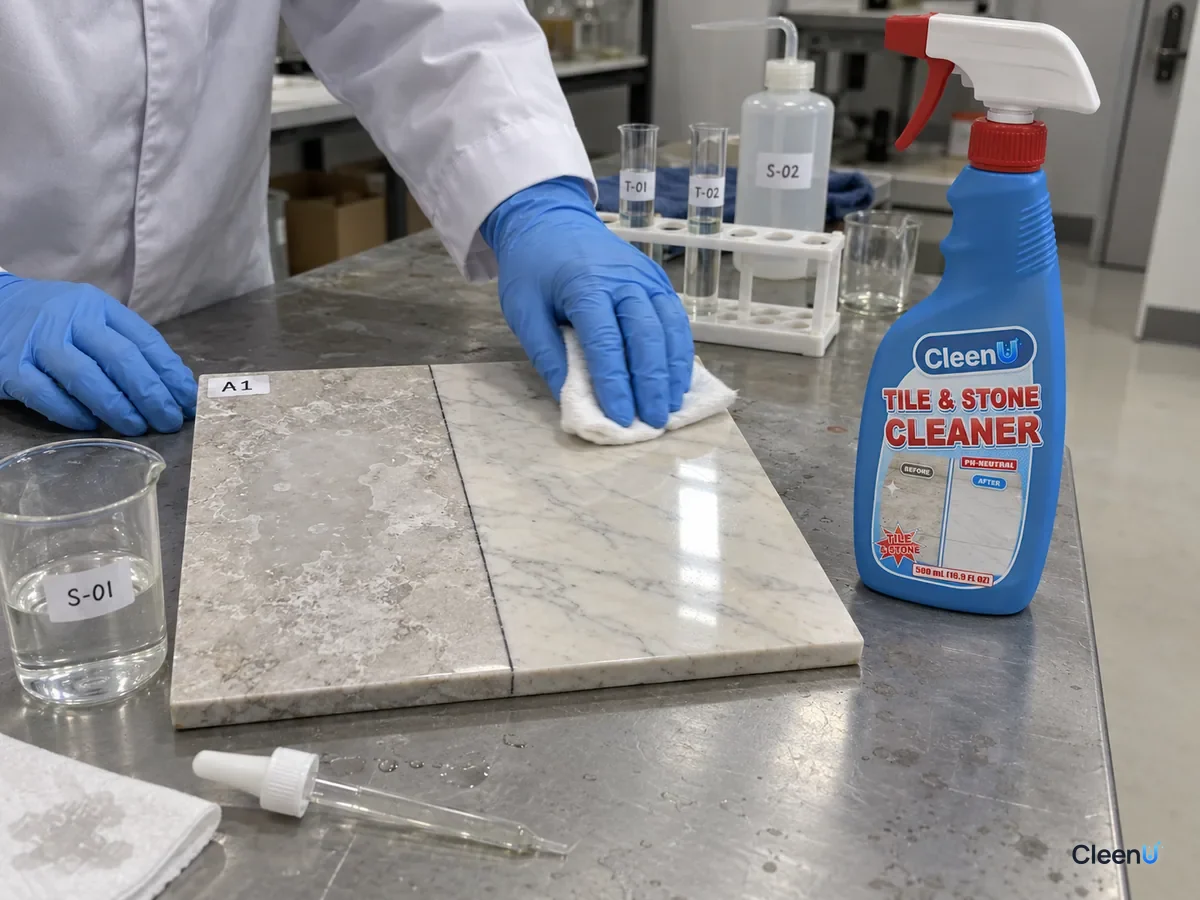
If the counter shows dull, pale, or rough patches, stop using the current product and rinse with water. Don't try to sand or polish it yourself; call a professional. Keep acidic cleaners, descalers, toilet bowl cleaners, and vinegar off marble, limestone, and terrazzo, and cover the counter before descaling the faucet.
Cleaning marble countertops: common questions
Can I use descaler on a marble countertop?
No. Descalers are acidic and react with the calcium carbonate in marble, etching dull spots that won't wipe away.
How do I remove white water spots from a marble vanity?
For fresh, light spots, spray neutral stone cleaner on a cloth, wipe, and dry. Leave heavy, long-standing buildup to a stone care professional.
Can I clean marble with vinegar?
No. Vinegar is a weak acid, but left on the stone it still etches.
Can I use acidic cleaners on quartz?
Quartz is more acid-resistant than marble, but regular acid can damage its surface treatment, so a neutral cleaner is still the better daily choice.
Can etching on marble be repaired?
Not with cleaning. Light etching may respond to marble polishing powder; heavier etching needs professional honing and polishing.
How do I prevent water spots on a marble vanity?
Wipe the counter dry after each use, especially around the faucet. That's the most effective prevention.
For a neutral stone cleaner with no acid or chlorine and a chelating agent to cut water spots, made for everyday care of marble, granite, and quartz counters, take a look at our Tile & Stone Cleaner.
Marble, limestone, and terrazzo counters can't take limescale removers, toilet bowl cleaners, or vinegar. They're made of calcium carbonate, the same compound as limescale, so acid that dissolves scale also etches the stone, leaving dull spots that can't be wiped away. Treat water spots with a neutral cleaner labeled for natural stone, and wipe the counter dry after each use. Leave heavy scale to a stone professional, cover the counter when descaling fixtures, rinse immediately if acid gets on it, and have existing etching professionally honed and polished.