
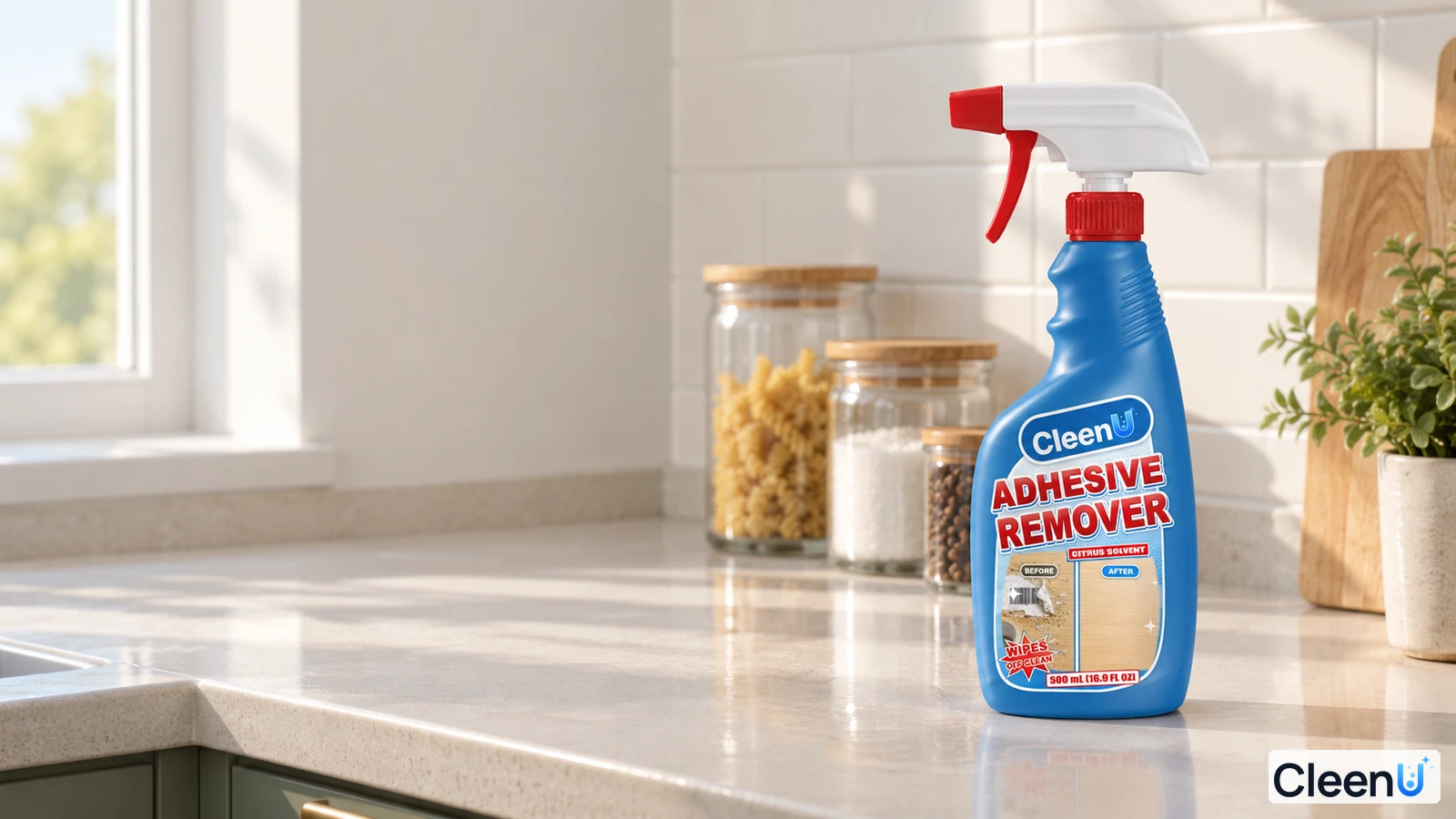
Product and application illustrations. Follow the product label and written use guidance.
CleenU product solution
Adhesive Remover
Citrus solvent · Softens and wipes off · Private label
Sticky label glue on jars, glass, or appliances that hot water won’t touch? Spray, wait 1–3 minutes until it turns cloudy and soft, and it wipes off in clumps. Citrus-scented, ready to use; private label from 500 bottles.
- Most label adhesives are acrylic or rubber blended with tackifying resins. When you peel a label, the adhesive splits and half stays on the jar. It doesn't dissolve in water, so soap and hot water only smear it wider. The citrus solvents in this remover are chemically similar to the adhesive, so within a minute or two they soak in, swell it, turn it cloudy, and kill the tack. Then one push with a cloth rolls it off in clumps.
- Reused glass jars, new cookware and appliances, and old window decals are where residue shows up most. A thin layer comes off after one spray; for old or thick adhesive, let it sit 5 minutes before wiping. Solvents leave a slight oily feel, so finish with a damp cloth or warm water with a drop of dish soap and the surface is left dry, without a film that attracts dust.
- MOQ
- 500 bottles
- Free samples
- 3–5 days
- Bulk lead time
- Scheduled with the order

Product value
What does Adhesive Remover clean?
Adhesive Remover takes off the sticky residue left on glass, ceramic, metal, and hard plastic after you peel a label or sticker.
View product detailsProduct summary
- Product type
- Solvent-based liquid adhesive remover
- Intended use
- Residue left after removing labels, price tags, and stickers
- Formula
- Built on citrus terpene and ester solvents with a small amount of surfactant to help the wipe-off emulsify; pH 6.5–8.0, ready to use, no dilution.
- For
- Cleaning product brands, hardware and home-improvement retail, property and janitorial buyers, ecommerce sellers

Before & after
Before and after (use illustration)
Before: a grey-white patch of adhesive where the label was, with paper fibers and dust stuck to the edges, tacky to the touch. After: sprayed, left to soften, wiped, and finished with a damp cloth, the patch is gone, the glass is clear, and it feels smooth.
- Before: a grey, tacky patch with paper and dust stuck in it
- After: the glue rolls off, and the glass is clear and smooth
- A damp-cloth finish leaves no oily film

How it works
How Adhesive Residue Comes Off
Pressure-sensitive adhesive is an elastic polymer blended with tackifying resin; it sticks through chain entanglement and by wetting the surface. Small, low-polarity citrus and ester solvents slip between the polymer chains and swell the layer. As the entanglement loosens, the adhesive loses cohesion and tack and turns into a soft paste. A cloth or plastic scraper then pushes it off in one piece, and a damp cloth removes the leftover solvent so no film remains.
- Penetrate
- Swell
- Lose tack
- Wipe off in clumps
- Damp-cloth finish

Usage guidance
Use guidance
- The first time you use it on acrylic, polystyrene, or a painted finish, test a hidden spot; solvents can haze or craze these surfaces.
- Peel off as much of the paper layer as you can so only adhesive is left; thick paper soaks up the cleaner.
- Spray until the residue is covered and wait 1–3 minutes, up to 5 on old or thick adhesive, until it turns cloudy and soft.
- Push it off in one direction with a dry cloth or plastic scraper, switching to a clean section as it rolls up. Finish with a damp cloth.
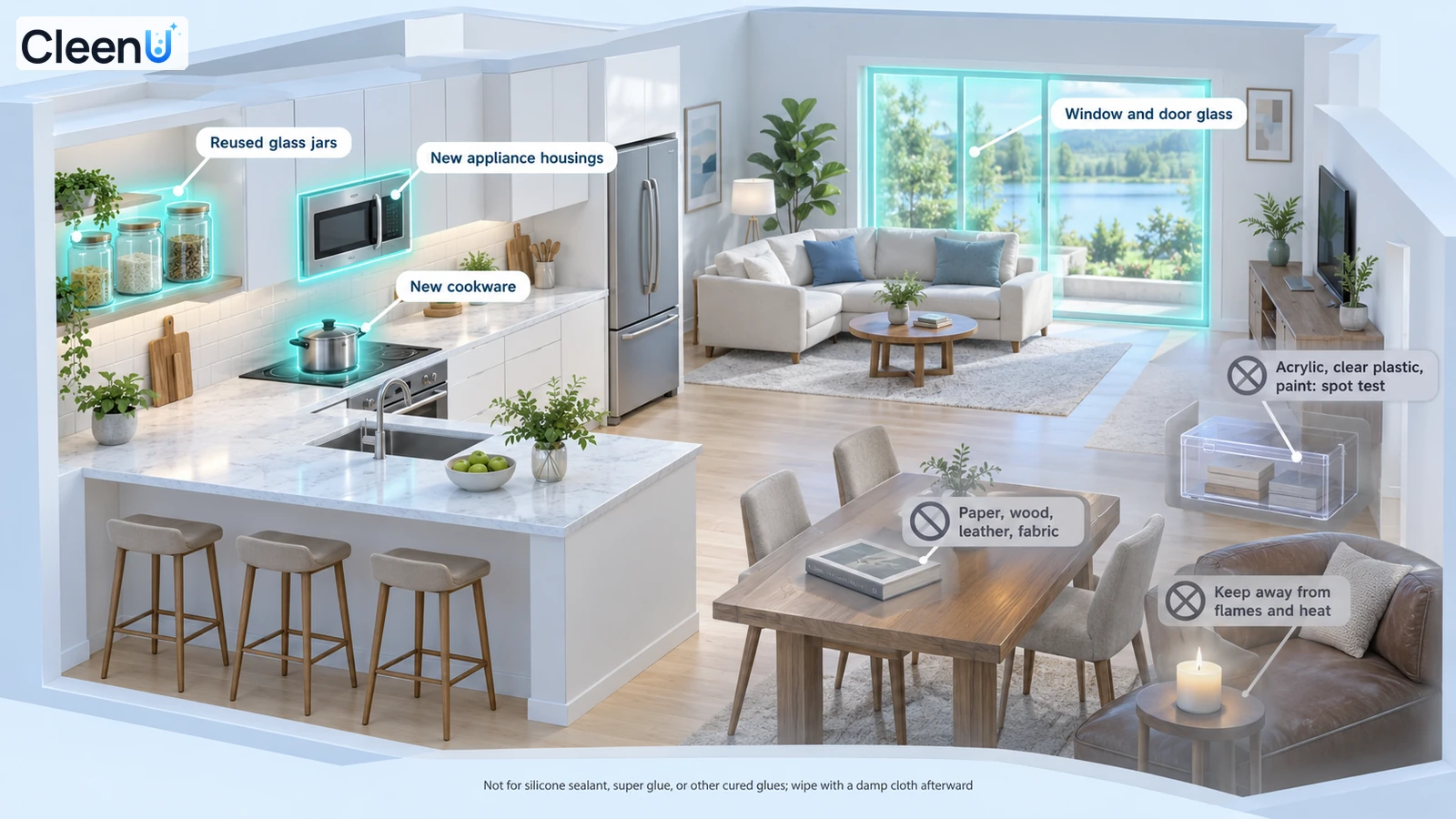
Before you use it
Important notes
- Not for: Acrylic, polystyrene, and painted or lacquered finishes that have not been spot-tested
- Not for: Paper, unfinished wood, leather, and fabric
- Not for: Anywhere near flames or heat
- Not for: Cured adhesives such as silicone caulk, construction adhesive, and super glue
- Test first for special materials, special equipment, or sensitive scenarios.
Product comparison
How to choose an Adhesive Remover
For a fresh label, warming it with a hair dryer and peeling slowly reduces residue. For adhesive already left on the surface, use Adhesive Remover. For years-old, thick, hardened residue on hard surfaces, use the Adhesive Residue Remover.
View product comparison
| Decision point | Adhesive Remover | Hot water and dish soap |
|---|---|---|
| Target | Pressure-sensitive adhesive residue | Dust and water-soluble soil |
| How it works | Solvents swell the adhesive and break its tack | Softens paper, barely touches adhesive |
| Result | Rolls off in clumps | Smears and spreads |
| Finish | Damp cloth to remove solvent | Dry off |
Where Adhesive Remover stands out
Residue Is Adhesive, Not Dirt: Dissolve It, Then Wipe
Most label adhesives are acrylic or rubber blended with tackifying resins. When you peel a label, the adhesive splits and half stays on the jar. It doesn't dissolve in water, so soap and hot water only smear it wider. The citrus solvents in this remover are chemically similar to the adhesive, so within a minute or two they soak in, swell it, turn it cloudy, and kill the tack. Then one push with a cloth rolls it off in clumps.
Jars, Glass, Appliance Panels: No Oily Film Left Behind
Reused glass jars, new cookware and appliances, and old window decals are where residue shows up most. A thin layer comes off after one spray; for old or thick adhesive, let it sit 5 minutes before wiping. Solvents leave a slight oily feel, so finish with a damp cloth or warm water with a drop of dish soap and the surface is left dry, without a film that attracts dust.
Who it's for, where it's used, and when not to use it
For
End-use scenarios
When not to use it
Product Specifications and Custom Options
Key product details and custom options for your project.
Product specifications
Product type, cleaning scope, and format.
| Product type | Solvent-based liquid adhesive remover |
| Surfaces | Label and sticker residue on glass, ceramic, metal, and hard plastic |
| Use scenarios | Reusing glass jars; New appliances and cookware; Window and windshield decals |
| Target soils | Residue left after removing labels, price tags, and stickers |
| Directions | Ready to use, no dilution; 1–3 min dwell, up to 5 min on thick residue |
| Not for | Acrylic, polystyrene, and painted or lacquered finishes that have not been spot-tested; Paper, unfinished wood, leather, and fabric; Anywhere near flames or heat |
| Size and packaging | 500 mL trigger spray bottle |
| pH | pH 6.5–8.0 at 25°C |
| Scent | Fresh citrus scent |
| Shelf life and storage | 24 months unopened; keep tightly closed in a cool, ventilated place away from ignition sources, heat, and direct sunlight |
B2B custom options
Private label, packaging, MOQ, samples, and delivery.
| OEM/ODM and private label | From product direction and sample review to packaging, production, and delivery for your Adhesive Remover project. |
| Packaging and labels | Mist trigger / foam trigger, fill size, labels, and retail sets can be customized |
| Case pack | 12 × 500 mL per case |
| MOQ | 500 bottles |
| Sample time | Free sample: 3–5 days |
| Bulk lead time | Scheduled with the order after packaging and label approval |
| Documents | SDS/MSDS, TDS, and batch COA provided per project on inquiry |
OEM/ODM project process
Move from product direction and sample review to packaging, production, and delivery for Adhesive Remover.
Define the adhesive you target
Decide between household label residue and heavier industrial tape or commercial labels. The adhesive type sets the solvent system and working speed.
Free sample
A free sample is usually ready in 3–5 days for project review.
Packaging and labels
Set fill size, trigger type, label language, the warnings your market requires, and a spot-test-on-plastic and keep-away-from-flames note.
Bulk delivery
Standard MOQ is 500 bottles; bulk orders are scheduled after packaging and labels are approved.
Why choose CleenU for Adhesive Remover?
From product positioning and samples to packaging and repeat supply, CleenU supports OEM/ODM projects built around Adhesive Remover.
Solvent system set by adhesive type
Acrylic and rubber adhesives respond differently to solvents. The ratio of citrus terpenes to esters sets speed, odor, and how gentle it is on plastics. We start from your target adhesive and surfaces.
Spray or gel, matched to the surface
Spray suits jars and flat surfaces; gel clings to windows and walls without running, which suits decals. We make both.
Sample reviews with clear criteria
Review samples on your glass, plastic, and metal panels with label residue against clear points: time to soften, wipe passes, oily film after wiping, and effect on common plastics.
Citrus or low-odor
Citrus masks solvent odor and consumers like it; a low-odor version suits offices and commercial use.
Labels and documents
We supply bilingual labels, SDS/MSDS, TDS, and batch COAs, with a spot-test-on-plastic and keep-away-from-flames note on the label, and can arrange third-party testing for your market.
Consistent supply and reorders
Each batch is retained and ships with a COA, so reorders match in color, scent, and feel.
Packaging and labeling options
Plan packaging format, label language, and shelf presentation around Adhesive Remover and your target channel.
Show packaging and label options
Packaging options
Core size: 500 mL trigger spray bottle. Also available: 1 L household refill, channel case packs, and ecommerce bundles with a plastic scraper and cloths. Mist trigger or foam trigger options, with labels and cartons made to your brand.
Supporting Documents and Materials
Purchasers usually confirm whether the materials are complete before formal cooperation. Preparing documents in advance helps with quoting, sampling, and channel review.
Show available documents
Project documents
When you inquire, we provide SDS/MSDS, a TDS, batch COAs, label directions, and packaging files for your project.
Related products, solutions, and articles
Explore related cleaning products, application guidance, and OEM/ODM resources for Adhesive Remover.
Frequently asked questions (FAQ)
Find practical answers about Adhesive Remover, private label, samples, MOQ, documents, and delivery.
How to use
Why won't hot water and dish soap get label glue off?
Because label adhesive is an acrylic or rubber polymer that doesn't dissolve in water, and dish soap does almost nothing to it. Hot water softens the paper, but the adhesive just smears wider. You need a solvent that swells the adhesive and kills its tack first.
How long should it sit before I wipe?
Usually 1–3 minutes, until the adhesive turns cloudy and soft. Give old or thick residue 5 minutes. Wipe too soon and the solvent has not soaked in, so you just push the glue around.
Can I use it on plastic?
Yes on most hard plastics, such as PP, PE, and ABS appliance housings. Clear plastics like acrylic and polystyrene, and painted surfaces, can haze or craze with solvents, so test a hidden spot first.
How do I get sticker residue off glass?
Spray it, wait 1–3 minutes until the glue turns cloudy and soft, then scrape at an angle with a plastic scraper or an old card and wipe it away. Finish with water or glass cleaner so no oily film is left. On coated or tinted car windows, test a corner first and never use a metal blade.
Is adhesive remover toxic? What precautions should I take?
It's built on citrus terpene and ester solvents, which have an odor and strip skin oils, so handle it like any solvent cleaner: use it with ventilation, wear gloves if your skin is sensitive, don't spray toward your face, keep it away from flames and heat, and cap it out of reach of children. Spot-test acrylic, clear PS plastic, and painted finishes first, and wash food containers with dish soap and water afterward.
What is this adhesive remover made of—is it a solvent?
Yes, it's a solvent-based remover: citrus terpene and ester solvents do the work, with a small amount of surfactant so the softened glue and leftover solvent wipe off cleanly. The solvents are chemically similar to the adhesive, so they soak in, swell it, and break its tack. It's ready to use with no dilution, and the concentrate pH runs 6.5–8.0.
Surfaces and common questions
The surface feels oily afterward. What do I do?
That's leftover solvent and it's normal. Wipe again with a damp cloth or warm water with a drop of dish soap and the surface dries clean. If you skip this, the film will pick up dust.
The glue keeps smearing into a bigger patch. What now?
Stop dry-wiping. Spray the whole patch again, let it sit until it turns cloudy and soft, then push in one direction with a dry cloth or plastic scraper so it rolls up. Switch to a clean side of the cloth once it balls up so you don’t spread it again.
Can I use it on window stickers and inspection decals?
Yes, on the adhesive left on the inside of the glass. Spray the glue, not the whole window, and keep it off seals, the dash, and paint; wipe any drips with a damp cloth right away and finish with glass cleaner.
Can I use it on food jars and cookware?
Yes, on the outside where the label was. Afterward, wash the whole container with dish soap and water, rinse, and let it dry before it touches food.
Can I use it on clothes or carpet?
No. The solvent soaks into the fibers, leaves an oily ring, and can pull color. Use a fabric stain remover for adhesive on textiles.
Can I use it on price-tag glue on boxes or book covers?
No. Paper soaks up the solvent and leaves an oily mark, and it can lift the print. Warm paper labels with a hair dryer and peel slowly, then dab off leftover glue with a piece of tape.
Does WD-40 or vinegar remove adhesive?
WD-40 softens some glue but leaves an oily film you then have to wash off; vinegar does little on most label glue. An adhesive remover dissolves the glue with citrus terpene solvents, so it wipes off in clumps and what's left wipes clean easily.
Can I use it on stainless steel cookware and appliances?
Yes. Spray, wait 1–3 minutes, and wipe along the grain; once the glue comes off in clumps, wipe with a damp cloth and dry so the brushed finish shows no oily marks. Wash cookware as usual before using it.
Buying and private label
What should we decide first for a private-label adhesive remover?
Three things: household label residue or heavier commercial adhesive, spray or gel (gel stays put on vertical surfaces), and citrus or low-odor. Those set the solvent system, packaging, and label warnings, so decide them before sampling.
What are the sample, MOQ, and lead-time terms?
Free samples are usually ready in 3–5 days, and we recommend testing first: on glass, plastic, and metal panels with label residue, record time to soften, wipe passes, oily film, and effect on common plastics. Standard MOQ is 500 bottles, and bulk orders are scheduled after packaging and labels are approved. SDS/MSDS, a TDS, batch COAs, and bilingual label content are sent per project on inquiry.
What can be customized?
We customize per project: formula direction, scent, fill size (500 mL spray, 1 L refill, and more), mist, foam, or gel format, label design and language, and ecommerce bundles with a plastic scraper and cloths.
How is private-label pricing quoted?
Pricing is tiered by packaging, trigger or cap, label, and order quantity, starting at the 500-bottle MOQ. Send your target quantity, fill size, and packaging needs, and we’ll quote unit prices by volume tier with sample and lead-time details.
Launching your own Adhesive Remover?
Send us your market, the adhesive jobs you target, spray or gel, and estimated volume. We will work through the solvent system, packaging, and label warnings with you.