

Product and application illustrations. Follow the product label and written use guidance.
CleenU product solution
Exterior Wall Efflorescence Remover
Dissolves efflorescence · Pre-wet and scrub · Private label
White powdery bloom on the lower part of a brick wall, with cement runs around the mortar joints? Wet the wall, spray, wait 5 minutes, scrub with a stiff brush, and rinse—once dry, the brick color and joints look crisp again. Private label from 500 bottles.
- New brickwork and concrete walls after a rainy season often grow a white frost. Water in the wall dissolves sulfates, carbonates, and calcium hydroxide from mortar and brick, carries them outward, and leaves white crystals as it evaporates. The calcium hydroxide then reacts with air to form calcium carbonate, which is harder to brush off. This remover’s acid dissolves the carbonate and other alkaline salts so they scrub and rinse away.
- As long as water keeps moving out through the wall, efflorescence can return. Once the cleaned wall is fully dry, apply a penetrating water repellent so less rain gets into the brick and mortar and the salts lose their carrier. Pre-wet the wall before cleaning so the brick and mortar are saturated and the acid only works at the surface.
- MOQ
- 500 bottles
- Free samples
- 3–5 days
- Bulk lead time
- Scheduled with the order

Product value
What does Exterior Wall Efflorescence Remover clean?
Exterior Wall Efflorescence Remover removes white efflorescence, salt bloom, and cement run marks from brick, face-brick, concrete, and masonry walls.
View product detailsProduct summary
- Product type
- Acidic efflorescence remover
- Intended use
- Efflorescence, salt bloom, and cement runs on brick, concrete, and masonry walls
- Formula
- Blended mineral and organic acids with a low-foam wetting agent, pH 1.5–3.0; use neat or at 1:3.
- For
- Cleaning product brands, construction and facade restoration contractors, building-supply channels, ecommerce sellers
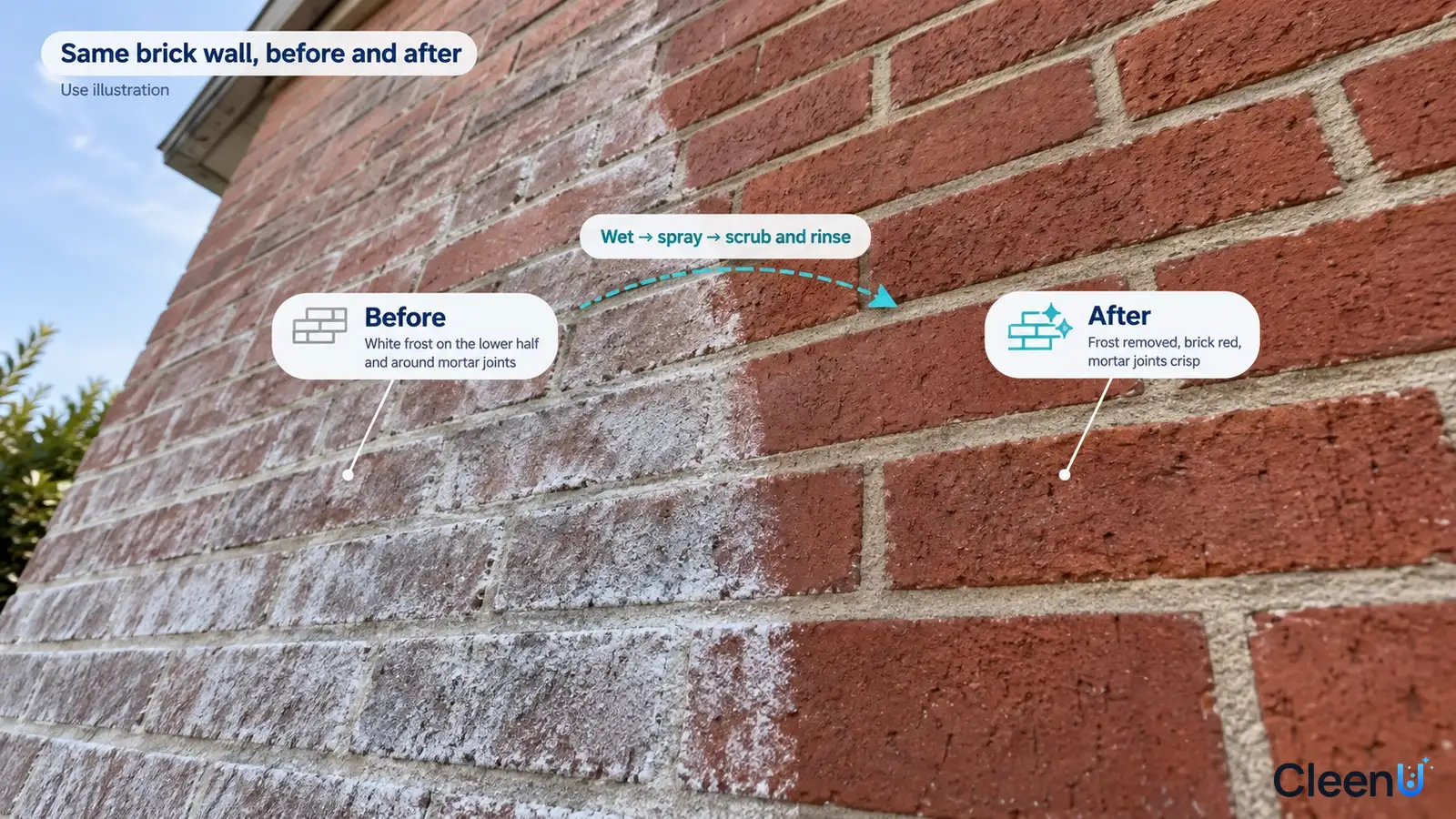
Before & after
Before and after (use illustration)
Before: the lower half of a red brick wall and the mortar joints are covered in white, frosty bloom with some cement run marks. After: pre-wetted, sprayed, scrubbed, rinsed, and dried, the frost is gone, the brick is red again, and the joints are crisp.
- Before: white, frosty efflorescence on the lower bricks and joints
- After: the bloom is gone and the brick is red again
- Rinsed and dry, the mortar lines look crisp

How it works
How Efflorescence Comes Off
Efflorescence is mainly calcium carbonate plus sodium and potassium sulfates. Soluble sulfates rinse away with water; calcium carbonate is the hard part. Hydrogen ions react with it to form soluble calcium salts and carbon dioxide (the fizz), the bloom loses its grip and brushes off, and water carries away dissolved salts and leftover acid. Pre-wetting fills the pores in brick and mortar with water so less acid soaks into the joints.
- Pre-wet
- Acid dissolves carbonate and alkaline salts
- Scrub
- Heavy rinse
- Protect once dry
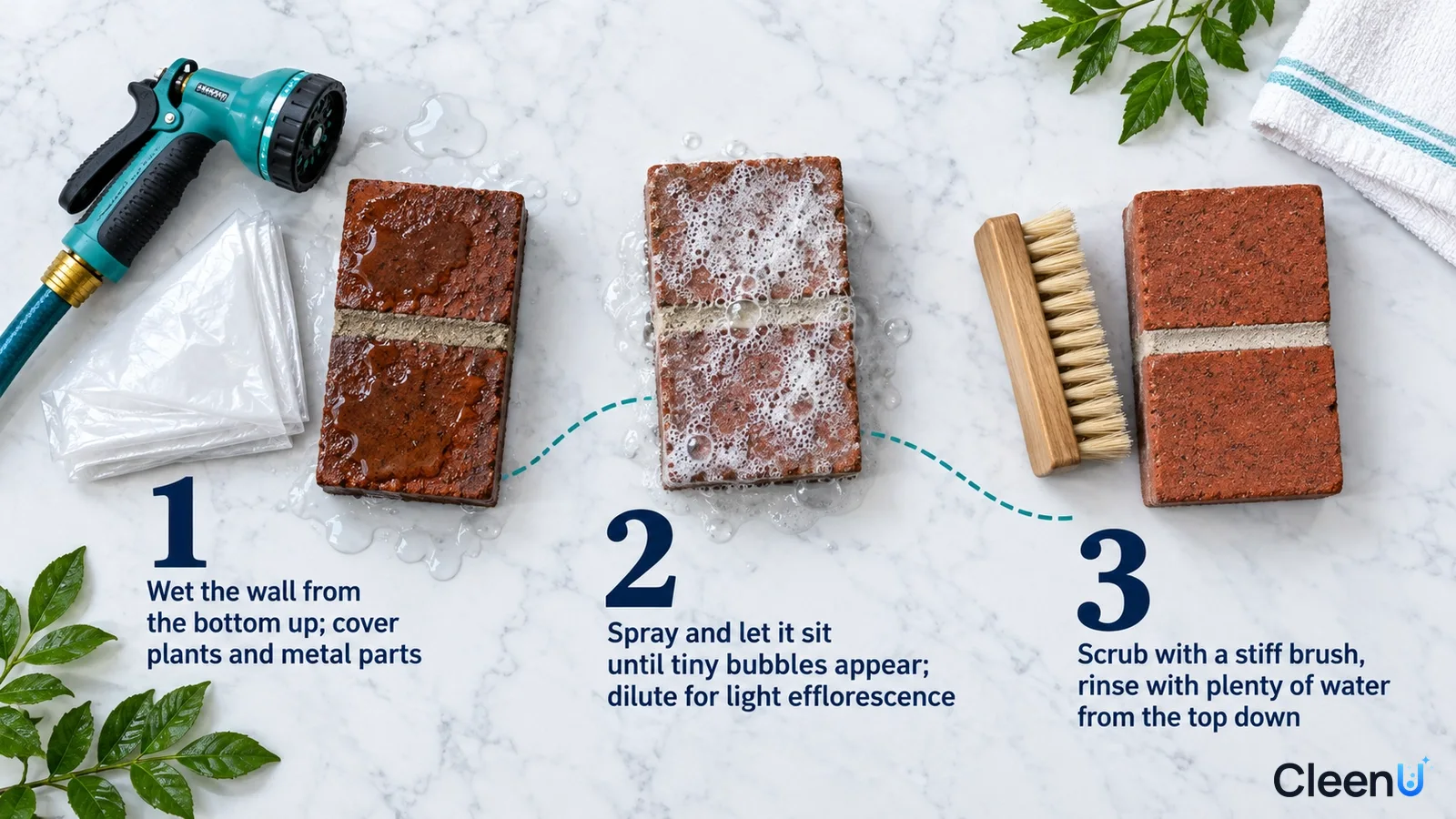
Usage guidance
Use guidance
- Wet the wall from the bottom up so brick and mortar are saturated; cover nearby plants and metal.
- Apply neat (1:3 for light bloom) and wait 5 minutes until fine fizzing appears.
- Scrub with a stiff brush and rinse heavily from top to bottom; once fully dry, apply a penetrating water repellent.

Before you use it
Important notes
- Not for: Marble, limestone, sandstone
- Not for: Old lime mortar and colored mortar that haven’t been tested
- Not for: Plants, aluminum, and metal
- Not for: Application in hot sun
- Test first for special materials, special equipment, or sensitive scenarios.
Product comparison
How to choose an Exterior Wall Efflorescence Remover
White efflorescence on brick and concrete walls: Exterior Wall Efflorescence Remover. Cement haze on new tile: Cement Residue Haze Remover. Green moss and algae: Moss Stain Remover or Outdoor Algae Stain Remover.
View product comparison
| Decision point | Exterior Wall Efflorescence Remover | Water and brush |
|---|---|---|
| Soluble salts | Dissolved and rinsed | Partly rinses off |
| Calcium carbonate | Dissolved by acid | Won’t brush off |
| Cement runs | Softened and brushed off | Barely affected |
| Recurrence | Reduced with a follow-up sealer | Returns quickly |
Where Exterior Wall Efflorescence Remover stands out
Efflorescence Is Salt Carried Out by Water
New brickwork and concrete walls after a rainy season often grow a white frost. Water in the wall dissolves sulfates, carbonates, and calcium hydroxide from mortar and brick, carries them outward, and leaves white crystals as it evaporates. The calcium hydroxide then reacts with air to form calcium carbonate, which is harder to brush off. This remover’s acid dissolves the carbonate and other alkaline salts so they scrub and rinse away.
Clean, Then Protect, So It Doesn’t Keep Coming Back
As long as water keeps moving out through the wall, efflorescence can return. Once the cleaned wall is fully dry, apply a penetrating water repellent so less rain gets into the brick and mortar and the salts lose their carrier. Pre-wet the wall before cleaning so the brick and mortar are saturated and the acid only works at the surface.
Who it's for, where it's used, and when not to use it
For
End-use scenarios
When not to use it
Product Specifications and Custom Options
Key product details and custom options for your project.
Product specifications
Product type, cleaning scope, and format.
| Product type | Acidic efflorescence remover |
| Surfaces | Brick, face-brick, concrete, and masonry walls |
| Use scenarios | New brickwork handover; Boundary and retaining walls after rain; Facade refurbishment |
| Target soils | Efflorescence, salt bloom, and cement runs on brick, concrete, and masonry walls |
| Directions | Use neat; 1:3 for light bloom; pre-wet the wall, 5 min dwell, then scrub and rinse |
| Not for | Marble, limestone, sandstone; Old lime mortar and colored mortar that haven’t been tested; Plants, aluminum, and metal; Application in hot sun |
| Size and packaging | 500 mL trigger spray bottle |
| pH | pH 1.5–3.0 at 25°C |
| Scent | Unscented |
| Shelf life and storage | 24 months unopened; keep tightly closed in a cool, dry, well-ventilated place. Protect from heat, direct sunlight, and freezing |
B2B custom options
Private label, packaging, MOQ, samples, and delivery.
| OEM/ODM and private label | From product direction and sample review to packaging, production, and delivery for your Exterior Wall Efflorescence Remover project. |
| Packaging and labels | Mist trigger / foam trigger, fill size, labels, and retail sets can be customized |
| Case pack | 12 × 500 mL per case |
| MOQ | 500 bottles |
| Sample time | Free sample: 3–5 days |
| Bulk lead time | Scheduled with the order after packaging and label approval |
| Documents | SDS/MSDS, TDS, and batch COA provided per project on inquiry |
OEM/ODM project process
Move from product direction and sample review to packaging, production, and delivery for Exterior Wall Efflorescence Remover.
Define customer and system
Decide professional facade work or DIY retail, and whether to sell a clean-plus-protect system.
Free sample
A free sample is usually ready in 3–5 days for project review.
Packaging and labels
Set fill size, trigger type, label language, the warnings your market requires, and pre-wet, acid-resistant gloves and goggles, and cover-plants-and-metal instructions.
Bulk delivery
Standard MOQ is 500 bottles; bulk orders are scheduled after packaging and labels are approved.
Why choose CleenU for Exterior Wall Efflorescence Remover?
From product positioning and samples to packaging and repeat supply, CleenU supports OEM/ODM projects built around Exterior Wall Efflorescence Remover.
Acid strength set by wall material
Brick, face brick, concrete, and mortar tolerate acid differently; we balance dissolving power against mortar impact for your walls.
Spray and job-site drums
500 mL for small areas; 5 L and 20 L for low-pressure sprayers.
Sample reviews with clear criteria
Review samples on your brick and concrete blocks with efflorescence against clear points: bloom removal, effect on mortar strength and color, and time to recurrence.
Mostly unscented
Acid facade cleaners are usually unscented; the focus is protection and warnings.
Labels and documents
We supply bilingual labels, SDS/MSDS, TDS, and batch COAs, with pre-wet, acid-resistant gloves and goggles, and cover-plants-and-metal instructions on the label, and can arrange third-party testing for your market.
Consistent supply and reorders
Each batch is retained and ships with a COA, so reorders match in color, scent, and feel.
Packaging and labeling options
Plan packaging format, label language, and shelf presentation around Exterior Wall Efflorescence Remover and your target channel.
Show packaging and label options
Packaging options
Core size: 500 mL trigger spray bottle. Also available: 1 L household refill, channel case packs, and ecommerce bundles with a penetrating sealer. Mist trigger or foam trigger options, with labels and cartons made to your brand.
Supporting Documents and Materials
Purchasers usually confirm whether the materials are complete before formal cooperation. Preparing documents in advance helps with quoting, sampling, and channel review.
Show available documents
Project documents
When you inquire, we provide SDS/MSDS, a TDS, batch COAs, label directions, and packaging files for your project.
Related products, solutions, and articles
Explore related cleaning products, application guidance, and OEM/ODM resources for Exterior Wall Efflorescence Remover.
Frequently asked questions (FAQ)
Find practical answers about Exterior Wall Efflorescence Remover, private label, samples, MOQ, documents, and delivery.
How to use
What is the white powder on my brick wall?
It’s efflorescence. Water in the wall carries salts from mortar and brick to the surface and leaves white crystals as it evaporates; some turn into hard-to-dissolve calcium carbonate.
Why does it come back after cleaning?
As long as moisture keeps moving out of the wall, it brings more salt. Once dry, apply a penetrating water repellent to cut water entry, and check drainage, eaves, and damp-proofing at the base.
Why wet the wall first?
Saturated brick and mortar keep the acid working at the surface instead of soaking into the joints, which protects the mortar and makes rinsing easier.
How do I remove efflorescence from concrete or brick?
Use an acid remover on wet masonry, scrub, then rinse heavily. Pre-wet the wall so the acid stays at the surface, spray from the bottom up (neat on heavy bloom or cement runs, 1:3 for a light haze), let it work about 5 minutes, scrub, and rinse from the top down. Work in sections you can scrub within that time, and keep it off marble, limestone, sandstone, plants, and metal.
Surfaces and common questions
Can I use it on natural stone walls?
Acid-resistant stone like granite can be tested first; marble, limestone, and sandstone will etch or discolor, so don’t use it on them.
Should I dilute it?
Use it neat on heavy bloom and cement runs; for a light haze, 1:3 is enough.
What precautions should I take?
Wear acid-resistant gloves and goggles, cover plants and metal frames, avoid hot sun and wind, and always rinse heavily after scrubbing.
Should I work from the top down or bottom up?
Wet and spray from the bottom up so product doesn’t run down dry brick and streak. Rinse from the top down after scrubbing to carry the dissolved salts away.
How large an area should I do at once?
Only what you can scrub within 5 minutes—usually 1–2 square meters. Don’t spray the whole wall; by the time you reach the end, the first section will have dried.
Should I seal the wall afterward?
Yes. Efflorescence comes from water carrying salts to the surface. Once the wall is clean and dry, a penetrating water repellent cuts water intake and makes new bloom much less likely.
Can you just paint over efflorescence?
No. Remove it and let the wall dry fully first. The white bloom is salt that moisture carries out of brick and mortar, and paint applied over it tends to lose adhesion as more salt pushes through. Clean it off with an acidic remover, rinse heavily, let the wall dry, and fix the water source; check that your paint or coating is suited to masonry.
Buying and private label
What should we decide first for a private-label exterior wall efflorescence remover?
Three things: professional building and facade restoration or DIY retail; ready-to-use or concentrate; and whether to pair it with a penetrating sealer as a clean-plus-protect kit. Repeat business comes from selling the clean-then-protect system.
What are the sample, MOQ, and lead-time terms?
Free samples are usually ready in 3–5 days. Standard MOQ is 500 bottles, and bulk orders are scheduled after packaging and labels are approved.
What can be customized?
All of it: formula direction, scent, fill size (500 mL spray, 5 L and 20 L containers, and more), mist or foam trigger, label design and language, and ecommerce bundles with a penetrating sealer.
Can we test samples first?
Yes, we ship samples first. Test them on brick and concrete blocks with efflorescence like the ones your customers handle, and record bloom removal, effect on mortar strength and color, and time to recurrence. That tells you more than a before-and-after photo.
Which documents can you provide?
We provide SDS/MSDS, a TDS, and batch COAs, plus bilingual label content for your target market. They aren’t posted publicly; we send them per project on inquiry.
How is private-label pricing quoted?
Pricing is tiered by packaging, trigger or cap, label, and order quantity, starting at the 500-bottle MOQ. Send your target quantity, fill size, and packaging needs, and we’ll quote unit prices by volume tier with sample and lead-time details.
Launching your own Exterior Wall Efflorescence Remover?
Send us your market, pro or retail, whether you want a clean-plus-protect kit, and estimated volume. We will work through formula and application instructions with you.