

Product and application illustrations. Follow the product label and written use guidance.
CleenU product solution
Garden Paver Cleaner
Alkaline, penetrating · Concentrate · Private label
Garden paths and pavers getting darker, with leaf stains, green algae, and black joints? Mix 1:5, pour it over the wet pavers, keep it wet for 10–15 minutes, scrub, and rinse—once dry, the original light color is back. Private label from 500 bottles.
- Concrete pavers and most natural stone have capillary pores. Tannins from rotting leaves, organic matter in muddy water, and algae and moss residues wash into the pores with the rain, and repeated wetting and drying deepens the color until the whole surface is dark and slippery after rain. An alkaline cleaner penetrates those pores to break down and emulsify the organics so they release and can be scrubbed and rinsed out.
- Paving covers a lot of area, and the key is keeping the cleaner in the pores long enough. Wet the pavers first so dry stone doesn’t soak it all up, apply the diluted cleaner evenly, and leave it 10 to 15 minutes, misting with water on hot days to keep it wet. Scrub with a stiff brush or floor machine and rinse with plenty of water. Once dry, the color looks even brighter than when first rinsed.
- MOQ
- 500 bottles
- Free samples
- 3–5 days
- Bulk lead time
- Scheduled with the order

Product value
What does Garden Paver Cleaner clean?
Garden Paver Cleaner cleans garden paths, patio pavers, concrete block, and paving slabs, removing dark grime, green growth, leaf stains, and mud.
View product detailsProduct summary
- Product type
- Alkaline outdoor paving cleaner
- Intended use
- Organic grime, green growth, leaf stains, and mud on pavers, paths, and concrete block
- Formula
- Alkaline builders with nonionic surfactants and a chelating agent, pH 9.5–11.0 as supplied; chlorine-free; use at 1:5, or 1:2 for heavy soil.
- For
- Cleaning product brands, garden and outdoor brands, hardware and building-supply channels, ecommerce sellers
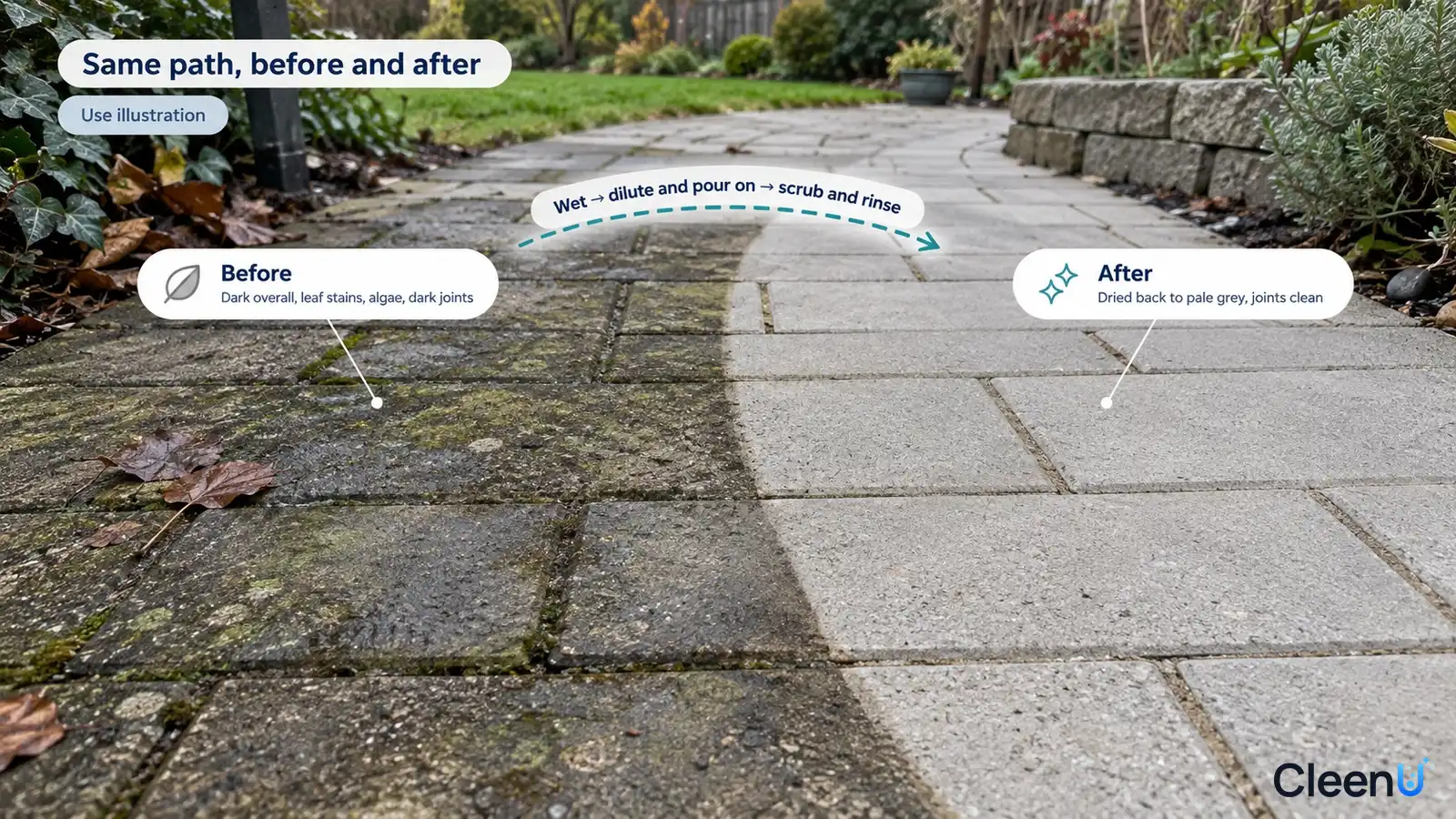
Before & after
Before and after (use illustration)
Before: the concrete paver path is dark overall, with leaf stains, green algae patches, and blackened joints. After: the left half, treated at 1:5, left 15 minutes, scrubbed, and rinsed, dries back to its original light grey, in sharp contrast with the untreated right half.
- Before: darkened concrete pavers with leaf stains and green algae
- After: the original light grey returns once dry
- Joints and faces clean, in clear contrast to an unwashed section

How it works
How Organic Soil Leaves the Pores
Dark staining on paving is mostly organic: plant tannins, humus, algae and moss residues, and some oil. Alkaline builders hydrolyze and saponify the fats and some organics and turn tannin pigments into more soluble salts. Surfactants lower surface tension to carry the solution deep into the pores and disperse the soil, and a chelating agent ties up calcium and magnesium so no new deposits form. Scrubbing adds the mechanical action, and water flushes the broken-down soil out.
- Pre-wet
- Alkali enters pores
- Breaks down and emulsifies organics
- Scrub loosens
- Water flushes out

Usage guidance
Use guidance
- Sweep off leaves and loose dirt and wet the pavers with a hose.
- Mix 1:5 (1:2 for heavy soil), apply evenly with a watering can or sprayer, and leave 10 to 15 minutes, misting in dry weather to keep it wet.
- Scrub with a stiff brush or floor machine, focusing on dark and green areas, then rinse with plenty of water.

Before you use it
Important notes
- Not for: Untested marble and limestone
- Not for: Lawns and flowers
- Not for: Concrete poured less than 28 days ago
- Not for: Direct sun or freezing weather
- Not for: Aluminum and galvanized fittings
Product comparison
How to choose a Garden Paver Cleaner
Organic grime and green growth on pavers: Garden Paver Cleaner. Thick moss in joints: Moss Stain Remover. Oil stains on driveways: Driveway Cleaner.
View product comparison
| Decision point | Garden Paver Cleaner | Pressure washing alone |
|---|---|---|
| Soil in pores | Broken down and scrubbed out | Surface only; pores stay dark |
| Joints | Leaves joint sand in place | Can blast out joint sand |
| Durability | More thorough organic removal | Darkens again sooner |
| Equipment | Watering can and brush | Pressure washer |
Where Garden Paver Cleaner stands out
Dark Pavers Mean Organic Soil in the Pores
Concrete pavers and most natural stone have capillary pores. Tannins from rotting leaves, organic matter in muddy water, and algae and moss residues wash into the pores with the rain, and repeated wetting and drying deepens the color until the whole surface is dark and slippery after rain. An alkaline cleaner penetrates those pores to break down and emulsify the organics so they release and can be scrubbed and rinsed out.
Wet First, Keep It Wet, Then Scrub
Paving covers a lot of area, and the key is keeping the cleaner in the pores long enough. Wet the pavers first so dry stone doesn’t soak it all up, apply the diluted cleaner evenly, and leave it 10 to 15 minutes, misting with water on hot days to keep it wet. Scrub with a stiff brush or floor machine and rinse with plenty of water. Once dry, the color looks even brighter than when first rinsed.
Who it's for, where it's used, and when not to use it
For
End-use scenarios
When not to use it
Product Specifications and Custom Options
Key product details and custom options for your project.
Product specifications
Product type, cleaning scope, and format.
| Product type | Alkaline outdoor paving cleaner |
| Surfaces | Garden paths, patio pavers, concrete block, and paving slabs |
| Use scenarios | Spring patio clean; Property and villa communities; Rentals and restaurant terraces |
| Target soils | Organic grime, green growth, leaf stains, and mud on pavers, paths, and concrete block |
| Directions | Dilute 1:5; 1:2 for heavy soil; 10–15 min dwell kept wet, then scrub and rinse |
| Not for | Untested marble and limestone; Lawns and flowers; Concrete poured less than 28 days ago; Direct sun or freezing weather; Aluminum and galvanized fittings |
| Size and packaging | 3.78 L (1 gal) concentrate jug |
| pH | pH 9.5–11.0 at 25°C |
| Scent | Fresh pine scent |
| Shelf life and storage | 24 months unopened; keep tightly closed in a cool, dry, well-ventilated place. Protect from heat, direct sunlight, and freezing |
B2B custom options
Private label, packaging, MOQ, samples, and delivery.
| OEM/ODM and private label | From product direction and sample review to packaging, production, and delivery for your Garden Paver Cleaner project. |
| Packaging and labels | Screw cap (concentrate jug) / measuring cap (1 L bottle) / optional sprayer, fill size, labels, and retail sets can be customized |
| Case pack | 4 × 3.78 L per case |
| MOQ | 500 bottles |
| Sample time | Free sample: 3–5 days |
| Bulk lead time | Scheduled with the order after packaging and label approval |
| Documents | SDS/MSDS, TDS, and batch COA provided per project on inquiry |
OEM/ODM project process
Move from product direction and sample review to packaging, production, and delivery for Garden Paver Cleaner.
Define format and size
Decide concentrate or ready-to-use, and 1 L retail or 5 L property drums.
Free sample
A free sample is usually ready in 3–5 days for project review.
Packaging and labels
Set fill size, screw cap, label language, the warnings your market requires, and dilution, keep-off-plants, and gloves-and-goggles instructions.
Bulk delivery
Standard MOQ is 500 bottles; bulk orders are scheduled after packaging and labels are approved. Patio cleaning peaks in spring and summer, so sample and stock in winter.
Why choose CleenU for Garden Paver Cleaner?
From product positioning and samples to packaging and repeat supply, CleenU supports OEM/ODM projects built around Garden Paver Cleaner.
Alkalinity by paving type
Concrete handles alkali well; natural stone is more sensitive. We can make a universal or a gentler stone version.
Concentrate plus drums
Concentrates save freight; 5 L drums suit property use; add a hose-end sprayer.
Sample reviews with clear criteria
Review samples on your weathered, darkened concrete paver and slab samples against clear points: organic soil removal, color recovery after drying, and effect on joints and natural stone.
Outdoor pine
Pine suits outdoor lines; unscented is also available.
Labels and documents
We supply bilingual labels, SDS/MSDS, TDS, and batch COAs, with dilution, keep-off-plants, and gloves-and-goggles instructions on the label, and can arrange third-party testing for your market.
Consistent supply and reorders
Each batch is retained and ships with a COA, so reorders match in color, scent, and feel.
Packaging and labeling options
Plan packaging format, label language, and shelf presentation around Garden Paver Cleaner and your target channel.
Show packaging and label options
Packaging options
Core size: 3.78 L (1 gal) concentrate jug with handle. Also available: 1 L concentrate in a measuring-cap grip bottle, channel case packs, and ecommerce bundles with a stiff brush and moss remover. Screw cap (concentrate jug) / measuring cap (1 L bottle) or optional sprayer options, with labels and cartons made to your brand.
Supporting Documents and Materials
Purchasers usually confirm whether the materials are complete before formal cooperation. Preparing documents in advance helps with quoting, sampling, and channel review.
Show available documents
Project documents
When you inquire, we provide SDS/MSDS, a TDS, batch COAs, label directions, and packaging files for your project.
Related products, solutions, and articles
Explore related cleaning products, application guidance, and OEM/ODM resources for Garden Paver Cleaner.
Frequently asked questions (FAQ)
Find practical answers about Garden Paver Cleaner, private label, samples, MOQ, documents, and delivery.
How to use
Why do my patio pavers keep getting darker?
Leaf tannins, muddy water, and algae residues soak into the pores and deepen with every rain. Sweeping and hosing can’t reach them; you need a cleaner that penetrates.
Do I need a pressure washer?
No; a stiff brush does the job. If you rinse with one, avoid blasting out the joint sand.
How much area does a bottle cover?
At 1:5, 1 L covers about 20 to 30 m²; double the product at 1:2 for heavy soil.
How do I clean pavers without power washing?
Use the cleaner and a stiff brush; no pressure washer needed. Wet the pavers first, pour on the solution mixed 1:5 with water (1:2 for heavy soil), keep the surface wet for 10–15 minutes, scrub, and rinse with a garden hose. The alkaline formula loosens leaf stains, algae, and mud in the pores, so brushing does the rest.
Surfaces and common questions
Will it harm grass and flowers?
It can, so keep it off them. Wet nearby plants with water before you start and rinse them again after.
Will it remove moss between pavers?
Thin green growth, yes. For thick, rooted moss in the joints, a moss remover works better.
When can I walk on it again?
Once it’s rinsed and surface-dry. Slipperiness after rain improves noticeably once the organic film is gone.
Will I end up with patchy color?
Yes, if you only do spots. Treat the whole area in one session, working section by section—pour, scrub, rinse—then rinse everything at the end so it dries evenly.
What if the pavers dry out while it sits?
Mist them with water or more solution to keep them wet. Product that dries on the stone works less well and can leave marks; on hot days, do smaller sections.
How do I keep them clean longer?
Once clean and dry, apply a penetrating sealer to reduce dirt and algae. Sweep leaves regularly so they don’t sit in rainwater and stain.
How do I clean pavers without removing the joint sand?
Scrub with a brush and rinse with a gentle hose stream instead of blasting the joints. Work the brush diagonally across the joints so the bristles don't dig the sand out, and top up the sand after everything dries if any has washed away.
Can I use Dawn dish soap or vinegar to clean pavers?
Use a paver cleaner instead. Dish soap is made for grease on dishes, foams heavily, and is hard to rinse out of porous stone; vinegar is acidic and can etch limestone, marble, and other calcium-based stone. An alkaline paver cleaner targets the organic soil that darkens patios. CleenU is not affiliated with Dawn.
Buying and private label
What should we decide first for a private-label garden paver cleaner?
Three things: concentrate or ready-to-use spray, home-and-garden retail or property-grade drums, and whether to build an outdoor paving line with moss and driveway cleaners. Paver cleaning is a mature garden category in Europe, North America, and Australia.
What are the sample, MOQ, and lead-time terms?
Free samples are usually ready in 3–5 days. Standard MOQ is 500 bottles, and bulk orders are scheduled after packaging and labels are approved.
What can be customized?
All of it: formula direction, scent, fill size (3.78 L jug, 1 L, 5 L, and more), cap and dosing format, label design and language, and ecommerce bundles with a stiff brush and moss remover.
Can we test samples first?
Yes, we ship samples first. Test them on weathered, darkened concrete paver and slab samples like the ones your customers handle, and record organic soil removal, color recovery after drying, and effect on joints and natural stone. That tells you more than a before-and-after photo.
Which documents can you provide?
We provide SDS/MSDS, a TDS, and batch COAs, plus bilingual label content for your target market. They aren’t posted publicly; we send them per project on inquiry.
How is private-label pricing quoted?
Pricing is tiered by packaging, cap type, label, and order quantity, starting at the 500-bottle MOQ. Send your target quantity, fill size, and packaging needs, and we’ll quote unit prices by volume tier with sample and lead-time details.
Launching your own Garden Paver Cleaner?
Send us your market, paving type, concentrate or ready-to-use, and estimated volume. We will plan around the outdoor season with you.