
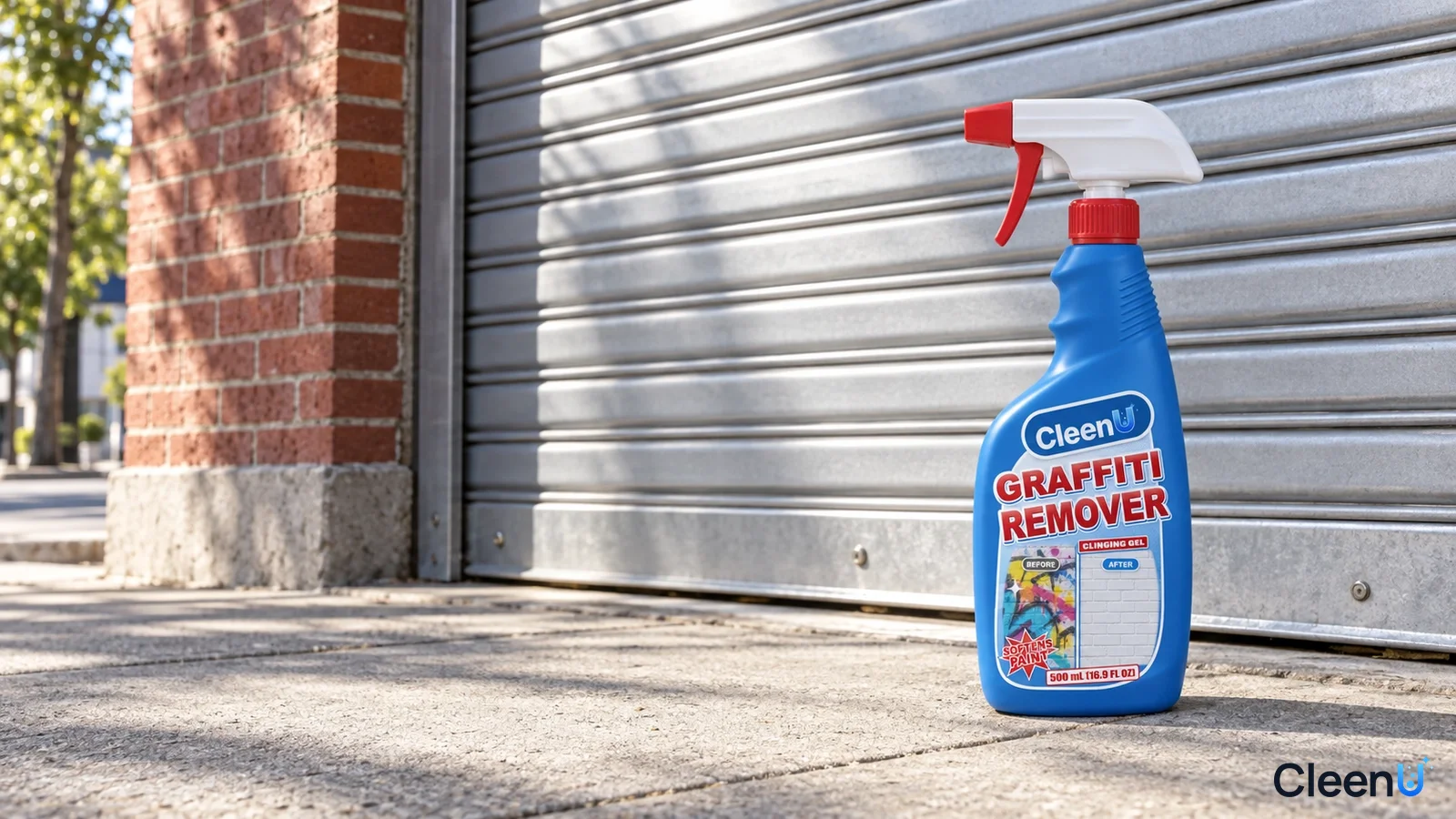
Product and application illustrations. Follow the product label and written use guidance.
CleenU product solution
Graffiti Remover
Clinging gel · Softens paint · Private label
Spray-paint graffiti and marker tags on shutters and brick? Spray, wait 5–10 minutes until the paint wrinkles and softens, then scrub or wipe and rinse to reveal the original surface. The gel clings to vertical walls; private label from 500 bottles.
- Spray paint and marker pigments sit in a resin binder. As the solvent flashes off, the resin forms a tough film locked onto the wall. Water and general cleaners do nothing, and scraping damages the surface. The solvents in this remover penetrate the resin film so it swells, wrinkles, and loses grip, and then a brush or cloth lifts it off.
- On smooth metal shutters and utility boxes, softened paint wipes off with a cloth. Brick and concrete are porous, and spray paint can soak in a few millimeters, so give it enough dwell, scrub in circles with a stiff brush, and flush the dissolved paint out with water or a pressure washer, repeating on stubborn spots. If the wall itself is painted, the solvent may soften the original coat too, so always test in a hidden spot.
- MOQ
- 500 bottles
- Free samples
- 3–5 days
- Bulk lead time
- Scheduled with the order

Product value
What does Graffiti Remover clean?
Graffiti Remover takes spray paint and marker tags off brick, concrete, metal doors, roll-up shutters, and street furniture.
View product detailsProduct summary
- Product type
- Solvent-based graffiti removal gel spray
- Intended use
- Spray paint and marker graffiti on brick, concrete, metal shutters, and street furniture
- Formula
- Low-odor blended solvents with a thickener and emulsifiers, pH 6.5–8.5; methylene-chloride-free; ready-to-use gel spray.
- For
- Property and facility maintenance firms, municipal and transport maintenance, hardware and building-supply channels, cleaning product brands
Before & after
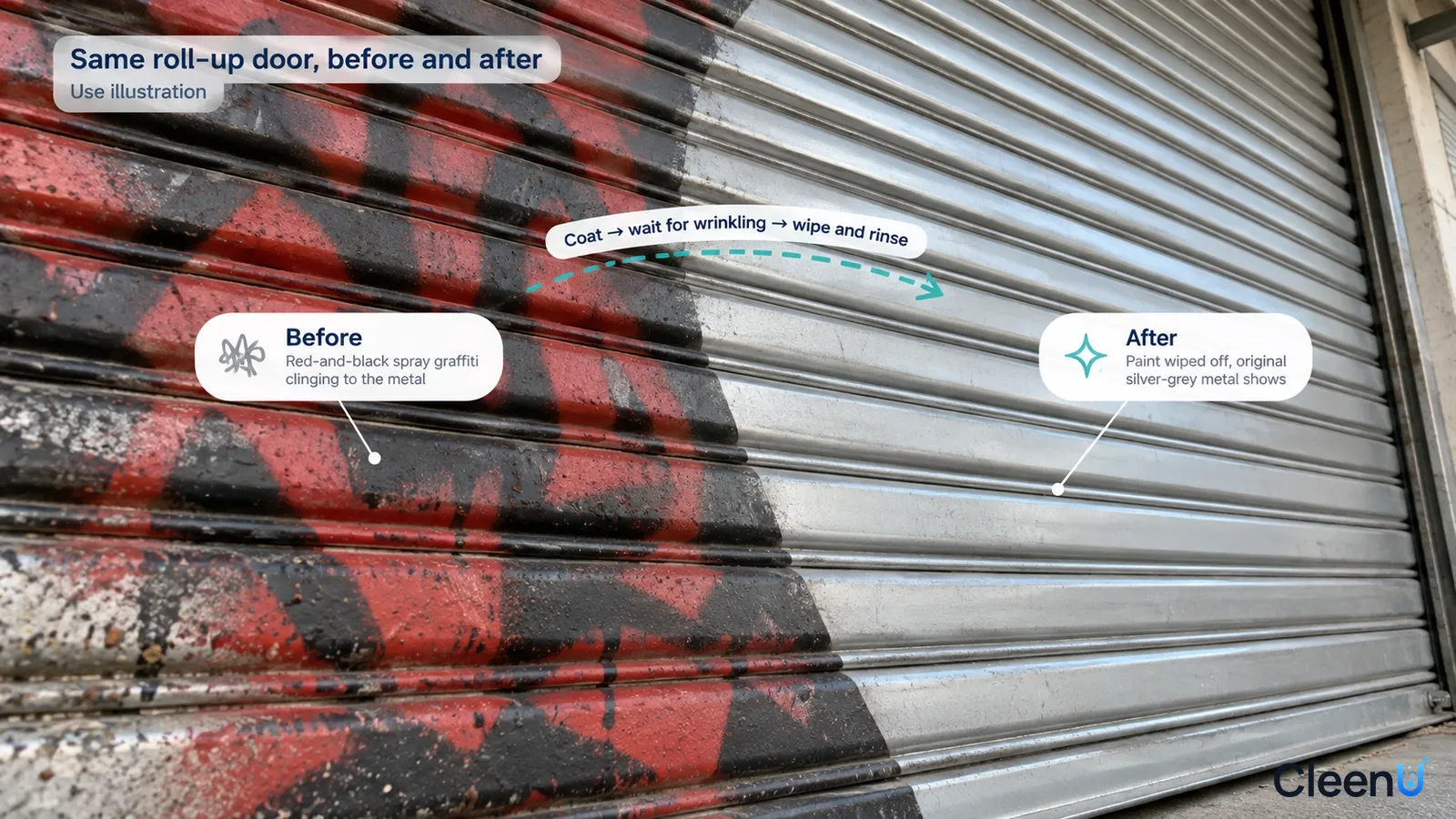
Before and after (use illustration)
Before: a shop’s metal shutter carries a large red and black spray-paint tag. After: sprayed, left 8 minutes until the paint wrinkles, wiped, and rinsed, the shutter shows its original silver-grey metal.
- Before: a large red-and-black spray-paint tag on a metal shutter
- After: the original silver-grey metal shows again
- The gel stays put, and wrinkled paint wipes away
How it works
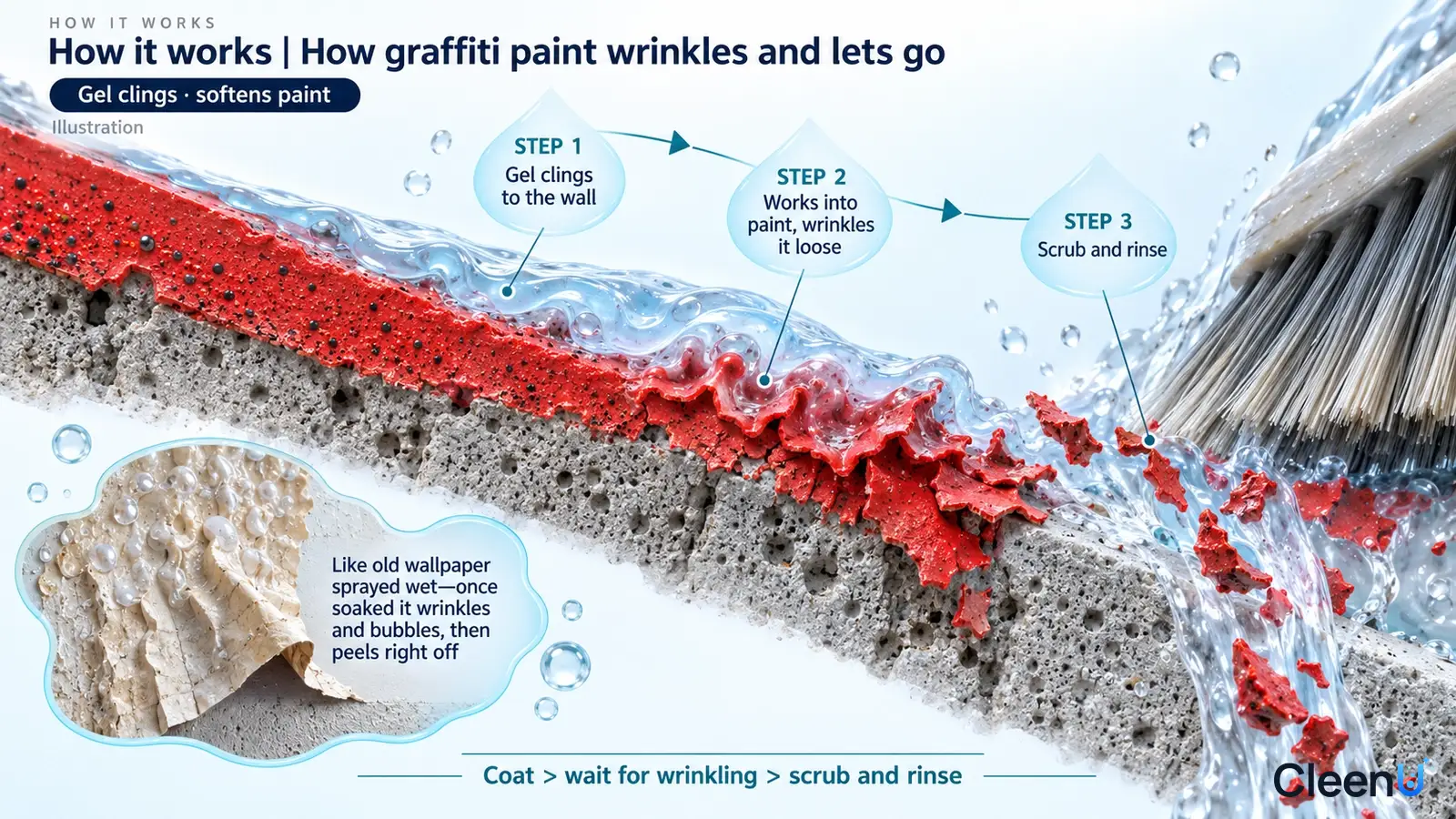
How a Graffiti Film Lets Go
Spray-paint and marker films are pigments held in acrylic, alkyd, or nitrocellulose resin. The remover’s solvent blend is compatible with those resins, so it penetrates and pushes the polymer chains apart until the film swells, softens, and separates from the wall. A thickener keeps the gel on vertical surfaces so the solvent doesn’t run off or evaporate too soon, and surfactants help the dissolved paint rinse away instead of sinking back into porous surfaces.
- Gel clings
- Solvent enters resin film
- Film swells, wrinkles, and loses grip
- Scrub or wipe
- Water flushes pores

Usage guidance
Use guidance
- Wear solvent-resistant gloves and eye protection, and test a hidden spot for 5 minutes first.
- Cover the tag and wait 5 to 10 minutes until the paint wrinkles and softens; don’t let it dry.
- Wipe smooth surfaces with a cloth; scrub brick and concrete in circles with a stiff brush, then rinse with water or a pressure washer, repeating on stubborn areas.

Before you use it
Important notes
- Not for: Untested painted walls
- Not for: Vehicle paint
- Not for: Plastic signs and acrylic
- Not for: Fiberglass
- Not for: Near flames or hot surfaces
Product comparison
How to choose a Graffiti Remover
Spray paint and marker on outdoor hard surfaces: Graffiti Remover. White salt bloom on brick: Efflorescence Cleaner. Oil stains on stone: Stone Oil Stain Remover.
View product comparison
| Decision point | Graffiti Remover | Painting over it |
|---|---|---|
| Result | Original surface restored | Leaves a mismatched patch |
| Brick and stone | Can be cleaned | Not paintable |
| Cost | One bottle, one visit | Paint plus labor |
| Repeat tags | Clean again | Patchwork builds up |
Where Graffiti Remover stands out
Dried Spray Paint Is a Plastic Film; Soften It First
Spray paint and marker pigments sit in a resin binder. As the solvent flashes off, the resin forms a tough film locked onto the wall. Water and general cleaners do nothing, and scraping damages the surface. The solvents in this remover penetrate the resin film so it swells, wrinkles, and loses grip, and then a brush or cloth lifts it off.
Brick and Concrete Are Porous: Scrub and Rinse
On smooth metal shutters and utility boxes, softened paint wipes off with a cloth. Brick and concrete are porous, and spray paint can soak in a few millimeters, so give it enough dwell, scrub in circles with a stiff brush, and flush the dissolved paint out with water or a pressure washer, repeating on stubborn spots. If the wall itself is painted, the solvent may soften the original coat too, so always test in a hidden spot.
Who it's for, where it's used, and when not to use it
For
End-use scenarios
When not to use it
Product Specifications and Custom Options
Key product details and custom options for your project.
Product specifications
Product type, cleaning scope, and format.
| Product type | Solvent-based graffiti removal gel spray |
| Surfaces | Brick, concrete, metal doors, roll-up shutters, and street furniture |
| Use scenarios | Shop shutters; Property walls and garages; Municipal and street furniture |
| Target soils | Spray paint and marker graffiti on brick, concrete, metal shutters, and street furniture |
| Directions | Ready to use, no dilution; 5–10 min dwell until paint softens, then brush or wipe |
| Not for | Untested painted walls; Vehicle paint; Plastic signs and acrylic; Fiberglass; Near flames or hot surfaces; Large-area use in enclosed spaces |
| Size and packaging | 500 mL trigger spray bottle |
| pH | pH 6.5–8.5 at 25°C |
| Scent | Unscented |
| Shelf life and storage | 24 months unopened; keep tightly closed in a cool, dry, well-ventilated place. Protect from heat, direct sunlight, and freezing |
B2B custom options
Private label, packaging, MOQ, samples, and delivery.
| OEM/ODM and private label | From product direction and sample review to packaging, production, and delivery for your Graffiti Remover project. |
| Packaging and labels | Mist trigger / foam trigger, fill size, labels, and retail sets can be customized |
| Case pack | 12 × 500 mL per case |
| MOQ | 500 bottles |
| Sample time | Free sample: 3–5 days |
| Bulk lead time | Scheduled with the order after packaging and label approval |
| Documents | SDS/MSDS, TDS, and batch COA provided per project on inquiry |
OEM/ODM project process
Move from product direction and sample review to packaging, production, and delivery for Graffiti Remover.
Define customer and size
Decide retail bottles for shops and homes or professional drums for property and municipal crews.
Free sample
A free sample is usually ready in 3–5 days for project review.
Packaging and labels
Set fill size, trigger type, label language, the warnings your market requires, and flammability, ventilation, PPE, and test-first warnings for solvent products.
Bulk delivery
Standard MOQ is 500 bottles; bulk orders are scheduled after packaging and labels are approved.
Why choose CleenU for Graffiti Remover?
From product positioning and samples to packaging and repeat supply, CleenU supports OEM/ODM projects built around Graffiti Remover.
Solvency balanced with safety
Solvent strength sets speed but also odor, flash point, and effect on the original surface. We pick the system for your market’s VOC rules.
Gel trigger plus drums
A gel trigger suits vertical walls; 5 L drums with brushes cover large areas; aerosols are also possible.
Sample reviews with clear criteria
Review samples on your brick, concrete, and metal panels with spray-paint tags against clear points: softening time for different paints, removal on brick and concrete, and effect on the original surface.
Low-odor, unscented
Low odor is the selling point for solvent products; no added fragrance.
Labels and documents
We supply bilingual labels, SDS/MSDS, TDS, and batch COAs, with flammability, ventilation, PPE, and test-first warnings for solvent products on the label, and can arrange third-party testing for your market.
Consistent supply and reorders
Each batch is retained and ships with a COA, so reorders match in color, scent, and feel.
Packaging and labeling options
Plan packaging format, label language, and shelf presentation around Graffiti Remover and your target channel.
Show packaging and label options
Packaging options
Core size: 500 mL trigger spray bottle. Also available: 1 L household refill, channel case packs, and ecommerce bundles with a stiff brush and solvent-resistant gloves. Mist trigger or foam trigger options, with labels and cartons made to your brand.
Supporting Documents and Materials
Purchasers usually confirm whether the materials are complete before formal cooperation. Preparing documents in advance helps with quoting, sampling, and channel review.
Show available documents
Project documents
When you inquire, we provide SDS/MSDS, a TDS, batch COAs, label directions, and packaging files for your project.
Related products, solutions, and articles
Explore related cleaning products, application guidance, and OEM/ODM resources for Graffiti Remover.
Frequently asked questions (FAQ)
Find practical answers about Graffiti Remover, private label, samples, MOQ, documents, and delivery.
How to use
How soon should graffiti be removed?
The sooner the better. Within 24 to 48 hours the paint hasn’t fully cured and softens in 5 minutes; tags left for weeks need longer dwell and repeat passes.
Can it fully remove graffiti from brick?
Mostly, yes. Paint soaks into brick and mortar pores, so scrub and pressure-rinse, repeating where needed. Occasional deep shadows may need professional treatment.
Can I use it on a painted wall?
Test first; the solvent may soften the original paint. Spray a hidden spot for 5 minutes, and if nothing wrinkles, use it with a shorter dwell.
How do I use graffiti remover?
Spray the gel onto the tag, wait until the paint softens and wrinkles, then scrub or scrape it off and rinse with water. It's ready to use, no dilution. The gel clings to vertical walls so the solvent stays in contact long enough to soften the paint film. On porous brick or concrete, repeat where a shadow remains.
How does graffiti remover dissolve dried spray paint?
It softens the paint film with solvents, then emulsifiers let the softened paint rinse away with water. Dried spray paint is a cured film bonded to the surface; the solvent swells and loosens that film, and the thickened gel keeps the solvent on the wall instead of running off. Scrubbing and rinsing finish the job.
Surfaces and common questions
Can I use it on a car?
Not recommended; it can damage paint and clear coat. Take vehicles to a detailer.
Is it smelly? What protection do I need?
It’s a low-odor solvent blend, but still ventilate, keep away from flames, and wear solvent-resistant gloves and goggles.
How do I prevent repeat tagging?
Apply an anti-graffiti coating after cleaning so future tags wipe off more easily, and remove new tags fast; quick removal discourages repeats.
There’s still a faint shadow on the brick after cleaning.
Brick and concrete are porous, so paint soaks in. Reapply, let it sit, scrub the pores with a stiff brush, and pressure-rinse. If a ghost remains after two rounds, it’s too deep—touch it up with matching paint.
Can I use it on traffic signs or utility boxes?
Utility boxes are usually powder-coated or painted—spot-test a corner and shorten the dwell. Reflective sign sheeting is easily damaged by solvent, so don’t use it there.
How do I handle the paint sludge and rinse water?
Lay down absorbent pads or plastic sheeting to catch sludge, and keep rinse water out of storm drains where possible. For large jobs, dispose of waste per local rules.
What is in this graffiti remover?
It's a low-odor solvent blend with thickeners and emulsifiers, pH 6.5–8.5, and it contains no methylene chloride. The ready-to-use gel spray is unscented. Because it is solvent-based, keep it away from flames and hot surfaces, and don't use it over large areas in enclosed spaces.
Buying and private label
What should we decide first for a private-label graffiti remover?
Three things: small retail bottles for shops and homes or 5 L professional packs for property and municipal crews; gel or liquid; and which market’s solvent warnings and VOC limits apply. Demand is steady in urban property and municipal purchasing in Europe and North America.
What are the sample, MOQ, and lead-time terms?
Free samples are usually ready in 3–5 days. Standard MOQ is 500 bottles, and bulk orders are scheduled after packaging and labels are approved.
What can be customized?
All of it: formula direction, scent, fill size (500 mL spray, 1 L refill, and more), mist or foam trigger, label design and language, and ecommerce bundles with a stiff brush and solvent-resistant gloves.
Can we test samples first?
Yes, we ship samples first. Test them on brick, concrete, and metal panels with spray-paint tags like the ones your customers handle, and record softening time for different paints, removal on brick and concrete, and effect on the original surface. That tells you more than a before-and-after photo.
Which documents can you provide?
We provide SDS/MSDS, a TDS, and batch COAs, plus bilingual label content for your target market. They aren’t posted publicly; we send them per project on inquiry.
How is private-label pricing quoted?
Pricing is tiered by packaging, trigger or cap, label, and order quantity, starting at the 500-bottle MOQ. Send your target quantity, fill size, and packaging needs, and we’ll quote unit prices by volume tier with sample and lead-time details.
Launching your own Graffiti Remover?
Send us your market, customer type, gel or liquid, and estimated volume. We will work through the solvent system and warning labels with you.