
OEM/ODM
Private-Label Bathroom Cleaner: Should Your First Product Be a Descaler or a Daily Spray?
Direct answer
Split the bathroom category by grime into daily cleaning, descaling, and mold, then pick a lead product by channel. A mildly acidic daily spray is used weekly and drives repeat sales. Descalers and mold removers solve sharper pain points at higher prices but need stricter labeling. For a first product, choose between daily and descaler.
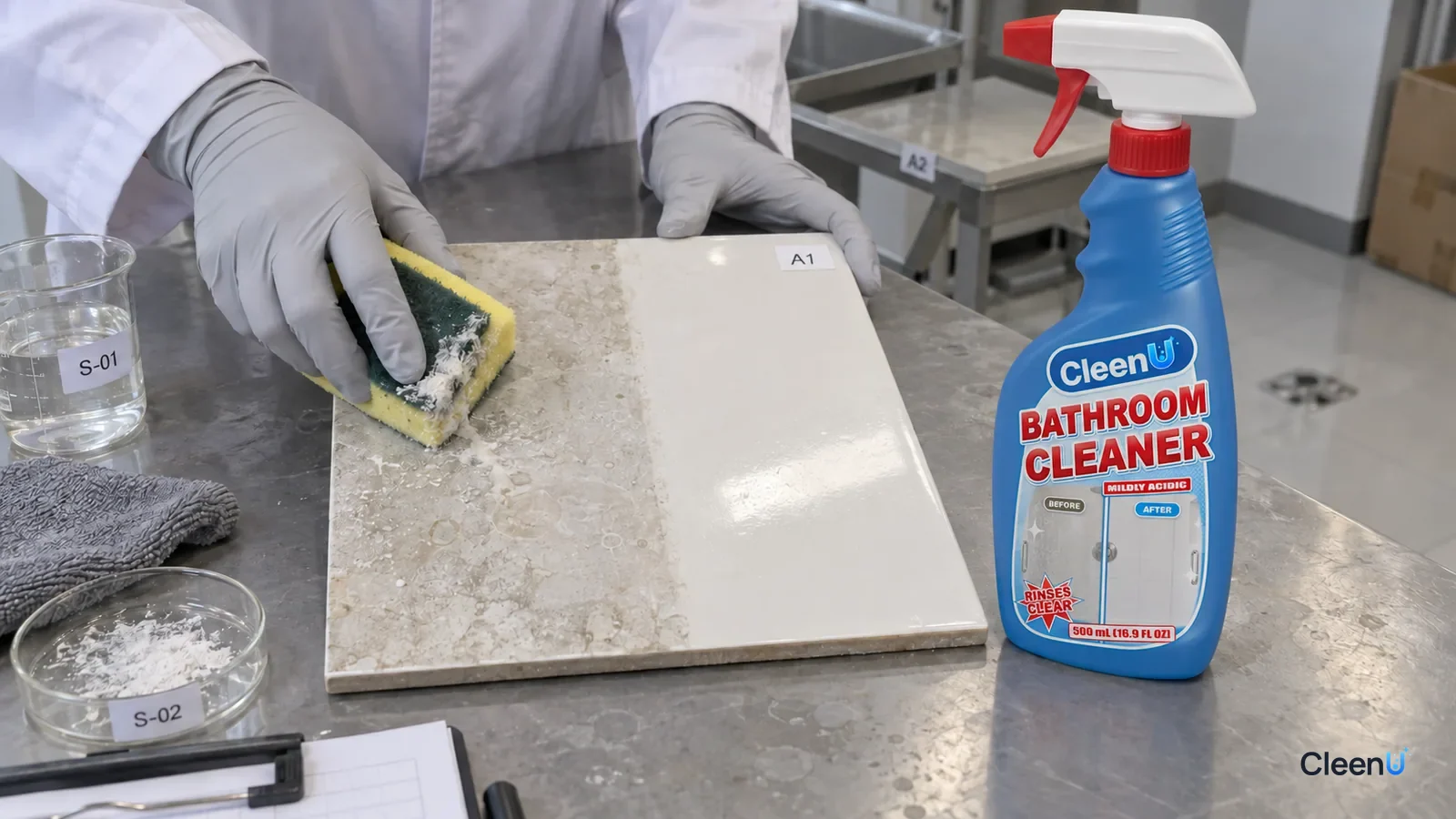
Bathroom cleaners are one of the most crowded corners of household cleaning: daily sprays, shower sprays, descalers, toilet cleaners, mold removers, grout cleaners. For a brand entering the category with private label, the first product shapes repeat sales, review risk, and how the line can grow. Here's how to choose, by grime, formula, channel, and compliance.
Bathroom grime determines how many products you need
Bathroom problems fall into three groups, each needing a different chemistry.
Soap scum and light scale (daily): the gray-white film on shower tile, glass doors, and sinks that grows back every week. A mildly acidic daily spray handles it, and it's used most often.
Heavy scale (descaling): hard white crust on faucet bases, showerhead nozzles, and the bottom of glass doors, worst in hard-water areas. It needs a stronger acidic descaler. The pain point is clear and customers will pay for results.
Mold (mold removal): black on caulk, grout, and corners. It needs an oxidizing mold remover, usually chlorine-based, which has the strictest labeling, packaging, and safety requirements.
These three use different pH systems, can't substitute for each other, and can't be mixed: acidic products and chlorine products together release a toxic gas. That warning has to be on the label, and it's also why they're best kept as separate SKUs.
Where to start
Mildly acidic daily spray: used every week, so repeat purchase is fast. It's gentle on most surfaces, broadly compatible, and lower review risk, which makes it a strong traffic driver for mass retail, general e-commerce, and cross-border sales. The downside is heavy competition, so you'll need to differentiate on scent, packaging, and claims.
Descaler: a strong, visible pain point. Before-and-after shots of white crust softening are made for short video and product detail pages, and demand is obvious in hard-water regions (much of the U.S. Southwest and Midwest, for example). The downside is stronger acidity, which puts natural stone, coated fixtures, and aluminum at risk. The label must spell out what it's not for, or you'll see "it etched my counter" reviews.
Mold remover: strong pain point and seasonal demand, but usually chlorine-based, which brings harsh odor, mixing hazards, and child-safety considerations. Labels, packaging (such as child-resistant closures), shipping, and market-specific compliance are all stricter. We don't recommend it as a new brand's first product unless your team already has compliance and safety-labeling experience.
So for most new brands, the first product comes down to a daily spray or a descaler: choose daily for mass channels and repeat sales, and choose a descaler for content-driven e-commerce and markets with hard water.
Starting points from our line
Our current products show the options. CleenU Bathroom Cleaner is a mildly acidic daily spray, pH 2.5 to 4.0 as supplied, made with organic acids such as citric acid and nonionic surfactants, and gentle on glazed tile, glass, and chrome. Our Shower Cleaner is a pH 3.0 to 4.5 daily spray you use after showering without rinsing. Our Faucet & Sink Scale Remover is an acidic descaler, pH 1.5 to 3.0, with a corrosion inhibitor. Our Mold & Mildew Stain Remover is a chlorine-based spray, pH 11.5 to 13.0. Any of these can be the starting point for private-label development, with scent, packaging, and labeling adjusted to your channel and positioning.
The most common labeling and marketing pitfalls
Leaving out the "not for" list: acidic products etch marble, and chlorine products bleach fabric. Unsuitable surfaces have to be listed.
Germ-kill claims: antibacterial, disinfecting, and sanitizing claims require registration or supporting data. Without it, don't make them, and never put a percentage on it.
Buried mixing warnings: the risk of combining acidic and chlorine products needs to be where customers will see it.
Exaggerated before-and-after images: keep visuals realistic so expectations match real results.
How the project runs
Define the brief: channel, target market, first-product positioning, packaging, and budget.
Sampling: we adjust the formula to your brief; free samples take 3–5 days.
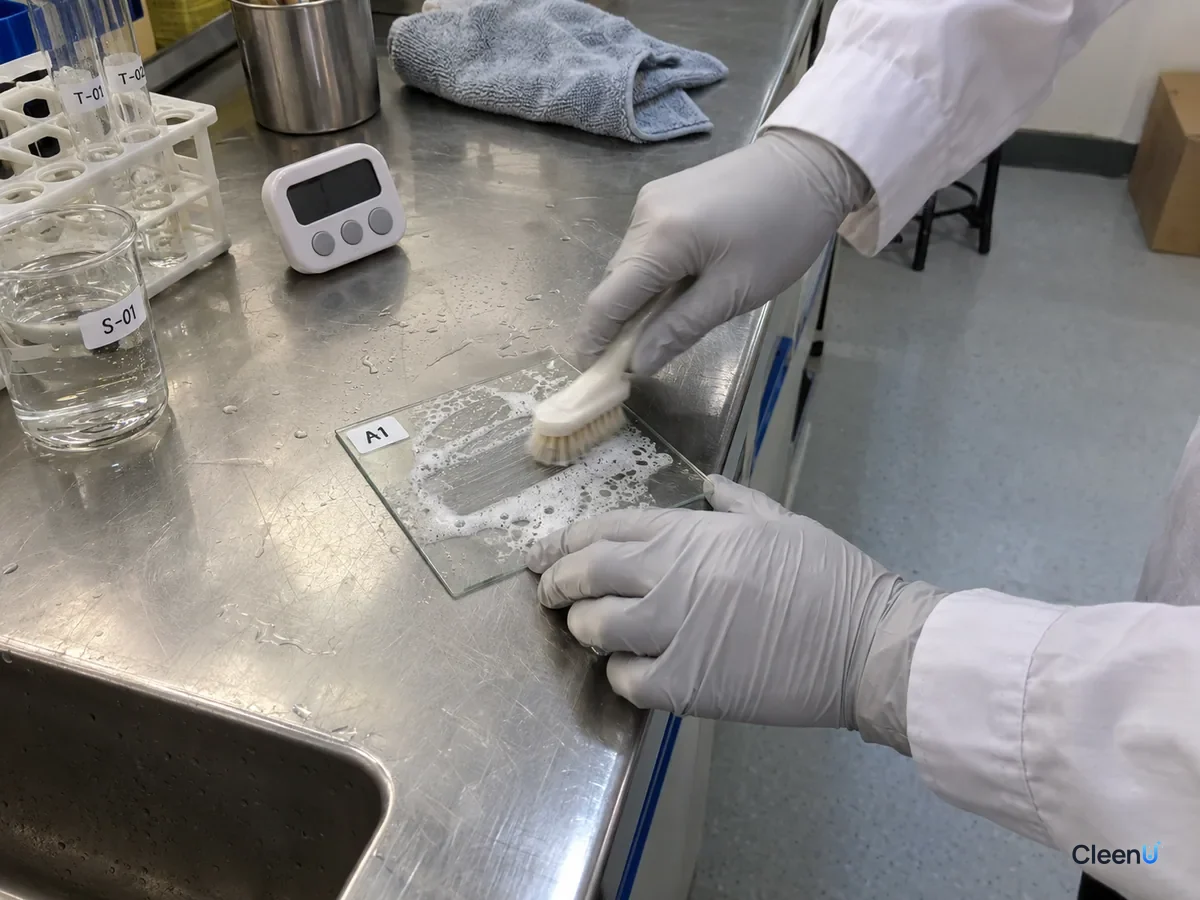
Validation: trial it on target surfaces like glazed tile, glass, and chrome to confirm results, surface safety, scent, and packaging.
Production after packaging and label approval: bulk orders are scheduled when the order is confirmed, with a 500-bottle minimum. Final pricing and lead times are confirmed in the formal quote.
For consumer education content, see How to clean a bathroom and Soap scum vs. hard water stains.
Where daily sprays and descalers really differ
Both a daily spray and a descaler rely on acid, but they face very different thicknesses of buildup, so the formulas lean in different directions. Soap scum forms when fatty acid salts in soap and body wash combine with calcium and magnesium in hard water, producing insoluble lime soap that also traps skin oil and dust. Light scale is calcium carbonate and other minerals left behind when shower water dries. That layer is thin. Organic acids at pH 2.5 to 4.0 can convert calcium carbonate and lime soap into soluble salts, while nonionic surfactants wet and emulsify the oils inside. A 2 to 5 minute dwell, a scrub, and a rinse finish the job. The priorities for a daily product are gentleness, easy rinsing, and very little left behind on glaze and chrome, because customers use it every week.
Heavy scale is a different problem. The white crust on faucet bases and showerhead nozzles is layer upon layer of mineral crystals, and acid has to dissolve its way through them one layer at a time. That takes lower pH, longer dwell, and repeat treatment. The stronger the acid, the higher the risk to surfaces, so descalers usually carry a corrosion inhibitor to protect metal and need a more detailed "do not use on" list. This is also why combining the two into one bottle rarely works. Make the daily spray too acidic and weekly users run into trouble on stone and coated fixtures. Make the descaler too mild and it doesn't fix the problem people bought it for, which earns its own bad reviews.
Making sample validation meaningful
Validation should mirror real use, not just "did it wipe clean." For a daily spray, treat glazed tile panels carrying soap scum and water spots at the label dwell time, scrub, and rinse. Then check for haze in side light and feel for smoothness. Repeat the routine several times on chrome and glass panels to see whether the finish changes over repeated use. For a descaler, time how quickly heavy-scale samples soften, and run side-by-side checks on target fixtures and on surfaces the product shouldn't touch. That tells you whether the label's exclusion list goes far enough.
Settle scent and dispenser at the same time. A foam trigger lets product cling to vertical walls and stay in contact longer, but more foam also means longer rinsing. A mist trigger covers more area but drifts. These are best decided after real users try samples, before you lock in production.
When channel or market shifts, so does the choice
If you're selling into regions with notably hard water, such as much of the American Southwest or parts of Australia, descaling demand gets amplified, and even a daily spray should lean its messaging toward preventing scale. In humid regions, mold and soap scum dominate, and a daily spray paired with simple "ventilate after every shower" education tends to build steadier repeat sales. For hotel and short-term rental cleaning, buyers care about cost per use, scent, and compatibility with many surfaces. A daily spray with a 1 L refill often gets onto the approved list more easily than a single heavy-duty descaler.
Online sellers also need to plan for shipping. Leaks are the most common after-sale complaint for liquids, so ask for an inner seal under the cap, plus drop and leak tests on the final packaging. Documents such as the SDS are provided per project after you inquire, which helps with marketplace review and warehouse intake.
Planning the second product
Whichever route you start with, sketch the second SKU before the first one launches. A daily spray brand often adds a descaler next, because the same customers eventually hit crust the weekly spray can't reach, and the descaler gives them a reason to come back. A descaler brand usually adds a daily spray to turn a one-time purchase into a weekly habit. In both cases, keep pH, color, and bottle shape visibly different so nobody grabs the strong product for a quick wipe-down, and keep the acid-and-chlorine warning consistent across the whole line. Mold removal can wait until the team has handled compliance for at least one product and understands which markets you're shipping to. Planning this way also keeps label design, scent choices, and refill sizes coherent, so the line looks like one family on the shelf rather than a set of unrelated bottles.
Three things to pin down before the first run
Before launch, agree in writing on the directions and dwell time printed on the label, the surfaces the label names, and the ones it warns against, such as natural stone and some metal finishes. All three should match the conditions the approved sample was tested under. If the sample was approved on glazed tile but the label says "all countertops," acid etching on marble will show up in reviews. Checking the approved sample, the label copy and the directions side by side before printing is far cheaper than relabeling after launch.
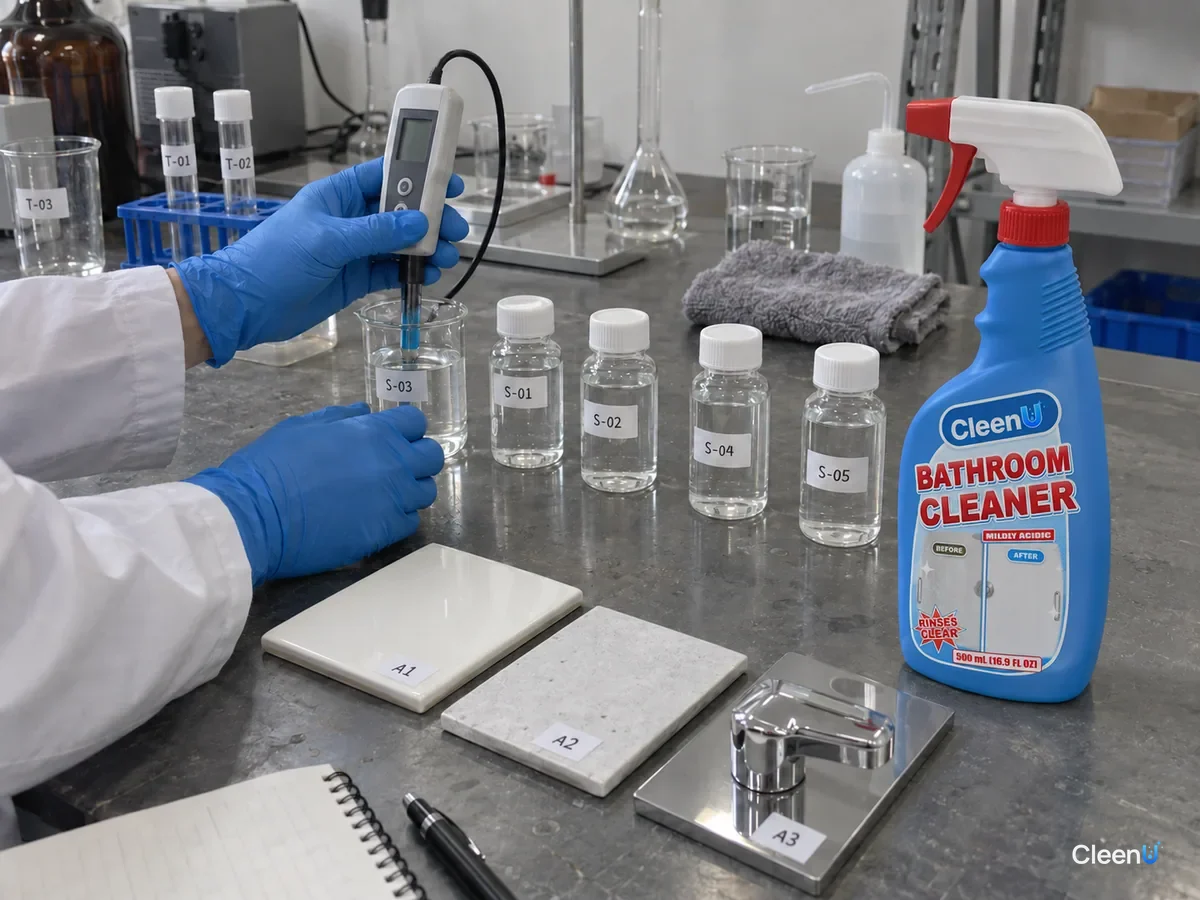
To start your private label from a mildly acidic daily bathroom spray that's gentle on glaze, glass, and chrome, take a look at our Bathroom Cleaner.
For a private-label bathroom cleaner, split the category into daily cleaning, descaling, and mold removal. They use different pH systems, can't be mixed, and work best as separate SKUs. For a new brand's first product, choose between a mildly acidic daily spray, for repeat sales and mass channels, and a descaler, for content-driven e-commerce and hard-water markets. Chlorine mold removers carry the strictest compliance requirements and are better saved for later. List unsuitable surfaces and mixing warnings clearly, skip unsupported germ-kill claims, and validate on target surfaces before finalizing packaging and production.