
Troubleshooting
How to Remove a Stubborn Toilet Bowl Ring
Direct answer
Lower the water level so the ring is exposed, apply an acidic toilet bowl gel along it, wait about 10 minutes, then scrub and flush. Repeat for thick buildup. The ring is usually urine scale and hard-water minerals baked together into a hard deposit, and the gel should never be mixed with bleach.
Check these five things before you start
- Where is the ring: exactly at the waterline, or under the rim at the flush holes?
- How does it feel through a gloved finger or the brush: raised, rough, hard?
- Is your water hard? Do your kettle and faucets get white crust too?
- Have you used bleach or chlorine toilet tablets recently?
- Is it a standard white porcelain bowl, or one with a special coating or colored glaze?
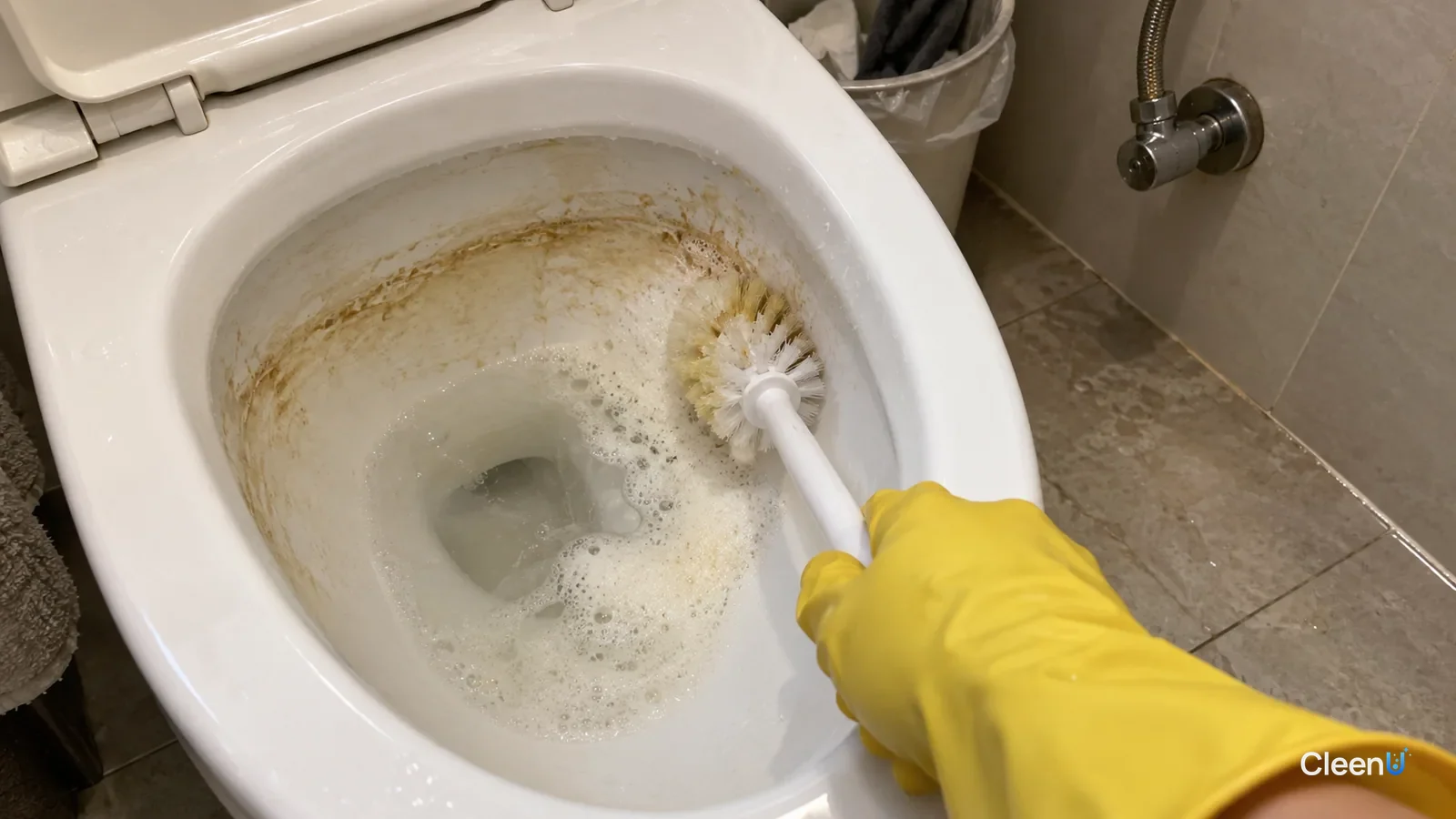
Almost every home has seen it: a yellow-brown line right where the water sits in the bowl. The brush slides right over it, dish soap and laundry detergent do nothing, and over time it gets darker and wider. Some people assume the porcelain is ruined, but most of the time the deposit is just too hard for the method being used.
Here's how the ring forms, why normal scrubbing won't touch it, a step-by-step way to remove it, and how to tell when it isn't a deposit at all but worn glaze.
How a toilet ring forms
Toilet deposits come from two sources: urine and tap water.
Urine contains urea, uric acid, various salts, and a little protein. Bacteria produce an enzyme called urease that breaks urea down into ammonia and carbon dioxide, which makes the local environment more alkaline. Under those conditions, calcium, magnesium, and phosphate in urine crystallize more easily into insoluble salts like calcium phosphate and struvite. That's urine scale.
Calcium and magnesium in tap water drop out as calcium carbonate when water evaporates or temperature shifts. That's hard-water scale, or limescale.
The waterline is exactly where both build up. When the water sits still, it slowly evaporates at the edge and leaves minerals behind. Every flush raises and lowers the level and brings in more urine and minerals. Over months, urine scale and limescale stack up in layers with organic matter and pigments trapped between them, shifting from cream to yellow-brown. Water with iron or manganese can turn it dark brown or black.
Why you can't scrub it off
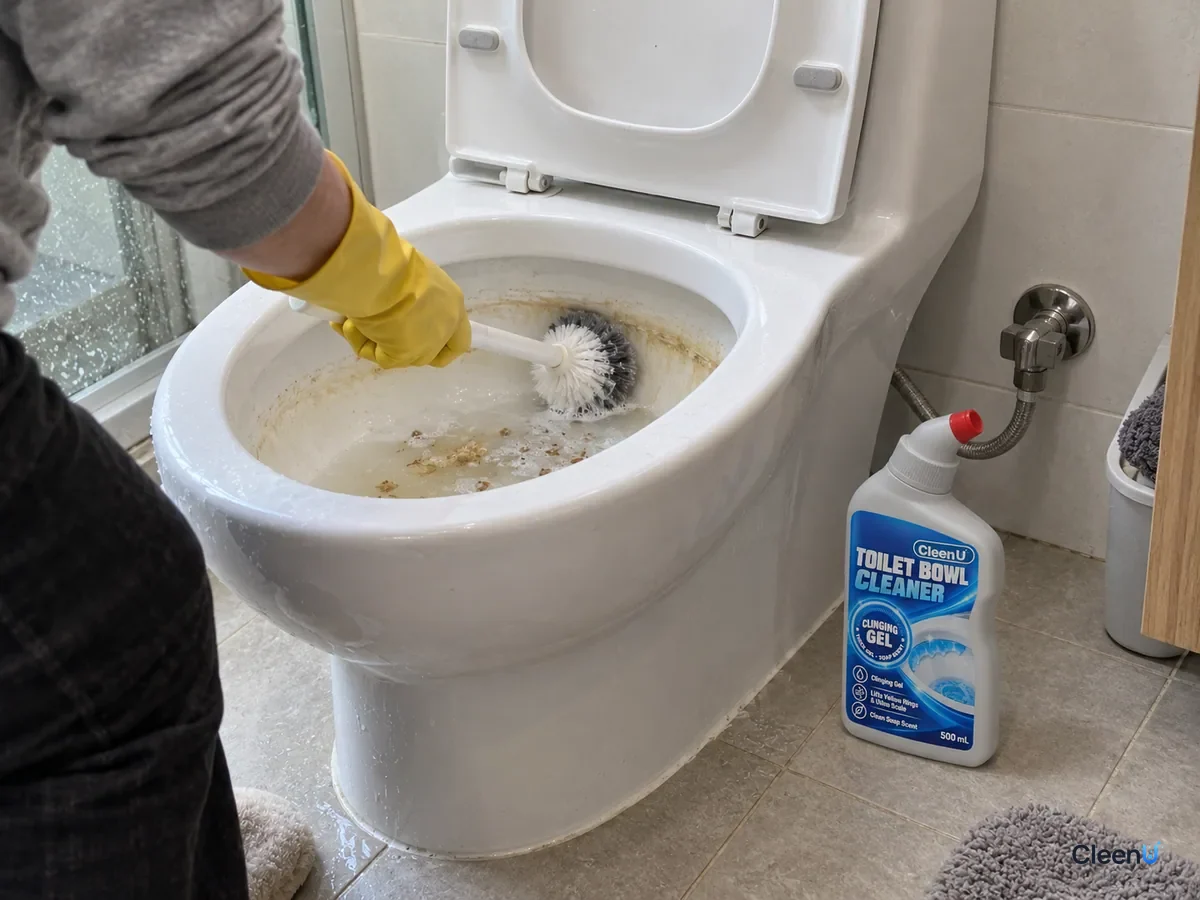
That deposit is mineral crystal, hard and dense, bonded to the glaze. Toilet brush bristles are soft and only remove organic grime on top; they barely touch crystal. Dish soap, laundry detergent, and general cleaners rely on surfactants and alkalinity, and alkaline conditions don't dissolve calcium salts. If anything, they keep them stable.
What loosens mineral scale is acid. Hydrogen ions react with calcium carbonate and calcium phosphate and turn insoluble calcium salts into soluble ones, releasing a little carbon dioxide. So a toilet ring needs an acidic toilet bowl cleaner and enough contact time.
There's one more catch: the ring is underwater. The water in the bowl dilutes cleaner almost instantly, and the acid concentration drops. That's why pouring cleaner into a full bowl and scrubbing often leaves the ring unchanged. Lower the water level first so the cleaner sits directly on the ring.
How a toilet bowl gel works
Take CleenU Toilet Bowl Cleaner as an example. It's an acidic clinging gel, pH 1.0 to 2.5 as supplied, made with mineral and organic acids, a thickener, and surfactants, with no chlorine, in an angled-neck squeeze bottle.
The acids dissolve urine scale and limescale. The thickener lets the gel cling to the bowl wall and under the rim instead of sliding straight into the water and getting diluted, which extends contact time. The surfactants wet the deposit and carry off loosened organic grime. The angled neck reaches under the rim to treat scale around the flush holes.
You run a bead around the rim, let it sit about 10 minutes, then scrub and flush. It's made for porcelain bowl walls, under-rim flush holes, the waterline, and urinals. It isn't for toilet seats, metal hardware, natural stone floors or counters, or coated or colored glazes on tubs and sinks.
Common situations: cause, what you see, fix, prevention
| Cause | What you see | Fix | Prevent it |
|---|---|---|---|
| Urine scale and limescale at the waterline | Hard yellow-brown ring that won't brush off | Lower the water, apply acidic gel along the ring, wait about 10 minutes, scrub | Clean weekly before it thickens |
| Cleaner diluted by bowl water | You poured cleaner and scrubbed, no change | Drop the water level, then apply gel | Always lower the water before treating the ring |
| Scale at the under-rim flush holes | Row of yellow spots under the rim; uneven flushing | Squeeze gel into the holes with the angled neck, wait, scrub with a narrow brush | Include the under-rim area every time |
| Iron or manganese in the water | Ring is dark brown or black | Let the gel sit a few minutes longer; repeat if needed | Clean more often in hard or iron-rich water |
| Worn or scratched glaze | Gray line remains after descaling; smooth, not raised | Can't be removed with cleaner | No steel wool, stiff brushes, or sandpaper |
Step by step: removing a toilet ring
Lower the water. Turn off the supply valve behind the toilet and flush once; the tank won't refill. Or bail some water out of the bowl with a cup until the level drops below the ring.
Put on gloves and open a window or run the fan. Blot the ring dry with toilet paper so the gel sticks better.
Squeeze a bead of gel along the ring so it covers it completely. If there's scale under the rim, tuck the angled neck under and run a bead around the flush holes.
Wait about 10 minutes. Don't flush, and don't add any other cleaner to the bowl.
Scrub along the ring with the toilet brush and use a narrow brush under the rim. Turn the water back on and flush.
Check the result. It's normal for thick buildup to need a second or third round; lower the water each time. Once it's gone, a weekly bead of gel and a quick scrub keeps the ring from coming back.
To tell soap scum from hard-water scale elsewhere in the bathroom, see Soap scum vs. hard water stains.
When the ring won't come off
If you've treated it several times and a gray or dark line is still there, smooth and not raised, it's probably not a deposit. The glaze is worn. Once steel wool, stiff brushes, or abrasive powder have scuffed the glaze, the surface loses its smoothness, and dirt and pigment settle into the scratches where cleaner can't fully reach.
Stronger acid and harder brushes will only make worn glaze worse. Keeping it clean and avoiding further abrasion is the only real option.
Why you can never use it with bleach
Never mix an acidic toilet cleaner with bleach or any product containing sodium hypochlorite, and don't use them back to back. Hypochlorite breaks down in acid and releases chlorine gas, which is strongly irritating. In a small, poorly ventilated bathroom it can irritate your airways and eyes and can be dangerous.
If you've just used bleach, flush several times and ventilate well before switching to an acidic product. For which cleaner belongs where in the bathroom, see How to clean a bathroom.
How to tell the ring is really gone
After flushing, shine a flashlight across the waterline from the side. If the glaze looks smooth and glossy again and your fingernail glides over it without catching, the mineral layer has dissolved. If the color is lighter but you still feel a gritty band, the bottom layer of scale is still there. Give it another round a day or two later rather than doubling the dose or leaving gel on for hours.
Why the ring comes back, and how to slow it down
A yellow ring forms where the water sits still and evaporates a little at a time, leaving calcium, magnesium and urine salts at the same line. Hard water speeds that up, and so does a toilet that isn't flushed often, like one in a guest bath. Two habits help most: brush the waterline once a week, before the deposit hardens, and run a short gel treatment every few weeks in hard-water homes. Fixing a running fill valve or a slow leak also matters, since a waterline that keeps shifting leaves several faint rings instead of one.
When it isn't scale at all
Some rings aren't mineral deposits. A gray or black band that wipes off easily is usually biofilm or mold, which an acidic gel won't target well; a regular toilet cleaner and brushing work better. A ring that is rough even after the stain is gone may be worn glaze, and no cleaner will restore that. In that case, regular brushing keeps it from getting darker.
Stop if you see this
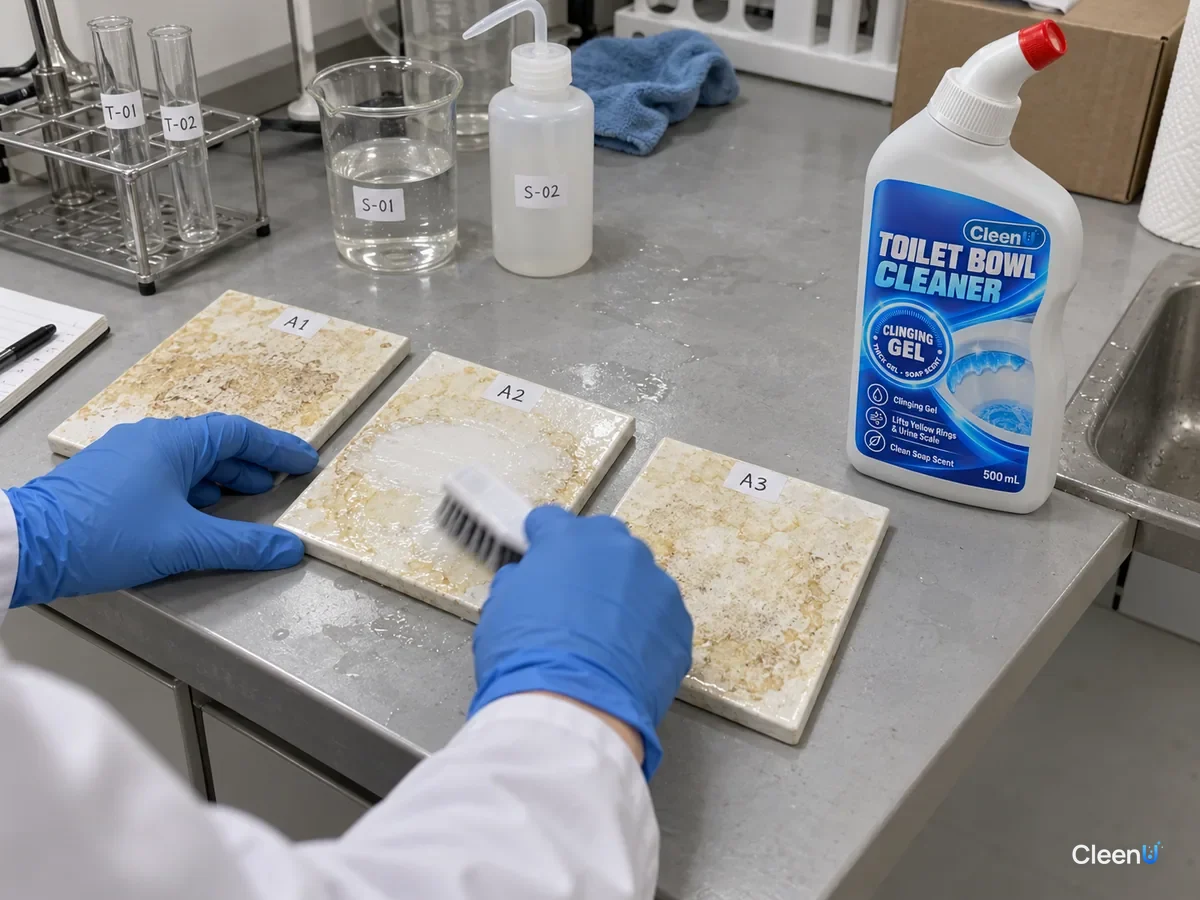
If you smell something sharp or your eyes or throat feel irritated, leave the bathroom and open a window. If gel splashes on skin or in your eyes, rinse with plenty of water and see a doctor if your eyes stay irritated. Never mix with bleach or other chlorine products. Keep the gel off toilet seats, metal hardware, natural stone, and colored glazes. If the toilet is cracked or leaking, call a plumber first.
Toilet bowl rings: common questions
Will cola or vinegar remove a toilet ring?
They help a little on fresh, light buildup but not much on thick, old rings. Both are weakly acidic, get diluted by bowl water, and don't stay in contact long enough. A dedicated acidic gel works better.
Why didn't toilet bowl cleaner work?
Most likely the bowl water diluted it. Lower the water so the ring is exposed, then apply the gel and let it sit. You'll see a clear difference.
How long should toilet gel sit on the ring?
Usually about 10 minutes; follow the label. For thick buildup, repeat once or twice rather than leaving it indefinitely.
Can I use steel wool on a toilet ring?
No. Steel wool damages the glaze, and scratched glaze stains faster and can't be repaired.
How often should I clean the toilet so the ring doesn't come back?
Weekly works well. A bead of gel around the rim and a quick scrub removes new deposits before they harden; clean more often in hard-water areas.
How do I clean yellow spots under the rim?
That's urine scale and limescale around the flush holes. Squeeze gel under the rim with the angled neck, let it sit, then scrub with a narrow brush.
How do I get rid of brown buildup in my toilet bowl?
Brown buildup at the waterline is usually mineral scale mixed with urine deposits, so it needs an acid, not more scrubbing. Lower the water level to expose the ring, coat it with an acidic toilet bowl gel, let it sit about 10 minutes, then scrub and flush. Repeat for thick layers, and never use it with bleach.
For a chlorine-free acidic gel that clings to the bowl and under the rim and loosens urine scale and limescale in about 10 minutes, take a look at our Toilet Bowl Cleaner.
A toilet ring is mineral scale, urine scale plus limescale, built up layer by layer at the waterline. Soft brushes and alkaline cleaners won't move it. It needs acid, and the water level has to come down first so the cleaner isn't diluted. Apply an acidic toilet gel along the ring, wait about 10 minutes, scrub, and flush, repeating for thick buildup. Never combine it with bleach, and skip steel wool. Clean weekly and it won't come back. If a smooth gray line remains, that's worn glaze, not scale.