
Troubleshooting
How to Remove Burn Marks and White Rings from a Glass Cooktop
Direct answer
Let the cooktop cool completely, lift burn marks with a cooktop razor scraper held at a low angle, then spray glass cooktop cleaner, wait 2 to 3 minutes, and wipe in small circles. White rings are usually hard-water scale or pan metal and need a different fix. Skip steel wool.
Check these five things before you start
- Is the cooktop fully cool? Hold the back of your hand above it and feel for heat.
- What does the mark look and feel like? Tan or brown and raised means burnt-on residue; cloudy white means scale or cleaner residue; metallic shine means pan marks.
- Was it a sugary spill, like jam or syrup? Those harden as they cool and need quicker action.
- Do you have the right tools: a cooktop razor scraper and a soft cloth, not steel wool?
- Does your cleaner's label say it's safe for glass-ceramic cooktops?
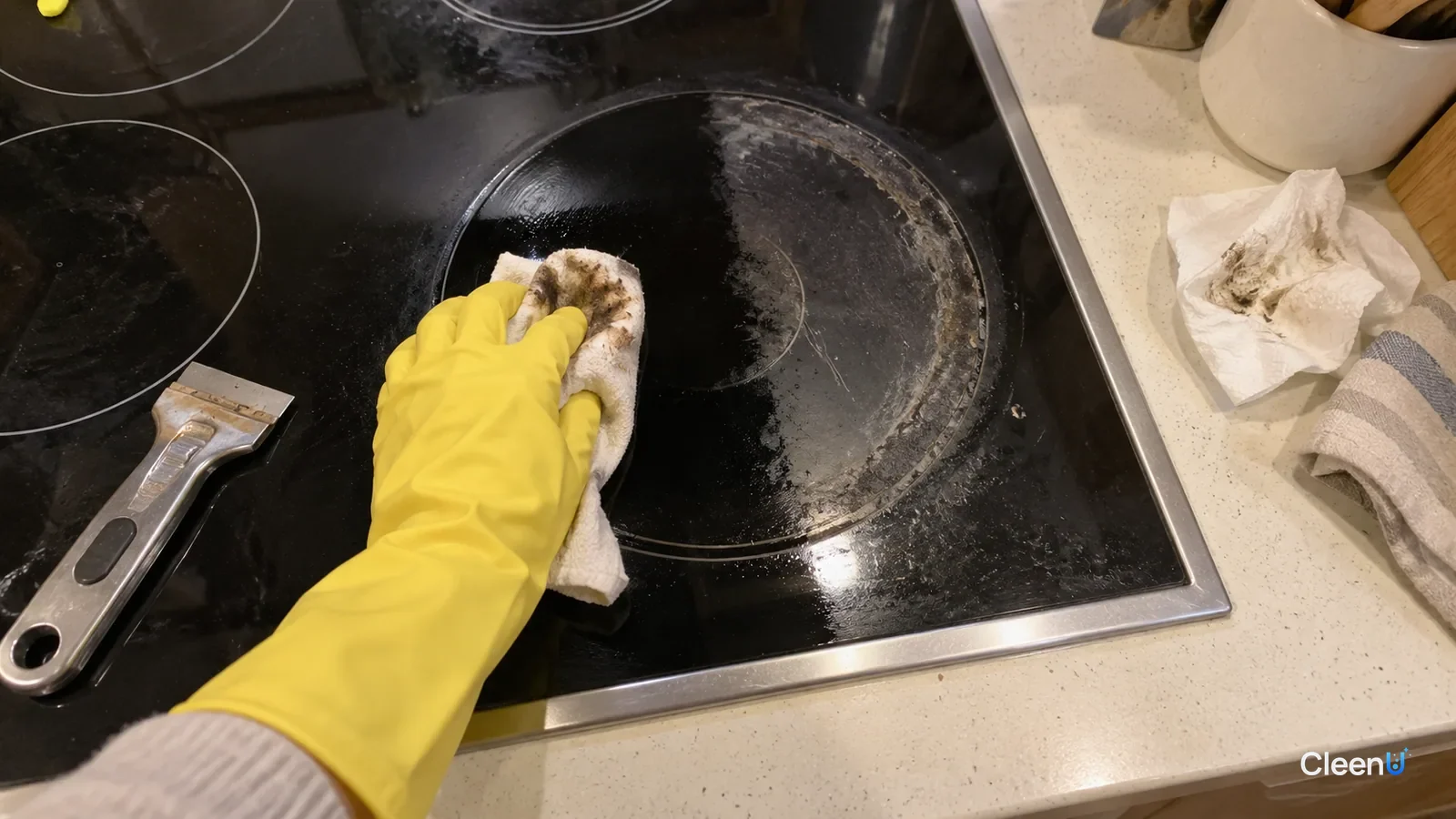
A glass-ceramic cooktop starts out as one glossy black sheet. A few months in, you've got tan-to-brown rings where the pans sit, cloudy white circles that won't wipe off, and sometimes shiny silver lines that look like scratches. Reaching for steel wool is the classic mistake: the burn marks stay, and now the glass has fine scratches too.
Those marks come from different sources and need different fixes. Figure out which one you're looking at first, then pick the tool and cleaner. You'll save half the effort and protect the glass.
Why burn marks are so stubborn
The cooking zones on a glass-ceramic cooktop get very hot, hundreds of degrees at the surface. When soup, oil, or milk boils over, the water flashes off instantly, and what's left behind changes under that heat.
Fats oxidize and polymerize: the molecules link together, turning liquid oil into a sticky, resin-like layer and then into a hard, tough film that shifts from yellow to brown. Proteins denature and char and grab onto the glass. Sugar caramelizes and cools into a hard, glassy layer.
Every time you cook, that film gets reheated, links up more, and darkens. That's why a cooktop seems to yellow over time. By that point it's no longer ordinary grease, and surfactants alone can't do much. You need to remove the thick layer physically first, then use a cleaner on the thin film left behind.
White rings: three kinds of "white"
White marks usually fall into one of three groups.
Hard-water rings. A wet pan bottom or a boil-over leaves water that evaporates and drops its calcium and magnesium salts on the glass as a cloudy ring that feels slightly gritty. It's mineral, so an alkaline cleaner won't touch it. A diluted white vinegar compress for a few minutes dissolves it; wipe with clean water afterward.
Cleaner residue. Too much cleaner that wasn't wiped off dries into a white haze that's easiest to see at an angle. A damp cloth with plain water, then a dry buff, fixes it.
Pan metal marks. Aluminum and copper-bottom pans that slide across the glass leave a thin layer of metal that looks like a bright silver or gray scratch. It's sitting on the surface, not cut into it, and a glass cooktop cleaner with a soft cloth in small circles usually removes it after a few passes. A real scratch catches your fingernail and won't come out.
Once you know which one it is, you won't fight scale with a degreaser or give up on a metal mark you thought was a scratch.
How a glass cooktop cleaner works
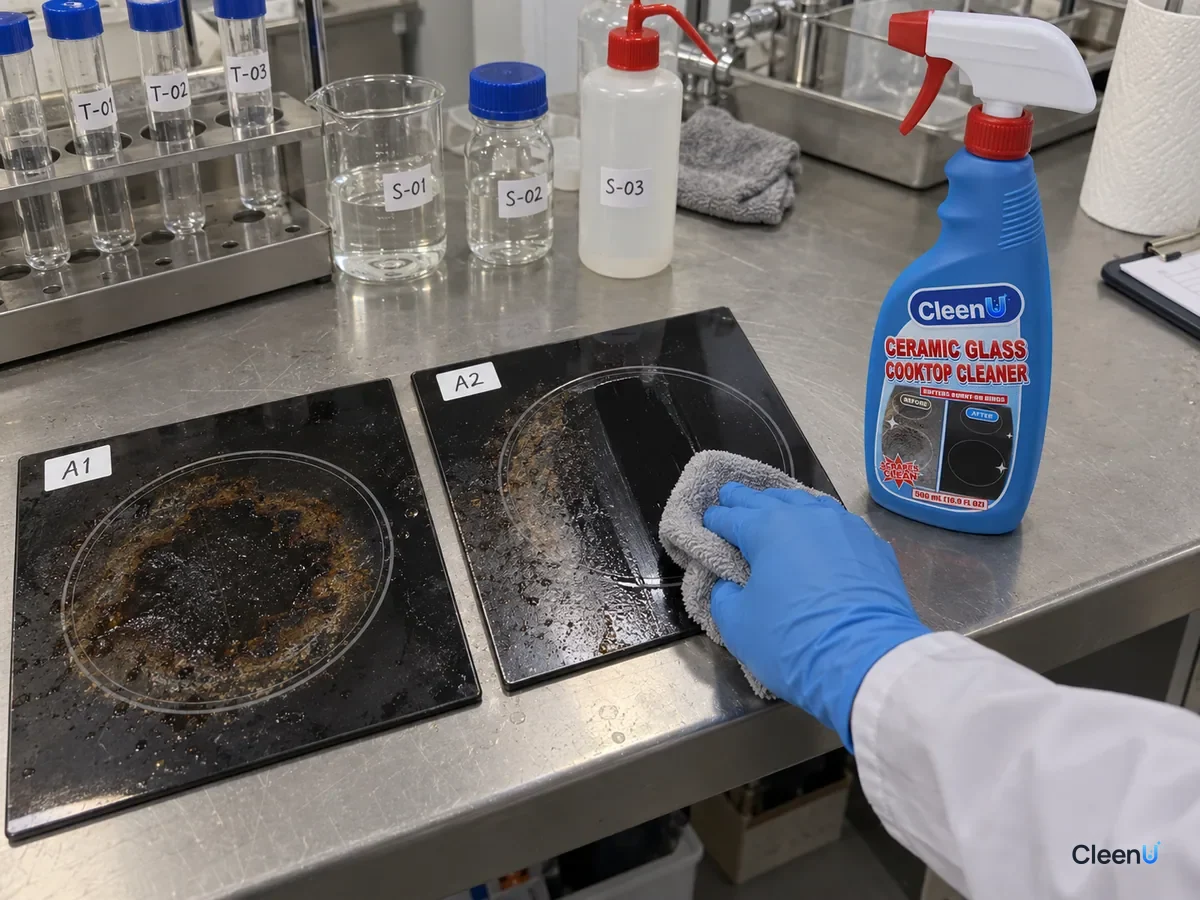
Take CleenU Ceramic Glass Cooktop Cleaner as an example. It's a mildly alkaline, ready-to-use spray, pH 8.5 to 10.0 as supplied, made with mild alkaline builders, nonionic surfactants, and a small amount of glycol ether solvent. It contains no abrasive particles, so it won't scratch the glass.
The alkaline builders partly saponify and loosen oxidized grease. The glycol ether solvent swells grease that hasn't fully polymerized so it lifts off the glass. The nonionic surfactants wet the surface and emulsify the loosened grime so the cloth can carry it away. Letting it sit 2 to 3 minutes gives all three time to work.
It's designed for the thin film left after scraping, everyday grease rings, and pan metal marks. Thick carbonized chunks and full sheets of burnt sugar still need the scraper first. And it isn't meant for white scale, which needs an acidic approach.
Common marks: cause, what you see, fix, prevention
| Cause | What you see | Fix | Prevent it |
|---|---|---|---|
| Grease reheated and polymerized | Tan-to-brown ring where the pan sits; hard to the touch | Once cool, scrape at a low angle, then spray cooktop cleaner, wait 2 to 3 minutes, wipe | Wipe after every cooking session once it cools |
| Sugary boil-over | Raised, hard lump, sometimes bubbly | Scrape while the glass is warm but safe to work near, then clean | Lower the heat for syrups and jams; clean spills fast |
| Minerals from water | Cloudy white ring that alkaline cleaner won't remove | Diluted white vinegar compress for a few minutes, wipe, rinse | Dry pan bottoms before setting them down |
| Too much cleaner | White haze or streaks at an angle | Wipe with a damp cloth, then buff dry | Spray lightly and finish with a dry cloth |
| Aluminum or copper pans sliding | Silver-white shiny line that looks like a scratch | Several passes with cooktop cleaner and a soft cloth | Lift pans to move them; don't drag |
| Actual scratch | Catches a fingernail; still there after cleaning | Can't be removed; keep it from getting worse | No steel wool or rough scouring pads; keep pan bottoms clean |
How to use a razor scraper without damaging the glass
The scraper is the most effective tool for glass-ceramic cooktops and the most misunderstood. People worry that a blade will scratch glass, but used correctly it's far safer than steel wool.
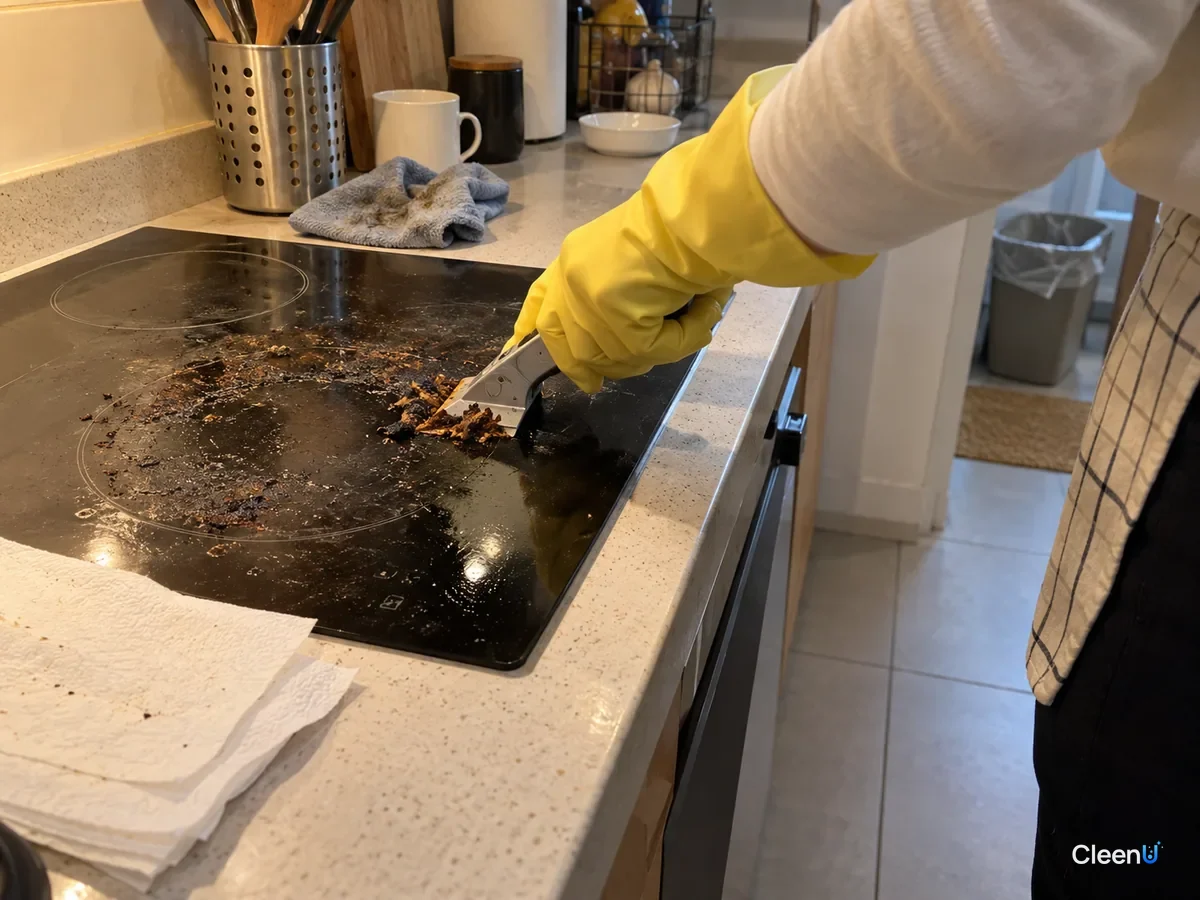
Use a scraper made for cooktops with a sharp, flat blade. A dull or nicked blade is what leaves marks. Wet the area first with a little cleaner or water so the blade glides. Hold it low, about 30 degrees or less, and push forward smoothly. Don't stand it up and chisel, and don't saw back and forth. Wipe away loosened bits as you go so hard debris doesn't get trapped under the blade.
Sugary spills are the exception to "wait until cool." Sugar hardens as it cools and can pull on the glass surface as it contracts. Scrape it off as soon as the glass is warm but safe to work near without burning yourself. The earlier, the easier.
A complete cleaning routine
Confirm the cooktop is cool. Scrape off thick burnt-on bits and raised lumps and wipe away the debris.
Spray cooktop cleaner over the marks so they're covered and leave it 2 to 3 minutes.
Wipe in small circles with a soft cloth or a non-scratch cooktop pad. For stubborn spots, spray again and repeat.
Wipe the whole surface with a well-wrung damp cloth to pick up loosened grime and leftover cleaner.
Buff dry with a microfiber cloth. When the glass is glossy black with no haze, you're done.
For white scale rings, lay a cloth soaked in diluted white vinegar on them for a few minutes, wipe them off, then wipe with clean water and dry. Don't use acidic and alkaline products at the same time.
Radiant vs. induction: why the marks look different
Both use a black glass-ceramic top, but they leave different marks. A radiant cooktop heats coils under the glass, so the glass itself gets very hot and cools slowly. Spills carbonize right on the hot surface, which is why burns on radiant tops are thick and dark and usually need the scraper. An induction cooktop heats the pan directly; the glass only picks up heat from the pan bottom and runs cooler. On induction you'll mostly see yellowed grease film and white water rings, fewer thick burns, and most of the time a spray, a short dwell, and a wipe are enough without a blade.
To decide whether you need the scraper, push the mark gently with a fingertip through a soft cloth. If it moves or lightens, it's film; go straight to the cleaner. If it doesn't budge and feels raised, it's carbon; scrape first, then wipe. That keeps you from taking a blade to a thin film over and over.
How to tell when you're done
After buffing dry, look at the glass in raking light. If the black is even with no haze and no grease rings, stop. If a faint yellow shadow remains around the burner zone but nothing moves under a fingernail or soft cloth, and the cloth no longer picks up color, what's left isn't residue anymore. It may be discoloration of the glass surface from long-term heat, and more scrubbing only adds scratch risk. White rings work the same way: if a vinegar compress lightens them clearly, it was scale; if two compresses change nothing, it's likely slight surface etching and not worth more effort.
The cloth is your simplest gauge. If it still comes up yellow or brown, there's film left to remove. Once it comes up clean, you're finished.
Stop if you see this
The glass is still hot; the cooktop has a crack, a chipped edge, or liquid around the controls; or your scraper blade is nicked. Don't let the cleaner sit on aluminum pan bottoms or a stainless trim for long, and wipe it dry afterward. No steel wool, rough scouring pads, or gritty powders. A cracked cooktop should not be used; contact the manufacturer.
Glass cooktop cleaning: common questions
Can I use steel wool on a glass cooktop?
No. Steel wool leaves fine scratches in glass-ceramic, and scratches trap grime, so it only gets harder to clean. Use a cooktop scraper and a soft cloth.
Cooktop cleaner won't remove the white rings. Now what?
Check whether they're hard-water scale. Scale is mineral, so alkaline cleaners won't dissolve it. Use a diluted white vinegar compress for a few minutes, then wipe with clean water.
Won't a razor blade scratch the glass?
Not if you use it correctly. A sharp, flat cooktop scraper, a wet surface, a low angle, and clearing debris as you go is much safer than steel wool.
Can a yellowed cooktop be restored?
Usually, yes. Yellowing is typically grease that's been reheated over and over, and a scraper plus cooktop cleaner over a few sessions lightens it noticeably. Discoloration in the glass itself or scratches won't come out.
Do I need cooktop cleaner every day?
No. A damp-cloth wipe after the cooktop cools is enough daily; use cooktop cleaner weekly or whenever burn marks appear.
Why deal with a sugary spill while the glass is still warm?
Sugar hardens into caramel as it cools and can pull at the glass as it contracts. Scrape it off once the surface is warm but safe to work near.
For a non-abrasive cooktop cleaner that loosens burnt-on grease rings after a 2 to 3 minute wait, take a look at our Ceramic Glass Cooktop Cleaner.
Marks on a glass cooktop come in three kinds: tan-to-brown burn marks from grease and sugar baked on over and over, white rings from scale or cleaner residue, and silver lines from pan metal. Scrape thick burn marks at a low angle, then use glass cooktop cleaner for 2 to 3 minutes and wipe. Treat scale with a diluted vinegar compress and remove metal marks with a few passes of cooktop cleaner. Always wait for the glass to cool and skip steel wool. A quick wipe after cooking keeps burn marks from building up.