

Product and application illustrations. Follow the product label and written use guidance.
CleenU product solution
Heavy-Duty Kitchen Degreaser
Commercial caustic · Cuts baked-on, carbonized grease · Private label
Carbonized black grease around the burners, and buildup on the hood and floor that keeps getting thicker? Dilute 1:5 for heavy grease or 1:20 for daily cleanup, spray, wait 3–5 minutes, scrub, and rinse. Commercial caustic formula, factory-direct private label.
- Commercial kitchens run high-heat wok and fryer stations all day, so grease on ranges, burners, hoods, and floors heats again and again into thick, hard, carbonized deposits that household cleaners can't penetrate. This degreaser saponifies fat with sodium hydroxide, penetrates thick layers with solvent and nonionic surfactants, handles hard water with chelators, and dilutes 1:5 to 1:20, so one jug goes a long way.
- At pH 12.5–13.5 this is a strong caustic. Wear alkali-resistant gloves, goggles, and an apron. It corrodes aluminum, zinc, galvanized, and painted surfaces. Rinse food-contact surfaces thoroughly, never spray onto hot surfaces or open flame (let equipment cool), and watch for slippery floors after cleaning.
- MOQ
- 500 bottles
- Free samples
- Free samples in 3–5 days
- Bulk lead time
- Scheduled with the order after packaging and labels are approved

Product value
What kitchens and equipment is it for?
CleenU Heavy-Duty Kitchen Degreaser cuts carbonized commercial grease.
View product detailsProduct summary
- Product type
- Heavy-duty commercial kitchen degreaser
- Core use
- Years of heavy grease, carbonized buildup, and floor grime on commercial ranges, burners, hoods, duct inlets, ovens, fryer exteriors, stainless prep tables, and kitchen floors
- Formula focus
- Sodium hydroxide with nonionic surfactants, chelators, and solvent, pH 12.5–13.5; unscented concentrate, dilute 1:5–1:20.
- Best for
- Janitorial and food service supply brands, Commercial cleaning contractors, Restaurant supply distributors

Before & after
Before and after (illustration)
Before: a Chinese restaurant's wok range after six months, with carbonized black grease around the burners, yellow-black buildup inside the hood, and a sticky floor. After: diluted 1:5 on cool equipment, left 5 minutes, scrubbed, and rinsed, the burners and hood show bare stainless and the floor isn't sticky.
- Before: carbonized burners, greasy hood, sticky floor
- 1:5 on cool equipment, 5 minutes, scrubbed, rinsed
- Bare stainless, clean floor

How it works
How heavy grease breaks down
Commercial kitchen grease is triglyceride oxidized and polymerized by heat into resin-like deposits with carbon particles on top. Sodium hydroxide saponifies triglycerides and part of the polymer into soluble soap and glycerol, glycol ether solvent swells the polymerized layer, nonionic surfactants penetrate and emulsify, chelators prevent lime soap, and a stiff brush removes what's softened.
- Dilute 1:5–1:20 by soil
- Apply to cool equipment
- Wait 3–5 minutes
- Caustic saponifies, solvent penetrates
- Scrub and rinse

Usage guidance
Use guidance
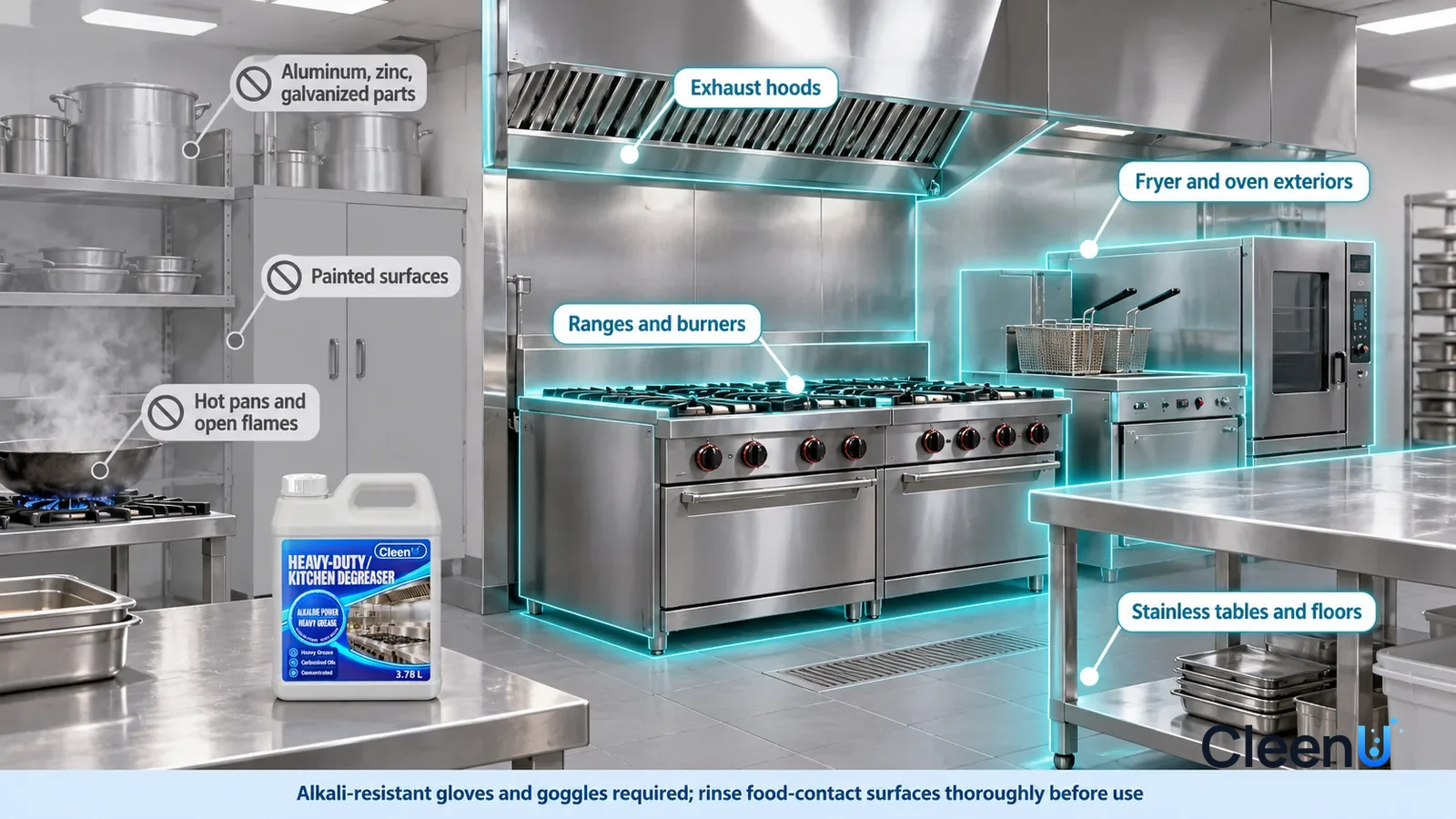
- Put on alkali-resistant gloves and goggles; dilute 1:5 for heavy grease or 1:20 for daily cleaning.
- Spray or wipe onto cool equipment and wait 3–5 minutes.
- Scrub with a stiff brush and rinse; rinse food-contact surfaces thoroughly before use.
Before you use it
Important notes
- Not for: Aluminum, zinc, and galvanized parts
- Not for: Painted surfaces
- Not for: Hot pans or open flame
- Not for: Use without protection
- Test first for special materials, special equipment, or sensitive scenarios.
Product comparison
How to choose a Heavy-Duty Kitchen Degreaser
Use Heavy-Duty Kitchen Degreaser in commercial kitchens, Kitchen Cleaner at home, and Oven Degreaser for oven interiors.
View product comparison
| Decision point | Heavy-Duty Kitchen Degreaser | Household kitchen cleaner |
|---|---|---|
| Carbonized grease | Caustic saponifies and penetrates | Not strong enough |
| Dosing | Concentrate, 1:5–1:20 | Ready-to-use, goes fast |
| Floor grease | Handles it | Limited |
| Cost | One jug, many jobs | Constant restocking |
Where Heavy-Duty Kitchen Degreaser stands out
Why household cleaners can't handle commercial grease
Commercial kitchens run high-heat wok and fryer stations all day, so grease on ranges, burners, hoods, and floors heats again and again into thick, hard, carbonized deposits that household cleaners can't penetrate. This degreaser saponifies fat with sodium hydroxide, penetrates thick layers with solvent and nonionic surfactants, handles hard water with chelators, and dilutes 1:5 to 1:20, so one jug goes a long way.
Caustic product: use it correctly
At pH 12.5–13.5 this is a strong caustic. Wear alkali-resistant gloves, goggles, and an apron. It corrodes aluminum, zinc, galvanized, and painted surfaces. Rinse food-contact surfaces thoroughly, never spray onto hot surfaces or open flame (let equipment cool), and watch for slippery floors after cleaning.
Who it's for, where it's used, and when not to use it
For
End-use scenarios
When not to use it
Product Specifications and Custom Options
Key product details and custom options for your project.
Product specifications
Product type, cleaning scope, and format.
| Product type | Heavy-duty commercial kitchen degreaser |
| Surfaces | Commercial ranges, burners, hoods, duct inlets, ovens, fryer exteriors, stainless prep tables, and kitchen floors |
| Applications | End-of-shift line cleaning, Periodic deep degreasing, Hood and floor grease |
| Main soils | Years of heavy grease, carbonized buildup, and floor grime on commercial ranges, burners, hoods, duct inlets, ovens, fryer exteriors, stainless prep tables, and kitchen floors |
| How to use | Dilute 1:5 heavy or 1:20 daily, apply to cool equipment, wait 3–5 minutes, scrub, rinse |
| Not for / avoid | Aluminum, zinc, and galvanized parts; Painted surfaces; Hot pans or open flame; Use without protection |
| Size & packaging | 1-gallon (3.78 L) handle jug with child-resistant cap |
| pH | pH 12.5–13.5 (25°C) |
| Scent | Unscented |
| Shelf life & storage | 24 months unopened; store sealed in a cool, dry place away from heat, moisture, and freezing |
B2B custom options
Private label, packaging, MOQ, samples, and delivery.
| OEM/ODM & private label | We run Heavy-Duty Kitchen Degreaser private-label projects from positioning and samples to packaging, production, and delivery. |
| Packaging & labels | Strength, container, labels, and hazard labeling available |
| Case pack | 4 × 1 gallon per case |
| OEM/ODM and private label | Available for project discussion |
| Packaging and labels | Strength, container, labels, and hazard labeling available |
| MOQ | 500 bottles |
| Sample time | Free samples in 3–5 days |
| Bulk lead time | Scheduled with the order after packaging and labels are approved |
| Documents | SDS/MSDS, TDS, and batch COA provided with quotes |
OEM/ODM project process
Move from product direction and sample review to packaging, production, and delivery for Heavy-Duty Kitchen Degreaser.
Define the buyer and plan
Choose gallon or 5-gallon pail, strength, and food service supply, cleaning contractor, or hotel channel.
Free samples
Free samples are usually ready in 3–5 days for project review.
Packaging and labels
Set strength, packaging, label language, and hazard labeling, plus directions on gloves and goggles, aluminum, zinc, and paint, and rinsing food-contact surfaces.
Production and delivery
Standard MOQ is 500 bottles; production is scheduled after packaging and labels are approved.
Why choose CleenU for Heavy-Duty Kitchen Degreaser?
From product positioning and samples to packaging and repeat supply, CleenU supports OEM/ODM projects built around Heavy-Duty Kitchen Degreaser.
Commercial concentrate
Dilutes by soil level for daily close-down and periodic deep cleaning.
Food service sizes
Gallons and 5-gallon pails with dilution charts and sprayers.
Sample testing that means something
We plan sample evaluation on wok ranges, hoods, fryer exteriors, and kitchen floors: degreasing at each dilution, dwell time, and ease of rinsing.
Labels and documents ready
Bilingual label copy, SDS/MSDS, TDS, and batch COAs, with warnings and directions prepared for your target market.
Consistent reorders
Every batch is retained and issued a COA, so reorders match on color, scent, and feel.
Formula discussion
Discuss formula direction based on product positioning, target market, and channel selling points.
Packaging and labeling options
Plan packaging format, label language, and shelf presentation around Heavy-Duty Kitchen Degreaser and your target channel.
Show packaging and label options
Packaging options
Main size: 1-gallon concentrate jug with handle and child-resistant cap. Also available: 5-gallon pails, kitchen kits with a dilution sprayer, and channel case packs, with labels and cartons in your branding.
Supporting Documents and Materials
Purchasers usually confirm whether the materials are complete before formal cooperation. Preparing documents in advance helps with quoting, sampling, and channel review.
Show available documents
Project documents
SDS/MSDS, TDS, batch COA, label directions, and packaging files are provided per project after inquiry.
Related products, solutions, and articles
Explore related cleaning products, application guidance, and OEM/ODM resources for Heavy-Duty Kitchen Degreaser.
Frequently asked questions (FAQ)
Find practical answers about Heavy-Duty Kitchen Degreaser, private label, samples, MOQ, documents, and delivery.
Product, use, and procurement
Why can't I use it on aluminum?
Strong alkali reacts with aluminum and darkens or corrodes it. Use a neutral or mild alkaline cleaner on aluminum pans and equipment.
Should a kitchen use it every day?
At 1:20 for daily wipe-downs of counters and range surrounds, and at 1:5 weekly or monthly for deep cleaning ranges and hoods.
How fast can we get samples and a first order?
Free samples ship in 3–5 days. MOQ is 500 bottles, and production is scheduled once packaging and labels are approved.
Product usage questions
How do I use it?
Dilute 1:5 for heavy grease and 1:20 for daily cleaning, spray or wipe on, wait 3–5 minutes, scrub, and rinse.
When shouldn't I use it?
Strongly alkaline: wear alkali-resistant gloves and eye protection; not for aluminum, zinc, galvanized, or painted surfaces; rinse any food-contact surface thoroughly.
Can I use it inside exhaust ducts?
At duct inlets, yes; leave full duct cleaning to a professional hood-cleaning company.
Can I use it in home kitchens?
Use Kitchen Cleaner at home; this is concentrated for commercial kitchens.
What about mopping floors?
Mop at 1:20, then mop again with clean water, and watch for slippery spots.
Can I soak sheet pans and fryer baskets?
Stainless ones, yes, at 1:10, then scrub and rinse; never soak aluminum.
Can I clean the inside of a fryer?
Drain and cool the fryer, boil out or soak at 1:10, then rinse and dry before refilling.
Will it streak stainless prep tables?
Rinse and dry, wiping with the grain, and it won't streak.
Can I soak hood filters?
Stainless filters, yes, at 1:10, then scrub; never aluminum.
Can I use it with sanitizer?
Don't mix them; clean and rinse first, then sanitize separately as required.
What is a heavy-duty kitchen degreaser for, and how is it different from a regular kitchen cleaner?
It's built for the baked-on, layered grease in commercial kitchens: ranges, hoods, fryers, and stainless filters and sheet pans. It's strongly alkaline, so it breaks down grease that dish soap or an everyday kitchen spray just smears around. That strength is also why it isn't for aluminum, zinc, galvanized, or painted surfaces, and why you should wear alkali-resistant gloves and eye protection. For light grease in a home kitchen, use a regular kitchen cleaner.
How strong should I mix it for heavy grease vs. daily cleaning?
Use 1:5 for heavy buildup and 1:20 for daily wipe-downs. For soaking stainless filters, sheet pans, and fryer baskets, mix 1:10. Give it 3–5 minutes on greasy surfaces, scrub with a stiff brush, and rinse with clean water; a stronger mix doesn't replace dwell time and scrubbing.
OEM/ODM customization questions
What can we customize?
Formula direction, scent, pack size and format, label design and language, and ecommerce bundles.
What paperwork comes with a private-label order?
Documents such as SDS/MSDS, TDS, COA, and label copy for your target market are prepared per project. We confirm which ones your order includes when we quote.
Launching your own commercial degreaser?
Send us your market, packaging, channels, and estimated volume. We'll build it out with you.