
Q&A
Can You Use Steel Wool on a Glass Stovetop?
Direct answer
No. Steel wool, rough scrub pads, and scouring powder leave fine scratches in glass-ceramic that trap grime, make it harder to clean over time, and can't be repaired. Lift burnt-on spots with a cooktop razor scraper held at a low angle, then use a non-abrasive cooktop cleaner and a soft cloth.
Glass cooktop tools: yes or no
Yes
- Microfiber cloths, soft sponges, and non-abrasive cooktop cleaner
No
- Steel wool or stainless scrubbers: they scratch the glass
- The rough green side of a sponge, scouring powder, gritty cleaning paste: abrasives leave fine scratches
- Metal spatulas or blades held upright: they can chip the edge and gouge the surface
It depends
- A cooktop razor scraper: fine with a sharp, flat blade, a wet surface, and a low angle
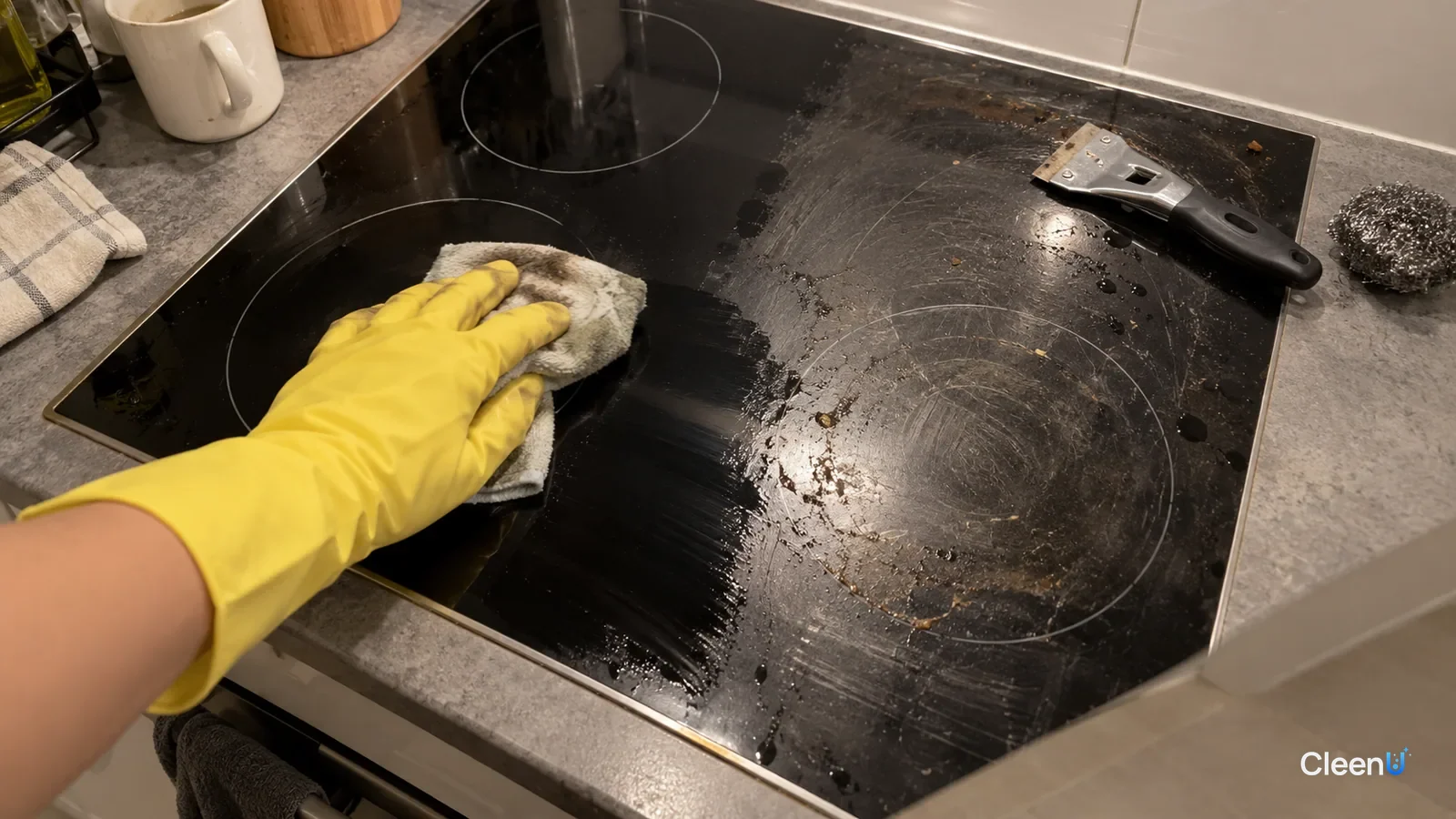
Electric smooth-tops, induction cooktops, and built-in glass-ceramic ranges all have one black sheet of glass-ceramic on top. When something boils over and bakes on, steel wool is the most tempting tool. It seems to work at first, but a few months later, hold a light to it and the surface is covered in fine circular scratches.
Why glass-ceramic and steel wool don't mix
Glass-ceramic is a special glass full of tiny crystals that let it handle extreme heat and big temperature swings, which is why it's used for cooktops. It's a little harder than ordinary glass, but its surface isn't scratch-proof.
Steel wool is a tangle of thin steel strands with sharp edges, and when you scrub hard, harder bits of char and grit get trapped between the strands. All of that grinds back and forth across the glass and cuts fine scratches. The rough side of a scrub sponge contains abrasive particles, and scouring powders and some cleaning pastes contain abrasives like calcium carbonate or silica, which do the same thing.
One fine scratch is nearly invisible. Hundreds or thousands of them together dull the surface, and under the light you see hazy circular swirls.
Why scratches make the cooktop harder to clean
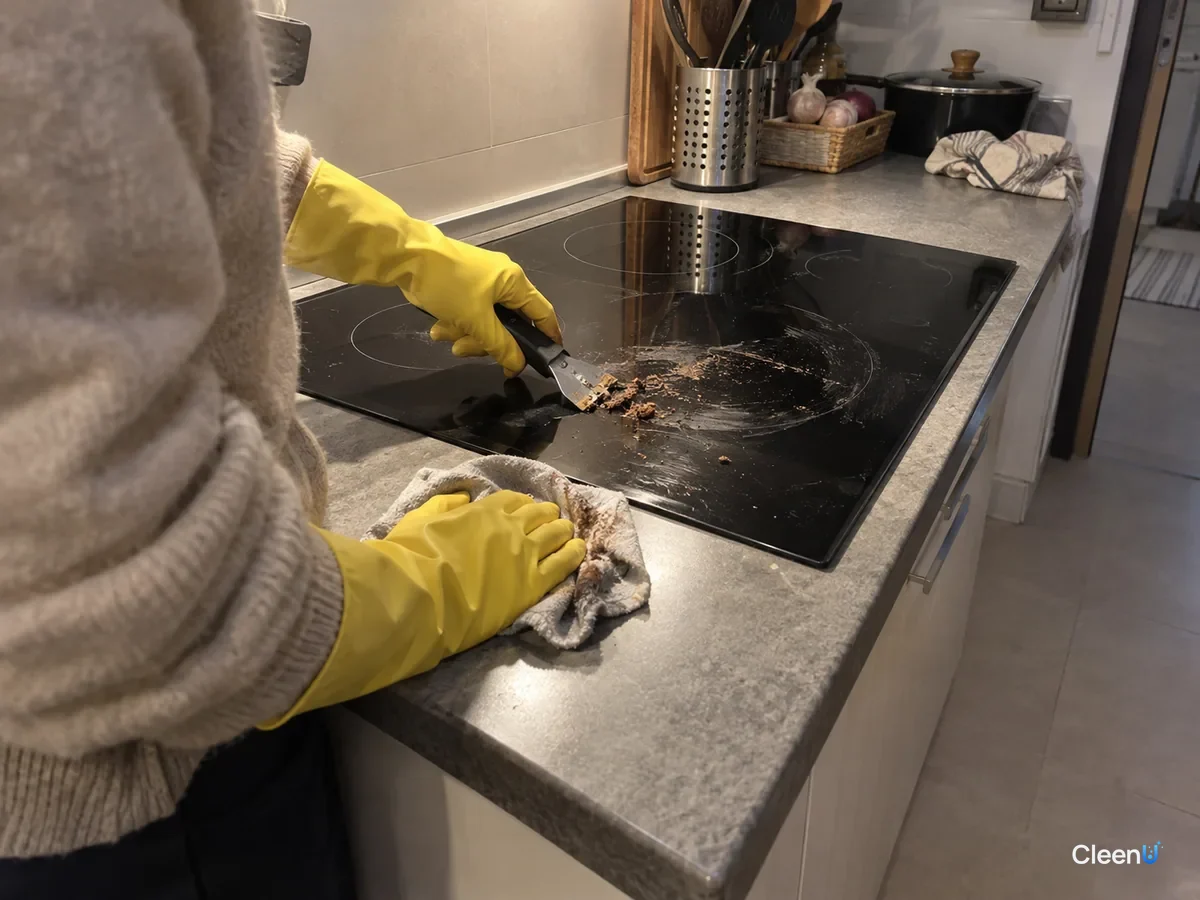
On smooth glass, burnt-on food and grease sit on top, and a scraper lifts them off in one piece. Once the surface is scratched, it's uneven. Spills and grease run into the scratches and burn in there when the cooktop heats up. Next time, the scraper can't reach the bottom of the scratches, so you reach for something rougher, which makes more scratches. It's a vicious cycle.
Worse, scratches in glass can't be repaired. Polishing compounds can only help with the faintest surface marks; anything deeper is permanent unless you replace the top.
How to remove burnt-on residue instead
A cooktop razor scraper is the most effective tool for burnt-on spots. Its sharp, flat blade, held almost flat against the glass, lifts residue off the surface instead of grinding it. Using a razor on glass sounds risky, but used correctly it's far safer than steel wool.
Wait until the cooktop is completely cool. Wet the area with a little cleaner or water. Hold the scraper at a low angle, about 30 degrees or less, and push forward smoothly. Wipe away loosened bits as you go so nothing gets trapped under the blade. Replace the blade when it's dull or nicked.
Sugary spills like syrup or jam are the exception: sugar hardens as it cools, so scrape it off as early as you can once the glass is warm but safe to work near.
After the thick residue is gone, use a cooktop cleaner on the thin film and grease rings left behind. Take CleenU Ceramic Glass Cooktop Cleaner as an example. It's a mildly alkaline, ready-to-use spray, pH 8.5 to 10.0 as supplied, made with mild alkaline builders, nonionic surfactants, and a little glycol ether solvent, with no abrasive particles, so it won't scratch glass. Spray the cooled cooktop, wait 2 to 3 minutes, wipe in circles with a soft cloth, then wipe with a damp cloth and buff dry. It isn't for hot cooktops, shouldn't be used with steel wool or rough pads, and shouldn't sit on aluminum pan bottoms or stainless cooktop trim (wipe them dry afterward).
For the full routine on burn marks and white rings, see the cooktop section of How to clean a kitchen.
Not every mark needs scraping
A lot of steel-wool damage happens because people can't tell what's actually on the cooktop. Glass-ceramic surfaces tend to show four kinds of marks, and each one calls for something different.
Burnt-on spills. When soup, starchy water, or milk boils over, the water evaporates and the starch, protein, and sugar left behind dehydrate and carbonize into a dark, raised crust. It sits on top of the glass, which is exactly why a scraper can lift it from underneath.
Grease rings. That yellow-brown halo around the burner is cooking oil that splattered, oxidized, and polymerized under heat. It's thin and tightly bonded, so a scraper won't pick much up. This is the cleaner's job. The mild alkaline builders loosen the polymerized film, the glycol ether helps soften it, and the nonionic surfactants emulsify and disperse what comes loose so a soft cloth can carry it away. That's what the 2- to 3-minute wait is for. Give it the full time and you won't need to scrub.
White water marks. When water or broth boils over and dries, it leaves a chalky ring of calcium and magnesium minerals. It's usually thin. A mildly alkaline cooktop cleaner does little against mineral deposits, so wipe with a damp cloth first and follow your cooktop manual for anything that remains.
Metal marks. Aluminum or copper-bottom pans slid across the glass can leave silvery-gray streaks that look a lot like scratches. They're often metal transferred onto the surface, and they frequently wipe off.
Scratch or stain? How to tell
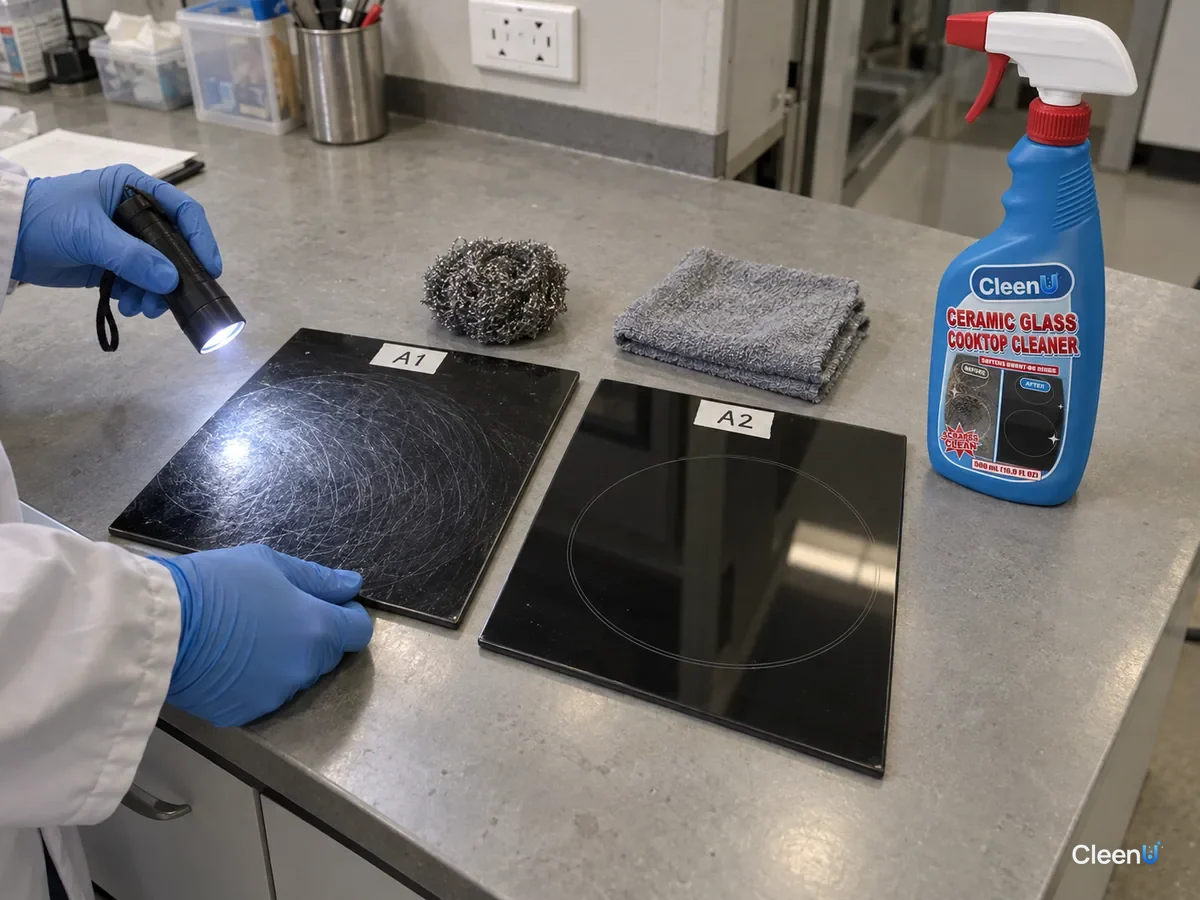
Once the cooktop is clean and fully dry, shine a flashlight across it at a low angle. A stain shows up as color or a film, and another damp wipe changes it. A scratch shows up as a fine bright line that doesn't change no matter how you wipe, and a fingernail dragged across it catches slightly.
That distinction decides your next move. A stain is worth another round of cleaner and the scraper. A scratch is permanent, and scrubbing at it only adds new scratches around it. At that point, stop and focus on not adding more.
Fast isn't the same as right
Steel wool feels fast because you see a change right away. But it gets that speed by grinding, taking off the burnt residue along with a little of the glass surface. A scraper plus cleaner works differently: loosen the residue, then separate it from the glass without wearing the glass itself. One approach uses up the cooktop a little every time. The other can be repeated hundreds of times while the surface stays glossy. On a cooktop you plan to keep for years, an extra minute or two is a good trade.
If your cooktop is already scratched
Stop using steel wool and abrasives so the scratches don't multiply.
Clean day to day with a soft cloth and non-abrasive cooktop cleaner. Grime in the scratches will gradually lighten, but the scratches themselves won't go away.
If scratches are deep, the glass is cracked, or an edge is chipped, stop using it and contact the manufacturer. Damaged glass-ceramic can crack further.
Taking care of the scraper itself
The scraper only protects the glass if the blade is in good shape. A sharp, straight edge slides under residue cleanly. A dull or nicked blade skips and chatters, and a chipped corner can mark the surface the same way steel wool does. Check the edge before each use, swap in a new blade as soon as it feels dull or shows rust, and keep the blade guard on in the drawer so it doesn't pick up its own nicks. Wipe the blade between passes so flakes of burnt residue don't get trapped under it and dragged across the glass.
Protecting your cooktop day to day
Make sure pan bottoms are clean and dry before you set them down. Grit and burnt-on residue on pans are another source of scratches.
Lift pans to move them instead of sliding them, especially cast iron and pans with rough bottoms.
After cooking, once the top cools, wipe it with a damp cloth. If burnt-on residue never builds up, you never need to scrub hard.
When something boils over, turn the heat down right away and clean it up early, especially sugary spills.
Stop if you see this
If the cooktop is cracked, chipped, or has scratches deep enough to catch a fingernail, stop using it and contact the manufacturer. Never clean it while it's hot. Replace scraper blades that are nicked or rusty, and never use a metal spatula held upright. Don't let cleaner sit on aluminum pan bottoms or stainless trim; wipe them dry.
Cleaning glass cooktops: common questions
Can I use steel wool on a glass cooktop?
No. It leaves fine scratches in the glass-ceramic that trap grime, make cleaning harder over time, and can't be repaired.
Can scratches on a glass cooktop be fixed?
The faintest surface marks may polish out a little; visible scratches can't be repaired, only kept from getting worse. Deep scratches or cracks need the manufacturer.
Won't a razor blade scratch the glass?
Not if you use it right. A sharp, flat cooktop scraper on a wet surface at a low angle, with debris wiped away as you go, is much safer than steel wool.
Can I use a scrub sponge?
Not the rough green side, which contains abrasives. The soft sponge side or a microfiber cloth is fine.
Can I clean a glass cooktop with scouring powder or toothpaste?
We don't recommend it. Both are abrasive and will dull the surface with fine scratches.
What if the burnt-on spot won't scrape off?
Spray cooktop cleaner and let it sit 2 to 3 minutes to soften it, then scrape again at a low angle. Do it in two or three rounds rather than switching to steel wool.
For a non-abrasive cooktop cleaner that won't scratch glass and softens burnt-on rings in 2 to 3 minutes, made to use with a scraper and soft cloth, take a look at our Ceramic Glass Cooktop Cleaner.
Don't use steel wool on a glass-ceramic cooktop, and skip rough scrub pads, scouring powder, and gritty pastes too. They grind fine scratches into the glass that trap grime, make it harder to clean, and can't be repaired. Instead, let the cooktop cool, wet it, push a cooktop razor scraper at a low angle to lift burnt-on spots, then use a non-abrasive cooktop cleaner for 2 to 3 minutes, wipe with a soft cloth, and buff dry. Keep pan bottoms clean, lift pans instead of sliding them, and wipe the top after cooking, and it'll stay glossy for years.