

Product and application illustrations. Follow the product label and written use guidance.
CleenU product solution
Boiler & Heat Exchanger Descaler
Inhibited acid descaling · Color indicator shows the endpoint · Private label
Combi boiler water running hot and cold, heat exchanger scaled up, and gas bills climbing? A technician isolates the system, dilutes to 5–10%, circulates 1–3 hours, tops up when the color turns from red to yellow, then drains, flushes, and neutralizes. Inhibited sulfamic acid formula, factory-direct private label.
- Calcium and magnesium drop out as scale on hot exchanger surfaces, and scale conducts heat far worse than metal, so even a thin layer cuts efficiency, raises fuel or power use, and makes combi boilers run hot and cold, get louder, and lock out more often. This descaler dissolves scale with sulfamic acid, protects metal with inhibitors, and turns from red to yellow when it needs topping up so you can track progress.
- At pH 1–2 this is a strong industrial acid for trained service technicians only, with acid-resistant gloves, goggles, and protective clothing; isolate the system and power per the manufacturer. Confirm compatibility or use a dedicated formula for aluminum exchangers. Afterward, drain, flush, and neutralize the system, dispose of waste per local rules, and never mix with chlorine products.
- MOQ
- Set by spec and packaging
- Free samples
- Free samples in 3–5 days
- Bulk lead time
- Scheduled once spec, packaging, and labels are approved

Product value
What equipment is it for?
CleenU Boiler & Heat Exchanger Descaler dissolves scale for professional technicians.
View product detailsProduct summary
- Product type
- Inhibited boiler and heat exchanger descaler
- Core use
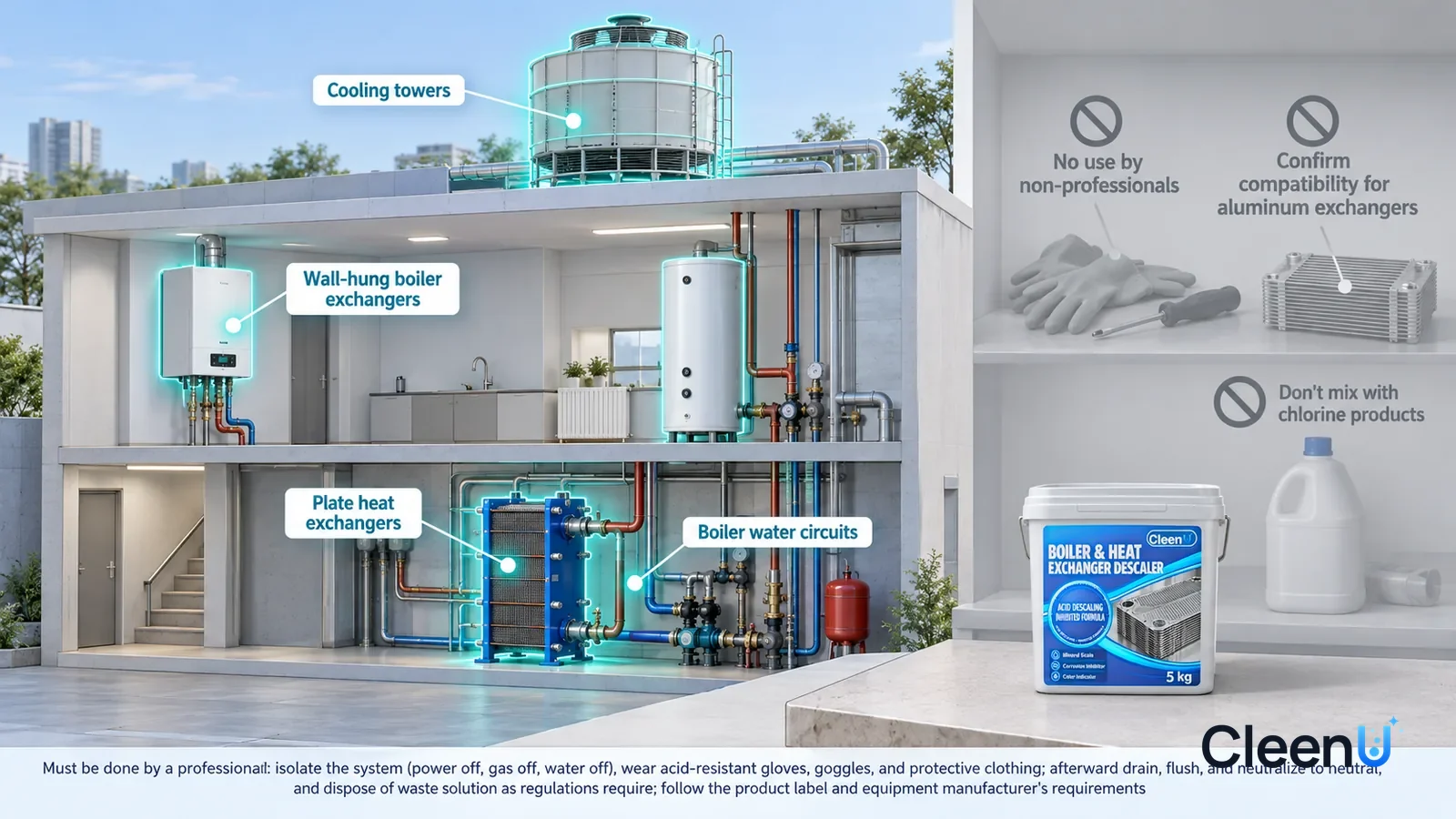
- Scale and mineral deposits in gas combi boilers, water heaters, plate heat exchangers, boiler circuits, cooling towers, and industrial exchangers
- Formula focus
- Sulfamic acid with corrosion inhibitors, wetting agent, and color indicator, pH 1.0–2.0; unscented concentrate, circulate at 5–10%.
- Best for
- HVAC and plumbing supply brands, Boiler and equipment service companies, Industrial maintenance distributors

Before & after
Before and after (illustration)
Before: a five-year-old gas combi boiler with a scaled plate exchanger, hot water swinging hot and cold, and rising noise. After: a technician isolated the water circuit, circulated 8% solution for 2 hours with one top-up, then drained, flushed, neutralized, and reassembled, and outlet temperature is steady and quieter.
- Before: scaled exchanger, unstable hot water
- 8% circulated 2 hours, one top-up, flushed, neutralized
- Steady temperature, quieter

How it works
How scale dissolves
Exchanger scale is mostly calcium and magnesium carbonate with some silicate and rust. Sulfamic acid reacts with carbonate to form soluble calcium and magnesium sulfamate and carbon dioxide; calcium sulfamate is highly soluble, so it doesn't redeposit. Inhibitors adsorb onto metal to film it and limit attack on the base metal, and the indicator shifts from red to yellow as pH rises, showing the acid is spent.
- Technician isolates system
- Dilute to 5–10%
- Circulate 1–3 hours
- Top up at red-to-yellow
- Drain, flush, neutralize

Usage guidance
Use guidance
- A trained technician isolates the system per the manufacturer, wears acid PPE, and dilutes to 5–10%.
- Circulate 1–3 hours with a pump, topping up when the indicator turns from red to yellow.
- Drain, flush with clean water, neutralize to neutral pH, and dispose of waste per local rules.
Before you use it
Important notes
- Not for: Use by non-professionals
- Not for: Aluminum exchangers without confirmed compatibility
- Not for: Mixing with chlorine products
- Not for: Discharging waste untreated
- Test first for special materials, special equipment, or sensitive scenarios.
Product comparison
How to choose a Boiler & Heat Exchanger Descaler
Use Boiler & Heat Exchanger Descaler for boilers and exchangers, Water Scale Inhibitor for household water systems, and Coffee Machine Descaler for coffee makers.
View product comparison
| Decision point | Boiler & Heat Exchanger Descaler | Hydrochloric acid |
|---|---|---|
| Metal attack | Inhibitor protected | Aggressive |
| Fumes | Solid acid, low fumes | Pungent |
| Endpoint | Color indicator | Hard to tell |
| Calcium redeposit | Highly soluble salt | — |
Where Boiler & Heat Exchanger Descaler stands out
Why scaled exchangers burn more fuel
Calcium and magnesium drop out as scale on hot exchanger surfaces, and scale conducts heat far worse than metal, so even a thin layer cuts efficiency, raises fuel or power use, and makes combi boilers run hot and cold, get louder, and lock out more often. This descaler dissolves scale with sulfamic acid, protects metal with inhibitors, and turns from red to yellow when it needs topping up so you can track progress.
Professional use, safety first
At pH 1–2 this is a strong industrial acid for trained service technicians only, with acid-resistant gloves, goggles, and protective clothing; isolate the system and power per the manufacturer. Confirm compatibility or use a dedicated formula for aluminum exchangers. Afterward, drain, flush, and neutralize the system, dispose of waste per local rules, and never mix with chlorine products.
Who it's for, where it's used, and when not to use it
For
End-use scenarios
When not to use it
Product Specifications and Custom Options
Key product details and custom options for your project.
Product specifications
Product type, cleaning scope, and format.
| Product type | Inhibited boiler and heat exchanger descaler |
| Surfaces | Gas combi boilers, water heaters, plate heat exchangers, boiler water circuits, cooling towers, and industrial heat exchangers |
| Applications | Combi boilers and water heaters, Plate heat exchangers, Cooling towers and industrial exchangers |
| Main soils | Scale and mineral deposits in gas combi boilers, water heaters, plate heat exchangers, boiler circuits, cooling towers, and industrial exchangers |
| How to use | Technician isolates system, dilute 5–10%, circulate 1–3 hours, top up at red-to-yellow, drain, flush, neutralize |
| Not for / avoid | Use by non-professionals; Aluminum exchangers without confirmed compatibility; Mixing with chlorine products; Discharging waste untreated |
| Size & packaging | 5 kg pail (powder or liquid) |
| pH | pH 1.0–2.0 (working solution, 25°C) |
| Scent | Unscented |
| Shelf life & storage | 24 months unopened; store sealed in a cool, dry place away from heat, moisture, and freezing |
B2B custom options
Private label, packaging, MOQ, samples, and delivery.
| OEM/ODM & private label | We run Boiler & Heat Exchanger Descaler private-label projects from positioning and samples to packaging, production, and delivery. |
| Packaging & labels | Powder or liquid, pail type, labels, and hazard labeling available |
| Case pack | 4 × 5 kg per case |
| OEM/ODM and private label | Available for project discussion |
| Packaging and labels | Powder or liquid, pail type, labels, and hazard labeling available |
| MOQ | Set by spec and packaging |
| Sample time | Free samples in 3–5 days |
| Bulk lead time | Scheduled once spec, packaging, and labels are approved |
| Documents | SDS/MSDS, TDS, and batch COA provided with quotes |
OEM/ODM project process
Move from product direction and sample review to packaging, production, and delivery for Boiler & Heat Exchanger Descaler.
Define the buyer and plan
Choose powder or liquid, 5 kg or 25 kg pail, and HVAC service or industrial equipment channel.
Free samples
Free samples are usually ready in 3–5 days for project review.
Packaging and labels
Set packaging, label language, and hazard labeling, plus directions on professional use, acid PPE, aluminum compatibility, flushing and neutralizing, and waste disposal.
Production and delivery
For tablets, powders, and similar formats, MOQ and lead time depend on the spec and packaging, confirmed once those are set.
Why choose CleenU for Boiler & Heat Exchanger Descaler?
From product positioning and samples to packaging and repeat supply, CleenU supports OEM/ODM projects built around Boiler & Heat Exchanger Descaler.
Inhibited formula
Sulfamic acid with inhibitors to limit attack on steel, copper, and stainless during descaling.
HVAC service channel
5 kg and 25 kg pails with dilution and procedure sheets for HVAC and equipment service firms.
Sample testing that means something
We plan sample evaluation on combi boiler plate exchangers, water heaters, and industrial plate exchangers: descaling speed, indicator accuracy, and metal coupon corrosion.
Labels and documents ready
Bilingual label copy, SDS/MSDS, TDS, and batch COAs, with warnings and directions prepared for your target market.
Consistent reorders
Every batch is retained and issued a COA, so reorders match on color, scent, and feel.
Formula discussion
Discuss formula direction based on product positioning, target market, and channel selling points.
Packaging and labeling options
Plan packaging format, label language, and shelf presentation around Boiler & Heat Exchanger Descaler and your target channel.
Show packaging and label options
Packaging options
Main size: 5 kg pail (powder or liquid). Also available: 25 kg pails, service kits with neutralizer, and channel case packs, with pail labels and cartons in your branding.
Supporting Documents and Materials
Purchasers usually confirm whether the materials are complete before formal cooperation. Preparing documents in advance helps with quoting, sampling, and channel review.
Show available documents
Project documents
SDS/MSDS, TDS, batch COA, label directions, and packaging files are provided per project after inquiry.
Related products, solutions, and articles
Explore related cleaning products, application guidance, and OEM/ODM resources for Boiler & Heat Exchanger Descaler.
Frequently asked questions (FAQ)
Find practical answers about Boiler & Heat Exchanger Descaler, private label, samples, MOQ, documents, and delivery.
Product, use, and procurement
Why use an inhibited descaler?
Heat exchangers are copper and steel, and plain strong acid attacks the metal while dissolving scale. Inhibitors sharply reduce attack on the base metal.
What does the color indicator do?
Red means the acid is still active; yellow means the scale has used it up and you need to add more, so you're not dosing blind.
How do samples and minimum orders work?
Free samples ship in 3–5 days. MOQ and lead time depend on the spec and packaging, and we confirm both once those are set.
Product usage questions
How do I use it?
Isolate the system per the manufacturer, dilute to 5–10%, circulate with a pump for 1–3 hours, top up when the indicator turns from red to yellow, then drain, flush, and neutralize.
When shouldn't I use it?
Strongly acidic industrial product for trained technicians only, with acid-resistant gloves, goggles, and protective clothing; reduce strength and time on aluminum exchangers; never mix with chlorine.
How often should a boiler be descaled?
Typically every 1–2 years for combi boilers, depending on water and use; follow the service plan for hard water and industrial equipment.
Can homeowners do it themselves?
We don't recommend it; descaling requires opening the water circuit, so use a qualified technician.
Can I use it on copper exchangers?
Have a technician run a small test first, and control temperature and contact time during the job; rinse and neutralize as directed afterward.
What if the color never turns yellow?
There's still acid left and scale is mostly dissolved; judge completion with flow and outlet performance.
Can it clean radiant floor heating loops?
Floor loop flushing needs specialized equipment; leave it to an HVAC company.
Can I use it on solar water heaters?
Only as a technician-run job based on the system design; follow the heater maker's maintenance guidance.
Powder or liquid?
Powder ships and stores easily; liquid dissolves faster. Choose by channel.
Do I need to passivate after descaling?
For industrial equipment, neutralize and passivate per the maintenance spec.
What chemical is used to descale a boiler heat exchanger?
An inhibited acid descaler. This one is a strongly acidic product: the acid dissolves scale, and a corrosion inhibitor reduces attack on the copper and steel underneath. A color indicator turns from red to yellow when the acid is used up, so the technician knows when to add more. Full composition is on the SDS and TDS we provide with your inquiry.
What is scale in a heat exchanger, and why remove it?
Scale is the hard mineral layer, mostly calcium carbonate, that forms when hard water is heated. It builds up on heat-transfer surfaces and in narrow passages, slowing heat transfer and restricting flow. Descaling dissolves that layer; the system is then drained, flushed, and neutralized.
OEM/ODM customization questions
What can we customize?
Formula direction, scent, pack size and format, label design and language, and ecommerce bundles.
What paperwork comes with a private-label order?
Documents such as SDS/MSDS, TDS, COA, and label copy for your target market are prepared per project. We confirm which ones your order includes when we quote.
Launching your own boiler descaler?
Send us your market, format, packaging, and estimated volume. We'll build it out with you.