

Product and application illustrations. Follow the product label and written use guidance.
CleenU product solution
Engine Degreaser
Water-based, nonflammable · Hoses off · Private label
Engine bay coated in black crud that hides leaks? Spray a fully cooled engine, wait 3–5 minutes, brush, and rinse with low-pressure water, and the grime washes away. Water-based and nonflammable, factory-direct private label.
- Small amounts of oil and transmission fluid seep from seals, road dust sticks, and engine heat bakes it into black crud on the block, oil pan, and lines. It hides leaks and hurts heat dissipation, and car wash soap won't move it.
- Solvent degreasers cut fast but smell strong, are flammable, and can be hard on hoses and plastic. This water-based alkaline formula is nonflammable, low-odor, hoses off, and includes an aluminum inhibitor. The keys: a fully cool engine and a prompt rinse, never letting it dry on the engine.
- MOQ
- 500 bottles
- Free samples
- Free samples in 3–5 days
- Bulk lead time
- Scheduled with the order after packaging and labels are approved

Product value
What parts of the engine bay can it clean?
CleenU Engine Degreaser cleans grime off the outside of engines.
View product detailsProduct summary
- Product type
- Water-based alkaline engine degreaser
- Core use
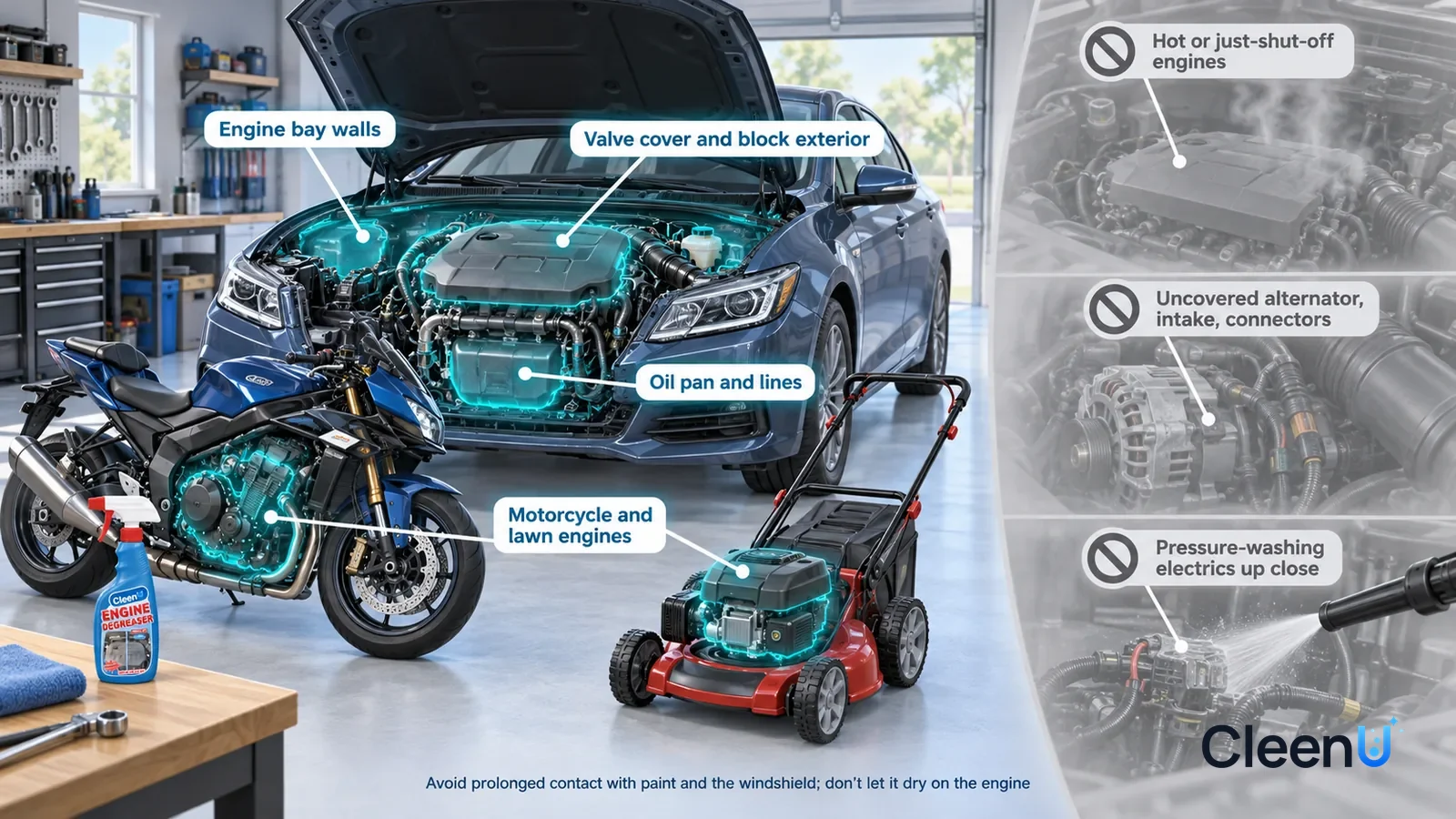
- Seeping oil, baked-on grime, and road dust on blocks, oil pans, valve covers, lines, and engine-bay walls
- Formula focus
- Alkaline builders with nonionic surfactants, chelators, and an aluminum inhibitor, pH 11.0–12.5; water-based, nonflammable; rinses off.
- Best for
- Car care brands, Detail and repair shops, Auto parts channels, Ecommerce sellers

Before & after
Before and after (illustration)
Before: an eight-year-old engine bay with black crud around the valve cover and oil pan and sticky lines. After: sprayed cold, left 4 minutes, brushed, and rinsed, the crud is essentially gone and metal and aluminum show their original finish without whitening.
- Before: crud around valve cover and oil pan
- After cold spray, brush, rinse: grime gone
- Aluminum clean, no whitening

How it works
How engine grime washes away
Engine crud is oil and transmission fluid mixed with road dust and oxidized by heat. Alkaline builders saponify the oils into soluble soap, nonionic surfactants emulsify the rest, chelators free trapped particles, and the aluminum inhibitor protects alloy surfaces. Low-pressure water carries the emulsion away.
- Cool engine, cover electrics
- Spray bottom to top
- Saponifies and emulsifies grime
- Wait 3–5 minutes, brush
- Rinse with low pressure

Usage guidance
Use guidance
- Let the engine cool fully and bag the alternator, intake, fuse box, and exposed connectors.
- Spray greasy areas bottom to top, wait 3–5 minutes, and brush stubborn spots.
- Rinse with low-pressure water bottom up, then top down. Don't let it dry; dress plastic parts afterward if you like.
Before you use it
Important notes
- Not for: Hot or just-shut-off engines
- Not for: Pressure-washing electrical parts up close
- Not for: Long contact with paint or the windshield
- Not for: An uncovered alternator, intake, or electronics
- Test first for special materials, special equipment, or sensitive scenarios.
Product comparison
How to choose a Engine Degreaser
Use Engine Degreaser for engine-bay grime, Asphalt & Tar Remover for tar spots on paint, and Car Interior Cleaner for interior plastic and faux leather.
View product comparison
| Decision point | Engine Degreaser | Solvent degreaser |
|---|---|---|
| Flammability | Water-based, nonflammable | Flammable |
| Odor | Low | Strong |
| Rubber and plastic | Gentle | Risky |
| Removal | Hoses off | Wipe or rinse |
Where Engine Degreaser stands out
Where engine crud comes from
Small amounts of oil and transmission fluid seep from seals, road dust sticks, and engine heat bakes it into black crud on the block, oil pan, and lines. It hides leaks and hurts heat dissipation, and car wash soap won't move it.
Why water-based
Solvent degreasers cut fast but smell strong, are flammable, and can be hard on hoses and plastic. This water-based alkaline formula is nonflammable, low-odor, hoses off, and includes an aluminum inhibitor. The keys: a fully cool engine and a prompt rinse, never letting it dry on the engine.
Who it's for, where it's used, and when not to use it
For
End-use scenarios
When not to use it
Product Specifications and Custom Options
Key product details and custom options for your project.
Product specifications
Product type, cleaning scope, and format.
| Product type | Water-based alkaline engine degreaser |
| Surfaces | Engine blocks, oil pans, valve covers, lines, and engine-bay walls on cars, motorcycles, outboards, and lawn equipment |
| Applications | Resale prep, Cleaning before tracking a leak, Off-road and motorcycle maintenance |
| Main soils | Seeping oil, baked-on grime, and road dust on blocks, oil pans, valve covers, lines, and engine-bay walls |
| How to use | Cool engine, cover electrics, spray, wait 3–5 minutes, brush, rinse with low pressure |
| Not for / avoid | Hot or just-shut-off engines; Pressure-washing electrical parts up close; Long contact with paint or the windshield; An uncovered alternator, intake, or electronics |
| Size & packaging | 500 mL trigger spray bottle |
| pH | pH 11.0–12.5 (25°C) |
| Scent | Light scent |
| Shelf life & storage | 24 months unopened; store sealed in a cool, dry, ventilated place away from heat, sun, and freezing |
B2B custom options
Private label, packaging, MOQ, samples, and delivery.
| OEM/ODM & private label | We run Engine Degreaser private-label projects from positioning and samples to packaging, production, and delivery. |
| Packaging & labels | Trigger or foaming head, strength, fill size, labels, and kits available |
| Case pack | 12 × 500 mL per case |
| OEM/ODM and private label | Available for project discussion |
| Packaging and labels | Trigger or foaming head, strength, fill size, labels, and kits available |
| MOQ | 500 bottles |
| Sample time | Free samples in 3–5 days |
| Bulk lead time | Scheduled with the order after packaging and labels are approved |
| Documents | SDS/MSDS, TDS, and batch COA provided with quotes |
OEM/ODM project process
Move from product direction and sample review to packaging, production, and delivery for Engine Degreaser.
Define the buyer and plan
Choose ready-to-use or concentrate, trigger or foaming head, and whether to pair it with a trim restorer as a clean-and-dress kit.
Free samples
Free samples are usually ready in 3–5 days for project review.
Packaging and labels
Set fill size, sprayer, label language, and prominent cool-engine, cover-electrics, no-pressure-washer warnings.
Production and delivery
Standard MOQ is 500 bottles; production is scheduled after packaging and labels are approved.
Why choose CleenU for Engine Degreaser?
From product positioning and samples to packaging and repeat supply, CleenU supports OEM/ODM projects built around Engine Degreaser.
Alkalinity tuned for aluminum
Modern engines use lots of aluminum, so we balance degreasing against corrosion protection to prevent whitening.
Concentrate and ready-to-use
Drivers prefer sprays and detail shops prefer gallon concentrate; mix formats by channel.
Sample testing that means something
We plan sample evaluation around engine bays of different ages and grime levels: dwell time, grease removal, aluminum whitening, and rinse residue.
Labels and documents ready
Bilingual label copy, SDS/MSDS, TDS, and batch COAs, with warnings and directions prepared for your target market.
Consistent reorders
Every batch is retained and issued a COA, so reorders match on color, scent, and feel.
Formula discussion
Discuss formula direction based on product positioning, target market, and channel selling points.
Packaging and labeling options
Plan packaging format, label language, and shelf presentation around Engine Degreaser and your target channel.
Show packaging and label options
Packaging options
Main size: 500 mL trigger spray. Also available: 500 mL foaming spray, 1-gallon concentrate, channel case packs, and ecommerce bundles with a trim restorer and engine brush, with labels and cartons in your branding.
Supporting Documents and Materials
Purchasers usually confirm whether the materials are complete before formal cooperation. Preparing documents in advance helps with quoting, sampling, and channel review.
Show available documents
Project documents
SDS/MSDS, TDS, batch COA, label directions, and packaging files are provided per project after inquiry.
Related products, solutions, and articles
Explore related cleaning products, application guidance, and OEM/ODM resources for Engine Degreaser.
Frequently asked questions (FAQ)
Find practical answers about Engine Degreaser, private label, samples, MOQ, documents, and delivery.
Product, use, and procurement
Why does so much grime build up under the hood?
Small amounts of oil and transmission fluid seep from seals, road dust sticks to them, and engine heat bakes it into black crud on the block, oil pan, and lines. It hides leaks and hurts heat dissipation.
Water-based or solvent degreaser?
Solvent degreasers cut fast but smell strong, are flammable, and can be tough on rubber and plastic. This is a water-based alkaline formula with an aluminum inhibitor. It's nonflammable, low-odor, and hoses off, which makes it the better pick for DIY in the driveway.
How often should I clean the engine bay?
Once or twice a year, or before tracking down a leak, selling the car, or doing mods. Off-road and dirt-road vehicles can go more often.
What should we decide first for a private-label engine degreaser?
Strength, applicator, and kit. Ready-to-use or concentrate (detail shops want gallon concentrates), trigger or foaming head (foam clings better on vertical surfaces), and whether to pair it with a trim restorer as a clean-and-dress kit.
How fast can we get samples and a first order?
Free samples ship in 3–5 days. MOQ is 500 bottles, and production is scheduled once packaging and labels are approved.
How does an engine degreaser actually work?
It breaks baked-on grease into tiny droplets that rinse away with water. The alkaline base softens oily grime, and surfactants surround the oil so it can't settle back onto the metal. That's why dwell time matters: spray a cool engine, let it sit 3 to 5 minutes, then rinse with low-pressure water before it dries.
Product usage questions
How do I prep the engine?
Make sure it's fully cool to the touch. Bag the alternator, air intake, fuse box, and any exposed connectors before you spray.
How long before I rinse?
Let it sit 3–5 minutes, scrub stubborn spots with a soft brush, and rinse with low-pressure water. Don't let it dry on the engine.
Can I use a pressure washer?
We don't recommend it. High pressure drives water into connectors and sensors. A garden hose is plenty.
Will it hurt aluminum or plastic parts?
Not when used as directed. The aluminum inhibitor helps, but the key is a cool engine and a prompt rinse. Dress plastic parts with a trim restorer afterward.
Can I use it on an EV's front compartment?
We don't recommend it; EVs have high-voltage parts, so follow the maker's guidance or use a pro.
Should I protect the bay afterward?
Yes. A plastic dressing restores the black finish and makes the next cleaning easier.
Can I wash the engine bay in winter?
Yes, above about 40°F; idle the engine a few minutes afterward to help it dry.
Is engine degreaser the same as brake cleaner or carb cleaner?
No—don't swap them. CleenU Engine Degreaser is water-based and meant to be rinsed off exterior engine surfaces. Brake and carb cleaners are fast-evaporating solvents made for brake parts and fuel-system internals, where no water or residue can be left behind. Degreaser or rinse water left on rotors or pads can affect braking.
Can I use it on paint, rubber hoses, and wiring?
Yes, as long as you rinse it off promptly and don't let it dry. If overspray lands on paint, rinse it right away. Hoses and wire jackets can be cleaned normally, but cover the alternator, fuse box, and any exposed connectors with plastic first, and test a small hidden spot the first time.
OEM/ODM customization questions
What can we customize?
Formula direction and strength, scent, fill size (500 mL spray, 1-gallon concentrate, and more), trigger or foaming head, label design and language, and kits with a trim restorer and engine brush.
How should we test samples?
Test section by section on engine bays of different ages and grime levels, and record dwell time, grease removal, any whitening on aluminum, and residue after rinsing. That tells you more than a before-and-after photo.
What paperwork comes with a private-label order?
Documents such as SDS/MSDS, TDS, COA, and label copy for your target market are prepared per project. We confirm which ones your order includes when we quote.
Launching your own engine degreaser?
Send us your market, ready-to-use or concentrate, sprayer type, and estimated volume. We'll build out product and safety copy with you.