
Troubleshooting
Clogged Showerhead Nozzles: Descaling Step by Step
Direct answer
Usually, yes. When scale clogs the nozzles, water sprays sideways and some holes stop working. Take the showerhead off, soak it in descaler mixed 1:1 with water for 15 to 30 minutes, rub the rubber nozzles and brush the face, then rinse and reinstall. If overall pressure is low, check the inlet screen too.
What you see
Half the spray shoots sideways onto the wall and the shower door. A few nozzles don't spray at all and have a white crust around them. The whole stream has gone thin and weak. The faceplate feels rough, with white specks around the holes.
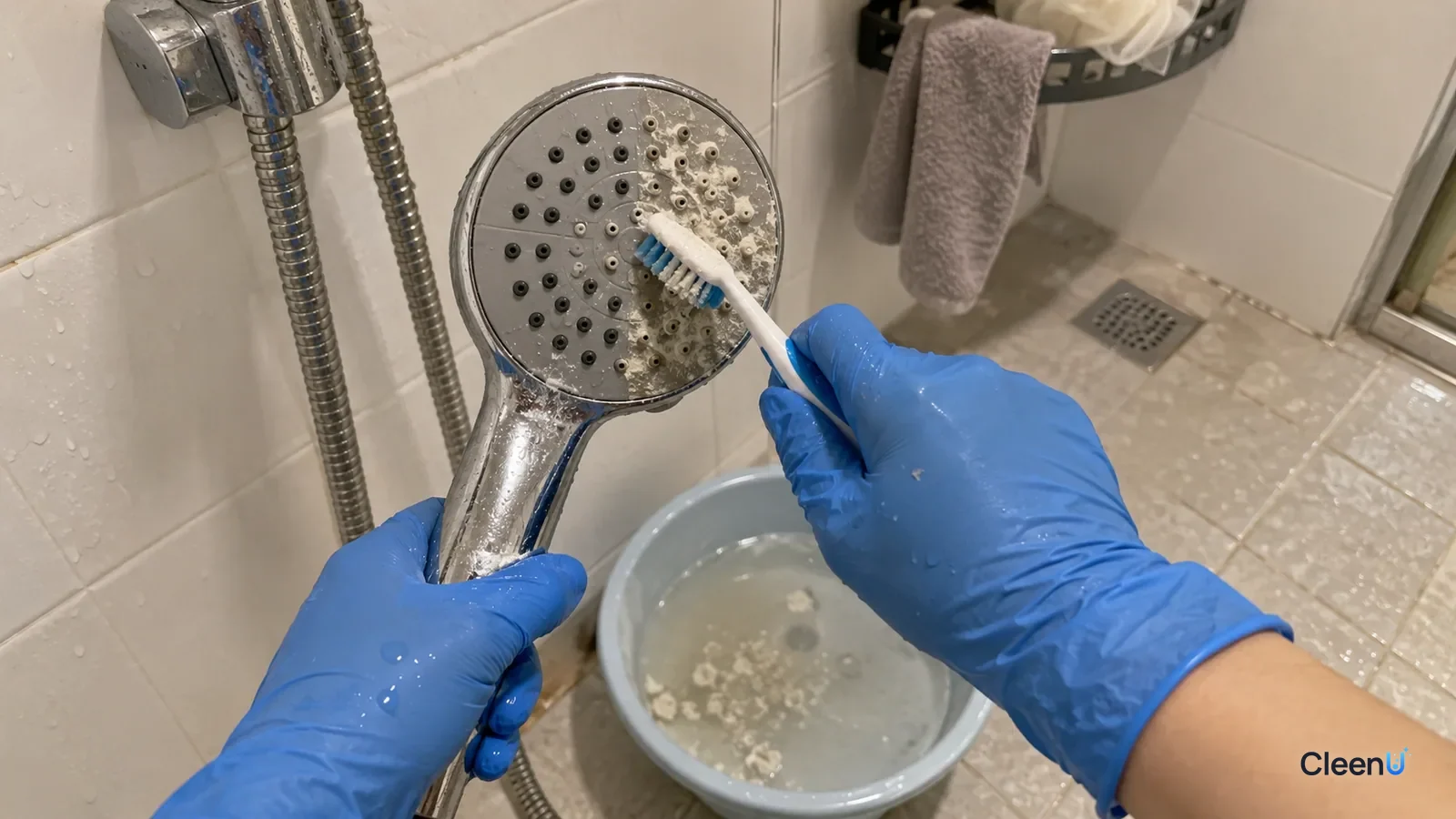
The showerhead is one of the worst spots for scale in the bathroom: hot water, tiny openings, and a little water left in every hole after each shower. Over time the nozzles gradually close up. The good news is that a clogged showerhead is easy to fix once you know the cause and the right method.
Why showerheads clog
Tap water carries dissolved calcium, magnesium, and bicarbonate. Heat makes calcium bicarbonate break down into insoluble calcium carbonate more readily, which is why water heaters and showerheads scale up much faster than cold taps.
When you turn the shower off, a little water stays in the nozzles. As it evaporates, calcium carbonate settles on the rim and walls of each hole, a thin layer per shower. Nozzles are only about a millimeter across to begin with. After a few months they narrow and warp, the spray goes crooked, and eventually some close off entirely.
Besides scale, debris from the pipes can clog a showerhead. After a renovation, a plumbing repair, or in older galvanized pipes, sand, rust, and bits of gasket can wash into the showerhead and lodge in the inlet screen or behind the faceplate.
Five steps to diagnose and fix it
Find out why your shower spray is weak or uneven in five steps
-
Step 1 Can you see white spots or crust on the faceplate, with some nozzles blocked or spraying sideways?
- Yes
- The nozzles are scaled up. Take the showerhead off and soak it as described below.
- No
- Go to the next check
-
Step 2 Are all the nozzles spraying, but the whole stream is thin and weak?
- Yes
- The inlet screen may be clogged with debris or scale. Remove the showerhead, clean the small screen at the connection with an old toothbrush, and rinse.
- No
- Go to the next check
-
Step 3 Is water pressure low at other faucets too?
- Yes
- It's not the showerhead. It may be overall water pressure, the water heater, or the pipes; have a plumber check.
- No
- Go to the next check
-
Step 4 Is it weak only on hot water, with cold water fine?
- Yes
- The water heater or hot-water line may be scaled. Follow the heater's maintenance instructions or call for service.
- No
- Go to the next check
-
Step 5 After descaling and cleaning the screen, is the spray still off?
- Yes
- An internal plate or flow restrictor may be damaged; consider replacing the showerhead.
- No
- Fixed. Keep it that way with the routine below.
Not every deposit on a showerhead is white. Reddish-brown flecks usually come from rust or sediment in older iron pipes, and gritty specks behind the face plate after plumbing work are typically sand or bits of pipe sealant. A descaler dissolves calcium and magnesium scale, but it won't do much for sand or debris. That's why the inlet screen check in the diagnosis above matters: if you find grit there, rinsing the screen fixes the problem and no soak is needed.
How a descaler works
Calcium carbonate doesn't dissolve in water and isn't bothered by alkalinity, so soaking in water or scrubbing with dish soap won't help. Acid dissolves it: hydrogen ions react with calcium carbonate to form water-soluble calcium salts, water, and carbon dioxide. The tiny bubbles you see on the faceplate during a soak are that reaction.
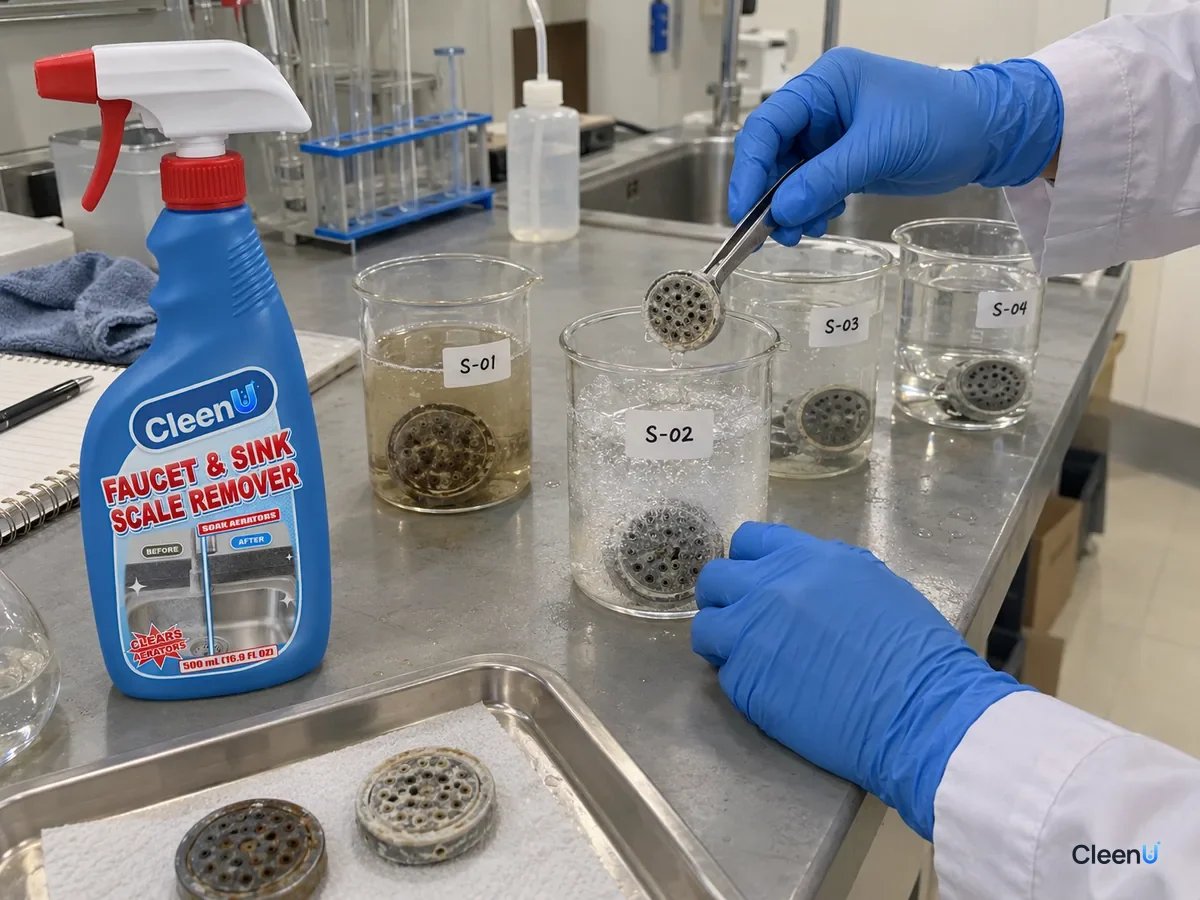
Take CleenU Faucet & Sink Scale Remover as an example. It's an acidic descaler, pH 1.5 to 3.0 as supplied, made with mineral and organic acids, a corrosion inhibitor, and a wetting agent, and it's unscented. The acids dissolve the scale; the wetting agent helps the liquid get into narrow nozzles instead of sitting on the surface; the corrosion inhibitor protects chrome and stainless. Aerators and showerheads can soak in a 1:1 mix with water for 15 to 30 minutes.
It isn't for marble, limestone, or cultured marble sinks, soaking coated hardware or brass, or aluminum, and it must never be used with chlorine bleach. For gold, matte black, brushed, or other coated showerheads, shorten the soak and test on the back first.
Descaling a showerhead, start to finish
Remove the showerhead. Handheld heads usually unscrew from the hose by hand; for fixed heads, follow the manual. If it's stuck, wrap it in a towel before using a wrench so you don't scratch it.
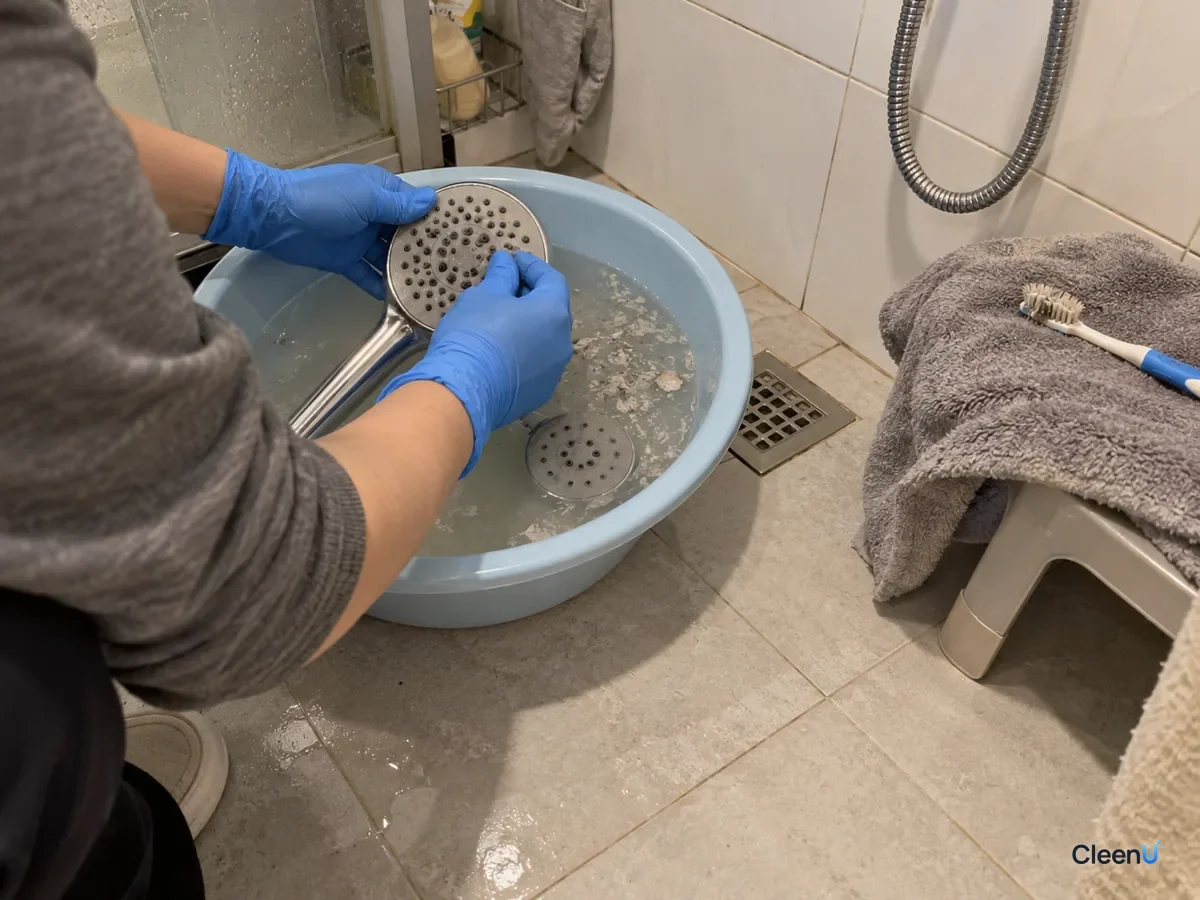
Mix the soak. In a container, combine descaler and water 1:1, enough to fully cover the faceplate.
Soak 15 to 30 minutes, face down. You'll see small bubbles rising.
Rub the nozzles. Many showerheads now have soft rubber nozzles; after soaking, rub each one back and forth with a fingertip and the softened scale squeezes out. Brush hard nozzles with an old toothbrush. For a stubborn hole, ease a fine needle in gently without forcing it wider.
Rinse. Rinse the showerhead inside and out, reconnect it, and run water for a minute or two to flush out loosened bits.
For fixed heads that won't come off, fill a plastic bag with the 1:1 mix, slip it over the head so the face is submerged, secure it with a rubber band, then remove it after the soak and run the water.
For faucets and other fixtures, see How to clean a bathroom. To tell scale from soap scum, see Soap scum vs. hard water stains.
Adjust the soak to the finish
Showerheads all look shiny, but they're built very differently, and that changes how long and how much you soak.
Chrome-plated plastic is the most common. The body is engineering plastic with a thin electroplated chrome layer. If the plating is intact, a 1:1 soak for 15 to 30 minutes is fine. If it's already peeling, acid can creep under the edge and lift more of it, so soak only the spray face and rinse right away.
Stainless steel and chrome-plated brass hold up better to acid and can take the normal soak time. A descaler with corrosion inhibitors is gentler on the metal than plain vinegar or citric acid.
Gold, matte black, gunmetal, and brushed finishes are usually painted or PVD-coated, and those aren't on the descaler's list for soaking. Let only the spray face touch the diluted solution, cut the time to 5 to 10 minutes, test a hidden spot first, and check the color after rinsing.
Silicone nozzles inside the face plate don't mind acid at all. Soaking and then rubbing them with a fingertip is the easiest way to clear them.
How to tell it worked
Reinstall the head and run the water. Check three things: the spray goes straight down instead of sideways, every nozzle is flowing, and the face feels smooth with no grit. If all three check out, you're done.
If most nozzles are back but one or two are still blocked, the scale in those holes didn't fully soften. Soak just the face for another 10 minutes and rub them again. If you've done two rounds, the white crust is gone, and the spray still veers off, the nozzle itself is probably deformed or the face plate is damaged. More soaking won't fix it, and a new showerhead is the faster answer.
Common mistakes
Soaking the whole hose. The braided hose doesn't need descaling, and a long acid soak isn't good for the fittings.
Leaving it for hours to speed things up. For heavy scale, two shorter soaks with a scrub in between are safer and work better than one very long one.
Widening holes with a needle. An enlarged hole sprays harder than its neighbors and makes the pattern messier, not better.
Skipping the flush. Softened scale left inside the head gets carried to the back of the nozzles and clogs them again quickly.
Keeping your showerhead from clogging
After each shower, rub the rubber nozzles with a fingertip and wipe the faceplate dry.
In hard-water areas, soak and descale monthly; thin scale clears in about 15 minutes.
After plumbing work, run the water for a few minutes before reattaching the showerhead so debris doesn't get trapped.
Consider a whole-house or water-heater softener to cut scale at the source.
Stop if you see this
If a coated showerhead changes color or the finish starts peeling during the soak, take it out, rinse it, and stop using the descaler. If descaler gets on your skin or in your eyes, rinse with plenty of water. Never mix with chlorine products, and keep it off marble, cultured stone, and aluminum. Don't force a showerhead that won't come off; you can damage the connection or the pipe.
Clogged showerheads: common questions
Why is my showerhead spraying sideways?
Usually scale has partly blocked the nozzles and changed the spray direction. Soak and descale it and rub the nozzles, and it straightens out.
Can I soak a showerhead in vinegar?
For light scale, yes, but vinegar is weak and slow, so heavy scale takes a long soak. A dedicated descaler adds a wetting agent and corrosion inhibitor, so it works faster and is gentler on finishes.
How long should I soak a showerhead?
In a 1:1 descaler and water mix for 15 to 30 minutes; follow the label. Shorten it and test first on coated finishes.
Is low shower pressure always scale?
Not always. If every nozzle sprays but weakly, the inlet screen is probably clogged. If other faucets are weak too, it's the water pressure or plumbing.
How do I clean rubber nozzles?
After soaking, rub each nozzle with a fingertip and the softened scale squeezes out. A quick rub after showers helps prevent buildup.
How often should I descale a showerhead?
Monthly in hard-water areas; check every two or three months with softer water, and descale when you see white spots or crooked spray.
For an acidic descaler you can mix 1:1 to soak showerheads and aerators, with a corrosion inhibitor that's gentler on chrome, take a look at our Faucet & Sink Scale Remover.
Uneven spray and dead nozzles usually mean scale. Heat makes calcium carbonate drop out more easily, and the water left in the nozzles after each shower builds it up layer by layer. Take the showerhead off, soak it in descaler mixed 1:1 with water for 15 to 30 minutes, rub the rubber nozzles and brush the face, then rinse and reinstall; use a plastic bag for heads that won't come off. If every nozzle sprays weakly, clean the inlet screen; if the whole house has low pressure, it's the plumbing. Rub the nozzles after showers and descale monthly in hard-water areas.