
How-to
How to Remove Hard Water Spots From Outside Windows
Direct answer
Rinse off dust and mud first. Gray rain streaks are mostly dust and grime, and glass cleaner handles them. White, spotty water marks are mineral deposits and need a descaler compress to soften them. Finish by squeegeeing top to bottom and drying the edges. Never lean out of a high window to reach the outside.
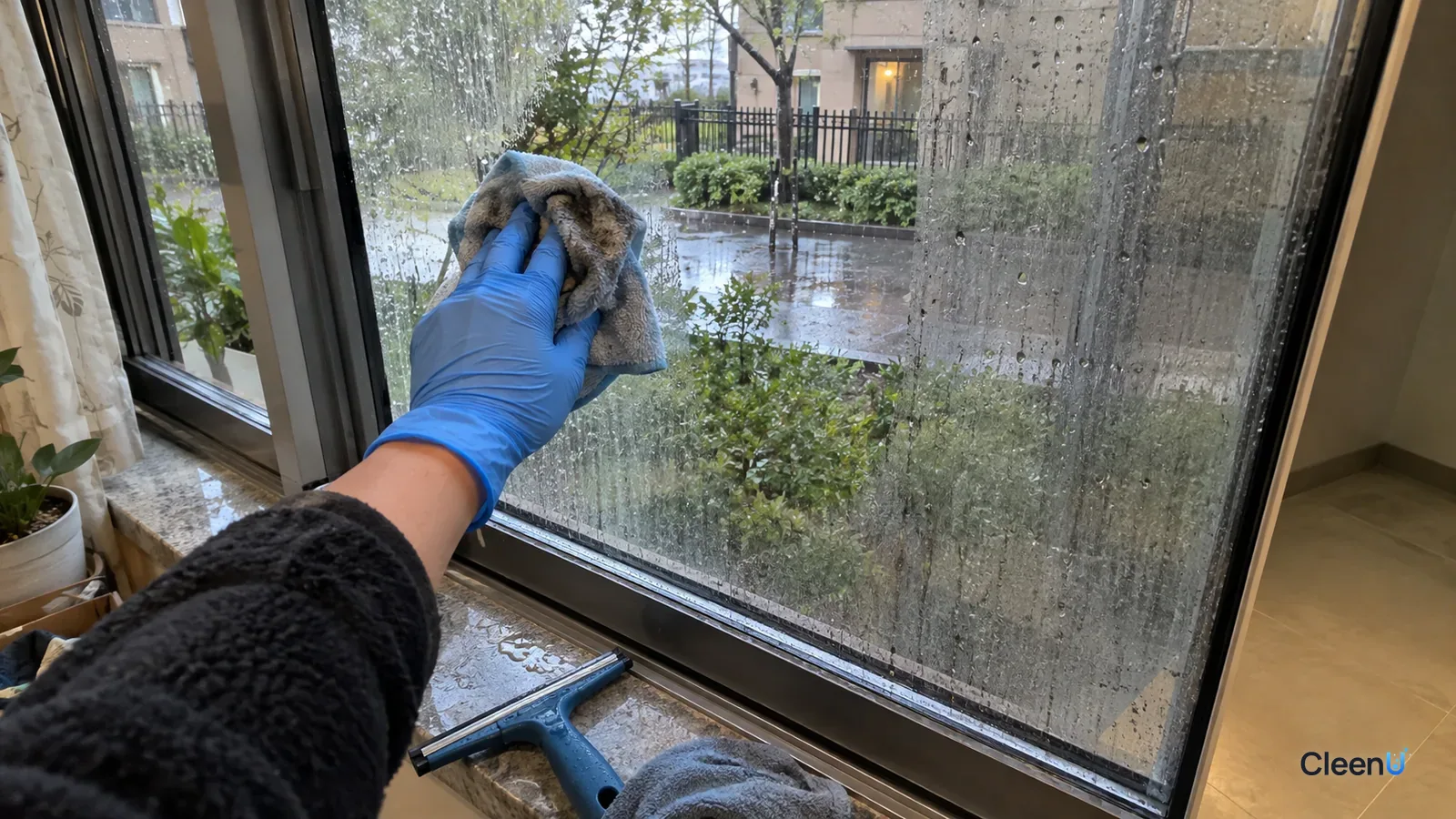
You just cleaned the inside of the window, but the outside has gray streaks running down it and patches of white spots that light up in the sun. Reaching out from inside, you can't get to it all, and sometimes it just gets streakier.
What's on the outside of a window is different from fingerprints and smudges inside, and it needs a different approach.
Two kinds of marks on outside glass
Gray rain streaks and mud spots: rain carries airborne dust, exhaust, and cooking particles onto the glass. As it runs down and evaporates, it leaves vertical gray streaks. Drips from AC units or upstairs balconies leave mud spots. These are mostly dust and grime, and glass cleaner and water take care of them.
White water spots: white dots or rings, usually where sprinklers, AC condensate, or watering hits the glass, or on windows that get wet often in hard-water areas. They're calcium carbonate and other minerals left as water evaporates, and they build up over time. Regular glass cleaner won't remove them; they need an acidic product that dissolves scale.
Mineral deposits left for a long time can also react with the glass and etch a frosted haze that won't wipe off. At that point it's damage to the glass, and cleaning can't fix it, so deal with water spots early.
What glass cleaner and descaler each do
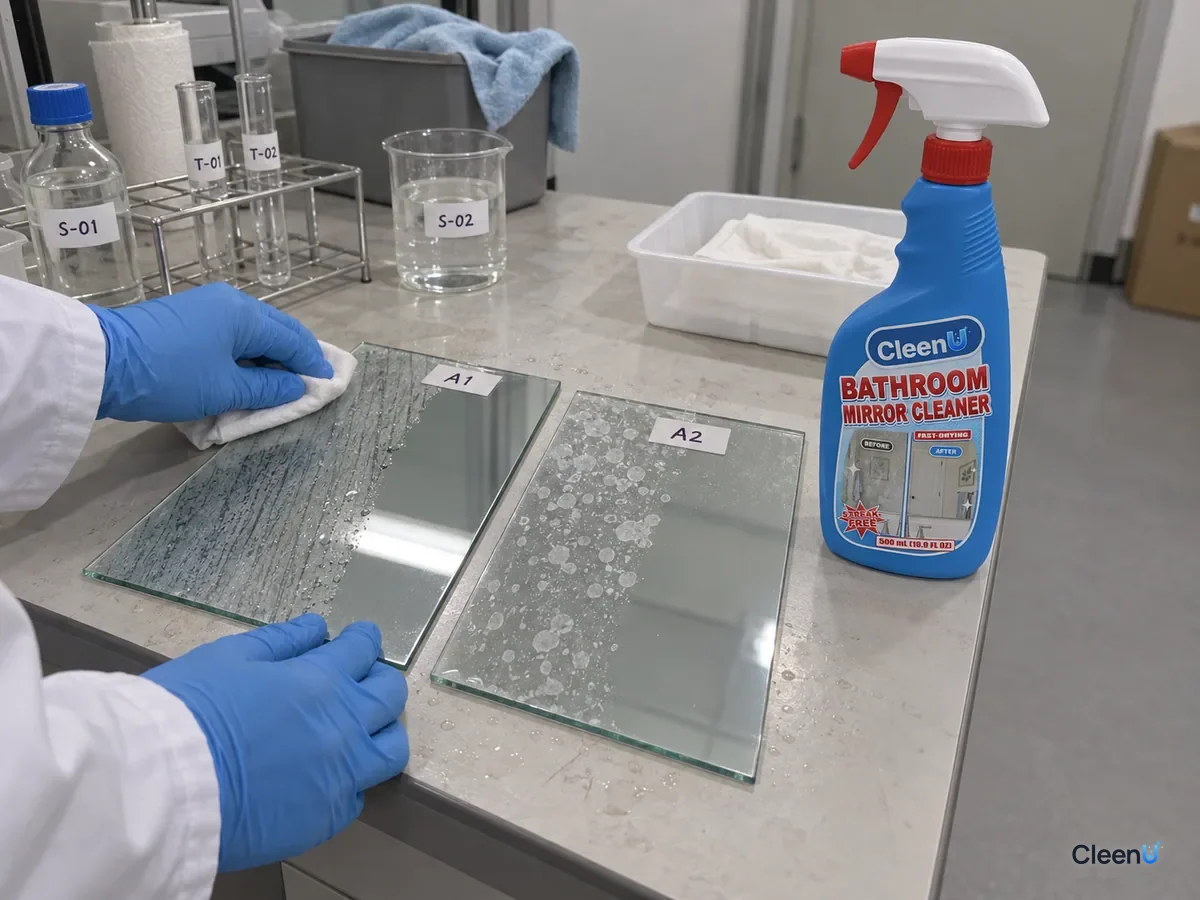
Take CleenU Bathroom Mirror Cleaner as an example. It's a fast-drying mirror and glass spray, pH 6.5 to 8.0 as supplied, made with fast-evaporating alcohols such as isopropyl alcohol and low-residue surfactants, with no ammonia. Spray and wipe; no dwell time. It handles dust, grease film, and fingerprints, which makes it right for gray rain streaks and for finishing after a rinse. Its label notes it isn't for glass with a heavy scale crust.
White spots need acid to dissolve the calcium carbonate. Diluted white vinegar works on light spots; a dedicated descaler used per its label handles heavier ones. If your window frames are aluminum or coated, or your sill is marble, keep acid off them and rinse right away.
Six steps to clean the outside of a window
From rinse to dry in six steps
Make sure you can reach it safely
Ground-floor windows, sliding balcony windows, and tilt-in windows that turn for cleaning are fine to do yourself. For fixed windows up high or anything you'd have to lean out to reach, don't risk it; hire a qualified professional.
Caution:Never stand on the sill or lean out the window, and tether any window tool with a safety strap.
Rinse off loose dirt
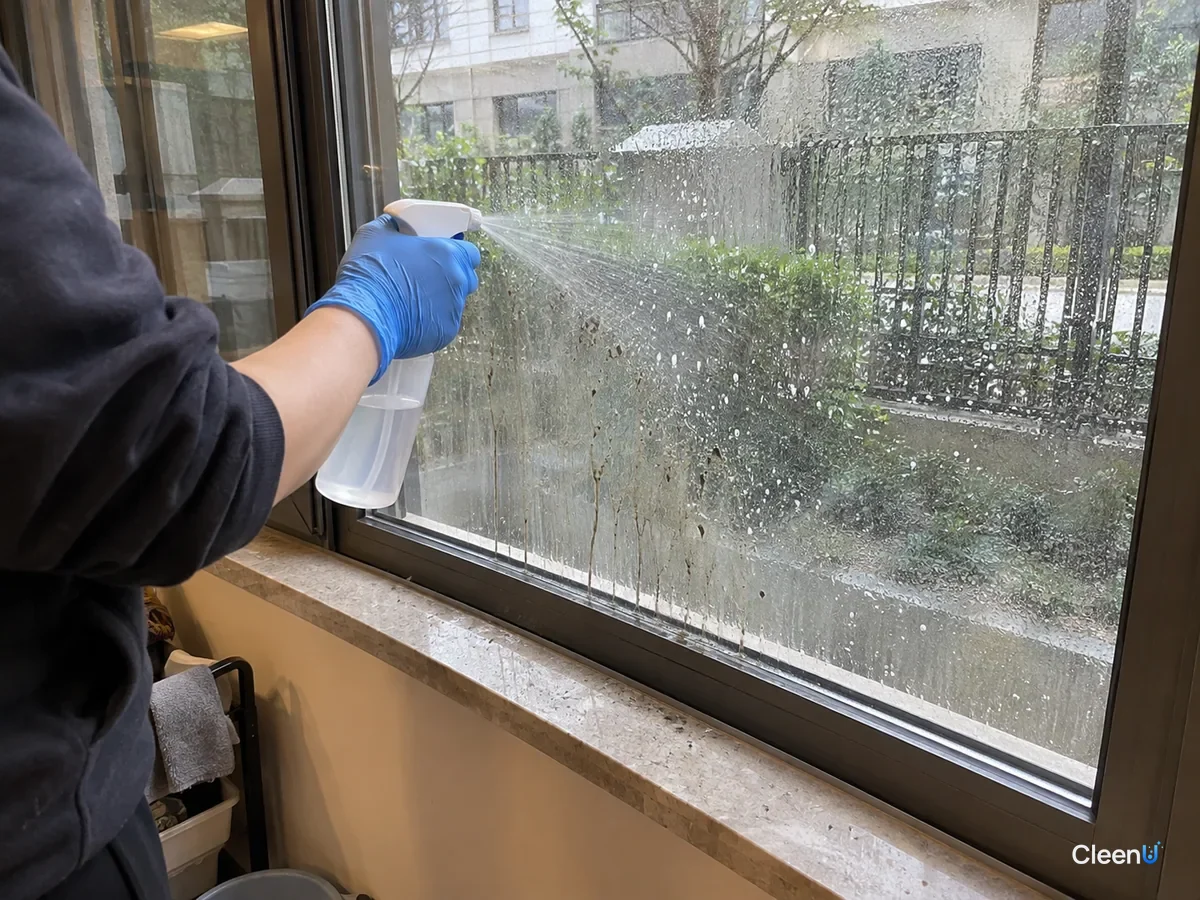
Wipe or spray the outside with water to remove dust and mud first so grit doesn't scratch the glass while you work.
Use glass cleaner on gray streaks
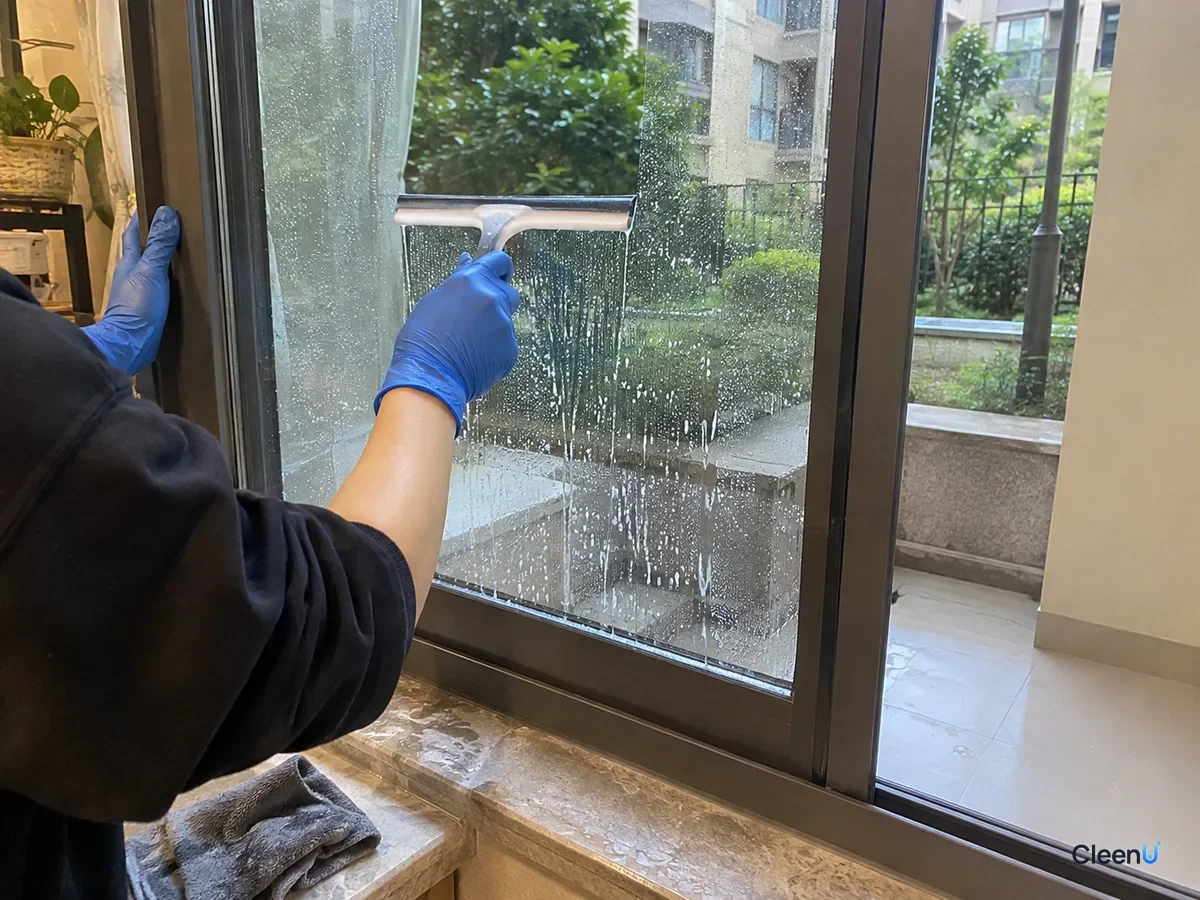
Spray glass cleaner on the glass or on your window scrubber's sleeve and work top to bottom to lift the gray streaks and grime film.
Compress the white spots
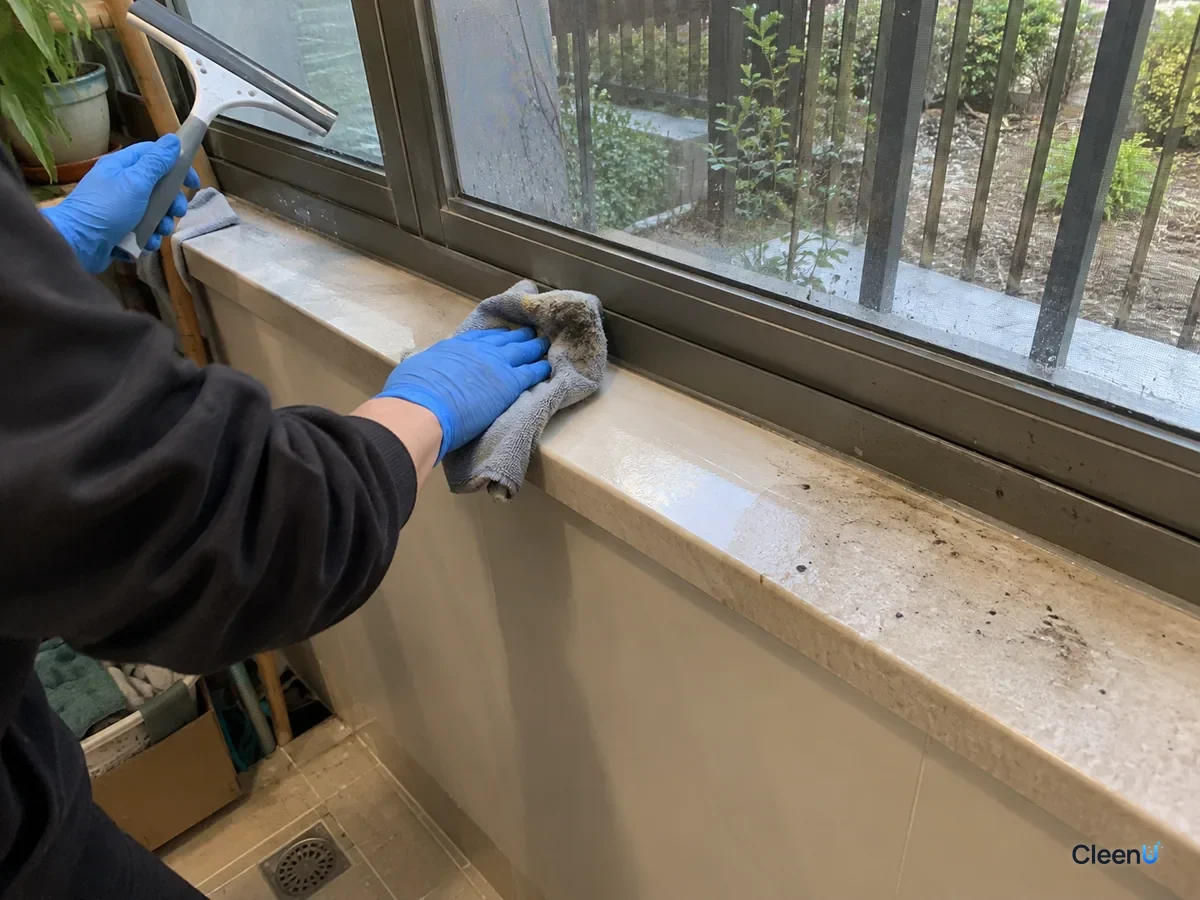
Soak a cloth or paper towel in diluted white vinegar or descaler, press it onto the white spots, and leave it a few minutes to soften the minerals, then wipe them off. Heavy spots may need a second round.
Caution:Keep acidic products off aluminum or coated frames and stone sills, and rinse immediately afterward.
Squeegee top to bottom
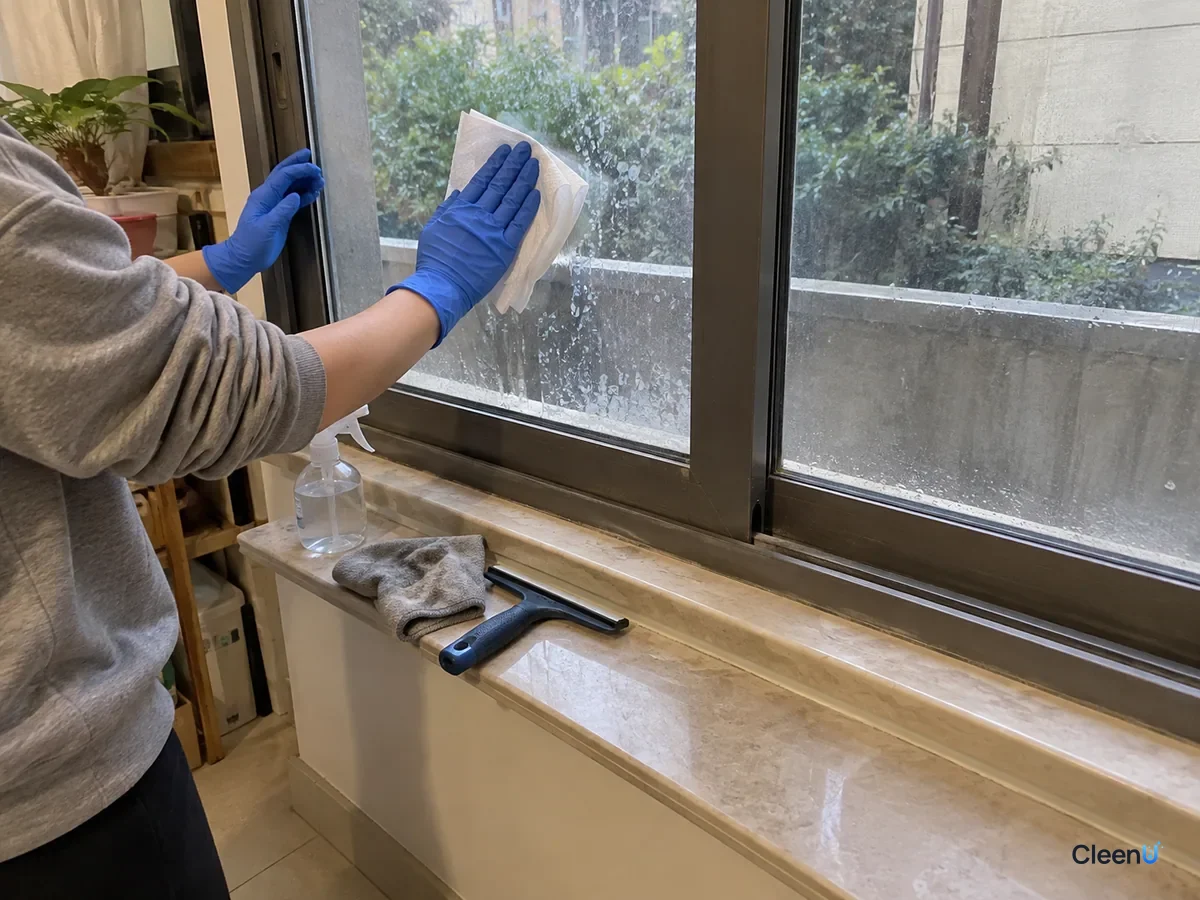
Rinse the whole pane, then squeegee from the top down, one stroke at a time, wiping the blade after each pass.
Dry the edges and frame
Dry the edges of the glass and the frame with a microfiber cloth. Don't let drops evaporate on their own or they'll leave new spots.
How white spots build up on glass
Tap water, sprinkler water, and AC condensate all carry dissolved calcium, magnesium, and bicarbonate. When a drop lands on glass, it evaporates from the edge inward, pushing those dissolved minerals toward the rim until they crystallize. That's why so many water spots are rings: fainter in the middle, whiter around the outside. The first layer of crystals is thin and wipes off with a damp cloth. But when the same patch of glass gets wet and dries again and again, new crystals grow on top of the old ones. Layer by layer, the spot gets harder and locks onto the tiny irregularities in the glass surface.
Acid works by dissolving that layer. The acid reacts with calcium carbonate to form a water-soluble calcium salt, water, and carbon dioxide, so what was a solid crust becomes a solution you can rinse away. That's why the compress matters more than elbow grease. Spray acid on vertical glass and it runs off in seconds, long before it has time to work. A soaked cloth or paper towel held against the spot keeps the acid in contact with the scale.
It also explains why glass cleaner can't touch white spots. It's a near-neutral, fast-drying formula that relies on alcohol and surfactants to wet and lift dust and grease film. It has no acid to dissolve calcium carbonate. The two products aren't a weaker and a stronger version of the same thing. They handle different steps.
How to tell the spots are actually gone
After the compress, rinse, and squeegee, wait until the glass is completely dry before you judge it. A wet film hides leftover spots. Once it's dry, look at it at an angle to the light. If the spots are gone and the glass feels smooth with no grit under your fingertip, you're done.
If the spots are lighter but still there, the mineral layer was thick, and another round of compressing is reasonable. If after two or three rounds the area dries to an even, frosted haze that feels smooth and doesn't change no matter how you wipe it, the glass is most likely etched. The minerals are long gone and what you're seeing is damage to the glass itself. More acid, a scouring pad, or steel wool will only scratch the good glass around it. Stop there and either live with it or talk to a professional glass restoration service.
Common mistakes
Compressing in direct sun. Hot glass dries vinegar or descaler in minutes, which cuts the working time short and can leave new marks. Scraping spots with a razor blade. A blade sometimes works on plain glass, but many energy-efficient windows have a coating on the outer surface, and a blade can take that coating off. Letting acid run down onto the frame and siding. Tuck an absorbent towel along the bottom edge while you work and rinse the frame along with the glass when you're done. Using glass cleaner first and the descaler second. Dissolve the minerals and rinse first, then finish with glass cleaner. Otherwise the acid and rinse water will streak the glass you just polished.
Why windows look worse after rain
Rain is fairly clean, but it scrubs dust and pollution from the air on the way down, and on the glass it picks up dust from the frame and walls above. After it stops, water evaporates slowly and leaves dust and dissolved material wherever it ran, as vertical streaks.
Location matters too. Windows near busy roads, construction, or a kitchen vent get heavier, greasier streaks.
A few window-cleaning tips
Clean on a cloudy day or when the sun isn't hitting the glass; liquid that dries too fast streaks.
Keep the squeegee blade clean and nick-free, or it leaves water lines.
Wipe the outside horizontally and the inside vertically so you can tell which side a streak is on.
For the inside of windows, see How to clean windows with a squeegee. For streaky glass, see Why glass streaks after cleaning.
Fewer water spots on the outside
Check whether AC units, planters, or sprinklers regularly spray the glass, and redirect them.
When you notice water spots after rain, deal with them early while they're thin.
Clean outside glass two or three times a year, more often in hard-water areas or on windows that get wet a lot.
Stop if you see this
If reaching the outside means leaning out or standing on the sill, stop and hire a qualified professional. Don't clean outside windows in high wind, rain, or freezing weather. If the glass is cracked or loose, stop and get it repaired. Keep acidic products off aluminum and coated frames and stone sills, and rinse your eyes with water if cleaner gets in them.
Water spots on outside windows: common questions
How do I get white spots off the outside of my windows?
They're mineral deposits. Compress them with diluted white vinegar or a descaler for a few minutes, wipe, then rinse and squeegee dry.
What should I use on rain streaks?
Gray streaks are mostly dust and grime. Rinse first, then use glass cleaner, and squeegee dry.
Why won't the white spots come off?
If they've been there a long time, the minerals may have etched the glass, leaving a frosted haze that cleaning can't remove.
How do I clean the outside of high windows?
Tilt-in windows that turn for cleaning are fine to do yourself. For anything that requires leaning out, hire a qualified professional.
Can I clean windows with vinegar?
It works on white water spots, but keep it off aluminum frames and stone sills and rinse afterward. It's weak on grease film.
How often should I clean the outside of my windows?
Two or three times a year, more often for windows that get wet a lot, in hard-water areas, or near busy roads.
For an ammonia-free, fast-drying, low-residue glass cleaner that handles gray rain streaks and finishes outside glass without streaks, take a look at our Bathroom Mirror Cleaner.
Marks on the outside of windows come in two kinds. Gray rain streaks and mud spots are dust and grime: rinse, then use glass cleaner. White spots and rings are minerals: compress them with diluted vinegar or a descaler before wiping. Finish by squeegeeing top to bottom and drying the edges and frame. Keep acid off aluminum frames and stone sills, and know that long-ignored spots can etch the glass. Most important, stay safe: if you can't reach a high window without leaning out, call a professional.