
Troubleshooting
Why Does My Litter Box Smell So Bad? Check the Scooping, Litter, Box, and Location
Direct answer
Most litter box odor is ammonia that bacteria release from urea in cat urine. The usual causes are infrequent scooping, litter too shallow to stop urine reaching the bottom, urine scale in a scratched box, and a hot, stuffy spot. Fix those first; a fragrance-free deodorizer comes last.
What you see
Sharp ammonia hits you at the door; the smell returns soon after you scoop; a washed, empty box still smells; it's much worse in summer; or the strongest odor is on the floor or rug near the box. Each pattern points to a different cause.
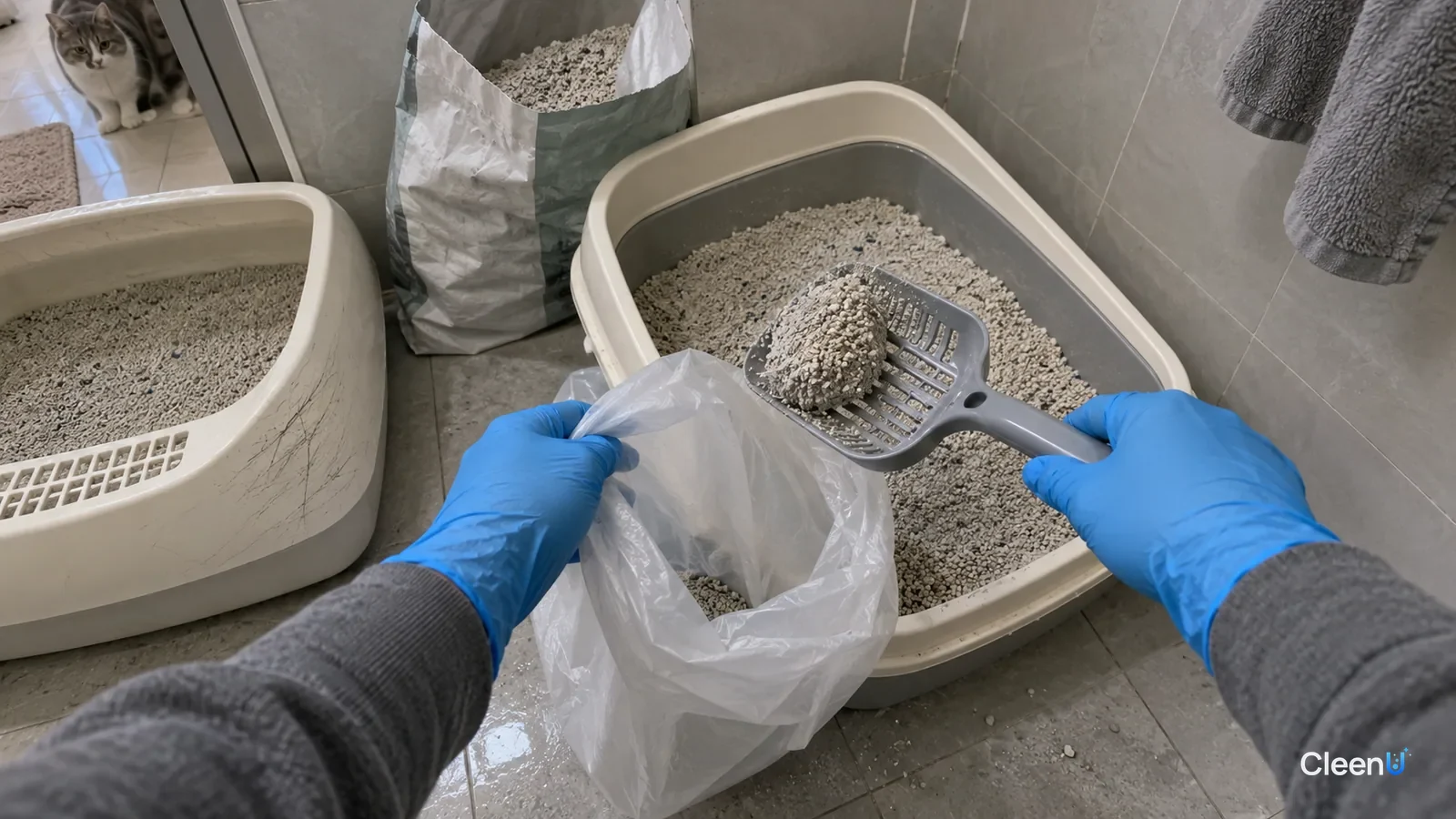
Why does my litter box smell so bad when I keep buying odor-control litter? Usually it's less about the product and more about how long urine sits in the box. A buried clump keeps releasing ammonia as bacteria break it down, and urine that soaks to the bottom, settles into scratches, or sits in a warm closet makes it worse faster. So work in this order: scooping, litter type and depth, the box, location, and number of boxes. A deodorizer is the last layer.
Two more things. Cats smell far better than we do, so scented litters and sprays that please you can put your cat off the box. And if the odor centers outside the box, on a rug or by the bed, your cat may be peeing outside it. That can be a health or behavior signal, so see the vet first; cleaning handles the result, not the cause.
Six checks that find the cause in most homes
The first five deal with where odor comes from. Only the last one deals with the odor itself.
Litter box smells? Rule things out in this order
-
Step 1 Do you scoop less than once a day, or do clumps crumble and leave a stuck-on urine cake?
- Yes
- Scoop at least once a day, twice with several cats. Crumbling or sticking clumps mean the litter is too shallow or clumps poorly; top it up or switch.
- No
- Go to the next check
-
Step 2 After you empty, scrub, and fully dry the box, does it still smell up close?
- Yes
- The box is holding odor, usually as urine scale in scratches and corners. If a thorough scrub doesn't fix it, replace the box.
- No
- Go to the next check
-
Step 3 Is the box in a closed bathroom or cabinet, covered, or somewhere that gets hot in summer?
- Yes
- Move it near an exhaust fan or a window and out of direct sun. If it's covered, take the lid off for a few days.
- No
- Go to the next check
-
Step 4 Do you have as many boxes as cats, or fewer?
- Yes
- Plan on one per cat plus one, in different spots. Until then, scoop each box twice a day.
- No
- Go to the next check
-
Step 5 Is the smell mainly outside the box, on a rug, in a corner, or by furniture?
- Yes
- Your cat may be peeing outside the box. See the vet first, then treat the spots with an enzyme cleaner, not an ammonia-based or scented one.
- No
- Go to the next check
-
Step 6 With all of that ruled out, does ammonia still come back soon after scooping?
- Yes
- Change all the litter more often, try a litter that clumps or absorbs better, and mist a fragrance-free deodorizer on the surface after scooping.
- No
- Keep your routine and top the litter back up after every scoop.
Why does a litter box smell like ammonia?
Fresh urine isn't where most of the ammonia comes from. Urine carries nitrogen out of the body mainly as urea, which has almost no smell. The trouble starts when bacteria get to it. Many common bacteria produce an enzyme called urease, which splits urea into ammonia and carbamate; the carbamate then breaks down on its own and releases a second molecule of ammonia. Microbiology reviews describe urease-producing bacteria as widespread. A litter box supplies everything the reaction needs: urea, moisture, warmth, and bacteria carried in on paws and in feces.
Cat urine is also usually more concentrated: the International Renal Interest Society (IRIS) lists normal urine specific gravity at roughly 1.015 to 1.045 for dogs and 1.035 to 1.060 for cats, so each clump carries more urea.
Ammonia has a second trick. In water it exists as ammonium ions, which stay put, and ammonia molecules, which escape; the more alkaline the conditions, the more escapes. Breaking down urea raises the local pH, so the reaction feeds itself: more breakdown, higher pH, more ammonia in the air. Heat, damp litter, and time speed it up, which is why a box on a sunny porch in July can be eye-watering.
Feces smell from sulfur compounds and indole-type molecules formed in the gut, so the only fix is prompt scooping. Cat urine also carries sulfur compounds behind its distinct "cat" smell.
How a buried clump of urine turns into ammonia
- Litter absorbs the urine, and urea stays in the clump or between granules
- Bacteria from feces, paws, and air release urease, which splits urea into ammonia and carbamate
- Carbamate breaks down and releases more ammonia, pushing the local pH up
- The higher the pH, the more ammonium becomes ammonia gas that escapes into the room
- Warmth, damp litter, and time speed up every step, so the time between scoops is your first control
So scooping frequency decides how much time bacteria get with the urea, and that matters more than any deodorizer. And anything that keeps urine from leaving in one piece, like crumbling clumps or a film trapped in scratches, leaves a small ammonia factory behind.
How do different litters control odor?
Every litter works one of two ways. Clumping litter locks urine into a clump you remove. Absorbent litter pulls urine and odor into its pores and holds it. Each fails differently.
Clay (bentonite) clumping litter is a layered clay that swells when wet and wraps urine into a firm clump. When it smells, clumping has usually failed: the layer is too thin and urine cakes on the bottom, or weak clumps leave damp crumbs. Added carbon or baking soda won't rescue poor clumping.
Tofu and plant-fiber litter absorbs fast and makes little dust, but plant material left damp can turn sour or musty, especially in hot weather. Its softer clumps stick to the bottom more easily when the litter is shallow.
Pine pellets usually don't clump. They absorb urine and break into sawdust, often in a sifting box. The common failure is wet sawdust piling up in the tray, so sift daily and empty it often. Pine smells fresh to people, but not every cat likes it.
Crystal (silica gel) litter is full of tiny pores that soak up moisture and some odor. It doesn't clump, so you scoop solids daily and stir the beads. It has a clear tipping point: near saturation, the beads turn yellow and damp, and the smell gets worse fairly suddenly. Only a full change helps then.
| Litter type | How it controls odor | Most common reason it smells | Change this first |
|---|---|---|---|
| Clay clumping | Locks urine into clumps | Too shallow, crumbling or stuck clumps | Add depth, scoop along the bottom |
| Tofu or plant fiber | Clumps and absorbs into fiber | Damp litter turns sour | Scoop more often, keep the bottom dry |
| Pine pellets | Absorbs into wood, sifting box | Wet sawdust piles up in the tray | Sift daily, empty the tray |
| Crystal (silica gel) | Pores adsorb moisture and odor | Beads near saturation | Stir daily, full change when beads yellow |
| Mixed litters | Two clumping styles combined | Uneven clumps, lots of crumbs | Go back to one type if crumbs persist |
No litter never smells. Judge yours on whether clumps come out whole, the bottom stays clean, and your cat uses it without hesitation. The Cornell Feline Health Center notes most cats prefer unscented, fine-grained litter.
How deep should cat litter be?
Depth is often overlooked. When litter is too shallow, urine reaches the bottom and glues the bottom layer into a flat cake that rarely comes up clean, leaving a urine film where urease keeps working. Scraping it off also scratches the box.
The Cornell Feline Health Center and the ASPCA both say most cats prefer litter about 1 to 2 inches deep (2.5 to 5 cm). Big cats, heavy urinators, and shared boxes need the deeper end; if clumps keep coming up with wet bottom litter attached, add more. Much deeper mostly wastes litter.
Top the litter up after every scoop, or within a week or two the layer thins and the litter seems to have "stopped working."
Frequency matters just as much. The CDC and the ASPCA both recommend cleaning the box every day; with several cats or in hot weather, twice is safer. Run the scoop along the bottom and into the corners. Then bag the waste and put it in a lidded trash can that gets emptied daily, or you've just moved the smell to the kitchen.
Litter box smells even after cleaning? Look at the box
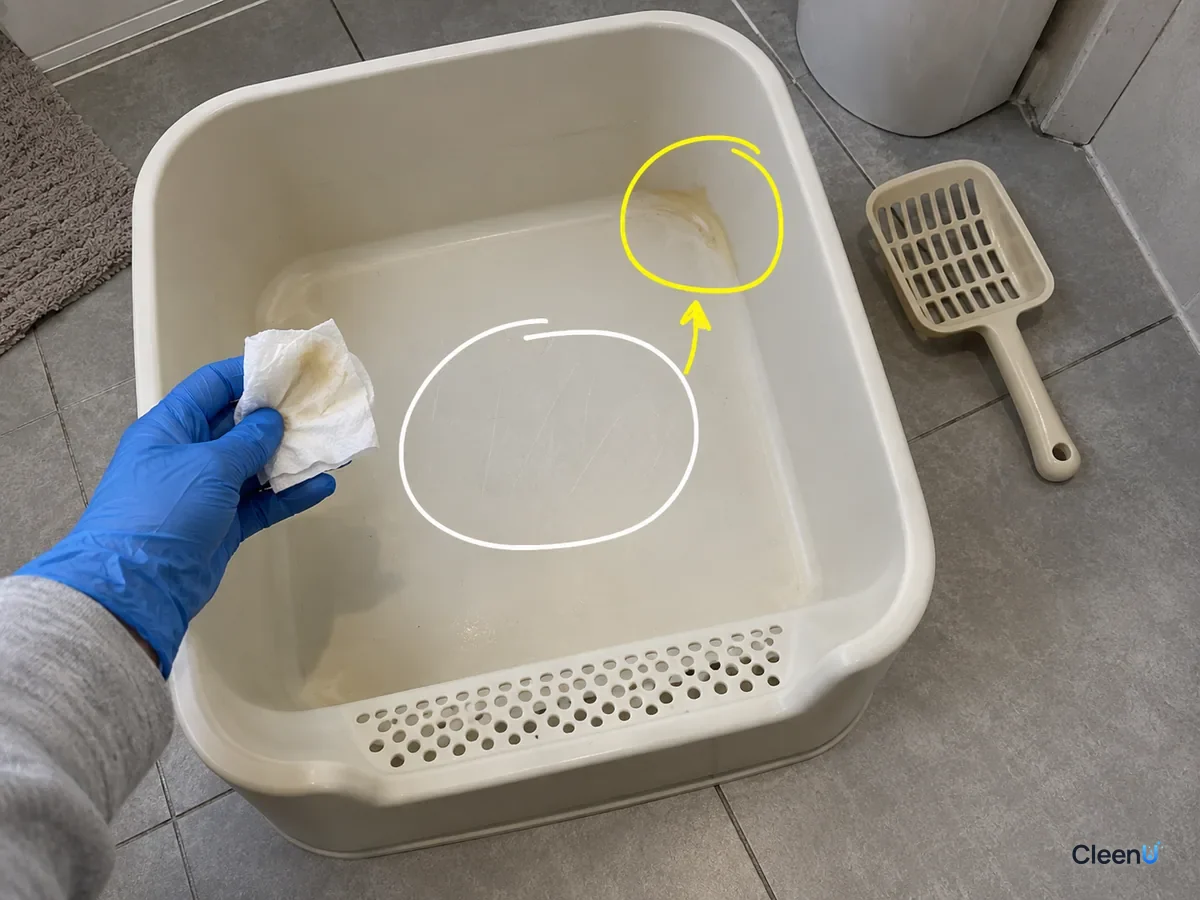
If you scoop daily, the litter is deep enough, and it still smells, suspect the box. Plastic picks up fine scratches, and where urine reaches the bottom, its salts and organic matter leave a yellowish film, often called urine scale, in scratches and corners that a scoop or quick rinse won't remove. Older plastic can also absorb odor.
Three quick checks:
- Scrub the empty box with warm water and a mild, unscented cleaner, rinse, dry it completely, and smell it up close.
- Wipe the corners with a damp white paper towel. A pale yellow mark means urine scale is still there.
- Shine your phone flashlight across the bottom at a low angle. If you can catch a fingernail in the scratches, they're deep enough to hold residue.
If it still smells after a thorough scrub and drying, or the scratches are deep, replace it with a smooth-walled box with rounded corners, and use a plastic scoop without scraping hard.
Where should the litter box go so it smells less?
Heat speeds up urea breakdown and ammonia release, and still air lets ammonia build up, so a sunny porch, a windowless bathroom without a fan, and a cabinet are the worst spots. Better spots have an exhaust fan or a window, stay out of direct sun, and sit away from food bowls. The Cornell Feline Health Center recommends a quiet, private spot away from food that the cat can always reach; a washer that suddenly starts spinning can make a cat think twice.
Does a covered litter box help with smell?
For you, a little. For your cat, often the opposite: the lid traps odor, heat, and moisture, so your cat walks into the most concentrated air. The ASPCA's advice for litter box problems includes removing covers and liners. The same logic applies to air fresheners next to the box. A mat at the entrance catches tracked litter; for the floor around it, see our guide to cleaning floors in a pet home.
How many litter boxes for 2 cats?
Three. The CDC, the Cornell Feline Health Center, and the ASPCA give the same rule: one box per cat plus one. Fewer boxes means more urine per box and faster ammonia, and some cats won't use a box another cat just used or get blocked by a housemate. Put the boxes in different places; three in a row look like one spot to a cat. If you can't fit that many, scoop each box twice a day.
Peeing outside the box: vet first, then clean the spots
Odor centered outside the box is a different problem. The Cornell Feline Health Center lists medical causes including urinary tract inflammation, kidney disease, thyroid disease, diabetes, and mobility or cognitive changes in older cats, and notes that a sick cat may not look sick. If your cat suddenly goes outside the box, goes often in small amounts, or has blood in the urine, see your vet before changing the setup.
One situation can't wait. A cat, especially a male, neutered or not, that strains in the box and produces little or no urine may have a urethral blockage, which Cornell describes as a true emergency. Go to an emergency vet right away.
Clean spots outside the box promptly, because cats return to places that smell like their urine. The ASPCA recommends an enzyme cleaner and warns against ammonia-based cleaners, which can draw the cat back. Blot up what you can, saturate the spot to the depth the urine reached with a pet urine enzyme cleaner, wait 10 to 15 minutes, blot, and let it air-dry.
How do litter box deodorizers work?
Deodorizers mask with fragrance, adsorb odor into porous materials like activated carbon, trap molecules with cyclodextrin, or bind them with zinc compounds. Masking is the worst fit for a litter box, because it adds fragrance exactly where your cat's nose is most critical.
Cyclodextrin is a ring of six to eight glucose units shaped like a short open tube. The water-repelling inside holds odor molecules of the right size, such as many sulfur compounds and the indole-type molecules in fecal odor, so less evaporates. Ammonia is tiny and very water-loving, so cyclodextrin does little for it.
Zinc ricinoleate, the zinc salt of castor oil's ricinoleic acid, is described in industry literature as binding nitrogen- and sulfur-containing odor molecules, such as amines and thiols, into compounds that don't evaporate easily. It has almost no smell of its own.
What each deodorizer ingredient actually handles
- Cyclodextrin: holds suitably sized, water-repelling odor molecules inside its ring so less evaporates
- Zinc ricinoleate: binds nitrogen- and sulfur-containing odor molecules into less volatile compounds, with no fragrance of its own
- Enzymes: break down protein and fat residue on the box walls and litter surface, reducing new odor sources
- The shared limit: they reduce odor; none replaces scooping, topping up, or full litter changes
One myth worth clearing up: baking soda is a weak base that neutralizes acidic odors, but ammonia is itself a base, so baking soda can't neutralize it.
How to use a litter box deodorizer spray without bothering your cat
A deodorizer should cut odor without wetting the litter, perfuming it, or touching your cat.
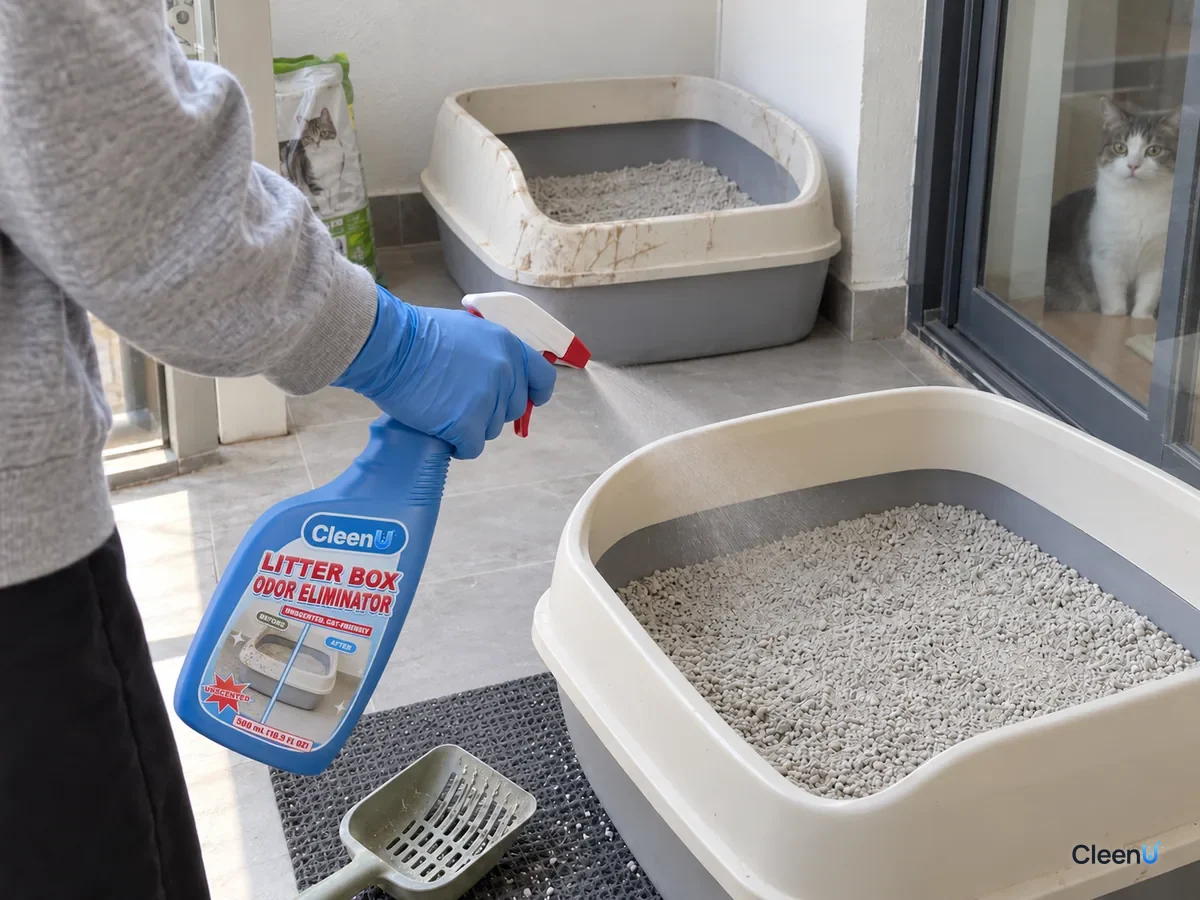
- Scoop first, then spray. Remove clumps and solids, top up, then lightly mist the surface with 3 to 5 sprays.
- Mist, don't soak. Too much liquid crusts clay litter, makes plant litter sticky, and breaks pine pellets down early. Wet litter becomes a new odor source.
- Never spray toward your cat. Spray only when your cat is away, and wait a few minutes before it uses the box. If it sniffs and walks away, stop.
- Treat the walls at each full change. Coat the inside of the empty box, wait 5 minutes, rinse, and dry completely before refilling. Hardened scale still needs a scrub first.
- Keep it away from chlorine bleach. Bleach reacts with urine residue to form irritating gases, and enzymes are proteins that bleach damages. If you need both, use them on different days with a rinse and dry in between.
How to pin down where the smell is coming from
Keep notes for two or three days and you'll usually narrow it to one or two causes.
- Smell by zone. Check the litter surface, the empty box, and the mat and corners. Each points to a different cause: litter and scooping, the box, or spots outside it.
- Time it. If ammonia returns within a few hours of scooping, a urine cake, crumbs, or scale is still in the box. If the box stays fresh all day, what's left is frequency and location.
- Test the location. Move the box to a ventilated spot for three days and change nothing else.
How much to spray: don't turn the deodorizer into a new odor source
The most common way to misuse a litter box deodorizer is spraying too much. Ammonia builds when three things meet: urea, bacteria, and moisture. Wetting the litter surface every time feeds the third one. Damp litter softens and crusts more easily, and bacteria break down urea faster. That's why a litter box deodorizer should be a fine mist applied lightly, per the label, so the droplets settle on the surface and dry quickly instead of leaving a damp layer.
You can check your own dose at home. After spraying, part the surface gently with a finger. If only the top looks slightly darker and it's dry again within a few minutes, you're fine. If the litter underneath is damp too, or the surface sticks together, you sprayed too much; use fewer pulls or hold the bottle farther away next time. Litters also react differently to moisture: tofu litter softens and turns mushy, pine swells into sawdust, and crystal litter changes color as it absorbs water. The first time you try a new deodorizer, mist one corner of the box and watch it for a day.
Choosing a litter box deodorizer: ingredient roles and the sprayer
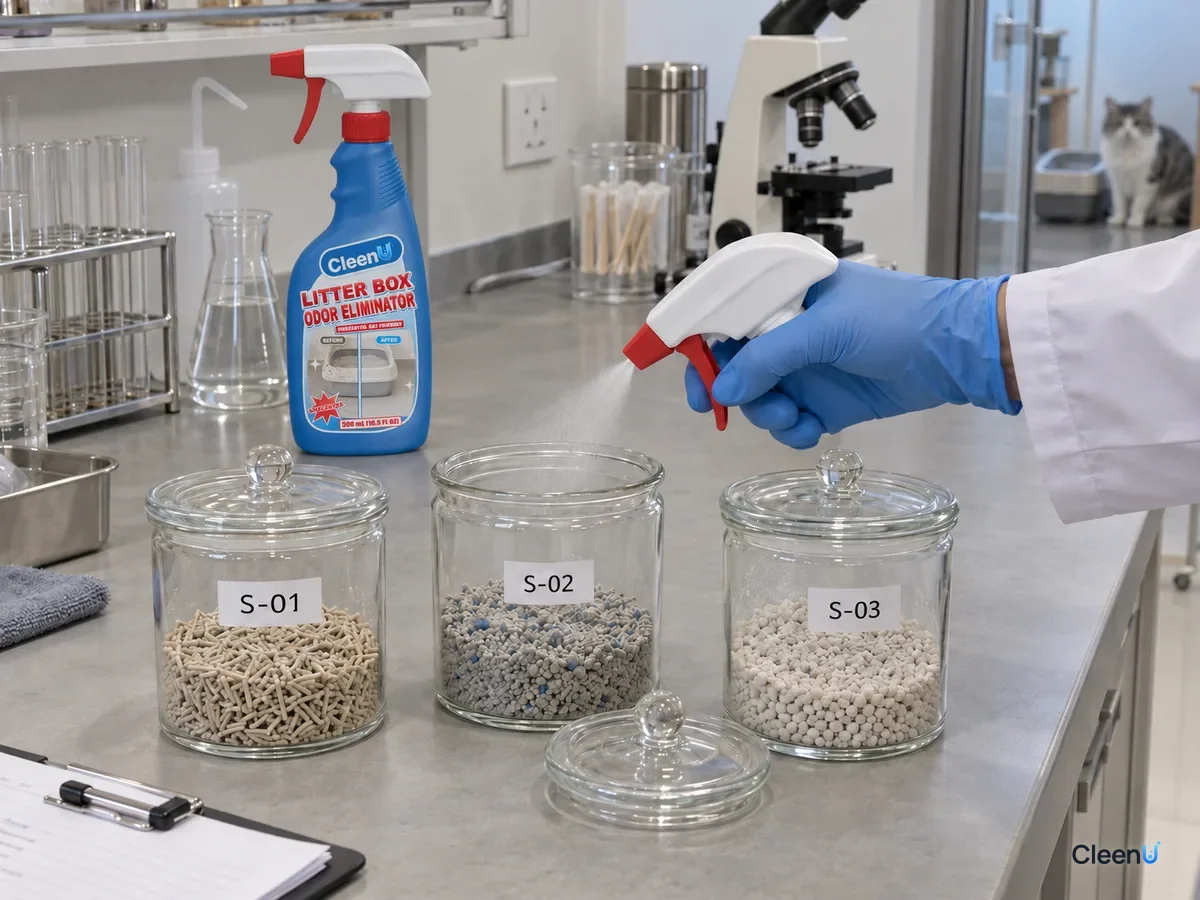
Based on the chemistry above, look for ingredients that split the work. A zinc salt such as zinc ricinoleate handles nitrogen-based odor like ammonia and amines. Cyclodextrin traps the sulfur compounds and indole-type molecules behind fecal odor. Enzymes break down organic residue on the box walls and litter surface. Skip added fragrance so you aren't layering perfume where your cat's nose matters most, and choose a fine mist that covers the surface in 3 to 5 sprays without wetting it.
CleenU Litter Box Odor Eliminator is one example: a ready-to-use, fragrance-free fine mist with enzymes, cyclodextrin, and zinc ricinoleate. Whatever you use, a few rules hold: don't spray toward your cat, don't combine it with chlorine bleach, don't spray the litter until it clumps, and don't use it in place of scooping and full changes. Keep your cat away while you spray. It's a deodorizer, not a disinfectant.
Once scooping, depth, and location are sorted, if you want to cut ammonia and fecal odor further, take a look at Litter Box Odor Eliminator.
For other jobs in a pet home, see our pet home cleaning hub.
Still smells after all that? Work down this list
Before you buy pricier litter or a stronger-smelling spray, start with the most common causes:
The most common reasons the smell sticks around
| Cause | What you'll notice | What to do | How to prevent it |
|---|---|---|---|
| Scooping without topping up | Clumps stuck to the bottom, a urine cake | Top up to about 2 inches, scrape the bottom clean | Refill to the original depth after every scoop |
| Too long between full changes | Ammonia returns soon after scooping, litter yellow and damp | Dump everything, scrub, refill | Change the whole box more often |
| The box holds odor | A scrubbed, dried, empty box still smells | Scrub once more, replace if it still smells | Plastic scoop, no hard scraping |
| Spots outside the box | The rug or corner smells worse than the box | Vet first, then enzyme cleaner on the spots | Enough boxes in calm locations |
| A hot, stuffy location | Worse in summer or with the door closed | Move it somewhere ventilated and shaded | Avoid cabinets and sunny porches |
| Too much deodorizer | Crusted surface, cat hesitates | Scoop out crusted litter, use less | Mist lightly, 3 to 5 sprays |
As for spending: the cheapest fix is time, one more scoop a day and topping up every time. Next is the box, since a new one costs less than cycling through deodorizers. Then a litter that clumps cleanly and your cat accepts. A deodorizer comes last; it freshens a well-managed box but can't save a neglected one. A self-cleaning box takes over scooping, but its waste drawer and drum still need regular cleaning.
Stop and deal with these first
A cat, especially a male, straining with little or no urine is an emergency: go to a vet immediately. Frequent trips, small amounts, blood in the urine, or sudden peeing outside the box call for a vet visit before you change the setup. If your cat refuses the box after you start a deodorizer, stop using it. If spray gets on your cat, rinse the fur with plenty of water and call your vet if it drools, paws at its eyes, or seems unwell. If scooping stings your eyes or throat, ventilate and scoop more often.
Litter box odor: questions cat owners ask
Why does my litter box smell like ammonia?
Bacteria are breaking down the urea in your cat's urine into ammonia. The longer clumps sit, and the warmer and damper the box, the stronger it gets, so scoop daily and keep the litter deep enough that urine can't reach the bottom.
Does a covered litter box help with smell?
It helps you more than your cat. The lid traps odor, heat, and moisture inside where your cat breathes it. If your cat hesitates or goes elsewhere, take the lid off for a few days.
How many litter boxes for 2 cats?
Three: one per cat plus one, in different spots. If you can't fit three, scoop each box twice a day and change the litter more often.
What's the best litter box deodorizer spray?
A fragrance-free one that comes out as a fine mist you can apply lightly. Strong scents can put cats off, and coarse sprays that soak the litter create crusts and new odor.
Does baking soda help with litter box smell?
It won't fix ammonia. It neutralizes acidic odors and absorbs a little moisture, but ammonia is a base, so scooping and depth are what control it.
Is litter box smell harmful to people?
In a regularly cleaned box, it's mainly unpleasant. High ammonia can irritate eyes and airways, so if it stings, ventilate and scoop more often.
Will my cat stop using a smelly litter box?
Many cats will and start going elsewhere, so scoop at least daily rather than waiting until you can smell it.
Why does my new litter smell worse than the old one?
Change the routine along with the litter. Pine and crystal litters need sifting or stirring, and a new clumping litter may need a different depth.
Why is my litter box so much worse in summer?
Heat speeds up the conversion of urea to ammonia. Move the box out of the sun, scoop twice a day, and change litter more often.
If I use a deodorizer, do I still need to change all the litter?
Yes. A deodorizer reduces odor, but once litter is saturated and full of crumbs, only a full change removes the source.
Sources: Cornell Feline Health Center, "Feline Behavior Problems: House Soiling" and "Feline Lower Urinary Tract Disease"; ASPCA, "Litter Box Problems"; CDC, "Cats | Healthy Pets, Healthy People"; International Renal Interest Society, "Urine Specific Gravity"; Mobley and Hausinger (1989) and Mobley et al. (1995), Microbiological Reviews, on bacterial urease. Accessed October 2026.
Litter box odor is mostly ammonia that bacteria release from urea in cat urine, plus sulfur compounds from feces. Stop the sources first: scoop daily, keep litter 1 to 2 inches deep, check the box for scale and deep scratches, keep it somewhere ventilated and quiet, and have one box per cat plus one. Odor outside the box means a vet visit first. Then a light, fragrance-free mist, never soaking the litter or aimed at your cat, makes the box fresher, but it can't replace scooping and changing the litter.