
Formulation Science
How Do Enzyme Cleaners Work? What They Break Down in Pet Urine, and What They Don't
Direct answer
Enzyme cleaners use protease, lipase, and amylase to cut the protein, fat, and starch residue in pet messes into small, water-soluble pieces, then surfactants carry them out of the fibers. They need a full soak and wet dwell time, and heat or bleach shuts them down. They don't break down uric acid.
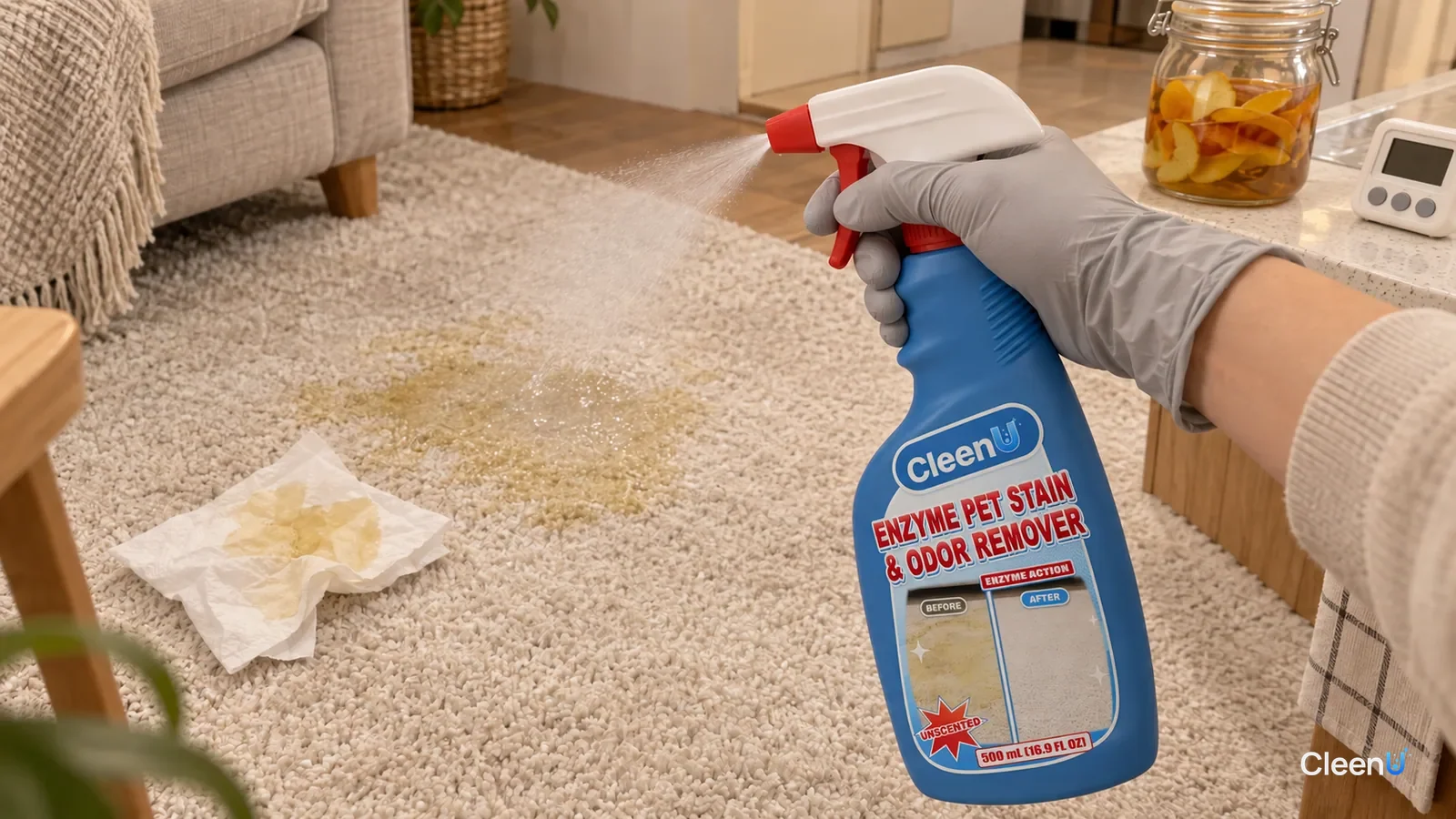
How do enzyme cleaners work? An enzyme cleaner is a cleaning solution with added enzymes, usually protease, lipase, and amylase. Each enzyme cuts one type of large soil molecule into smaller pieces that dissolve in water. Surfactants wet the fibers and keep those pieces suspended, and blotting pulls the liquid, and everything dissolved in it, out of the carpet.
So does an enzyme cleaner really break down pet urine? It breaks down an important part of it. The protein and oily residue in a urine spot, plus the drool, vomit, and skin oil that come along with it, are exactly what these enzymes cut. Urea and salts, most of what's dissolved in urine, already dissolve in water, and these enzymes don't touch them; they leave when you soak the spot to depth and blot. Give an enzyme cleaner water, time, and the right conditions and it gets much closer to the source of the smell than any fragrance spray. Mist and wipe, or hit it with a hot hair dryer, and the enzymes barely get a chance to work.
What counts as an enzyme cleaner (and what doesn't)
So what is an enzyme cleaner? On store shelves, "enzyme cleaner," "enzymatic cleaner," and "bio-enzymatic cleaner" usually mean the same thing: purified enzymes from industrial fermentation, blended with surfactants, stabilizers, and a preservative system at a pH where the enzymes can work. What an enzyme cleaner is made of, in other words, is a few defined enzymes plus the ingredients that keep them working.
Three other products get mixed up with it:
- DIY citrus "enzyme" cleaners: peels, brown sugar, and water fermented in a jar for months. Same name, very little else in common.
- Bacteria-based cleaners: some "bio" products contain bacterial cultures that produce enzymes on site over time, a different and typically slower route.
- Enzyme laundry detergent: real enzymes, but formulated for a wash cycle, not for soaking a carpet pad.
This article is about the first group: enzyme preparations such as protease, lipase, and amylase combined with surfactants, mostly sold ready to use with no mixing.
What an enzyme is: scissors that only fit one shape
Enzymes are biological catalysts, and almost all of them are proteins. As the OpenStax Biology 2e textbook explains, an enzyme lowers the energy barrier a reaction has to clear, so a slow reaction happens fast, and the enzyme isn't used up. A soil molecule has to fit a pocket on the enzyme called the active site. If its shape and chemistry match, it gets cut; if not, nothing happens. That's specificity.
Think of each enzyme as a pair of scissors that only fits one shape. Protease cuts the peptide bonds that hold proteins together. Lipase cuts the ester bonds in fats and oils. Amylase cuts the bonds that link starch into long chains. Things that don't fit, like urea, mineral salts, or sand, are ignored. Because pet messes are usually a mix of protein, fat, and starch, pet enzyme cleaners typically combine several enzymes.
Specificity cuts both ways: a matched enzyme turns protein residue that ordinary cleaners only loosen into pieces that rinse away, while a protease-and-lipase formula does almost nothing for tea, ink, or rust.
Terms you'll see on enzyme cleaner labels
- Enzyme
- A biological catalyst, usually a protein, that isn't used up by the reaction. In a cleaner, it cuts large soil molecules into small pieces.
- Specificity
- Each enzyme handles only certain molecular structures, which is why formulas combine enzymes to match the soil.
- Denaturing
- Heat, strong acids or bases, or oxidizers unfold the enzyme's structure. The active site loses its shape and the enzyme stops working, usually for good.
- Nonionic surfactant
- A surfactant with no electrical charge. It wets fibers and keeps cut-up residue suspended, and generally interferes with enzymes less than charged surfactants do.
Protease, lipase, and amylase: which pet stains each one handles
The detergent industry treats protease, lipase, and amylase as the core "detergent-compatible" enzymes behind stain removal in laundry and dish products (Niyonzima and More, 2015 review). Pet cleaners borrow the same idea and point it at urine, drool, vomit, and body oil.
| Enzyme | What it cuts | Pet messes it matches | After cutting |
|---|---|---|---|
| Protease | Peptide bonds in proteins | Proteins in urine, mucins in drool, undigested food in vomit, blood, fecal residue | Short peptides and amino acids that dissolve and let go of the fiber |
| Lipase | Ester bonds in fats | Skin oil, greasy paw and coat transfer, fat in vomit and feces | Fatty acids and glycerol that surfactants can emulsify and carry off |
| Amylase | Bonds in starch | Kibble and treat residue in vomit and feces, food mixed into drool | Short sugars that dissolve instead of drying into a film |
| None of the three | Urea, salts, uric acid, dyes, grit | Most of what's dissolved in urine, colored stains, tracked-in dirt | Dissolved and carried off by water and surfactant, or needs a different method |
That last row is the part most marketing skips. Urine is mostly water, urea, and salts, which dissolve readily and which protease, lipase, and amylase don't break down. Over time, bacteria use an enzyme called urease to turn urea into ammonia (Mobley and colleagues describe this in their microbiology reviews), one reason an old urine spot smells sharper than a fresh one. Getting urea and salts out depends on soaking, dwell time, and blotting.
Uric acid is also outside these three enzymes. Breaking it down takes a dedicated enzyme such as uricase; protease can't do it. And according to the Merck Veterinary Manual, most dogs convert uric acid into soluble allantoin, while Dalmatians and a few other breeds excrete more of the less soluble urate form. So claims that an enzyme cleaner "breaks down uric acid crystals" don't apply to protease, lipase, and amylase formulas. Common pet urine enzyme cleaners use exactly those three enzymes: it breaks down protein and fat-based odor sources and works with its surfactants to lift urine out. It doesn't break down uric acid.
Does protease have anything to do in a urine spot, then? Yes. Cat urine carries large amounts of a protein called cauxin (Miyazaki et al., 2006), and urine soaking into carpet also picks up skin flakes, body oil, and existing soil. Left in place, that residue keeps feeding the bacteria that generate odor. Cut it up and carry it out, and a large share of the odor source goes with it.
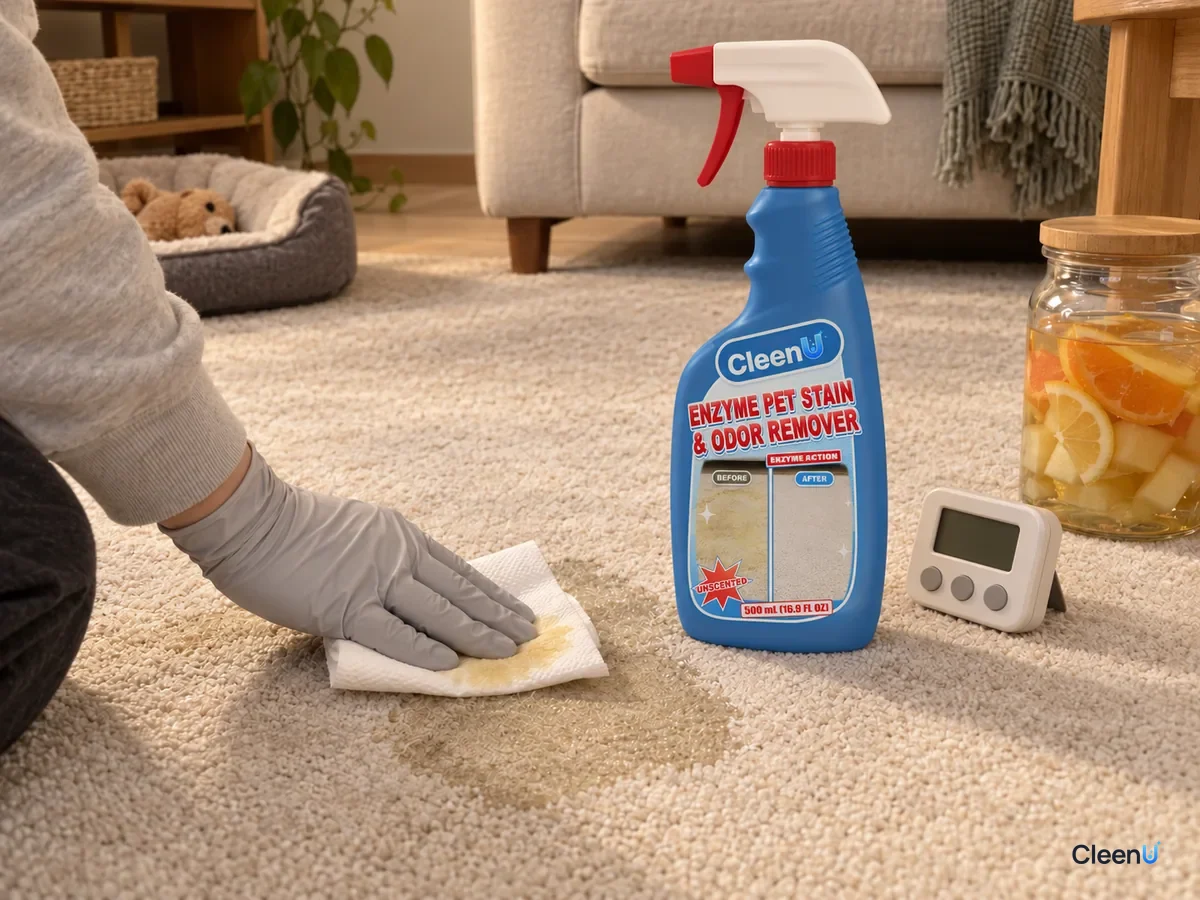
So does an enzyme cleaner actually break down pet urine?
A urine spot isn't one thing. It's several layers of problem stacked together, and an enzyme cleaner does something different to each.
Why a spot smells clean today and stinky three days later
What you see
You wipe a urine spot on the rug with a damp cloth and it looks fine. Two or three days later, especially in humid weather or after mopping nearby, the smell is back and the pet returns to the same spot.
Why it happens
Wiping only removed liquid near the tips of the fibers. Urine that soaked into the backing and pad is still there. Bacteria slowly work on its protein and fat residue, urea keeps turning into ammonia, and odor rises as moisture evaporates. Enzymes handle the protein and fat. Urea and salts leave only when liquid is pulled out. Skip either job and the smell comes back.
What it means for use
Spray as deep and as wide as the urine went, give it the full dwell time, then blot until the towel stops picking up color. Spraying the surface and walking away just re-wets the residue and can make the smell stronger for a while.
Put simply: enzymes cut the organic residue, surfactants loosen and suspend it, and blotting removes it. That's why the ASPCA recommends an enzymatic cleaner for soiled spots, and why Cornell's Feline Health Center talks about neutralizing odor rather than covering it. A common mistake is to spray, let the spot air-dry, and assume the enzymes keep "eating" the urine. They work while the spot is wet; once it dries, whatever was cut up is still in the fibers.
Why you have to soak the spot as deep as the urine went
Enzymes only work in liquid, and only when they touch the soil. That's why the most important instruction on any enzyme cleaner is to cover an area wider than the stain and go as deep as the urine did.
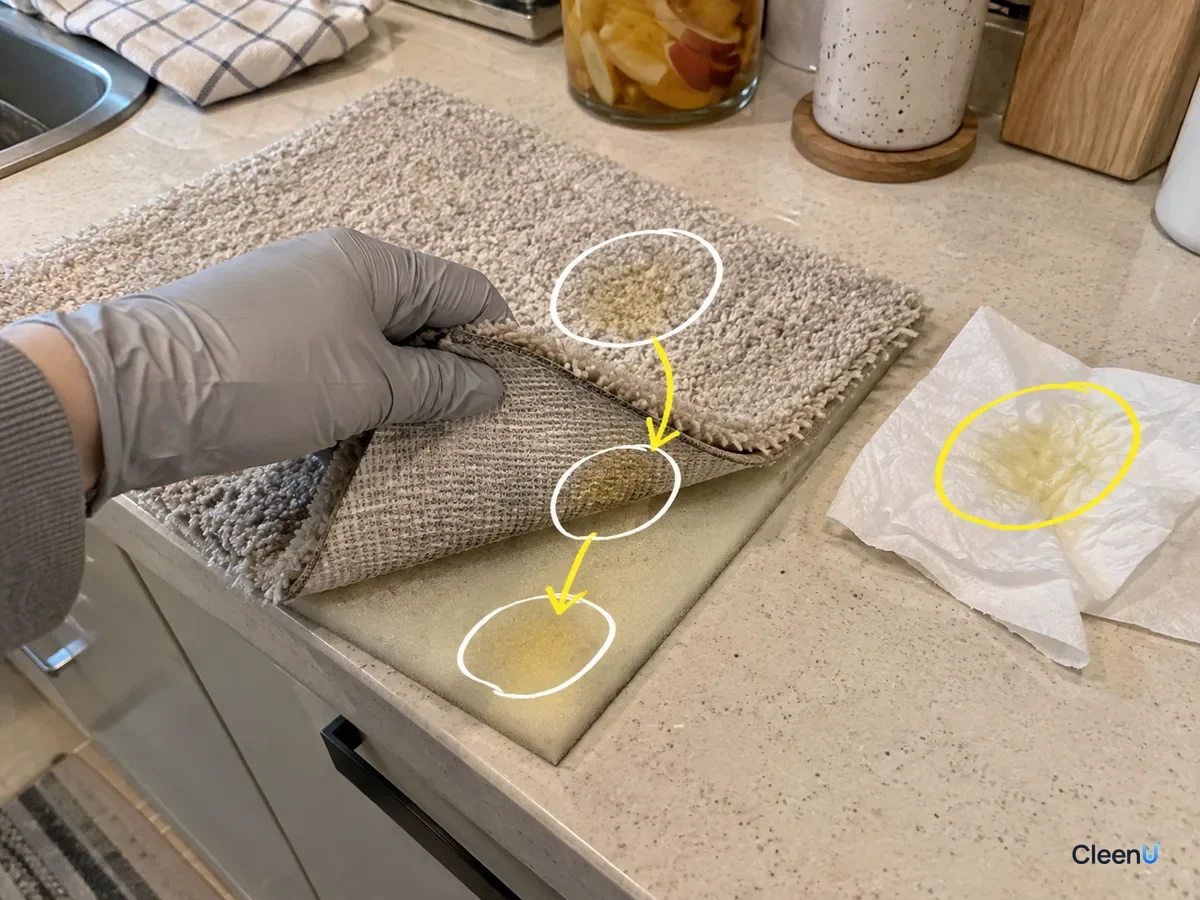
Urine runs down through the pile into the backing, and a large puddle keeps going into the pad and sometimes the subfloor, spreading sideways, so the area underneath is often bigger than the mark on top. A light mist leaves the enzymes on the pile tips, nowhere near the residue below. Dog accidents usually mean more volume and a wider spread, so use more product.
After spraying, press the center with a gloved finger; the base of the pile should feel wet too. Mattresses and foam cushions can't be soaked this way and need a low-moisture approach, covered below.
Why enzymes need dwell time, and why the spot has to stay wet
Cutting soil takes time. Enzyme molecules have to diffuse between fibers, find a substrate, bind, cut, and move on. It isn't instant like a strong alkaline degreaser. The 10 to 15 minutes you often see on pet enzyme cleaner labels is the working time the enzymes and surfactants need.
Keep the spot wet during that time. Cutting a peptide or ester bond is a hydrolysis reaction that uses water itself, so when the liquid evaporates, the reaction stops and half-cut residue stays put. So:
- Don't speed things up with a hair dryer, space heater, or a vent blowing straight on the spot. Heat and fast drying both shorten the enzymes' working time.
- Near a sunny window or over radiant heat, mist a little more to keep the surface damp, without flooding the pad.
- When the time is up, blot. Then let it air-dry, or run a room-temperature fan.
Old stains often need two or three rounds, because dried residue has to redissolve before it can be cut. Instead of one huge soak, repeat the cycle: soak, wait, blot, dry, sniff, repeat.
What stops an enzyme cleaner from working
Enzymes have a comfort zone of temperature, pH, and chemistry. Outside it they slow down, and pushed far enough they denature and stop working permanently. Commercial enzymes differ, so we won't quote cutoffs here. These conditions reliably make enzyme cleaners less effective:
- Heat. Hot water, hot air, and steam denature proteins, and enzymes are proteins. Heat can also set some protein stains, which is why enzyme mattress cleaners usually say not to use hot water on blood.
- Strong acids or bases. Vinegar and citric acid on one side, heavy-duty degreasers and drain openers on the other, push the local pH out of the enzymes' working range.
- Oxidizers. Hypochlorous acid, the active ingredient in chlorine bleach, unfolds proteins and makes them clump (Winter et al., Cell, 2008, University of Michigan). By the same principle, bleach damages enzymes, and the detergent industry works specifically on making enzymes more oxidizer-tolerant (Al-Ghanayem and Joseph, 2020 review). That's why pet enzyme cleaner labels usually say not to use them at the same time as, or right after, a chlorine disinfectant.
- Drying too fast. No water, no hydrolysis.
- Leftover products. Degreasers, scented sprays, and fabric softeners already in the carpet can shift the pH or leave a film between the enzymes and the residue.
- Storage. Enzyme activity declines slowly over shelf life, faster in heat and sun. Store cool, cap tight, and use it within the shelf life on the label.
For the same reason, don't dilute a ready-to-use enzyme cleaner with hot water or mix in vinegar, rubbing alcohol, or laundry detergent. The formula is balanced around the enzymes.
DIY citrus enzyme cleaner vs. a store-bought enzyme cleaner
Search for enzyme cleaners and you'll find recipes: citrus peels, brown sugar, and water sealed in a jar for about three months, then strained. The result is called an eco-enzyme or bio-enzyme cleaner and is shared as an all-purpose cleaner, sometimes for pet urine. Apart from the word "enzyme," it has little in common with a commercial enzyme cleaner. We haven't found a study comparing the two directly, so this comparison comes from how each is made.
| DIY citrus ferment | Commercial enzyme cleaner | |
|---|---|---|
| How it's made | Peels, sugar, and water ferment with whatever yeast and bacteria show up | Enzymes from industrial fermentation, purified, then formulated |
| What's in it | Organic acids, a little alcohol, leftover sugar, microbes, and peel bits; possibly small amounts of enzymes, type and amount unknown | Specific enzymes, surfactants, stabilizers, and a preservative system |
| pH | Fermentation makes acids, so it's usually acidic | Set where the enzymes work; pet enzyme cleaners are often close to neutral |
| What it does to urine | Acts mostly like a weak, vinegar-like acid; sugar can stay in the fibers | Enzymes cut protein and fat residue; surfactants carry out what's dissolved |
| Batch consistency | Every jar is different, and each jar keeps changing | Made in batches with inspections and a stated shelf life |
| Storage | Still fermenting; sealed jars can build pressure, grow a film, or turn | Stored as labeled, with a defined unopened shelf life |
Two details matter for pet owners. A citrus ferment is acidic and often smells sour, and Cornell's Feline Health Center advises avoiding ammonia- or vinegar-containing products on soiled spots because they smell like urine and can be irritating. And leftover sugar feeds microbes, which can leave a tacky spot that picks up new odors. Pet urine needs enzymes that match the soil, consistent strength, and a way to carry residue out; a homemade ferment can't promise any of those.
Are enzyme cleaners corrosive? Hard surfaces are rarely the problem; protein materials are
The answer has two parts: acid-base corrosion, and what the enzymes do to the material itself. What corrodes metal, etches stone, or ages rubber is usually a strong acid, strong base, oxidizer, or solvent. Pet enzyme cleaners keep their pH near neutral so the enzymes can work. That near-neutral range generally isn't a corrosion concern for tile, glazed surfaces, metal, or common plastics.
Then there's the enzyme. Wool, silk, leather, and suede are protein, and protease can't tell urine protein from wool protein. Prolonged contact can affect the feel, luster, and strength of wool and silk and the surface of leather. That's the damage to watch for. A protease-based pet cleaner's label should rule out wool, silk, and other animal-protein fibers, leather, and suede, as well as unsealed hardwood, which soaks up liquid.
Some people are sensitive to enzymes, so wear gloves, don't spray toward your face, and avoid breathing the mist. Keep pets away while you clean and until the spot is completely dry, and never spray a pet directly.
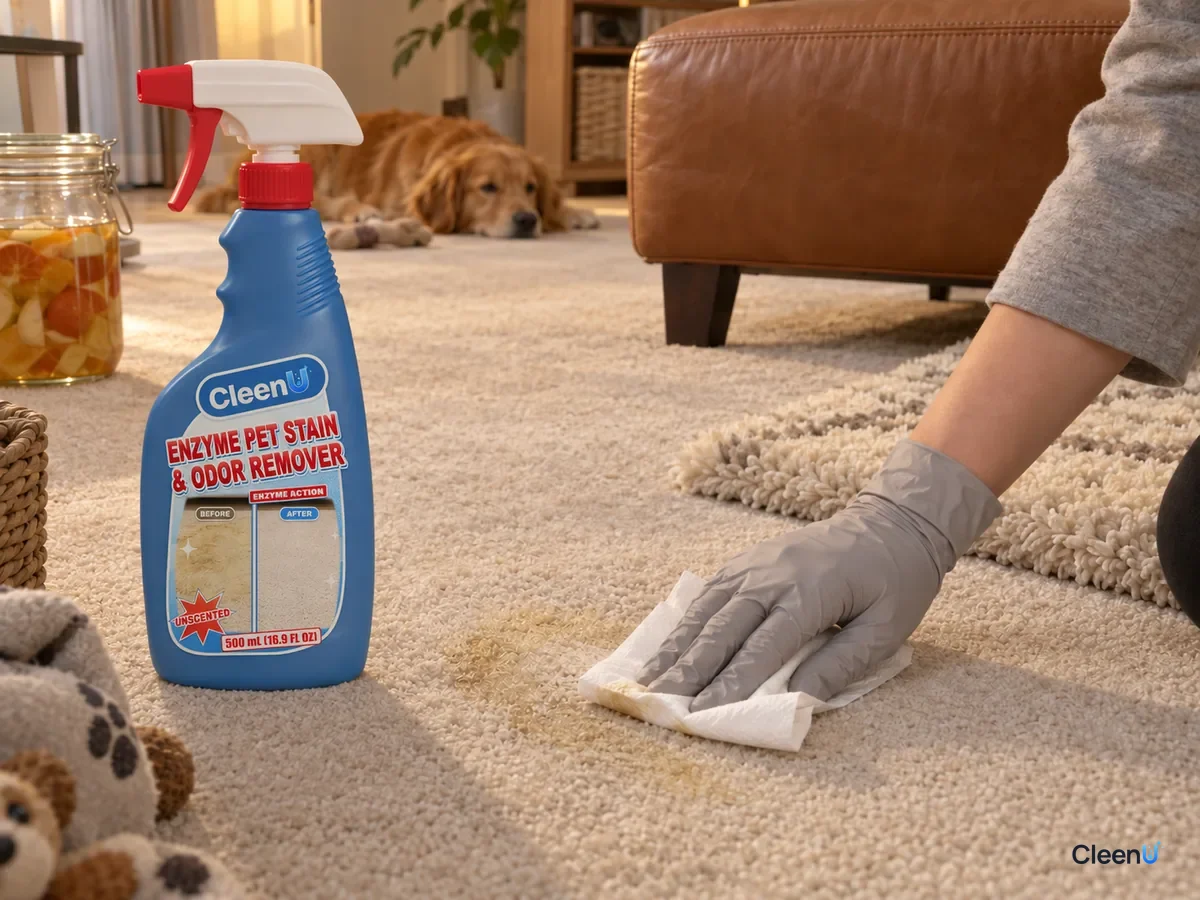
How to check whether an enzyme cleaner is working at home
These quick checks show whether the enzymes are doing anything and whether your technique is the problem. They're home observations, not test reports.
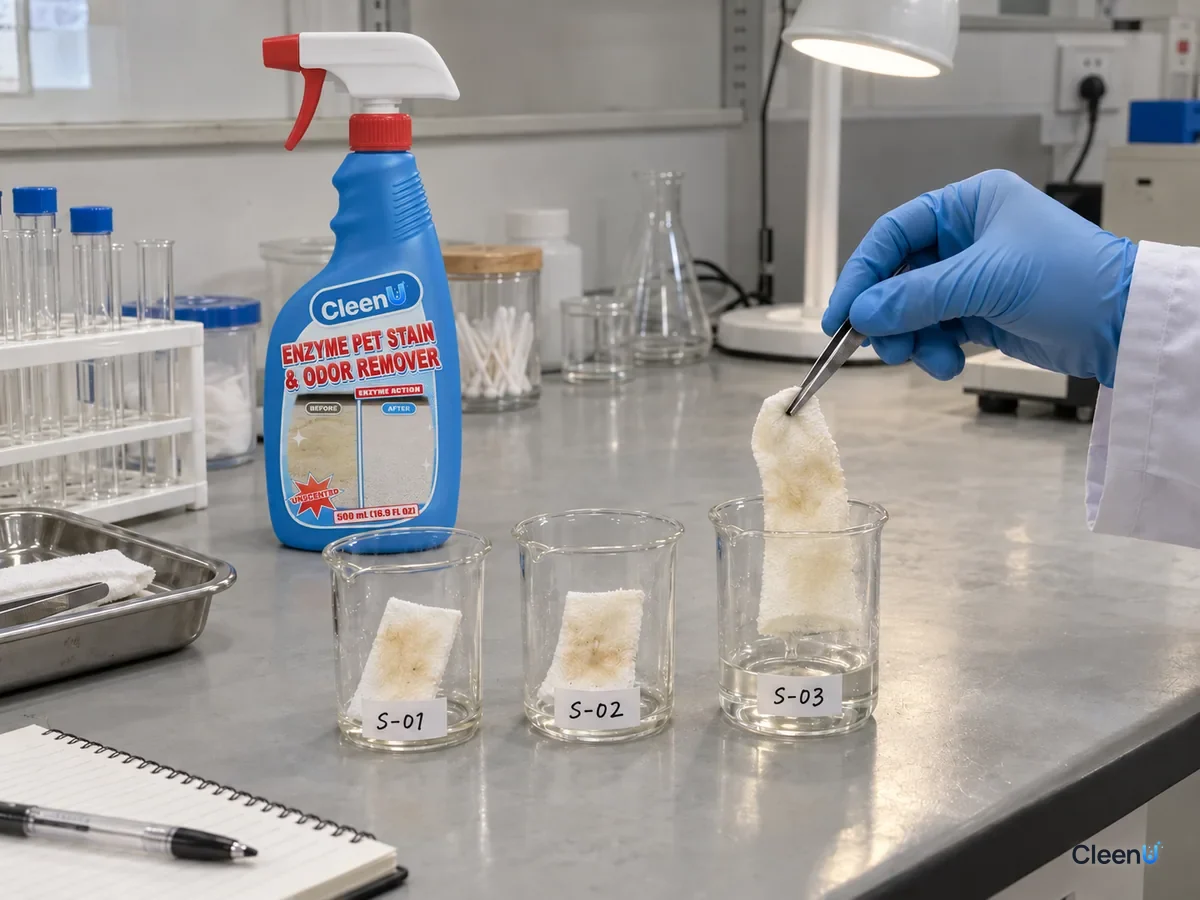
Egg-white strip test: dab raw egg white on two strips of old white cotton and let them dry. Spray one with enzyme cleaner and one with the same amount of water, wait 15 minutes, blot, wipe, and dry. Compare the stiff, yellowed edge under a light. Repeat with tea and the difference shrinks a lot. That's specificity you can see.
Paper towel color: after the dwell time, blot with plain white paper towels. A yellow tint means dissolved residue is coming out. Keep switching towels until the color fades before you let the spot dry.
Dry-then-rewet sniff test: once the spot is fully dry (overnight for most carpet), smell it up close, then mist a little water on the center, wait a few minutes, and smell again. A strong return means residue is still down there. This beats sniffing a wet spot.
Next-day check: if your pet keeps sniffing or scratching the spot, it's picking up something you can't, and the job isn't finished.
Why two "enzyme cleaners" can perform so differently
The egg-white strip test above is a simplified at-home version of an "enzyme versus no enzyme" comparison. When two products both say "enzyme" on the label, the difference usually comes down to three things:
- Whether the enzymes are still active. Enzymes are proteins, and heat, sun, and age slowly deactivate them. The same bottle kept on a hot balcony and in a cool cabinet may behave differently a few months later.
- Whether the enzymes fit the rest of the formula. Strong acids, strong bases, oxidizers, and some solvents denature enzymes, which is why enzyme cleaners are usually near neutral and lean on mild nonionic surfactants that help wet the fibers without fighting the enzymes.
- How much of the cleaning comes from the enzymes. Surfactants lift some soil on their own. The gap between "with enzyme" and "without" is widest on protein soils and narrow on tea or mud, which is why enzyme cleaners make the most sense for urine, vomit, and drool.
So when you compare enzyme cleaners, check which enzymes the label lists, whether the pH is near neutral, and whether it gives a dwell time and the materials to avoid. Store it cool with the cap tight. Those details tell you more than words like "bio" or "natural."
Carpet and mattress need different enzyme approaches
On carpet, fabric sofas, pet beds, and sealed hard floors, follow the steps above: blot up the urine, soak the spot as deep as the urine went, wait 10 to 15 minutes, blot, and let it air-dry. CleenU Enzyme Pet Stain & Odor Remover is one example: a ready-to-use spray with protease, lipase, and amylase plus nonionic surfactants, close to neutral and unscented, so what you smell afterward is what's really there.
Mattresses and thick cushions can't be soaked, because water that reaches the foam and springs is hard to get back out. A fine, low-moisture enzyme mist made for mattresses suits them better. Mist the fabric until it's just damp, wait a few minutes, blot with a wrung-out damp cloth, then dry it with a fan or open window. Don't soak the mattress, don't use hot water on blood, and don't use it on wool or silk covers.
Enzyme cleaners aren't disinfectants; they handle stains and odor sources. If a pet suddenly starts going outside the litter box or its usual spot, that can be a health or behavior signal, such as urinary discomfort. Have a veterinarian check first; cleaning only handles the aftermath.
For cat and dog urine, vomit, and drool on carpet and upholstery, take a look at CleenU Enzyme Pet Stain & Odor Remover.
How enzyme cleaner use changes by surface and stain age
| Situation | How to use an enzyme cleaner | Watch for |
|---|---|---|
| Fresh urine, synthetic low-pile carpet | Blot, soak a ring wider than the stain, wait 10–15 minutes, blot, air-dry | One round is often enough; confirm with a dry-then-rewet sniff |
| Old urine, carpet | Rewet the residue, then run a full cycle; repeat if needed | Still smells after several rounds: consider replacing the pad |
| Fabric sofa cushions | Treat zip-off covers separately; otherwise blot harder and dose to the label | Spot-test dark fabric first |
| Mattress | Switch to a fine, low-moisture mist; blot with a damp cloth and fan-dry | Don't soak the foam; no hot water or hot air |
| Tile, sealed wood floors | Wipe up the urine, spray, let it dwell, then wipe clean and dry | Grout can take a longer dwell; skip unsealed hardwood |
| Wool rugs, silk, leather | Don't use a protease product | Follow the material maker's guidance or call a professional cleaner |
Still smells after you followed the steps? Likely causes, most to least common
- You missed some of it. There's more than one spot, or the real area is bigger than the mark. Get low, sniff a wider circle, and treat the full area.
- You didn't reach the depth. The urine in the pad or cushion foam never met the enzymes. Wet the base of the pile, or treat removable layers separately.
- Nothing came out. You sprayed and waited but didn't blot, so dissolved residue stayed put. Blot thoroughly next round, until the towel color fades.
- Something else is in the way. Bleach, vinegar, or scented odor sprays from earlier are still in the fibers. Blot with plain water a few times, let it dry, then use the enzyme cleaner.
- You judged it too early. Wet spots smell stronger. Let it dry overnight before deciding.
- The material is saturated. If several rounds still fail the rewet test, it's usually a repeatedly soaked carpet pad, foam cushion, or floorboard gaps. Replacing the pad or section, or calling a professional cleaner, is usually better value than more bottles.
If a pet keeps going in the same spot, look at the pet side too: litter box number, location, and cleaning, a dog's house-training, and possible health issues. A clean spot is less likely to draw a pet back, but it can't fix why the pet chose it.
Enzyme cleaners and pet urine: common questions
How do enzyme cleaners work on cat urine?
They cut the protein and fat residue in cat urine into small, water-soluble pieces that leave when you blot, along with the urea and salts. They don't break down uric acid, so soaking to depth and blotting matter as much as the enzymes.
How long do you leave enzyme cleaner on carpet?
Follow the label, which for pet urine enzyme cleaners is typically 10 to 15 minutes with the spot kept wet. Then blot instead of letting it air-dry, so the cut-up residue actually leaves the fibers.
Does enzyme cleaner work on old cat pee?
Yes, but expect two or three rounds of rewetting, soaking, waiting, blotting, and drying. If the rewet sniff test still fails after several rounds, the urine is likely in the pad or the material itself.
Can I use hot water with an enzyme cleaner?
No. Heat denatures enzymes and can set some protein stains. Spray the ready-to-use product as is, and dry the spot with a room-temperature fan.
Can I mix enzyme cleaner with vinegar or bleach?
Don't mix them or use them back to back. Vinegar pushes the pH out of the enzymes' range, and bleach unfolds proteins, enzymes included. If you've used either, blot with plain water and let the spot dry first.
Is a homemade citrus enzyme cleaner as good as a store-bought one?
No, not for pet urine. A homemade ferment is usually acidic, contains leftover sugar, and has unknown enzyme content that changes jar to jar. Sealed jars can also keep fermenting and build pressure.
Do enzyme cleaners disinfect?
Don't count on an enzyme cleaner to disinfect; it handles stains and odor sources. If you need to disinfect, such as when a pet has diarrhea or an infectious illness, follow your veterinarian's advice and keep the two steps separate.
When can my pet go back on the spot?
After it's completely dry. Keep pets away during cleaning and drying, never spray a pet directly, and give thick carpet overnight.
For everyday floor care in a pet home, see Cleaning floors in a pet home: paw prints, drool, and odor. If you use a robot mop, don't let it run over a urine spot; see Can a robot mop clean up pet urine? For storing opened cleaners, see Do cleaning products expire? More pet-home cleaning guides are on our pet home cleaning page.
Sources (accessed October 2026): OpenStax, Biology 2e, 6.5 "Enzymes"; Niyonzima and More, Prep Biochem Biotechnol (2015); Al-Ghanayem and Joseph, Appl Microbiol Biotechnol (2020); Winter et al., Cell (2008); Mobley et al., Microbiol Rev (1989, 1995); Miyazaki et al., Chem Biol (2006); Merck Veterinary Manual, "Urolithiasis in Dogs"; ASPCA, "Litter Box Problems"; Cornell Feline Health Center, "Feline Behavior Problems: House Soiling."
Enzyme cleaners work by cutting soil, not by covering odor. Protease, lipase, and amylase break protein, fat, and starch residue into small pieces, surfactants keep them suspended, and blotting pulls them out of the carpet. That handles a key part of a pet urine stain, but not urea, salts, or uric acid, which leave only when you soak to depth and blot. Get the conditions right: spray as deep as the urine went, keep it wet for 10 to 15 minutes, blot, and air-dry at room temperature. Keep heat, vinegar, and bleach away, and skip wool, silk, and leather. A homemade citrus ferment isn't the same thing. For pet urine, use a defined, batch-made enzyme cleaner.