
Formulation Science
Can You Use Bleach After Enzyme Cleaner? The Right Order for Bleach, Alcohol, Vinegar, and Enzymes on Pet Urine
Direct answer
Yes, but not right away, and never mixed. Blot the urine, treat it with an enzyme cleaner, blot, wipe with water, and let it dry completely. Only then, if you need to disinfect, use a disinfectant per its label. Don't pour bleach straight onto urine or use it alongside enzyme cleaners or vinegar.
What happens when bleach hits a urine spot
- Bacterial urease breaks urea down, so the spot accumulates ammonia and ammonium, more the longer it sits
- Sodium hypochlorite reacts with that ammonia and other nitrogen compounds in urine to form chloramines
- Chloramines escape into the air and irritate eyes, nose, and airways; much of that "bleach smell" is them
- Organic matter in the urine keeps consuming the available chlorine, leaving less to disinfect
- The result: harsher fumes, weaker disinfection, and possible bleaching of light rugs and dark grout
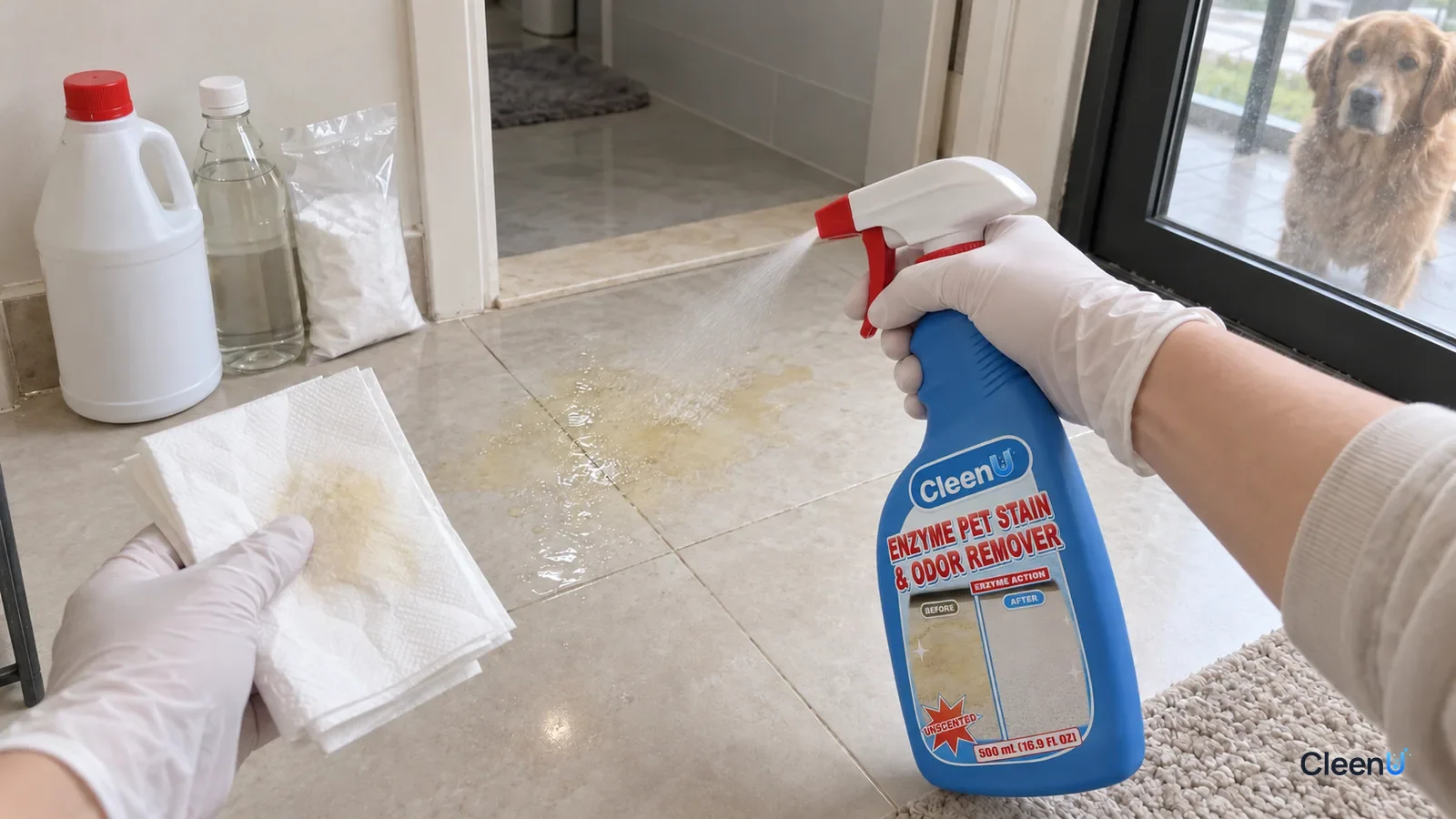
Can you use bleach after enzyme cleaner? You can, as long as the two never meet. Plenty of people grab bleach after a pet accident because it feels thorough, or spray an enzyme cleaner and follow up with bleach to cover both bases. But the two do different jobs. The enzyme cleaner removes urine and the organic residue in it; a disinfectant inactivates microbes on a surface. In the wrong order, or too close together, both work worse, and the smell can get sharper.
The rule is short: clean first, disinfect later, and keep the steps apart. For most accidents from a healthy pet, blotting, an enzyme cleaner, a plain-water wipe, and drying are enough. If your pet has diarrhea or an infectious illness, or your veterinarian or doctor recommends disinfecting, do it afterward on a clean, dry hard surface, per the label. Three habits to drop: bleach straight on urine, bleach with vinegar, and bleach right after an enzyme cleaner. Below is what bleach, rubbing alcohol, vinegar, baking soda, and enzyme cleaners each do to a urine spot.
Cleaning, deodorizing, and disinfecting are three different jobs
A single "odor and disinfecting" spray often blurs these together, but they target different things.
| Job | What it handles | Typical method | What it can't do |
|---|---|---|---|
| Cleaning | Pulls urine, protein and fat residue, and salts out of the material | Blot, treat with an enzyme cleaner or cleaner, blot again, wipe with water | Doesn't guarantee microbes are inactivated |
| Deodorizing | Removes or neutralizes the odor source instead of covering it | Remove the residue itself; absorbing or trapping odor ingredients | If the source is still there, the effect fades |
| Disinfecting | Inactivates bacteria and viruses on a surface | A disinfectant at label strength and contact time, then a water wipe | Doesn't remove urine, and works poorly on a dirty surface |
That last column is the key. The CDC's disinfection guidance says chlorine disinfectants are inactivated by organic matter, notably when material like blood is present. A urine spot is a puddle of organic and nitrogen-containing compounds, so bleach poured on it spends its chlorine on the urine before it does much disinfecting. That's why public health guidance says to clean before disinfecting. The CDC's advice for cat households follows the same order: clean up urine, feces, and vomit right away, then disinfect the area.
Disinfecting also isn't deodorizing. Bleach's sharp odor masks the urine; once it fades, the urine smell can return, because the urine never left.
In the US, disinfectants are registered with the EPA as antimicrobial pesticides, and the label's dilution and contact time are the directions to follow. A cleaner that doesn't carry those claims, like an enzyme cleaner, isn't meant to disinfect.
What's in a urine spot: bleach meets organic matter and ammonia
Urine is mostly water, carrying urea and various salts, plus small amounts of protein, pigments, and other compounds. Once urine leaves the body, bacteria in the environment use an enzyme called urease to break urea into ammonia and carbon dioxide, a reaction described in Mobley and colleagues' microbiology reviews. The longer a spot sits, the more ammonia builds up and the sharper it smells. The same reaction pushes the spot toward alkaline.
On tile, urine runs into the grout lines; on carpet and upholstery, it soaks to the backing and pad; on wood, it slips into the seams. What looks wiped up is often only part of where it went. So you have to treat as deep as the urine went, and anything you pour on top meets the urea, ammonia, and protein residue below. Bleach isn't landing on clean tile. It's landing on a layer full of ammonia and organic matter.
Five common liquids and what each one actually does to urine
Here's the side-by-side, with the chemistry explained below.
| Liquid | Main ingredient | What it does to urine | Limits and risks | With an enzyme cleaner |
|---|---|---|---|---|
| Chlorine bleach | Sodium hypochlorite, alkaline | Oxidizes, bleaches, inactivates surface microbes; its smell masks urine | Forms chloramines with urine and ammonia; gets used up by organic matter; bleaches fabric and dark grout | Damages proteins, and enzymes are proteins; never together or back to back |
| Rubbing alcohol | Isopropyl or ethyl alcohol | Dissolves some odor compounds and carries a little off as it evaporates; denatures proteins | Evaporates too fast to stay in contact on porous surfaces; leaves urea and salts behind; flammable | Denatures enzymes; don't combine |
| White vinegar | Acetic acid | Neutralizes ammonia into a nonvolatile salt, so the ammonia smell fades for a while | Doesn't remove protein residue; smells sour; releases chlorine gas with bleach | Drops the pH below the enzymes' working range |
| Baking soda | Sodium bicarbonate, a weak base | Absorbs moisture; neutralizes acidic odor compounds | Doesn't neutralize ammonia, which is also a base; powder has to be vacuumed | Doesn't harm enzymes, but adds little |
| Enzyme cleaner | Enzymes such as protease and lipase plus surfactants | Cuts protein and fat residue; blotting carries the urine out | Not a disinfectant; needs soaking and dwell time; sensitive to heat and bleach | The workhorse for the cleaning step |
Why bleach on pet urine smells worse: hypochlorite meets ammonia
You've probably been there: the dog pees on the tile, you mop it with bleach, and the room smells harsher than before. That's real chemistry. The Tennessee Poison Center at Vanderbilt University Medical Center states that mixing bleach with ammonia produces chloramine gas, and that "ammonia" includes household ammonia and urine. Mixing bleach with an acid such as vinegar releases chlorine gas.
The CDC explains the same effect for swimming pools: when chlorine combines with urine, sweat, and skin cells, less chlorine is available to disinfect and irritating chloramines form. That "chlorine smell" at an indoor pool is mostly chloramines. A urine spot on your floor is a far more concentrated version. The Merck Veterinary Manual also notes that chloramines formed when hypochlorite and ammonia mix can cause respiratory distress 12 to 24 hours later.
So bleach on urine causes three problems: harsher fumes, chlorine wasted on the urine, and leftover chlorine that interferes with the enzyme cleaner you use next. And Pet Poison Helpline notes that bleach can irritate a pet's skin, gets swallowed when pets lick their paws, and can lodge between toes and pads.
If you've already poured bleach and the room is harsh: open windows, take people and pets out of the room, and don't add anything else, especially vinegar or acidic toilet bowl cleaner. Once the fumes clear, wipe the area with plenty of plain water a few times and let it dry.
Stop and leave the room if this happens
If you used bleach on urine, or mixed bleach with vinegar, an acidic toilet bowl cleaner, or any other cleaner, and the room fills with a sharp smell, or anyone has stinging eyes, tearing, coughing, chest tightness, or shortness of breath, or a pet starts drooling, sneezing, pawing at its face, licking its paws repeatedly, or vomiting: stop, open the windows, and move people and pets to fresh air. For people, call 911 if breathing symptoms persist or worsen; Poison Help is 1-800-222-1222. For pets, bring the product container and call your veterinarian, the ASPCA Animal Poison Control Center at (888) 426-4435, or Pet Poison Helpline at (855) 764-7661 (both may charge a fee). Don't induce vomiting unless a veterinarian tells you to.
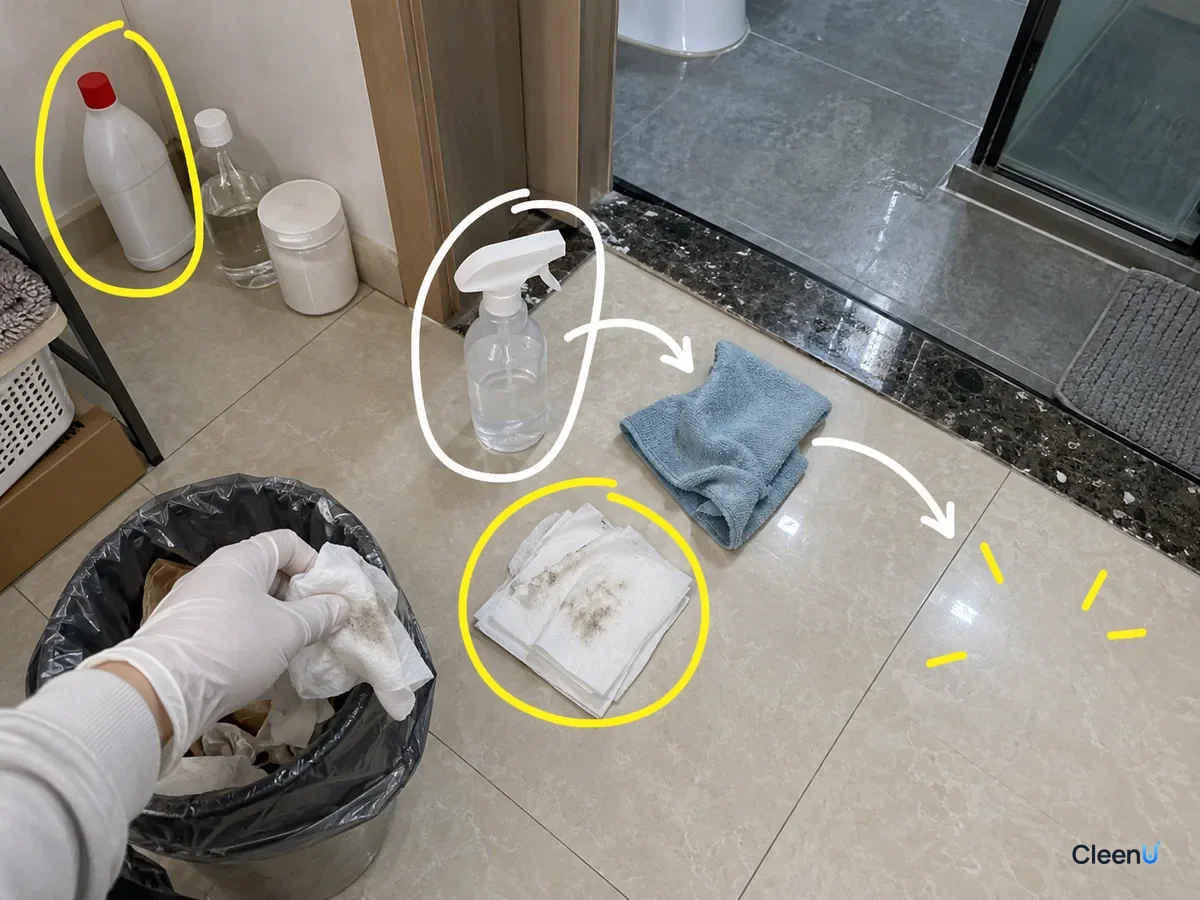
Why enzyme cleaners and chlorine disinfectants shouldn't be used together or back to back
Look at it from both directions.
Bleach first, enzymes second. Hypochlorous acid is a strong oxidizer. In a 2008 study in Cell, Winter and colleagues at the University of Michigan found that hypochlorous acid, the active ingredient in household bleach, oxidizes and unfolds proteins and makes them clump, even at low doses. Enzymes are proteins. By that principle, hypochlorite left in grout or carpet fibers will damage the enzymes you spray next and keep them from working. The detergent industry's ongoing work on making enzymes more oxidizer-tolerant (Al-Ghanayem and Joseph, 2020 review) shows how real that problem is. We haven't seen a published experiment testing this exact combination, so treat this as a conclusion from chemistry, not a lab result.
Enzymes first, bleach right after. Right after an enzyme treatment, the spot holds dissolved urine components, cut-up protein fragments, and the cleaner's own ingredients. Bleach poured on now spends its chlorine on that organic load, and the ammonia and nitrogen-containing breakdown products can react with hypochlorite to form irritating chloramines. Disinfection drops and the fumes rise.
Either way, the answer to "enzyme cleaner vs. bleach" is not "both at once." Never mix them in a bucket or spray bottle, and don't use one right after the other. That's why "using with chlorine disinfectants at the same time or right after" often appears on the avoid list of pet enzyme cleaners.
The right handoff: after the enzyme cleaner's dwell time, blot thoroughly, wipe the surface once or twice with plain water, and let it dry completely before you decide whether to disinfect. If bleach went down first, reverse it. Wipe with plenty of water, ventilate until you can't smell chlorine and the surface is dry, then use the enzyme cleaner on the remaining urine odor. There's no single number of hours that fits every surface. Use three checks instead: the surface has been wiped with water, it's completely dry, and you can't smell the previous product. Tile usually gets there the same day. Carpet and upholstery need overnight.
Rubbing alcohol: too fast to clean, and it denatures enzymes
Wiping a urine spot with rubbing alcohol does make it smell better for a while. Alcohol dissolves some odor compounds and carries a bit off as it evaporates. But it leaves three problems.
It doesn't remove the urine. Urea and salts dissolve mainly in water, and alcohol flashes off quickly, so the urine deep in grout and fibers stays put and the smell returns.
It can't meet disinfecting conditions on porous surfaces. Alcohol denatures microbial proteins, which takes the right concentration and enough wet contact time, and on carpet it soaks in or evaporates too fast.
It works against an enzyme cleaner. Alcohol denatures proteins, enzymes included. Mixing alcohol into an enzyme cleaner, or spraying enzymes right after an alcohol wipe, weakens the enzymes.
Two safety notes. Alcohol is flammable, so keep it away from gas burners, candles, and anything lit when using it over a large area. And pets lick floors and paws. Pet Poison Helpline notes that swallowed isopropyl alcohol can cause drunken-like signs, low blood sugar (especially in small or young pets), stomach upset, and more serious effects, and that it's roughly twice as toxic to dogs as ethanol. Let any alcohol-wiped area dry completely before pets return. Don't combine bleach and alcohol either; the mix can form harmful chlorinated compounds.
Vinegar and baking soda: lots of fizz, mostly canceling each other out
The most-shared home remedy for pet urine is baking soda followed by vinegar. It foams and fizzes and looks like deep cleaning. Write out the reaction and the picture changes:
Sodium bicarbonate (baking soda) + acetic acid (vinegar) → sodium acetate + water + carbon dioxide
The bubbles are carbon dioxide, and what's left is a weak sodium acetate solution. The acid and the base neutralize each other. The fizz can loosen a bit of surface grime on hard floors, but it doesn't break down protein residue or pull out urine that soaked in, and in carpet it leaves salt and powder to vacuum out.
So which is better, an enzyme cleaner vs. vinegar? Vinegar on its own does one real thing: acetic acid neutralizes ammonia into ammonium acetate, which doesn't evaporate, so the ammonia smell drops for a while. But it falls short three ways. It doesn't remove protein and fat residue, so bacteria keep breaking it down and ammonia keeps coming back. Its sour smell lingers, and Cornell's Feline Health Center advises against products containing ammonia or vinegar on soiled spots because they smell like urine and can be irritating. And its acidity pushes the pH below the enzymes' working range, so an enzyme cleaner used right after won't perform as well.
Baking soda alone does even less. It's a weak base that can neutralize acidic odor compounds and soak up a little moisture, but the sharpest part of urine odor, ammonia, is itself a base. Baking soda doesn't neutralize it.
The dangerous combination is vinegar and bleach. Both the CDC's disinfection guidance and the Tennessee Poison Center warn that chlorine bleach mixed with acid releases chlorine gas. Vinegar and many toilet bowl cleaners are acidic. In whatever order, keep them away from bleach on the same spot.
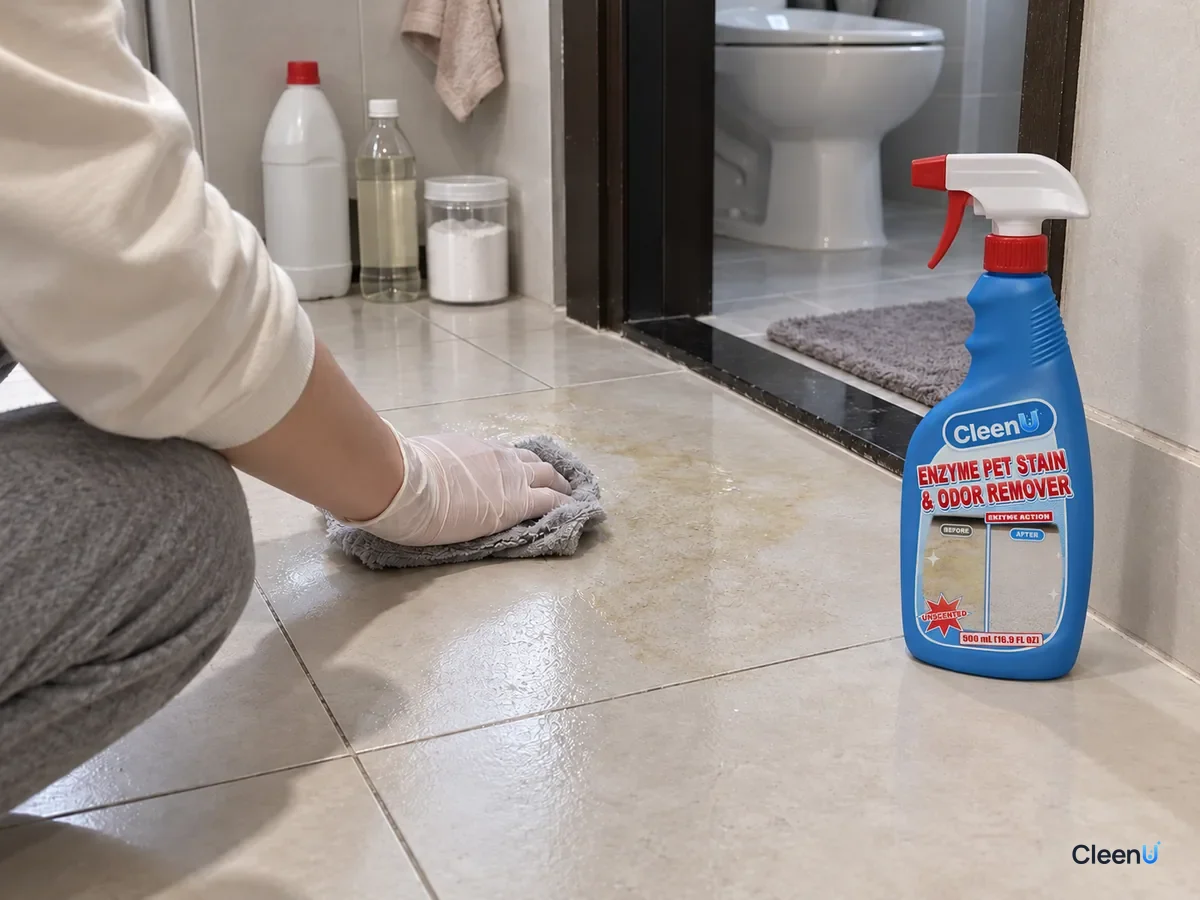
What the enzyme cleaner does in this sequence
In the clean-deodorize-disinfect sequence, the enzyme cleaner handles cleaning and deodorizing. Protease and lipase cut the protein and fat residue in the urine spot, surfactants keep it suspended, and blotting carries the urine components out. Once the source is gone, the smell stops coming back in waves. The ASPCA likewise recommends an enzymatic cleaner for spots where pets have soiled, and advises against ammonia-based cleaners, since urine contains ammonia and the smell can draw a cat back to the spot.
Its limits matter too. It isn't a disinfectant. It needs a full soak, dwell time, and blotting. It's sensitive to heat and chlorine. And it isn't for protein materials like wool, silk, and leather.
When you pick a product for this step, check three things: the label lists protease and lipase, the pH is near neutral, and it's unscented, so what you smell afterward is what's really there rather than perfume. CleenU Enzyme Pet Stain & Odor Remover is one example: a ready-to-use spray with protease, lipase, and amylase plus nonionic surfactants and no added fragrance. Blot the urine, soak the spot as deep as the urine went, wait 10 to 15 minutes, blot, and let it air-dry.
For the cleaning and odor step on pet urine, take a look at CleenU Enzyme Pet Stain & Odor Remover.
When you actually need to disinfect, and how to sequence it
When a healthy pet has the occasional accident, cleaning and deodorizing are usually enough. Consider disinfecting when:
- Your pet has diarrhea or vomiting or is ill, and your veterinarian recommends disinfecting the area.
- One pet in a multi-pet home has been diagnosed with an infectious disease and is isolated or recovering.
- Someone in the home is immunocompromised, pregnant, or very young, and their doctor has given hygiene advice.
- There's blood in the urine or an unusual color, or your pet has suddenly started going outside its usual spot. Those are health signals first. Get your pet to a veterinarian; cleaning only handles the aftermath.
Which disinfectant to use and at what strength is a question for your veterinarian and the product label, not this article. What you can control is the order:
When a urine spot needs disinfecting, work in this order
- Move pets out, put on gloves, and open a window
- Blot up the urine with paper towels or an absorbent cloth; press, don't rub, so it doesn't spread
- Soak the spot with an enzyme cleaner, covering a ring wider than the stain, and wait the labeled time
- Blot, then wipe once or twice with plain water to remove cleaner and dissolved urine
- Let the surface dry completely, with no urine or cleaner smell left
- Disinfect only hard surfaces you can wipe and rinse, diluted and left wet for the contact time on the label
- Wipe off the disinfectant residue with plain water and let it dry again before pets return
- Bag used towels and cloths, put them in a lidded trash can, and wash your hands
Don't pour bleach on carpet, upholstery, or mattresses yourself. It bleaches color, weakens fibers, soaks in where you can't rinse it out, and leftover chlorine interferes with later cleaning. If those surfaces need more than cleaning, follow your veterinarian's advice and consider a professional cleaner.
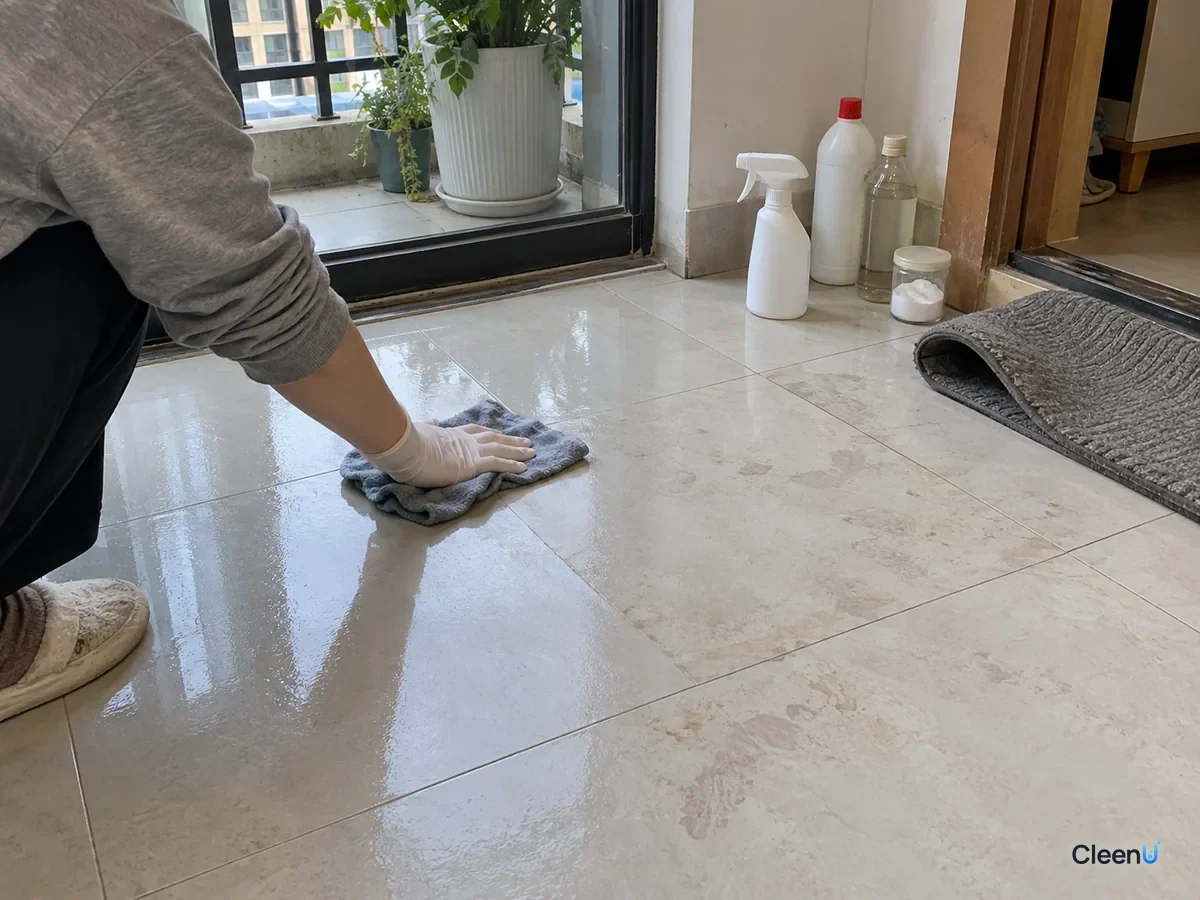
How to tell each step is done at home
You don't need equipment, just your nose, white paper towels, and a little patience.
- Blotting: press a fresh white paper towel on the spot. When it comes up with little or no yellow, move on.
- Cleaning: once the spot is completely dry, get down close and smell it. Then mist a little plain water on the spot, wait a few minutes, and smell again. If the urine smell comes back, residue is still down there; do another enzyme round, deep enough to reach it.
- Ready for the next step: the surface has been wiped with water, it's dry, and you can't smell the previous product. Where bleach was used, if you have pool or drinking-water chlorine test strips, dip one in water wiped from the surface. No chlorine reading means it's ready for the enzyme cleaner.
- Ready for pets: the surface is fully dry with no lingering smell. A pet that keeps sniffing or scratching the spot is telling you something is still there.
Why "wipe, rinse, and dry" in between matters: residue decides how much enzyme survives
As noted above, "chlorine stops enzymes" is a conclusion from chemistry rather than a published measurement, but the reasoning is solid. Hypochlorous acid is a strong oxidizer, enzymes are proteins, and oxidized proteins unfold and clump, so the "scissors" that cut up the stain go dull. Vinegar drops the local pH and rubbing alcohol dehydrates and denatures proteins; the idea is similar, the degree differs.
What matters is how much residue is left. A wet film of freshly mopped bleach and the trace left after you wipe, rinse with plain water, and let the surface dry are not in the same league. So the sequence in this article isn't "never use both." It's "keep them apart": clean and deodorize with the enzyme cleaner first, blot, and let it dry. If you need to disinfect, do it separately per the disinfectant's label and rinse or wipe as the label says. If you disinfected first, wipe the surface and let it dry completely before the enzyme cleaner goes on.
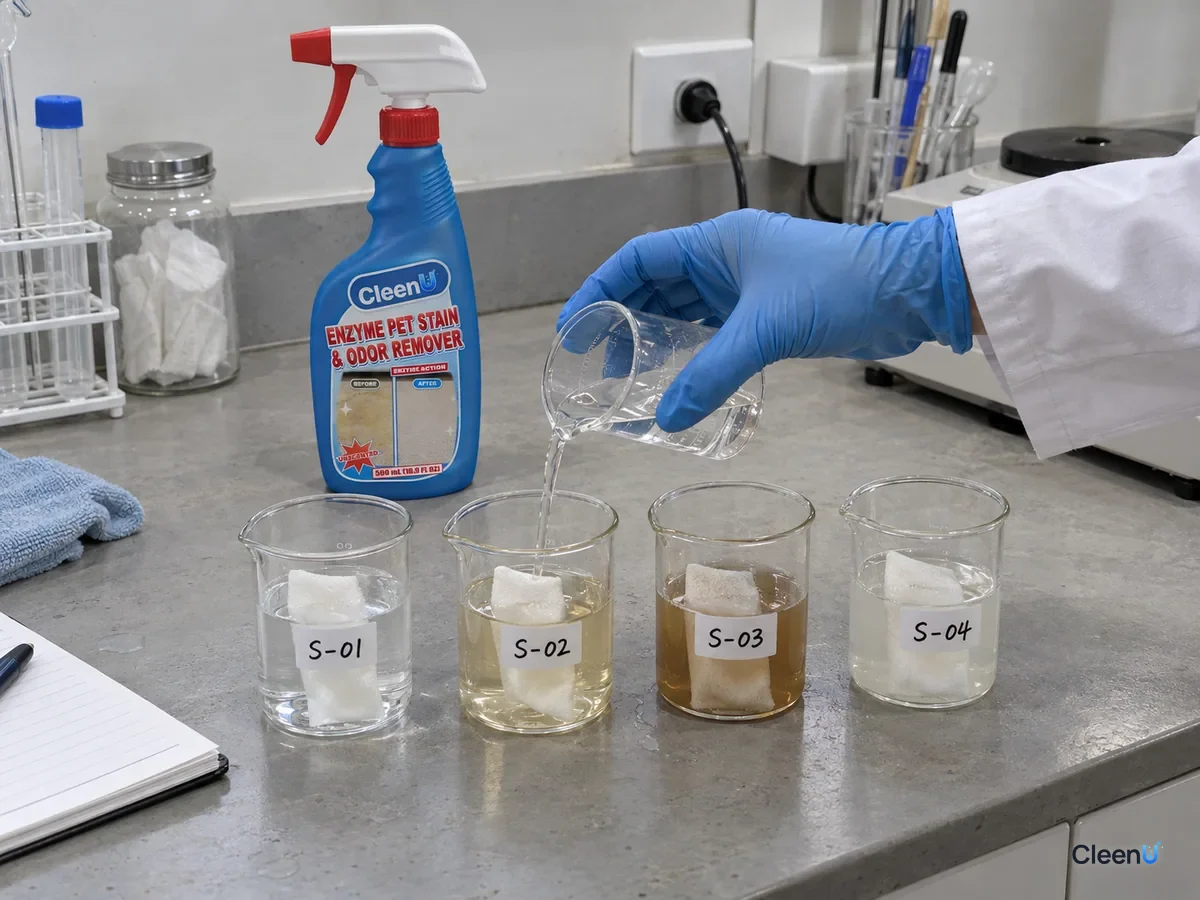
To see the idea at home, try an egg-white strip comparison. Dab raw egg white on two strips of old white cotton and let them dry. Spray one straight with enzyme cleaner. Wipe the other with a wet vinegar-water cloth, don't dry it, then spray it with enzyme cleaner. Give both the same dwell time, blot, and compare the stiff edge of leftover egg white under a light. It's a home observation, not a lab test, but it shows why the "wipe and dry" step in the middle isn't optional.
The right order for common situations
| Situation | Order | Watch for |
|---|---|---|
| Fresh urine on tile, healthy pet | Blot → enzyme cleaner, dwell → blot → water wipe → dry | Give grout a little longer; disinfecting usually isn't needed |
| Fresh urine on carpet or upholstery | Blot → soak with enzyme cleaner, dwell → blot → dry overnight | No bleach; spot-test dark fabric |
| You already used bleach | Ventilate → wipe with plenty of water → dry, no chlorine smell → enzyme cleaner | Don't add vinegar or acidic toilet cleaner |
| You already used vinegar or baking soda | Blot with plain water a few times → dry → enzyme cleaner | Vacuum out powder from carpet first |
| Diarrhea or infectious illness, hard floor | Full cleaning → dry → disinfect per vet advice and label → water wipe → dry | Follow label contact time; keep pets off until dry |
| Diarrhea or infectious illness, carpet or sofa | Clean first, then follow your veterinarian's advice | No DIY bleach; consider a professional cleaner |
| Sealed wood floor | Blot → a little enzyme cleaner → damp-wipe → dry | No bleach or flooding; skip enzyme cleaner on unsealed hardwood |
Still smells, or smells worse? Likely causes, most to least common
- You're smelling chloramines from recent bleach. Ventilate, wipe with water, and don't layer on another product.
- The cleaning didn't go deep enough. The surface is clean, but urine is still in the grout or pad. Do a dry-then-rewet sniff; if the smell returns, run another enzyme round deep enough to reach it.
- A previous product is interfering. Bleach, vinegar, or alcohol applied just before the enzyme cleaner weakened it. Wipe with water, let it dry, and treat again.
- Nothing got blotted or rinsed. Spray-and-dry leaves the dissolved urine where it was.
- You missed a spot. Recheck corners, door frames, and furniture legs your pet favors.
- The material is saturated. A carpet pad or floorboard seams soaked repeatedly may keep smelling after several rounds; replacing that section or calling a professional cleaner is the realistic fix.
If a pet keeps going in the same place, look at the pet side too: litter box number and placement, a dog's house-training, and possible health problems.
Pet urine, bleach, and enzyme cleaners: common questions
Can you mix enzyme cleaner with bleach?
No. Hypochlorite in bleach unfolds proteins, and enzymes are proteins, so bleach damages the enzymes; the organic load from the urine and cleaner also uses up the chlorine and can form irritating chloramines. Keep them in separate steps with a water wipe and full drying in between.
Can you mix enzyme cleaner with vinegar?
Don't mix them or use them back to back. Vinegar drops the pH below the enzymes' working range. If you've already used vinegar, blot with plain water a few times and let the spot dry before using the enzyme cleaner.
Can you mix enzyme cleaner with baking soda?
Don't bother. Baking soda won't neutralize the ammonia in urine and leaves powder in carpet that you have to vacuum out. Use the enzyme cleaner on its own, then blot.
Can you use bleach after enzyme cleaner?
Yes, once the enzyme cleaner has been blotted up, the surface has been wiped with plain water, and it's completely dry. Use bleach only on hard surfaces that need disinfecting, never on carpet or upholstery, and follow the label.
Does bleach get rid of dog urine smell?
No. Bleach covers urine odor with a harsher smell and reacts with urine to form chloramines. The urine components stay put, so the smell can return once the bleach odor fades.
Enzyme cleaner vs. disinfectant: which should I use on pet urine?
Use the enzyme cleaner first; the two don't replace each other. The enzyme cleaner removes urine and odor sources, and a disinfectant inactivates microbes on a clean, dry hard surface when there's a real reason to disinfect.
Can I clean pet urine with rubbing alcohol?
Not a good idea. Alcohol evaporates before it removes urea and salts, can't stay wet long enough to disinfect carpet, denatures enzymes, and is flammable. Pets can also lick up residue.
I already poured bleach on the spot. Can I still use an enzyme cleaner?
Yes, after the bleach is gone. Ventilate, wipe with plenty of water several times, and wait until the surface is dry and you can't smell chlorine before using the enzyme cleaner.
Can bleach be mixed with vinegar or toilet bowl cleaner?
Never. Vinegar and many toilet bowl cleaners are acidic, and acid plus bleach releases chlorine gas. Even used separately, rinse and dry between them.
How long should pets stay away from a cleaned urine spot?
Until the surface is completely dry. If you used a disinfectant, wipe off the residue with water and let it dry before pets come back, since they lick floors and paws.
Related reading: why bleach and acidic cleaners must never mix, in Why you should never mix bleach and acidic toilet cleaners; whether vinegar or bleach belongs in mop water, in Can you mop with dish soap, vinegar, or bleach?; the difference between cleaning and disinfecting, in Does robot mop cleaning solution disinfect floors?; and what to do before a robot mop meets a urine spot, in Can a robot mop clean up pet urine? More pet-home guides are on our pet home cleaning page.
Sources (accessed October 2026): CDC, "Chemical Disinfectants," "Preventing Eye Irritation from Pool Chemicals," and "Cats | Healthy Pets, Healthy People"; Tennessee Poison Center (VUMC), "Why shouldn't I mix household chemicals with bleach?"; Winter et al., Cell (2008); Al-Ghanayem and Joseph (2020); Mobley et al. (1989, 1995); Merck Veterinary Manual; Pet Poison Helpline; ASPCA; Cornell Feline Health Center; EPA, "What Are Antimicrobial Pesticides?" General information, not veterinary or medical advice.
Can you use bleach after enzyme cleaner? Yes, but only as a separate, later step. Clean first, disinfect later, and keep the steps apart. The enzyme cleaner removes urine and organic residue; a disinfectant belongs only on a clean, dry hard surface when there's a real reason to use one. Bleach poured on urine forms irritating chloramines, bleach mixed with vinegar or acidic toilet cleaner releases chlorine gas, and bleach used right before or after an enzyme cleaner weakens both. Rubbing alcohol evaporates before it removes urine, and vinegar plus baking soda mostly cancel each other out. Before each next step, check three things: wiped with water, completely dry, and no smell left from the step before.