
Comparison
Do Pet Odor Eliminators Work? Masking, Absorbing, and Enzyme Cleaners Compared
Direct answer
Yes, when the approach matches the odor source. Fragrance only masks smell for a few hours. Absorbers like charcoal and cyclodextrin handle light background odor in air and fabric. Enzyme cleaners break down urine and vomit residue at the source, which is the only way to keep the smell from coming back.
Who should choose what
-
You found urine on carpet, a sofa, or a mattress, fresh or old
Choose Breakdown and removal first. Soak to full depth with an enzyme cleaner, let it dwell, blot, and dry completely
The source sits deep in the fabric, and only removing the residue keeps odor from returning when it gets humid. Skip ammonia and vinegar products, and never pour on bleach.
-
The litter box area always smells like ammonia
Choose Frequent scooping and full changes, plus a light mist of an enzyme, cyclodextrin, and zinc litter box spray after scooping
It breaks down urine residue on the box and litter while trapping part of the ammonia and waste odor. Choose fragrance-free so the cat doesn't avoid its box.
-
The sofa, pet bed, or car seats smell like the pet, but you can't find urine
Choose Vacuum first, then saturate with an enzyme-based fabric odor spray and let it air-dry
Body odor comes from skin oil and dander, which enzymes break down. Launder removable covers instead.
-
Guests are coming and you need a quick improvement
Choose Ventilate, deal with the most obvious source by scooping the box and putting away dirty bedding, and use a light scent briefly if needed
Fragrance lasts a few hours at best, so treat it as a stopgap and return to source cleaning afterward.
-
Closets, shoe cabinets, or the car smell musty
Choose Charcoal bags or a cyclodextrin spray
Small spaces with light sources are where absorbers do well. Replace bags on schedule.
-
You have a cat and want to avoid scent entirely
Choose Products whose ingredient list has no fragrance or essential oils
Cats are more sensitive to some essential oils and phenols, and fragrance-free products make it easier to tell whether a source is really gone.
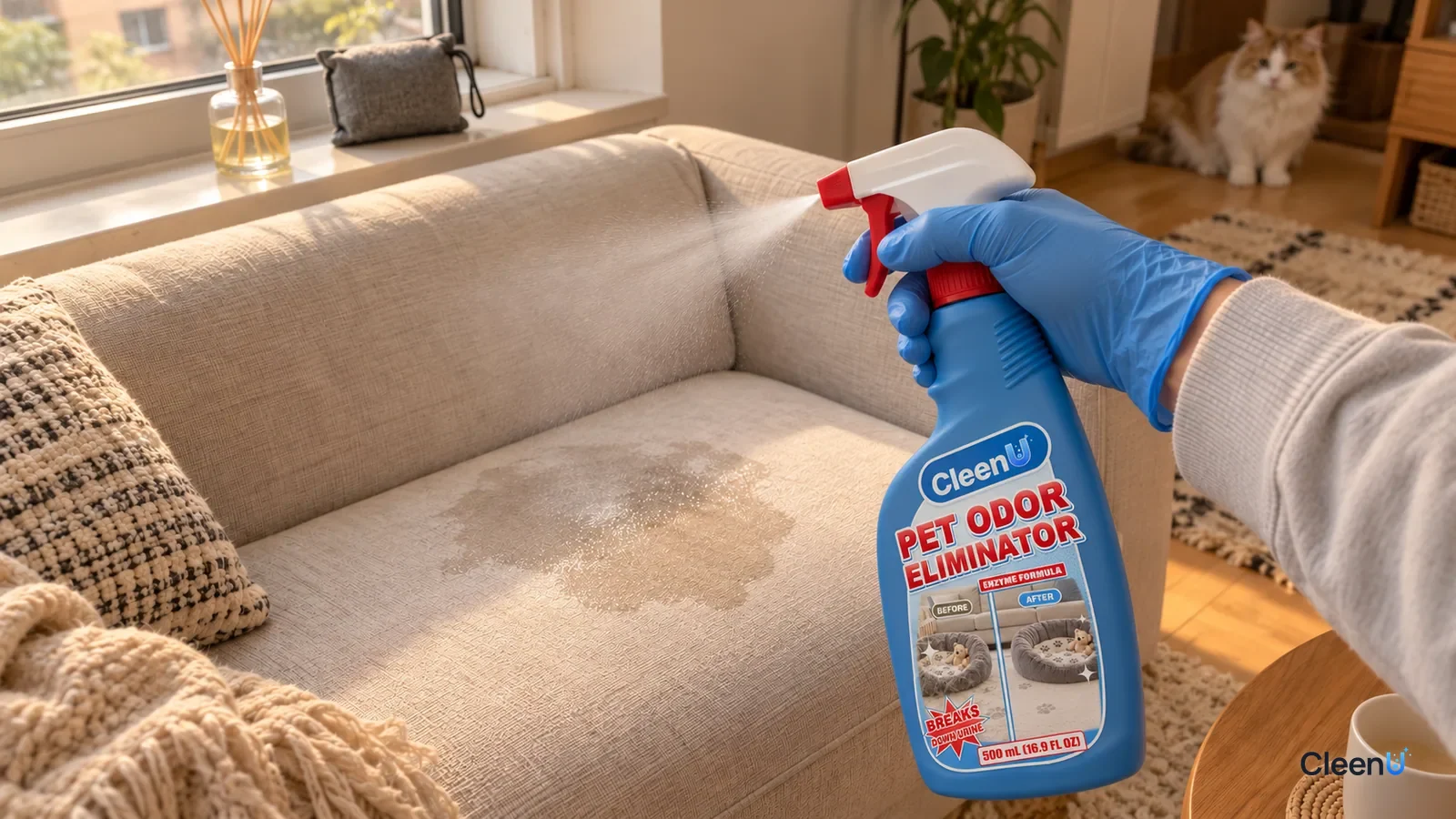
Do pet odor eliminators work? The usual story is "It smelled great when I sprayed it, and by evening the smell was back." That's rarely a defective product. It's a mismatch: the odor comes from old urine in a carpet pad, and the product perfumes the air. Products sold as "pet odor eliminators" rely on unrelated mechanisms. Some change what you perceive, some trap odor molecules, and some break down what produces the smell.
So whether one "works" depends on where the smell comes from and which layer the product acts on. Below we compare the three main approaches, show how to read an ingredient list, and match approaches to situations.
First, which layer of the odor does a product act on?
Any pet smell in a home has three layers. On the outside are odor molecules in the air: ammonia from urea breakdown, sulfur compounds from protein breakdown, and short-chain fatty acids from skin oils. In the middle are odor carriers: sofas, curtains, and rugs that absorb those molecules and release them slowly. At the core is the source: urine, vomit residue, oily bedding, and urine crust on a litter box, where bacteria keep producing new odor molecules.
Fragrance acts only on your perception. Absorbers capture part of what's in the air or on fabric. Only breakdown and removal reach the source. The deeper the layer, the longer the result lasts, and the more it depends on technique: finding the source, soaking it, giving it time, and drying it. That's why one product earns both rave reviews and complaints.
Approach 1: Masking. Not smelling it isn't the same as removing it
Fragrance sprays, candles, plug-ins, and most air fresheners fall here. When your nose detects several smells at once, a strong, pleasant scent dominates and a weaker bad one fades into the background. The ammonia and sulfur molecules are all still there, and the source keeps producing more.
How long it lasts: as long as the fragrance. Top notes evaporate first, and within a few hours the scent usually fades while the source keeps releasing odor, sometimes blending with leftover perfume into something worse.
Good for: covering faint background odor after the source is already cleaned, or a quick fix before guests arrive.
Limits: the smell returns, it hides whether you've cleaned the source, and it's hard on cats. The ASPCA recommends against scented cleaners for litter boxes because scent can put a cat off its box. The Merck Veterinary Manual also notes that cats lack a liver enzyme (glucuronyl transferase) used to process certain compounds, making them more sensitive to phenols and some essential oils. In a cat home, use scented products sparingly, if at all.
Here's the counterintuitive part: the stronger a pet odor product smells, the more likely it's mostly masking. When a source has truly been dealt with, the room should smell like nothing, not like perfume.
Approach 2: Absorbing and trapping odor molecules
These products don't change your perception. They pull some odor molecules out of the air or off a surface. There are three main types, and they work differently.
Activated charcoal, bamboo charcoal, and zeolite: physical adsorption. Activated carbon is riddled with tiny pores, and odor molecules that touch the pore walls stick there. It typically handles larger organic odor molecules, such as some sulfur compounds, better than ammonia, which is small and highly polar; plain activated carbon usually has limited capacity for it. Air has to reach the carbon for it to work, so a bag in a corner only slowly catches what drifts by. Once pores fill up with odor or moisture, performance drops. "Recharging" a bag in the sun usually drives off some moisture and loosely held molecules, not everything.
Cyclodextrin: molecular trapping. Cyclodextrins are rings of glucose units, usually six to eight, shaped like a tiny open-ended bucket. The outside attracts water, so they dissolve. The inside is relatively water-repelling, so suitably sized odor molecules slip in and form an "inclusion complex," which makes them less volatile. Many fabric odor sprays use cyclodextrin. The binding is reversible, so trapped molecules ultimately leave in the wash, and cyclodextrin is usually weak against very small, water-loving molecules like ammonia.
Chemical neutralizing and binding: baking soda, vinegar, and zinc salts. Baking soda is a weak base. It reacts with acidic odors such as short-chain fatty acids and turns them into salts that don't evaporate, so it helps a bit with sweaty, stale smells. Ammonia is itself a base, though, so baking soda does essentially nothing to it chemically. That's why sprinkling baking soda on cat urine disappoints. Vinegar is an acid and can temporarily knock down ammonia, but the Cornell Feline Health Center advises against vinegar- or ammonia-based products on urine spots because they smell like urine to cats and may encourage reuse. Vinegar mixed with chlorine bleach also releases chlorine gas. Zinc salts such as zinc ricinoleate bind sulfur- and nitrogen-containing odor molecules and show up in litter box and body-odor products.
How long it lasts: until it fills up or a source outpaces it. For light background smell it holds up a while; next to an active urine spot it saturates quickly.
Good for: closets, shoe cabinets, cars, and the air around a litter box; light body odor on sofas, curtains, and pet bed covers; leftover smell after the source is cleaned.
Limits: it can't reach sources in carpet pad or foam, it typically does little for ammonia, and it needs replacing or washing once full.
Approach 3: Breaking down and removing the source
This is the only approach that keeps a smell from returning. Enzyme cleaners and surfactant cleaning are the main tools.
Pet urine, vomit, saliva, and skin oil leave protein, fat, and starch residue, which is food for bacteria and raw material for odor. Protease, lipase, and amylase enzymes cut those molecules into smaller, more water-soluble pieces, and surfactants carry them out of the fibers so you can blot or rinse them away. Washing bedding and scrubbing litter boxes and bowls belong here too.
How long it lasts: once a source is cleaned out, that spot stops producing odor unless there's a new accident. The trade-off: enzymes need time and moisture, usually a 10- to 15-minute dwell, the product must reach the source's depth, and you still blot and dry completely.
Limits: it can't treat what it doesn't reach. Protease-based products don't belong on wool, silk, or other protein fibers. Enzymes are proteins too, and chlorine disinfectants disrupt their structure, so don't use the two together or back to back. And protease, lipase, and amylase don't break down uric acid crystals, which is why blotting the residue out matters.
There's also a fourth group, oxidizers such as chlorine dioxide, peroxides, and chlorine bleach. They destroy odor molecules quickly but can bleach and irritate, and the Tennessee Poison Center at Vanderbilt warns that chlorine bleach mixed with urine forms irritating chloramine gas. They aren't a practical everyday answer to pet odor at home.
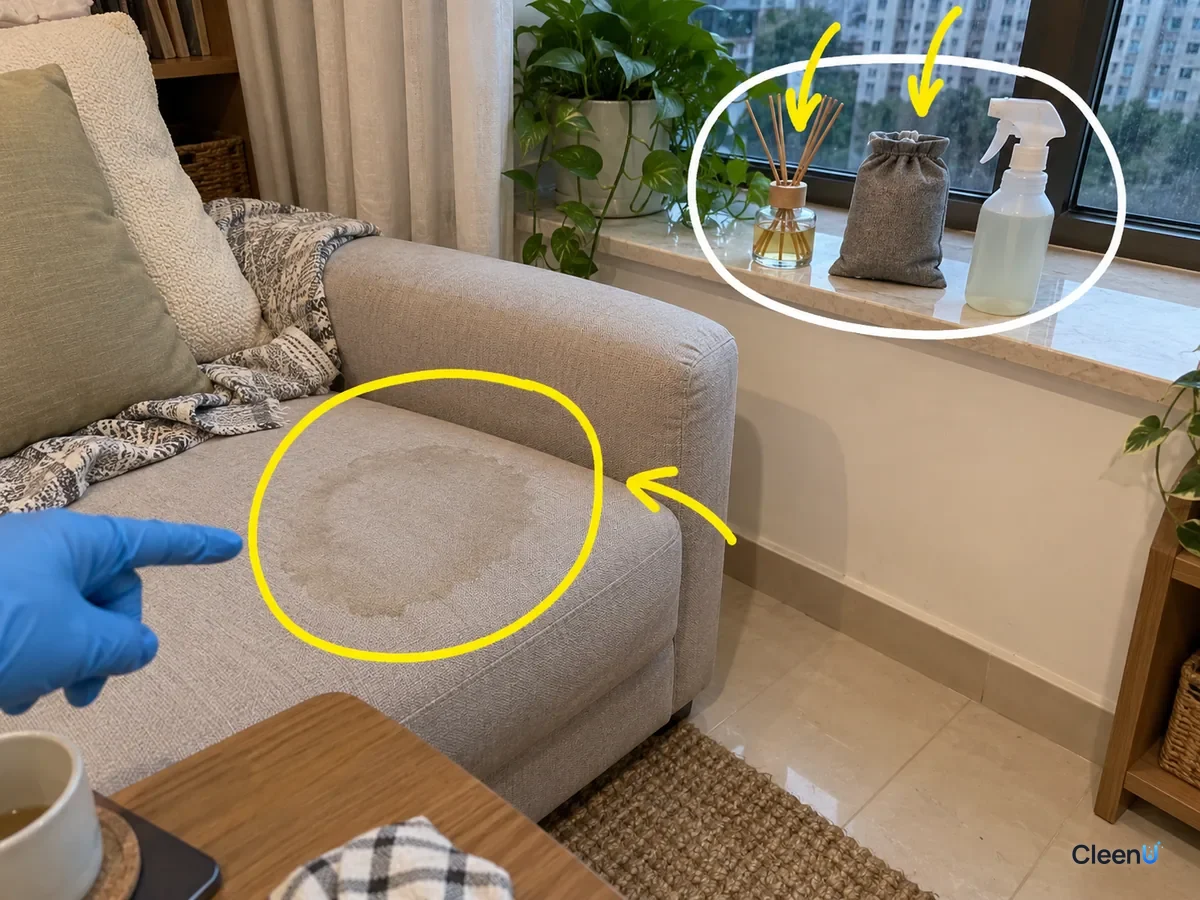
Three approaches to pet odor, side by side
| Factor | Masking | Absorbing and trapping | Breaking down and removing |
|---|---|---|---|
| How it works | Fragrance overrides your perception; odor molecules stay | Carbon adsorbs, cyclodextrin traps, zinc salts bind part of the odor | Enzymes break down protein, fat, and starch residue; surfactants lift it out |
| Layer it acts on | Your perception only | Air and fabric surfaces | The odor source itself |
| Best for | Leftover smell after cleaning, quick fixes | Light background odor, fabric body odor, closets and cars | Urine, vomit, bedding and litter box residue |
| How long it lasts | Usually a few hours, until the scent fades | Until it's saturated or outpaced by new odor | No more odor from that spot unless there's a new accident |
| Main limits | Source untouched; cats are sensitive to some scent ingredients | Can't reach deep sources; usually weak on ammonia | Needs full-depth soaking, dwell time, blotting, and drying; doesn't mix with chlorine |
| Typical label wording | Fragrance, parfum, essential oils | Activated charcoal, cyclodextrin, zinc ricinoleate | Protease, lipase, amylase, enzymes, surfactants |
Read the label: which approach is in the bottle?
Front-label phrases like "molecular odor technology" or "plant-powered" don't tell you the approach. The ingredient list does:
What label ingredients tell you about the approach
- Fragrance, parfum, or essential oils such as tea tree, eucalyptus, citrus, lavender
- Masking; if listed prominently, masking may be the main job
- Cyclodextrin, hydroxypropyl beta-cyclodextrin
- Traps some odor molecules; common in fabric sprays
- Activated charcoal, bamboo charcoal, zeolite
- Physical adsorption, usually in bags or filters
- Zinc ricinoleate or other zinc salts
- Binds sulfur- and nitrogen-based odor molecules
- Sodium bicarbonate (baking soda)
- Neutralizes acidic odors; little effect on ammonia
- Protease, lipase, amylase, enzyme blend
- Breaks down protein, fat, and starch residue at the source
- Alkyl polyglucoside, alcohol ethoxylates, other surfactants
- Cleans, lifting loosened residue out of fibers
- Sodium hypochlorite, chlorine dioxide, hydrogen peroxide
- Oxidizes; can bleach and irritate; keep away from enzyme and ammonia products
- Benzalkonium chloride and other quats, phenols
- Disinfectant ingredients; cats are more sensitive to these, so take extra care in pet areas
Three tips. First, many products combine approaches, such as enzymes plus cyclodextrin or a light scent. What matters is the main engine: fragrance and water make an air freshener, while enzymes and surfactants can treat a source. Second, "fragrance-free" is useful in a cat home, because a treated spot then smells like nothing only if the source is gone. Third, claims should match ingredients. A product with no enzymes that promises to "break down urine," or one that's mostly fragrance and promises long-lasting odor elimination, deserves skepticism. In the U.S., the EPA treats claims about killing germs, or controlling the bacteria that cause odor, as pesticide claims that require registration, so a product making them should carry an EPA registration number.
If your pet suddenly starts having accidents, urinating more often, or passing bloody urine, or its body odor changes sharply, those can be health or behavior signals. See your veterinarian first. An odor eliminator deals with the aftermath, not the cause.
Two common misjudgments: "stronger scent works better" and "it smells clean right away"
Misjudgment 1: the stronger the scent, the better it works. Scent is the signature of masking. If a room smells like perfume after spraying, you can't tell whether the source was treated or covered. The real test is that, once dry, the spot smells like close to nothing up close.
Misjudgment 2: it smells clean right after spraying, so it worked. Fragrance and moisture distort your judgment at first. Wait until the spot is fully dry, check again the next day, and mist it with water to see whether odor returns.
Your nose also adapts to familiar smells, so step outside for 30 minutes before judging.
How to combine air treatments with source cleaning
The three approaches aren't substitutes. They work in sequence:
- Find the source. Get low and sniff, and use a UV flashlight and white paper towels to confirm urine spots, bedding, the litter box, and bowls.
- Break it down and remove it. Soak urine with an enzyme cleaner to full depth, let it dwell, and blot. Wash bedding, scrub the litter box, and scrub bowls.
- Dry completely. Open windows and run fans until pressing the spot brings up no moisture.
- Finish with absorbers. Use a cyclodextrin fabric spray for leftover body odor and charcoal bags in closets, cars, or near the litter box.
- Fragrance last, or not at all. If you use it, choose a light scent, keep it out of rooms where cats spend time, and ventilate.
Reverse the order and perfume hides the spots you're hunting for, while charcoal without cleaning saturates in days.
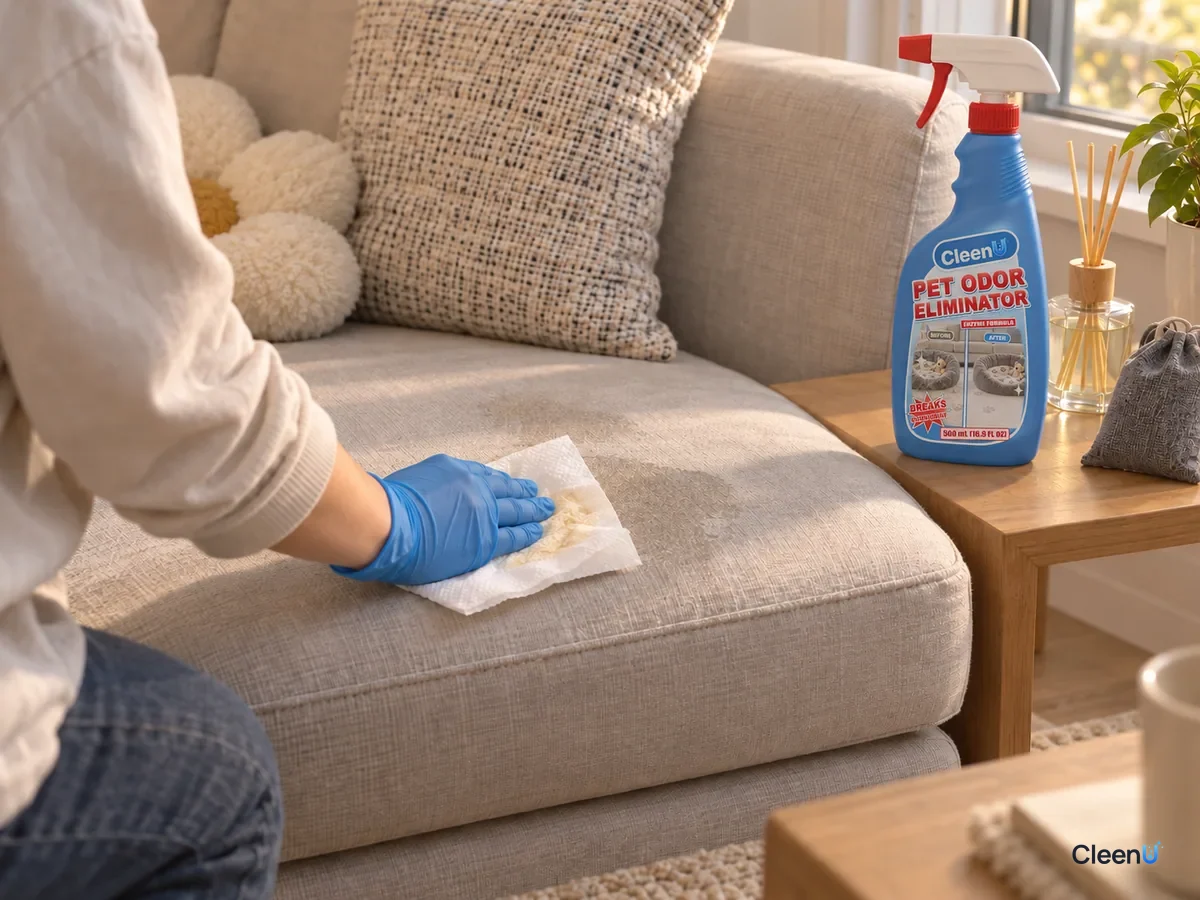
Which approach fits your situation
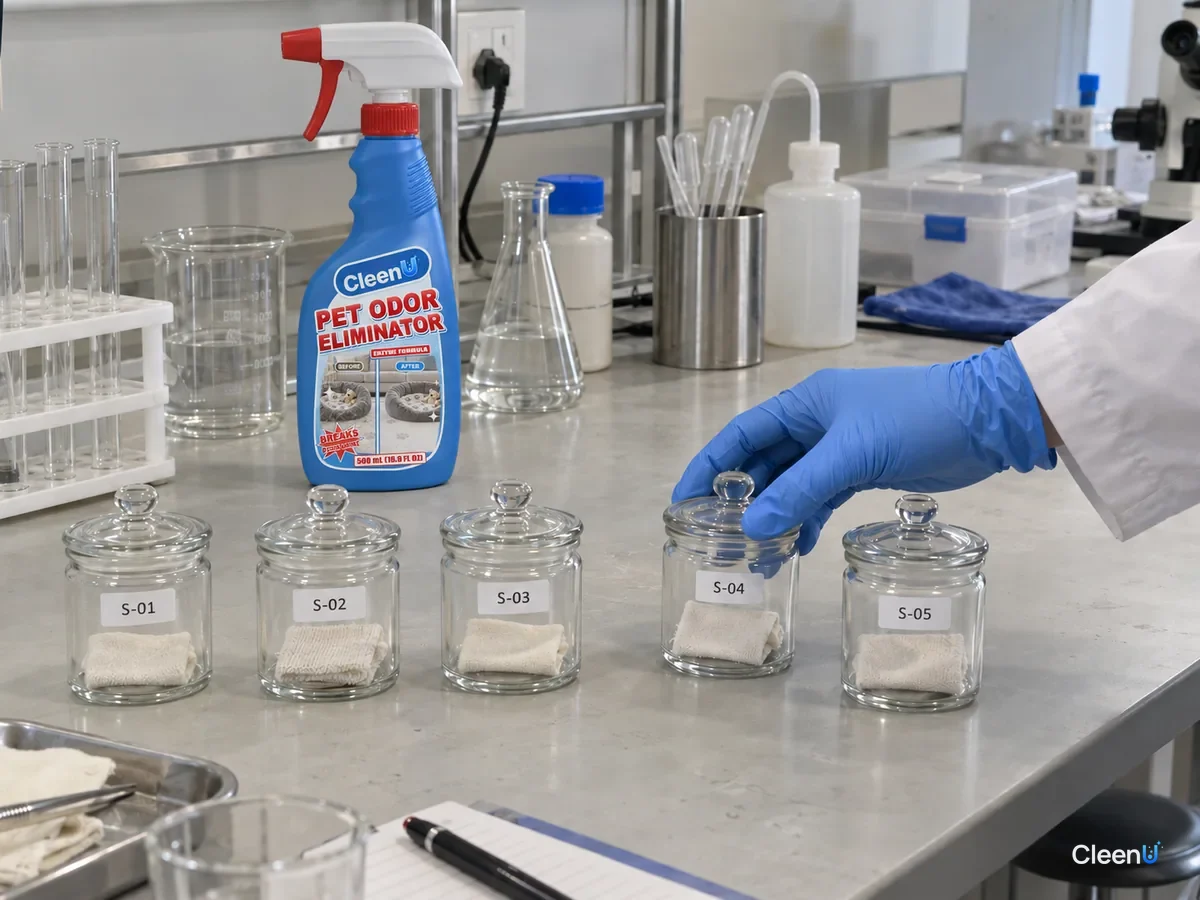
How to test a pet odor eliminator at home
You can run a simple side-by-side test without equipment:
- Pick two similar spots from the same kind of source, such as two old urine spots on the same rug. Treat one with the product per its label and the other with plain water, blotting both the same way.
- After both are fully dry, wait 24 hours and have someone sniff each without knowing which is which.
- Mist both with water, wait a few minutes, and sniff again. If the treated spot is clearly weaker both dry and re-wetted, the product reached the source. If it only smells better while dry and the odor returns once damp, masking or absorption was doing the work.
The re-wet sniff is the heart of the test. When urine dries, the urea and protein residue it leaves behind don't go anywhere. Add moisture and bacteria start breaking them down again, and the ammonia and fishy notes come right back. Fragrance only makes the first few minutes smell good, and an absorber lets go once it's full; only a source that's been broken down and removed holds up in the re-wet round.
Two more tips. Make sure the person sniffing doesn't know which spot was treated, or expectations will color the result. And with a scented product, wait until the scent fades before you judge, ideally the next day. While you're at it, rub a white cloth over the treated spot to check for color transfer and look for fuzzing or stiffening; that catches a material problem early.
Still smells after an odor eliminator? Check these in order
- Wrong approach. You perfumed the air or set out charcoal, but the urine or bedding was never treated. Go back to the source.
- Not deep enough. The enzyme cleaner only wet the surface, while urine in the pad or foam is untouched. Soak to the depth the urine reached, and treat rugs from the back too.
- Not enough time, or not dry. You wiped it off right away, or the inside is still damp. Follow the label dwell time and dry until pressing brings up no moisture.
- Another source. There's another spot nearby or in another room. Turn off the lights and sweep again with a UV flashlight.
- Saturated absorbers. The charcoal bag is old, or the sprayed fabric was never washed. Replace and launder.
- Product conflicts. Chlorine was used just before or after the enzyme cleaner, or several products were layered at once. Use one method at a time.
- The pet or its health. See your veterinarian.
What's worth the money
Fragrance is cheapest per bottle but never solves the problem, so you pay for it daily. Charcoal bags need regular replacement and do little against an active source. An enzyme cleaner costs more and you use a fair amount, but once a source is cleaned out, you stop spending on it. The real trap is treating the same source repeatedly with a cheap method.
If you've treated one spot correctly three times and it still smells after drying and re-wetting, the source is out of reach, such as the subfloor or a mattress core. Replacing that layer or calling a professional beats buying more product.
Matching a product to your problem
Once you can read the approach off the label, choosing is simple. For urine and litter boxes, pick a fragrance-free enzyme product that breaks the source down. For body odor in fabric, an enzyme spray with odor-control ingredients works, and a scented one is fine if you like a light scent. For stale cabinets and car interiors, absorbing or trapping is enough.
Take CleenU Pet Odor Eliminator as an example. It's a breakdown-plus-odor-control product: protease and lipase enzymes with odor-control ingredients and mild surfactants, no bleach, and a light fresh linen scent, made for body odor in sofas, pet beds, and car upholstery. Saturate, wait 10 to 15 minutes, and let it air-dry. Don't soak leather, skip silk and wool, don't heat-dry, never spray it at a pet, and don't mix it with bleach or other cleaners. It isn't a disinfectant, and we make no germ-killing claims; keep pets away until surfaces are dry. If you're dealing with urine, or you have a cat and want no scent at all, follow the approach above and choose a fragrance-free enzyme cleaner.
For pet smell in sofas, pet beds, and car seats, try our Pet Odor Eliminator.
For more pet-home cleaning by situation, see our pet home cleaning page. For floors, read Pet-Home vs Regular Robot Mop Cleaning Solution.
Common questions about pet odor eliminators
Do pet odor eliminator candles work?
They mask odor rather than remove it. A candle's scent covers the smell while it burns and shortly after, but the source keeps producing odor. Cat owners should be cautious with scented candles and diffusers because cats are more sensitive to some essential oils.
Do charcoal odor absorbers work?
For light odor in small spaces, yes. Charcoal adsorbs larger organic odor molecules from air that reaches it, but it usually does little for ammonia and can't touch urine in a carpet. Use it after source cleaning, and replace it once it's saturated.
Is an enzyme cleaner the same as a pet odor eliminator?
No. An enzyme cleaner breaks down the residue that causes odor. "Pet odor eliminator" is a marketing label that can mean a fragrance spray, an absorber, or an enzyme product. Check the ingredient list for enzymes and surfactants.
Does pet odor eliminator spray work on urine?
Only if it contains enzymes and you use it correctly: blot, soak to the depth the urine reached, wait the full dwell time, blot again, and dry. A fragrance-only spray just covers urine odor briefly.
Does baking soda get rid of cat urine smell?
Not the ammonia part. Baking soda is a weak base that neutralizes acidic odors, and ammonia is also a base. At best it absorbs a little moisture and surface smell; urine needs an enzyme cleaner.
Can I use vinegar instead of a pet odor eliminator?
Not on urine spots. Vinegar can temporarily neutralize ammonia, but the Cornell Feline Health Center advises against vinegar- and ammonia-based products there because they may draw a cat back. Vinegar mixed with bleach also releases chlorine gas.
Why does the smell come back the day after I spray?
The source is still there. The fragrance or moisture faded, and the source kept producing odor. Find the urine, bedding, or litter box residue and treat it with an enzyme cleaner or by washing, then judge it once it's dry.
Can I use an enzyme odor eliminator with bleach or disinfectant?
Don't use them together or back to back. Chlorine disrupts the structure of enzymes, and bleach mixed with urine forms irritating chloramine gas. If you need to disinfect, do it separately on your vet's advice.
Are fragrance-free odor eliminators less effective?
No. Fragrance-free only means no added scent; effectiveness depends on the approach. A fragrance-free enzyme cleaner that leaves a spot smelling like nothing shows the source is gone rather than covered.
Are pet odor eliminators harmful to breathe?
Used as directed with good ventilation, most household odor products pose low risk, but every product has conditions of use. Avoid breathing the spray, keep pets out until surfaces dry, and ventilate if anyone coughs.
Sources (accessed October 2026): ASPCA, "Litter Box Problems"; Cornell Feline Health Center, "Feline Behavior Problems: House Soiling"; Merck Veterinary Manual, "Toxicoses From Essential Oils in Animals"; Tennessee Poison Center, Vanderbilt University Medical Center, "Why shouldn't I mix household chemicals with bleach?"; U.S. EPA, "Determining If a Cleaning Product Is a Pesticide Under FIFRA."
Pet odor eliminators work when their approach matches the source. Fragrance masks smell for a few hours. Charcoal, cyclodextrin, and zinc salts trap light background odor in air and fabric. Enzyme cleaners break down urine, vomit, and bedding residue so the smell stops returning. Check the ingredient list before you buy, then find the source, break it down, dry it completely, and finish with absorbers if needed. Fragrance is optional, and a sudden change in your pet's bathroom habits or smell calls for a vet visit first.