
How-to
How to Get Dog Pee Out of Carpet, Wood Floors, and Couches
Direct answer
Blot, soak with an enzyme cleaner, wait 10 to 15 minutes, blot under weight, and dry completely. Surfaces differ in how wet they can get and whether you can rinse: treat carpet down to the backing and pad, keep wood floors fast and dry, and give couch foam light passes.
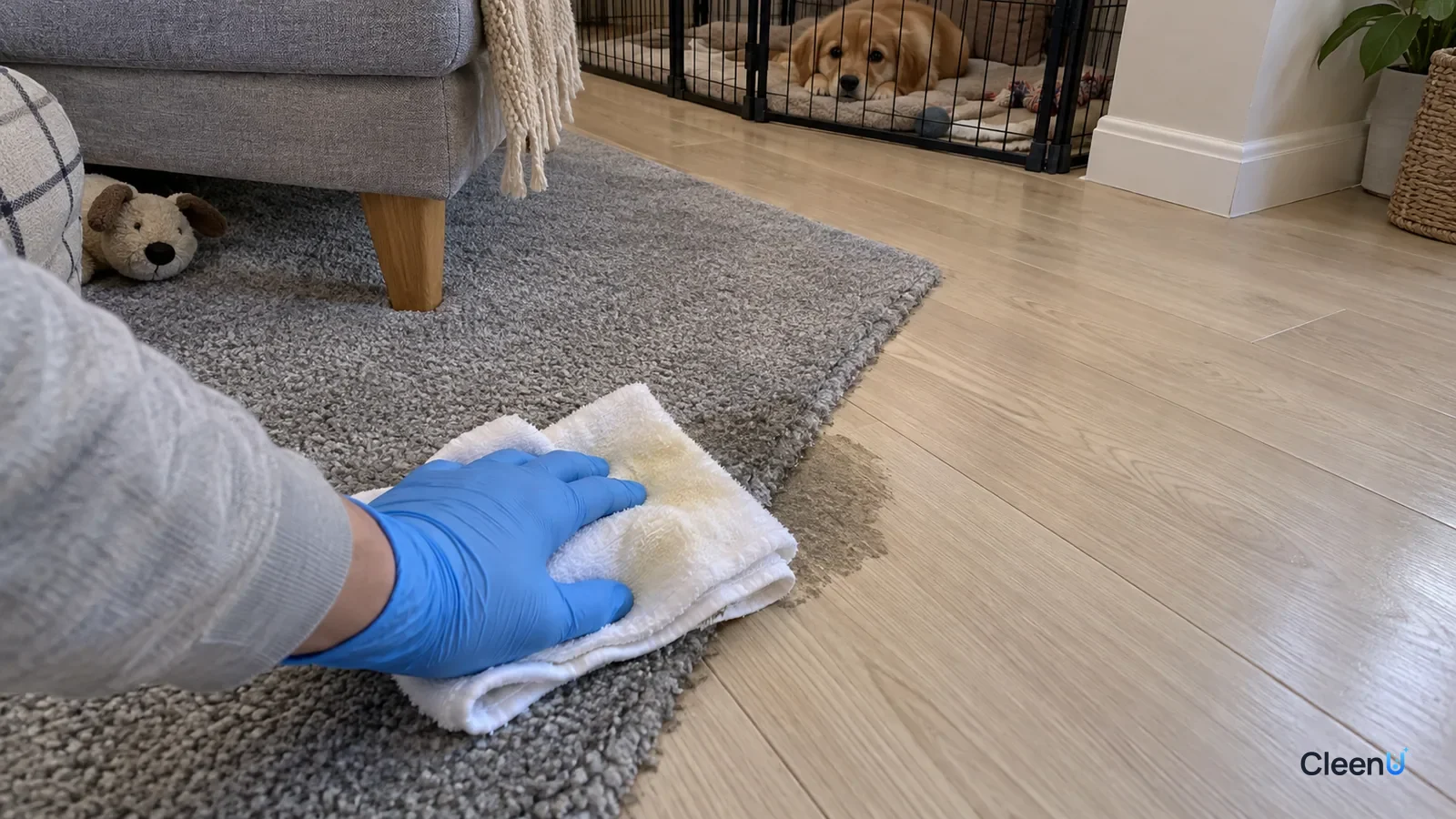
How to get dog pee out of carpet comes down to one sequence: blot up as much urine as you can, soak an enzyme cleaner as deep as the urine went, give it 10 to 15 minutes, blot hard, and let everything dry from the backing up. What changes from room to room is how much liquid a surface can take and whether you can rinse it. Carpet can be soaked, but you have to stop yellow rings from wicking back up. Wood floors hate water. Couch foam needs enough cleaner without staying wet for days. Tile and patios can be flushed.
Dogs also bring their own problems: they tend to pee more at once, so it travels farther into the pad and floor seams; males lift a leg on corners and sofa legs; and a puppy in training can have several accidents a day. Below: how far urine travels, the core steps, a surface-by-surface table, then marking and potty training.
How far dog pee travels: pile, backing, pad, and floor seams
A typical living room carpet has nylon or polyester pile tufted into a woven primary backing, locked in with adhesive, plus a secondary backing underneath. Wall-to-wall carpet usually sits on a foam or felt pad, with the subfloor below that. Urine passes through the pile in seconds, starts spreading sideways at the backing and adhesive layer, and if there's enough of it, soaks into the pad and can reach the subfloor.
Capillary action does the spreading. The gaps between fibers, the weave of the backing, and the pores in foam or felt act like thousands of tiny channels, and surface tension plus the liquid's pull toward fibers drives urine along them with no help. That's why the wet zone underneath is usually wider than the spot you see on top, shaped like an upside-down funnel. The pad behaves like a sponge, and pressing from above won't pull much back out of it.
Capillary action also explains why a cleaned spot can dry into a yellow ring. Carpet dries from the top down, so moisture from below wicks up the fibers and evaporates at the tips, leaving dissolved residue behind. Carpet cleaners call this wicking. The fix isn't scrubbing harder; it's pulling liquid and residue out from below and letting the underside dry.
How capillary action spreads dog pee and brings stains back
- Urine lands on the pile and quickly passes through to the backing and adhesive
- Gaps between fibers, the backing weave, and pad pores form tiny channels; surface tension pulls urine sideways, so the wet zone below outgrows the visible spot
- With enough volume, urine reaches the pad, which holds it like a sponge
- As the carpet dries from the top, moisture wicks up the fibers and leaves residue at the tips as a yellow ring
- The counter-move: treat past the visible edge, blot under weight, and dry the underside so moisture moves into the towel instead of to the tips
Hard floors fail differently. Tile doesn't absorb urine, but cement grout is porous. With laminate and engineered wood, the weak point is the seams: the wear layer and finish shed liquid, but the click joints don't, and urine reaches the core. Laminate's high-density fiberboard core swells when wet, and the raised, peaked edges usually don't go back down. Solid hardwood with an intact finish holds out for a while, but worn finish and board seams let urine in, and wood soaks it up fastest through the end grain.
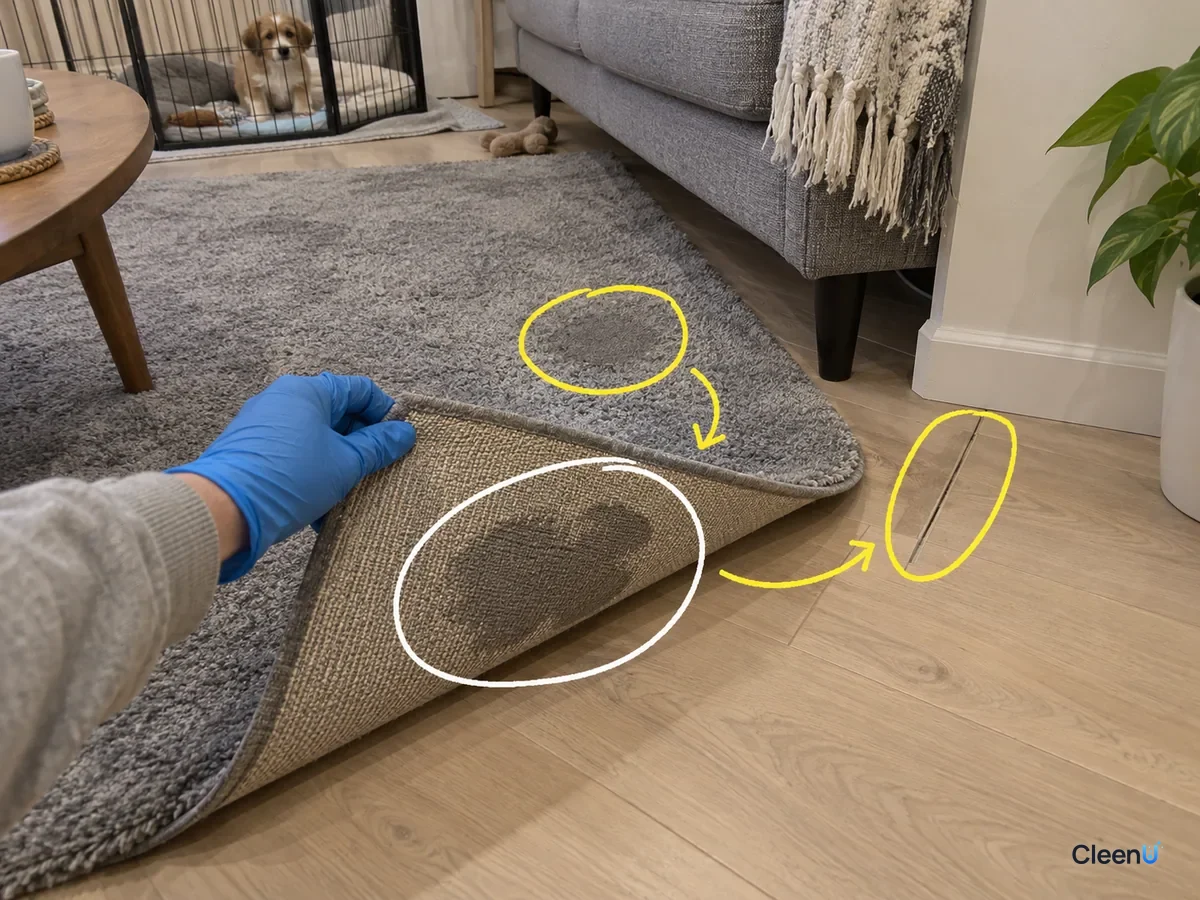
Why dog pee stains hardwood floors black, and why laminate swells
Sometimes dog pee on a hardwood floor leaves a gray-black ring that won't wipe off. That's usually not dirt on the surface; the wood itself has changed color. Bacteria break urea down into ammonia, and tannin-rich woods such as oak darken when they meet ammonia. Furniture makers have long used this reaction on purpose to "fume" oak darker. When urine gets through worn finish or into seams and sits there, the tannins and ammonia keep reacting, and the stain sits inside the wood, not on it.
So dog pee on hardwood floors tends to end one of three ways. Intact finish, caught early, blotted right away: usually no trace. Sat for hours, older finish, or on a seam: some may soak in, and later the seam darkens or smells. Already gray-black or with lifted edges: no cleaner fixes that. The color is in the wood and the swelling is structural, so it takes sanding and refinishing or new boards from a flooring pro. Scrubbing a damaged board just drives more water into the seams.
If the dark mark no longer smells, what's left is cosmetic; if it still smells, treat the source before repairing the look.
What actually works on dog pee, and where each product fits
Cleaning dog urine takes three jobs: remove the liquid, dissolve and carry residue out of fibers and gaps, and break down protein- and oil-based odor sources.
Towels handle the first job, the most underrated step: the more you pull out now, the less you chase later. An enzyme cleaner handles the other two: surfactants wet the fibers and carry loosened residue out, enzymes break down protein and oil odor sources, and blotting removes both. Plain water helps pre-wet old stains, and tile or patios can simply be rinsed.
Three things to skip. Ammonia cleaners: the Cornell Feline Health Center advises against ammonia or vinegar products on soiled spots because they smell like urine and can be irritating, and the ASPCA notes that because urine contains ammonia, ammonia cleaners may draw a cat back to the spot. That guidance is written for cats, but dogs also find bathroom spots by smell. Bleach: the Tennessee Poison Center notes that bleach mixed with ammonia, including the ammonia in urine, produces chloramine gas; it can also strip carpet color and, since hypochlorite denatures proteins, knock out an enzyme cleaner used right after. Vinegar and baking soda dull odor briefly but don't reach the backing.
Core steps for a fresh dog pee spot on carpet
This example is a fresh accident at the edge of a gray living room carpet. The table later covers other surfaces.
Eight steps for a fresh dog pee spot on carpet
Move the dog out
Put your dog in a playpen or another room until the spot is dry. Fresh urine smell tells a dog "this is a bathroom."
Blot by standing on a towel
Lay several layers of thick towel or paper towels on the spot and press with your foot or palm, switching to dry sections until they stop coming up wet. Press, don't rub; rubbing spreads urine wider and deeper.
Caution:Don't spray water or cleaner on fresh urine first. Pull out what you can before adding liquid.
Spot-test somewhere hidden
Spray a little on a carpet edge or under the couch, blot, and check a white towel for dye transfer and the pile for any change.
Soak past the edge
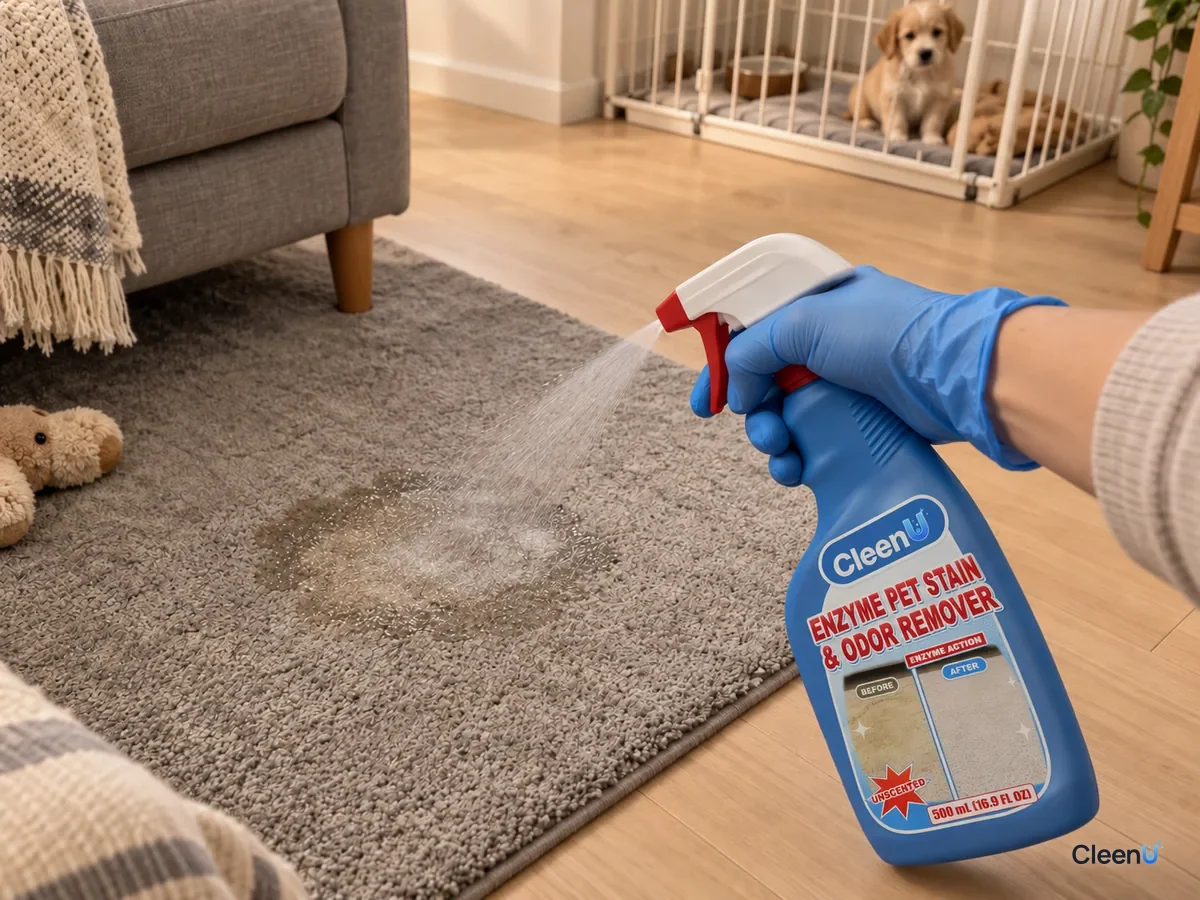
Spray beyond the wet outline until the carpet is clearly wet, using about as much liquid as the accident, so the cleaner reaches the same depth.
Wait 10 to 15 minutes
Leave it alone. If the room is dry and the surface starts drying out, mist a little more.
Blot, then add weight
Press a clean white towel down hard, switching to dry sections; then fold it, set a few old books or a tub of water on top, and leave it until the towel stops getting noticeably wetter.
Dry the underside too
Remove the weight and towel, aim a fan at the spot, and lift the carpet corner if you can. Keep rugs and dog beds off it until it's dry.
Re-check once dry
When it feels as dry as the carpet around it, sniff up close, then mist with water or lay a damp towel on it for about ten minutes and sniff again. Look for a yellow ring. If you find either, treat the same spot again.
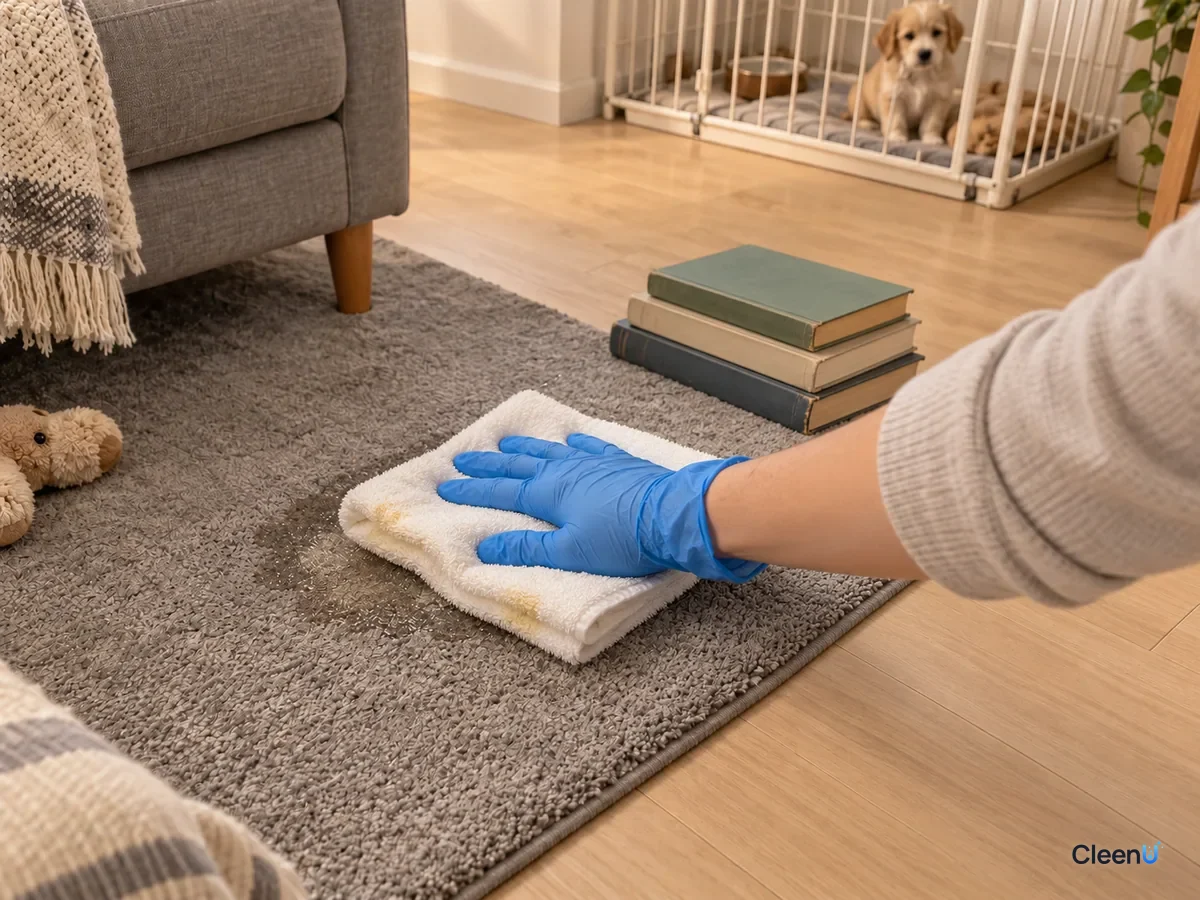
The weight step turns capillary action in your favor: a dry towel pressed tight against the carpet becomes the driest nearby material, so urine from below travels into the towel instead of drying at the fiber tips.
How to get old dog urine out of carpet: two extra steps
With an old stain, residue has dried into the fibers and backing, and one pass rarely redissolves all of it. Add a step at the front and a round at the end. First, mist the stain and a margin around it with plain water and wait a few minutes so dried residue loosens. Then spray the cleaner, wait, blot, and weight as above. If it still smells once dry, do the whole sequence again. Old stains are usually bigger than they look; a UV flashlight can help you find the edge, but let your nose make the final call.
Sometimes the smell is gone but a yellow mark remains on light carpet. If two rounds removed the smell and the mark no longer fades, the fiber is likely dyed or discolored. That's cosmetic, and scrubbing harder only fuzzes the pile. Live with it, or have a carpet pro assess or patch it.
Surface by surface: how wet it can get and whether you can rinse
| Surface | How wet it can get | Rinse? | What to do | When to stop |
|---|---|---|---|---|
| Synthetic carpet (low or high pile) | Can be soaked | No; blot it out | Soak past the edge, blot under weight, lift a corner to dry; part high pile with your fingers so liquid gets in | Fading or softened backing glue at the test spot |
| Soaked carpet pad | Spraying from above won't reach it | No | Pull back the carpet and treat or replace that section of pad | Pad is dark or smells: replacing beats treating |
| Wool or silk rugs | No protease cleaners | No | Blot with dry towels only and call a rug cleaner | DIY risks color loss and felting |
| Fabric couch | Fabric can get wet; foam gets light passes | No | Wash removable covers per the tag; spray foam locally, blot, stand cushions up to dry | Deeply soaked foam may need a new insert |
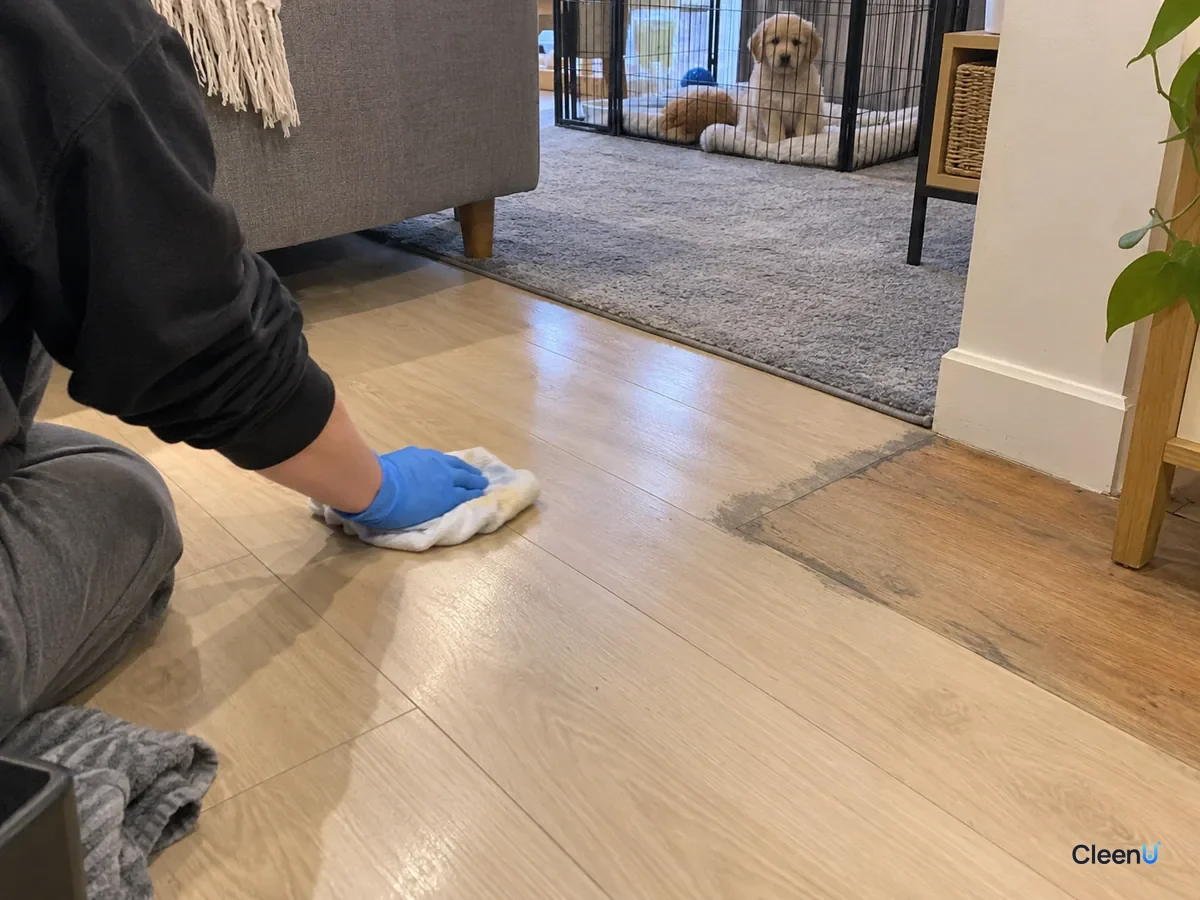
| Sealed hardwood, engineered, laminate | As little water as possible | No | Blot, spray cleaner onto a folded towel, lay it on the spot and keep it damp 10 to 15 minutes, lift, wipe dry, then dry the seams | Lifted edges or gray-black marks |
| Tile and grout | Can be soaked | Yes | Soak, soft-brush grout, wipe or rinse, dry | Grout that stays dark may be old staining or mold |
| Patio or balcony (tile, concrete) | Can be soaked | Yes, generously | Flush with water, spray and scrub, rinse toward the drain | Concrete that keeps whitening may need a sealer |
| Walls, baseboards, furniture legs | Lightly | No | Wipe top to bottom, focusing on the baseboard-floor gap | Paint lifting or wood legs turning cloudy |
On wood, the towel method keeps cleaner on the stain instead of in the seams, and it assumes an intact finish; skip enzyme cleaners on unsealed hardwood. Wool and silk are protein fibers, which a protease can't tell from urine protein. On couches, the common mistake is too much liquid at once.
Why do dogs pee on the wall? Marking height and where to look
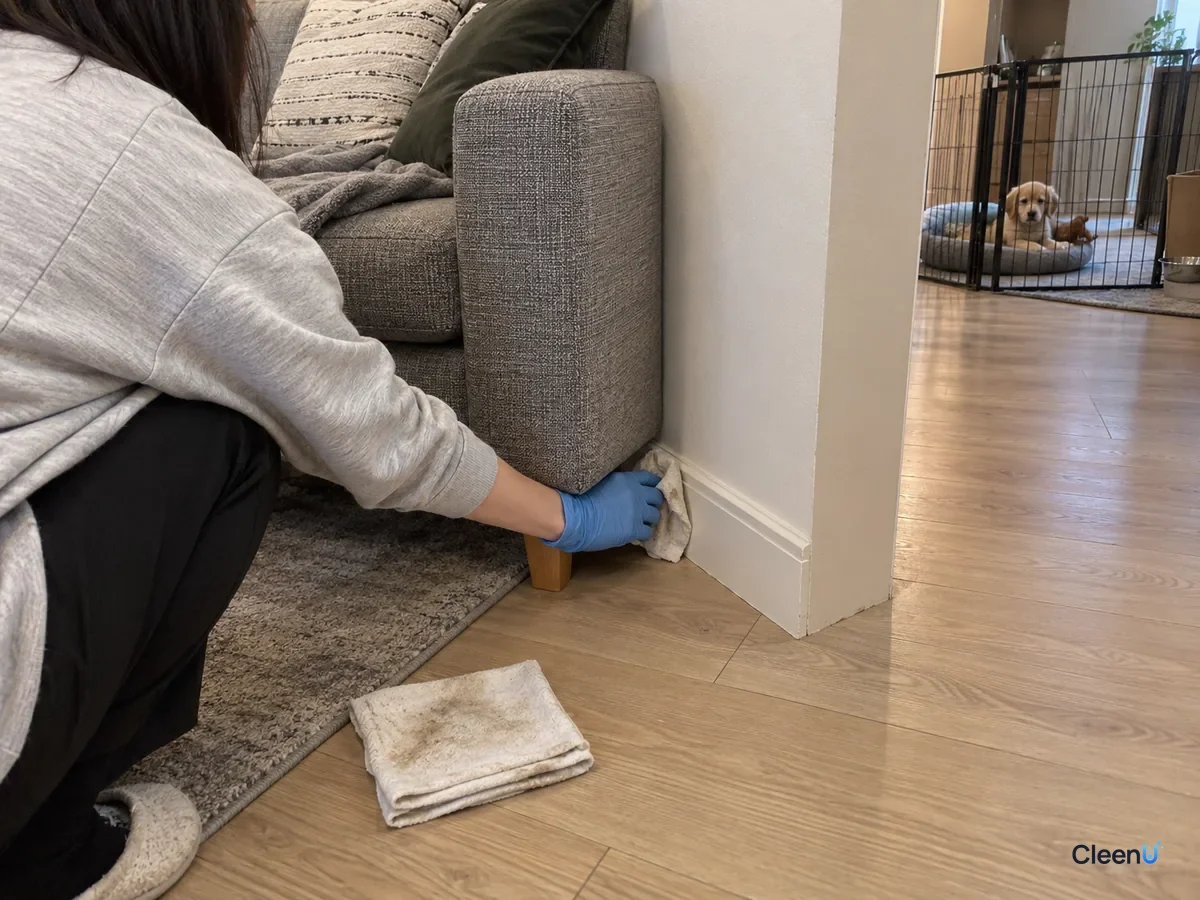
Leg-lift marking isn't an accident, and it hides in different places: room corners, door frames, sofa and bed legs, curtain hems, new furniture and boxes, and shoes or bags brought in from outside. Amounts are small, at roughly the height of your dog's lifted leg, near the floor for small dogs and up to knee height for large ones.
Marking urine hits the vertical surface, runs down, and collects where the baseboard meets the floor, so the floor puddle is only part of it. Wipe vertical surfaces top to bottom, press a towel corner into the baseboard gap, and in carpeted rooms check the carpet edge along the wall, where the tack strip and pad often hold the worst of it. Wash curtain hems if they come off.
Marking is behavioral and shows up more in intact males or after changes at home, but sudden peeing indoors can also be medical. The ASPCA lists possible causes of house soiling in dogs that include urinary tract infections, age-related sphincter weakness, hormone-related incontinence after spaying, bladder stones, diabetes, kidney disease, and neurological problems, and recommends ruling them out with a vet first. A quick distinction: marking is usually small, aimed at vertical surfaces, in the same places. Wet bedding where your dog sleeps, dribbling while walking, or noticeably more drinking and peeing calls for a vet visit. Leave behavior correction to your vet or a trainer; your job is to remove old marks so they don't keep pulling your dog back.
Potty training a puppy: make cleanup a daily routine
During potty training, accidents are normal. Treat each one while it's fresh so it doesn't leave a "you can go here too" scent, and keep floors from staying wet day after day.
Put washable mats or pee pads in the playpen area, roll up rugs you can move, and lay a waterproof pad under the rest. Keep a cleanup station by the playpen: old towels, enzyme pet stain cleaner, paper towels, and a zip bag, so you can start blotting within a minute. Wash reusable mats daily.
Keep spot treatment and routine mopping separate. Treat accidents with the enzyme cleaner as above; once dry, a neutral no-rinse floor cleaner handles everyday mopping on sealed wood, tile, vinyl plank, and laminate around the playpen. If you run a robot mop, walk the floor before you leave; see can a robot mop clean up pet urine? For everyday floor care, see cleaning floors in a pet home.
If accidents increase or a trained dog backslides, rule out health problems first.
CleenU Enzyme Pet Stain & Odor Remover and CleenU Floor Cleaner: who does what
CleenU Enzyme Pet Stain & Odor Remover handles the urine spot itself. It's a ready-to-use spray pairing protease, lipase, and amylase enzymes with nonionic surfactants, pH 6.5 to 8.0 (at 77°F/25°C), unscented, in a 500 mL (16.9 oz) trigger bottle, with a 24-month unopened shelf life. It's made for pet urine on carpet, fabric couches, mattresses, pet beds, and sealed hard floors. With no added fragrance, a spot that stops smelling has had its source removed, not covered. It's a cleaner, not a disinfectant. Skip wool, silk, and other animal-protein fibers, genuine leather and suede, and unsealed hardwood; don't use it with or right after chlorine bleach; and spot-test dark fabrics.
For dog pee on carpet, couches, and sealed floors, try CleenU Enzyme Pet Stain & Odor Remover.
CleenU Floor Cleaner handles the everyday floor once the spot is done. It's a neutral no-rinse formula, pH 7.0 to 8.5 (at 77°F/25°C), with low-foam nonionic surfactants and a small amount of fast-drying solvent. Spray and mop as is, or dilute 1:20 for large areas, on tile, vinyl plank, laminate, and sealed wood for everyday footprints, dust, and light soil. It has a fresh citrus scent, so let the floor dry before your dog walks on it. It isn't for unsealed, waxed, or oiled wood, carpet, or robot mop tanks.
For everyday spray-and-mop around the playpen and hallway, try CleenU Floor Cleaner.
The split is simple: enzyme cleaner where there's urine, floor cleaner for the everyday floor afterward, and neither replaces the other. For the rest of a pet home, start with our pet home cleaning guide.
How to check you're done: smell, color, and material
At home, check smell, color, and material. Smell: once fully dry, no urine smell up close or after re-wetting. Color: no yellow ring on light carpet or on a pressed white paper towel, no darkening along wood seams. Material: pile not fuzzed or stiff, no lifted laminate edges, no water ring on couch fabric. And your dog stops sniffing or circling there.
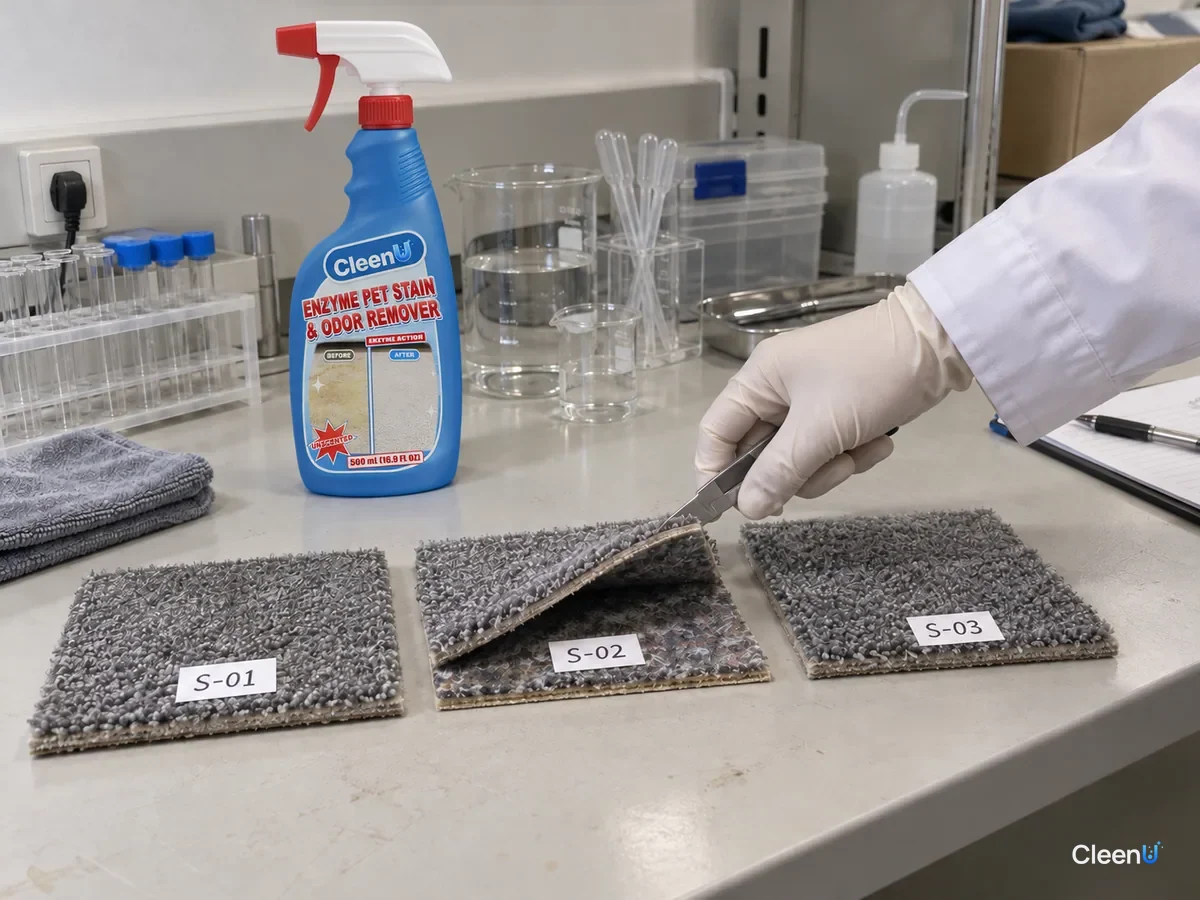
For more certainty, borrow the lab approach and make these checks a little more controlled:
A more controlled check
- Penetration and removal: the cleaner has to reach as deep as the urine did; in a lab, carpet-plus-pad blocks are cut open to show the wet zone and remaining residue
- Odor return: once fully dry, re-wet or gently warm the spot and sniff again, ideally with a second person, comparing it with a spot treated with water only
- Wicking: on light carpet treated at the label rate and air-dried, check fiber tips for yellow rings
- Material compatibility: rub with a white cloth to check for dye transfer, and spot-test wood flooring in a hidden area for finish and edge changes
Penetration and removal shows the biggest difference between methods. With the same cleaner, a light mist and a full soak followed by weighted blotting look completely different once you cut the block open.
Still smells or still stained? Work down this list
| Likely cause | What you'll notice | Next step |
|---|---|---|
| Not enough cleaner, didn't reach the backing | No smell on top, but it shows when pressed or re-wet | Soak past the edge, blot under weight, repeat |
| Underside never dried | Smell returns after rain or mopping, with a musty note | Lift the carpet edge and run a fan until the underside is dry |
| Wicking during drying | A yellow ring after drying, little smell | Mist the ring with water, blot, weight, and dry the underside |
| Another spot you missed | Smell centered away from what you treated | Check corners, baseboards, sofa legs, and curtain hems |
| Pad or subfloor saturated | Still smells after two rounds; area not shrinking | Pull back the carpet, replace soaked pad, call a flooring pro |
| Wood discoloration | Gray-black mark, no urine smell | Stop cleaning; sand and refinish or replace boards |
The first three are the most common and cheapest to fix, so start there. On cost: wash small rugs whole instead of spot-treating them repeatedly; replace a soaked section of wall-to-wall pad rather than spraying it again and again; and once wood swells or turns black, call a flooring pro early. If two proper rounds still leave a clear smell on the re-wet test, change approach.
Stop and rethink if you see any of these
Stop if the test spot fades, the pile fuzzes or stiffens, or backing glue softens; if the material is wool, silk, leather, suede, or unsealed wood; if wood edges have lifted or a gray-black mark has formed; if two rounds still leave a clear smell on the re-wet test and the area keeps growing; or if anyone gets eye, nose, or throat irritation, especially after bleach was used. In the first four cases, stop treating it yourself and consider new pad, a professional cleaner, or a flooring repair. For irritation, open windows and leave the room. If your dog pees often, has blood in its urine, struggles to pee, leaks while lying down, or drinks noticeably more, see a vet soon.
Cleaning up dog pee: common questions
How do you get old dog urine out of carpet?
Pre-wet it. Mist the stain and a margin around it with plain water, wait a few minutes, then spray an enzyme cleaner, wait 10 to 15 minutes, blot under weight, and dry the underside with a fan. Expect one or two full rounds.
Can dog urine ruin hardwood floors?
Yes, if it sits. Urine that gets through worn finish or seams can darken tannin-rich woods like oak and swell laminate cores. Blot fast and keep water on top; gray-black marks or lifted edges need sanding, refinishing, or new boards.
Why do dogs pee on the wall?
Treat it as marking first. Clean vertical surfaces top to bottom plus the baseboard gap, and ask your vet to rule out medical causes if it starts suddenly.
Why did a yellow ring show up after the carpet dried?
That's wicking. Carpet dries from the top, and moisture from below carries residue up to the fiber tips. Mist the ring with water, blot, weight it, and dry the underside.
Can I use vinegar and baking soda on dog pee?
Only as a finishing step. Vinegar dulls some ammonia briefly and baking soda absorbs a little surface odor, but neither reaches the backing; the spot still needs an enzyme cleaner and blotting.
Can I use bleach on dog urine?
Don't. Bleach reacts with ammonia compounds in urine to form irritating chloramine gas, can strip carpet color, and can knock out an enzyme cleaner used afterward.
Dog pee soaked into the carpet pad. Can it be saved?
A small area can be treated by pulling back the carpet. If the pad is dark, smells, or still smells after two rounds, replace that section.
How do I clean dog urine from a couch?
Wash removable covers per the tag. Spray the foam locally, blot, repeat with light passes, then stand cushions up in front of a fan.
Will I go through too much enzyme cleaner during potty training?
Use it on every accident, not for routine mopping. Put washable pads in the playpen, treat spots with enzyme cleaner, and mop dry hard floors with a neutral floor cleaner.
Can a robot mop clean up dog pee?
Don't let it. It spreads urine farther and fouls the mop pad and water path. Treat the spot by hand, let it dry, then run the robot.
Why is my dog suddenly peeing in the house?
See your vet first. Urinary infections, bladder stones, diabetes, kidney disease, and age-related sphincter weakness can all cause indoor accidents; rule them out before working on behavior.
Sources (accessed Oct 2026)
- ASPCA, "Separation Anxiety" (dog behavior page listing medical causes of house soiling)
- Tennessee Poison Center (Vanderbilt), "Why shouldn't I mix household chemicals with bleach?"
- Cornell Feline Health Center, "Feline Behavior Problems: House Soiling" (on avoiding ammonia and vinegar cleaners)
- ASPCA, "Litter Box Problems" (on ammonia cleaners drawing pets back)
- Mobley HL, et al., Microbiological Reviews, 1989 and 1995, on microbial urease
Not a substitute for veterinary care.
Getting dog pee out of carpet and everything else follows one order: blot, soak, wait, blot under weight, dry completely, then confirm with a re-wet sniff test. Surfaces only change how wet you can get and whether you can rinse. Treat carpet down to the backing and pad and stop wicking rings; keep wood floors fast and dry, and hand swollen or blackened boards to a flooring pro; give couches light passes; rinse tile and patios freely. Check vertical surfaces and baseboards for marking, build a daily routine during potty training, and see a vet if your dog suddenly starts peeing indoors.