
How-to
How to Clean Vomit From Carpet When Your Cat or Dog Throws Up: Scrape, Blot, Then Enzyme
Direct answer
Scrape the solids from the outside in and bag them, blot the liquid with white paper towels, then spray an enzyme cleaner, let it sit, and blot it dry. If a yellow mark shows up after it dries, spot-treat it with a carpet cleaner. Skip hot water and never scrub.
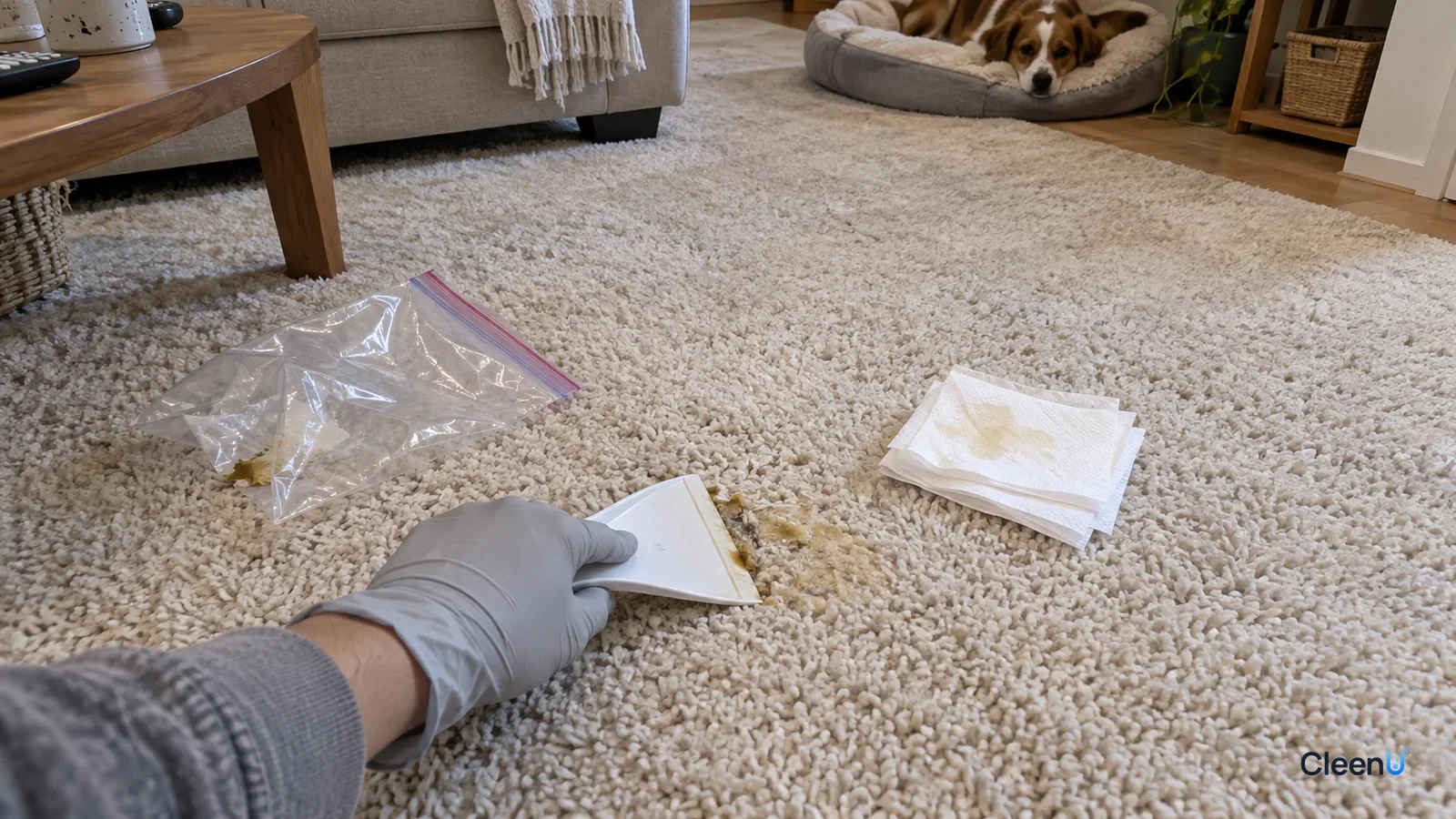
The fastest way to clean vomit from carpet is also the least intuitive: don't grab a wad of paper towels and wipe. Wiping presses half-digested food, mucus, and bile down into the pile, and what you could have lifted off in one pass becomes a stain you'll fight for days. Order matters more than the product. Lift the solids, pull out the liquid, break down the protein and fat with an enzyme cleaner, and only then deal with color.
Vomit is harder than most spills because it brings acid, pigment, protein, fat, hair, and sometimes grass or treat dye all at once, and each needs its own step.
What's in pet vomit, and how each part sticks to carpet
The makeup of the mess decides the order of the cleanup.
- Stomach acid: hydrochloric acid makes vomit acidic. The longer acidic liquid sits on fibers, the more likely it is to affect some dyes and leave a color change that won't wash out, so speed matters.
- Bile and bile pigments: yellow or yellow-green fluid, often seen when a pet vomits on an empty stomach, usually contains bile. Bile pigments are colored and are a main source of yellow marks on light carpet. Bile also carries bile salts, natural emulsifiers that help pull fat into the fibers with them.
- Protein and mucus: partly digested kibble is high in protein, and stomach mucus makes the whole mess slick and sticky, so it smears and clings to hair. Dried protein forms a stiff crust on the fiber surface.
- Fat: food fat, partly emulsified by bile, soaks in and leaves a dark, greasy patch that attracts dirt later.
- Hairballs and foreign material: a cat hairball is hair bound into a tube by mucus; grass, plastic bits, or other objects can show up too.
- Colorants: dyes in some treats and foods can act like fabric dye on certain fibers.
What happens to a pile of vomit on carpet
- Solids sit on top of the pile while the liquid runs down the yarns
- Mucus and protein glue food particles and hair to the fibers and spread when wiped
- Acid and pigments from bile touch the fibers, and the longer they sit, the more likely they are to stain or affect the dye
- As water evaporates, protein and mucus dry into a crust and fat leaves a dark mark
- Leftover protein and fat break down slowly at room temperature and give off a sour smell
So the order runs from easiest to hardest: scrape solids, blot liquid, use enzymes on protein and fat, and handle color last. Pour water on first and wipe, and you drive solids, liquid, and pigment deeper together.
One more rule: no hot water. Heat denatures and sets protein, a basic principle from any biology textbook, and protein-based stains usually get harder to remove after heat. Vomit is full of protein. Room-temperature water is all you need.
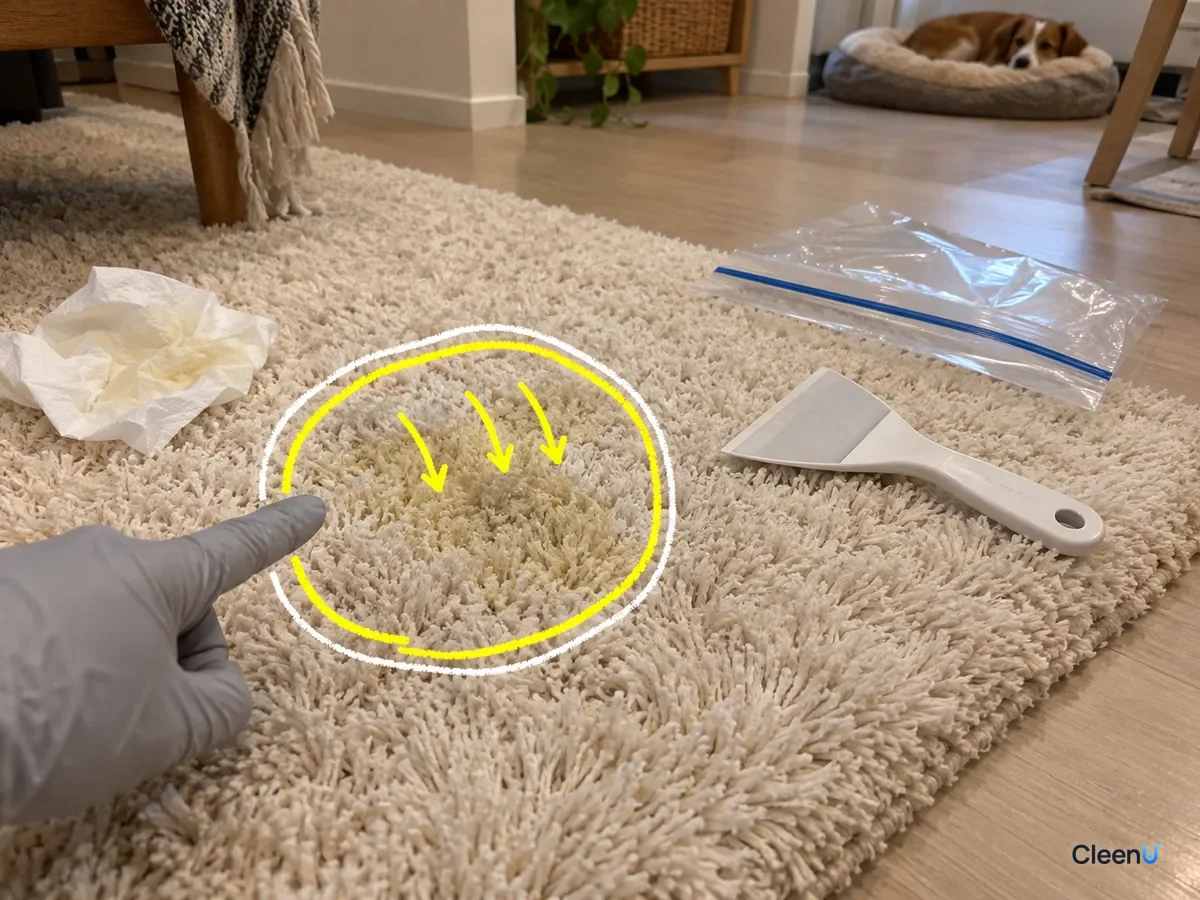
Why light carpet turns yellow after it dries
A spot can look clean while it's wet and show a yellow or brown ring the next morning. It's usually one of three things, and each one has a different fix.
Wicking. Carpet dries from the yarn tips down. As the tips dry, moisture lower in the pile moves up the fibers and carries dissolved bile pigment and residue from the base and backing to the tips. When the water evaporates, the color is left at the most visible spot. Wicking tells you there was still residue below.
Dyeing. Bile pigment and colorants from treats can dye fibers that bind dye easily, like nylon and wool. At that point the color isn't dirt sitting on the surface. A cleaner can lighten it but may not remove it completely.
Water rings and resoiling. Over-wetting until liquid reaches the backing can leave a brownish ring at the edge. Cleaner residue that isn't blotted out can make the spot attract dirt faster, so it turns into a gray patch a few weeks later.
How wicking brings a stain back
- Liquid from the vomit carries bile pigment to the base of the pile and the backing
- Surface cleaning removes the top layer but leaves residue below
- The carpet dries from the yarn tips first, and moisture below moves up the fibers
- The moving water carries dissolved color and residue up to the tips
- The water evaporates, the color stays on top, and a yellow ring appears
The fix is simple. After your final blot, lay a stack of dry white paper towels or a thick folded white towel over the damp spot and weigh it down with a book or a container of water for a few hours or overnight. The moisture and color moving up wick into the towels instead of stopping at the yarn tips. The color on the towels also tells you how much residue is left.
Step by step, from discovery to dry
Your cat or dog threw up on the carpet: do it in this order
Move the pet away and put on gloves
Send the dog to its bed or close it in another room so it can't come back to sniff, lick, or step in it. Glove up and grab a scraper, a zip bag, and white paper towels. Pause your robot vacuum if it's scheduled so it doesn't run through the mess.
Scrape the solids from the outside in
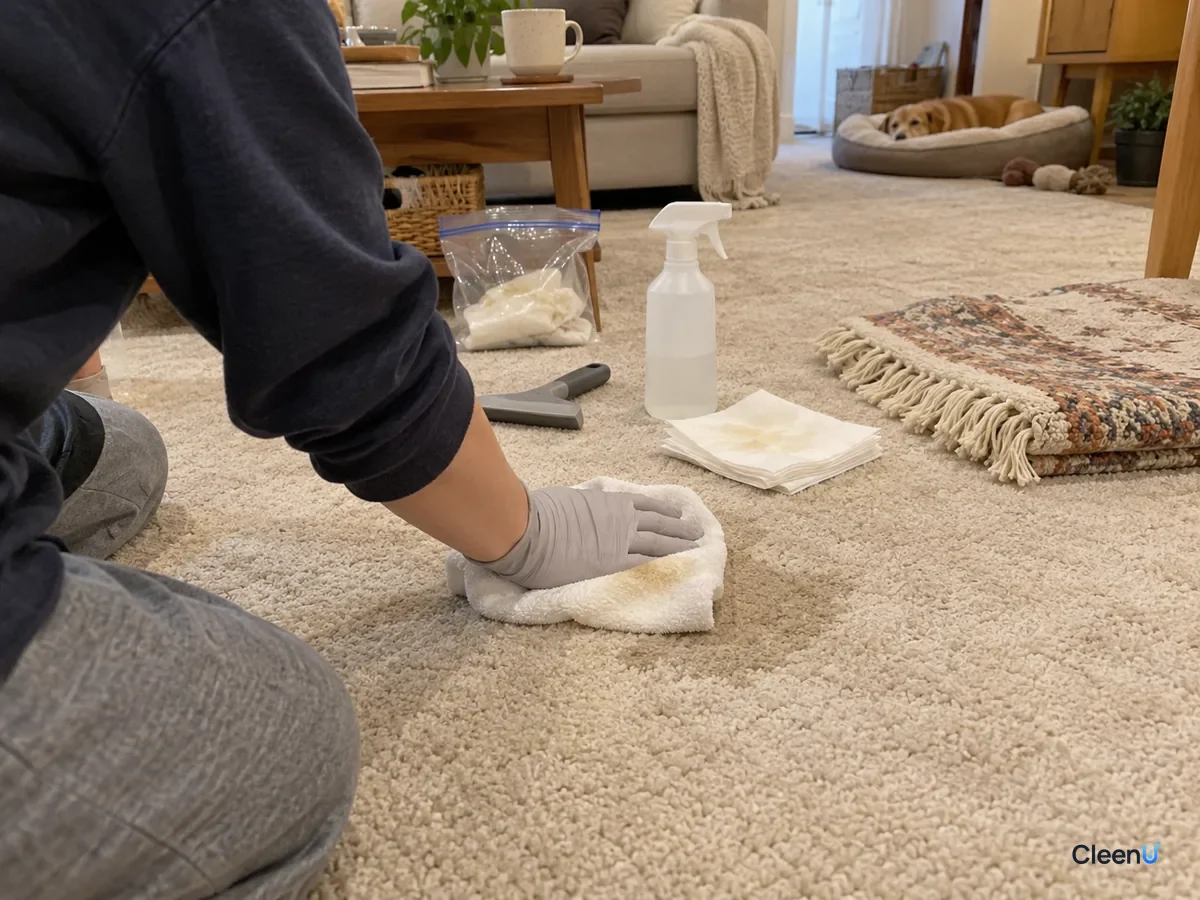
Use a plastic scraper or an old gift card to work from the edge toward the center, gather the solids into a pile, and lift them into the bag. On a shag or long-pile rug, lift gently along the direction of the pile instead of pressing down. A hairball can be picked up with a paper towel.
Caution:Don't grab and press with a paper towel. That pushes food particles and mucus to the base of the pile.
Blot the liquid, don't rub
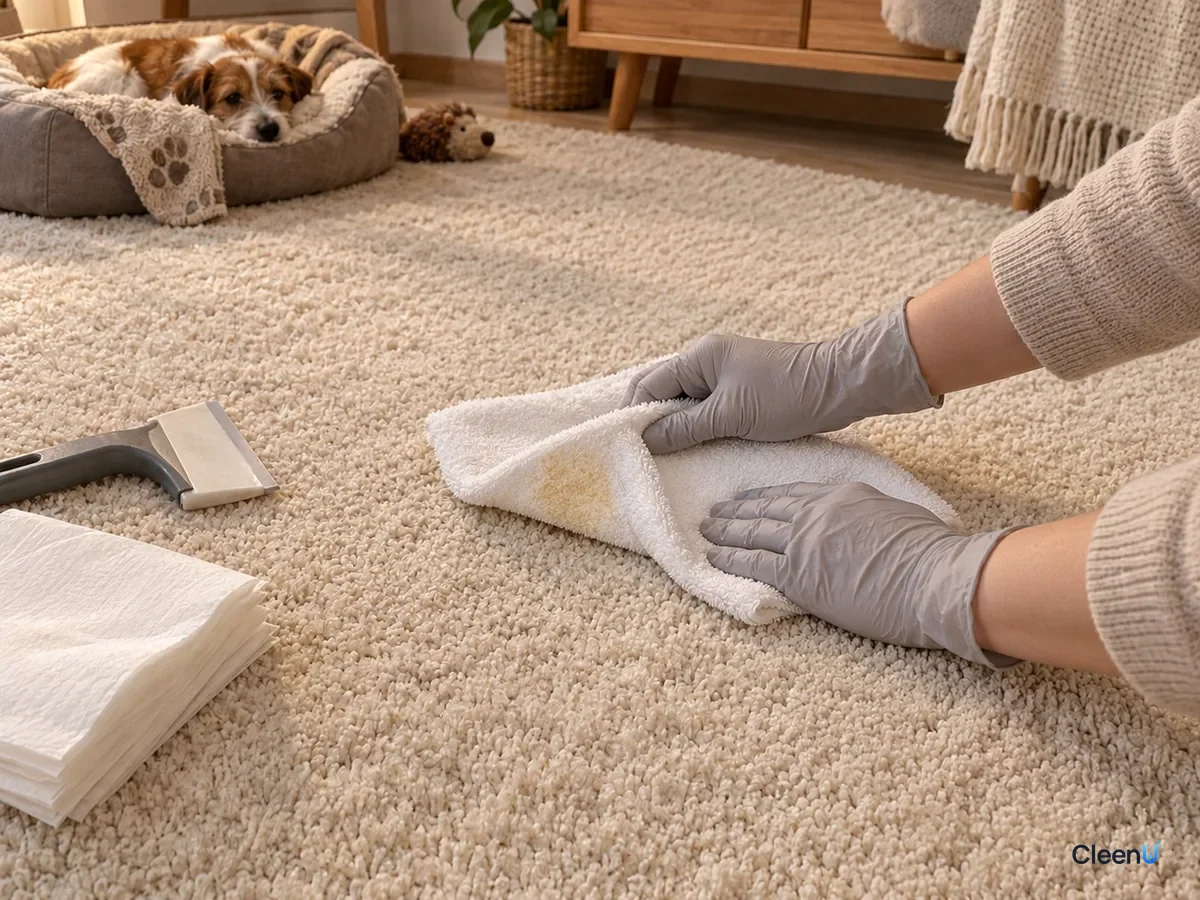
Fold white paper towels into a pad and press from the outside in, switching to a fresh one as each fills, until almost no color comes up. White towels let you see what you're pulling out.
Spray the enzyme cleaner and let it sit
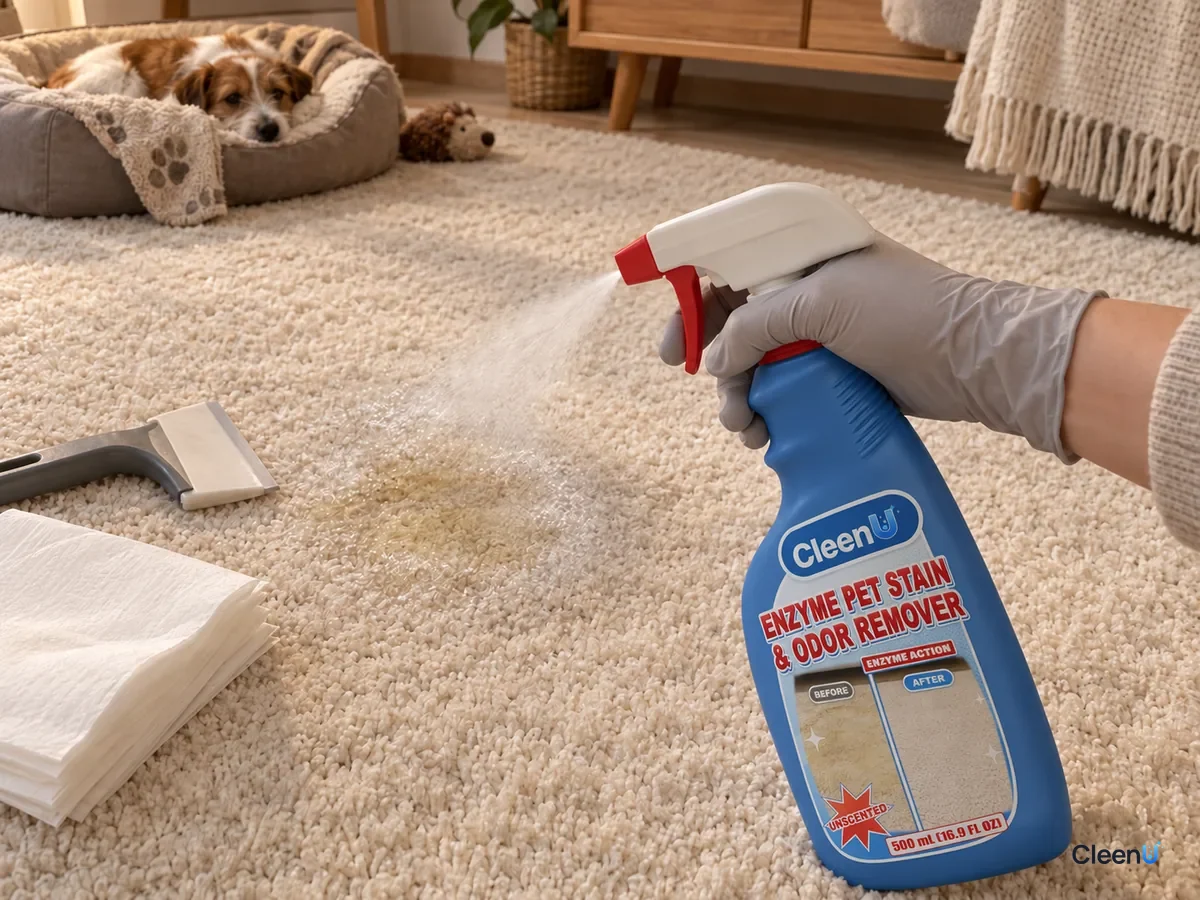
Spray a pet enzyme cleaner over an area a little wider than the stain, deep enough that the base of the pile is damp too. Let it sit 10 to 15 minutes so the enzymes can break down protein and fat.
Caution:Not for wool or silk rugs. Dampen the base of the pile, but don't soak the backing.
Blot it dry
Press with a clean white towel to lift the cleaner and the loosened residue. Stop when the towel no longer picks up much color. For a strong smell, spray again, wait, and blot.
Weigh down towels, then dry
Lay a stack of dry white paper towels over the spot, weigh it down for a few hours or overnight, then remove it and run a fan. Towels that come up lighter each time mean less residue below.
Check color once fully dry
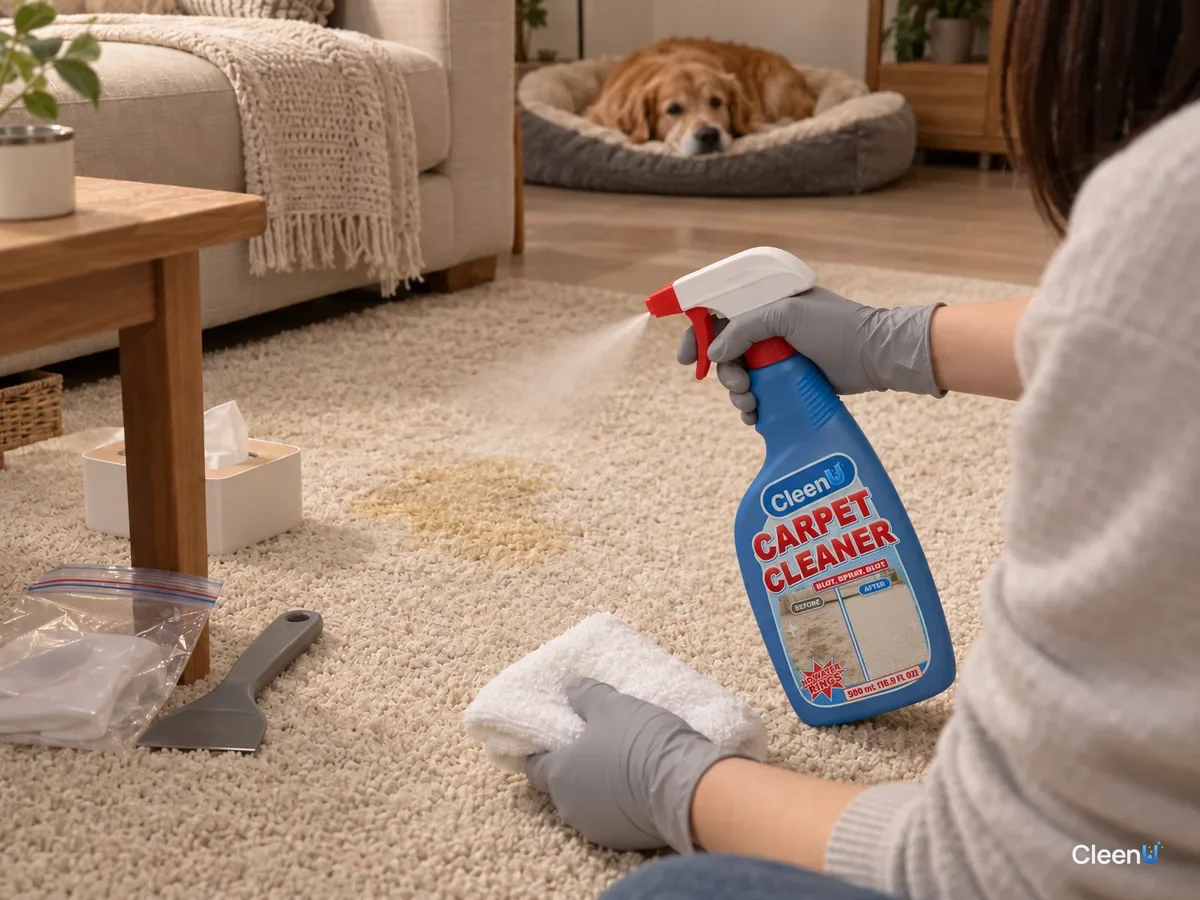
Look again only when it's completely dry. For a remaining yellow, treat, or grease mark, spot-treat with a carpet spot cleaner: spray the mark, let it loosen, blot without rubbing, weigh down towels again, and dry.
Groom the pile and vacuum
Once dry, brush the pile back into place with your hand or a soft brush, then vacuum to pick up loosened residue and paper lint.
Stop and change plans if you see any of this
Stop if the rug is wool, silk, or hand-knotted, or its label says professional cleaning only; a damp white cloth pressed on a hidden spot picks up color; the backing is soaked or the underside feels wet; or the pile starts to fuzz, untwist, or distort. In those cases, stop adding liquid and pressure and call a professional rug cleaner. If the vomit contains blood, looks like coffee grounds, has an obvious foreign object, or you suspect your pet ate medication, a cleaning product, or a toxic plant, call your veterinarian first and clean the carpet later.
What the enzyme cleaner does, and what the carpet cleaner does
Vomit calls for two products because it's two problems: protein, fat, and odor on one side, color and grease marks on the other.
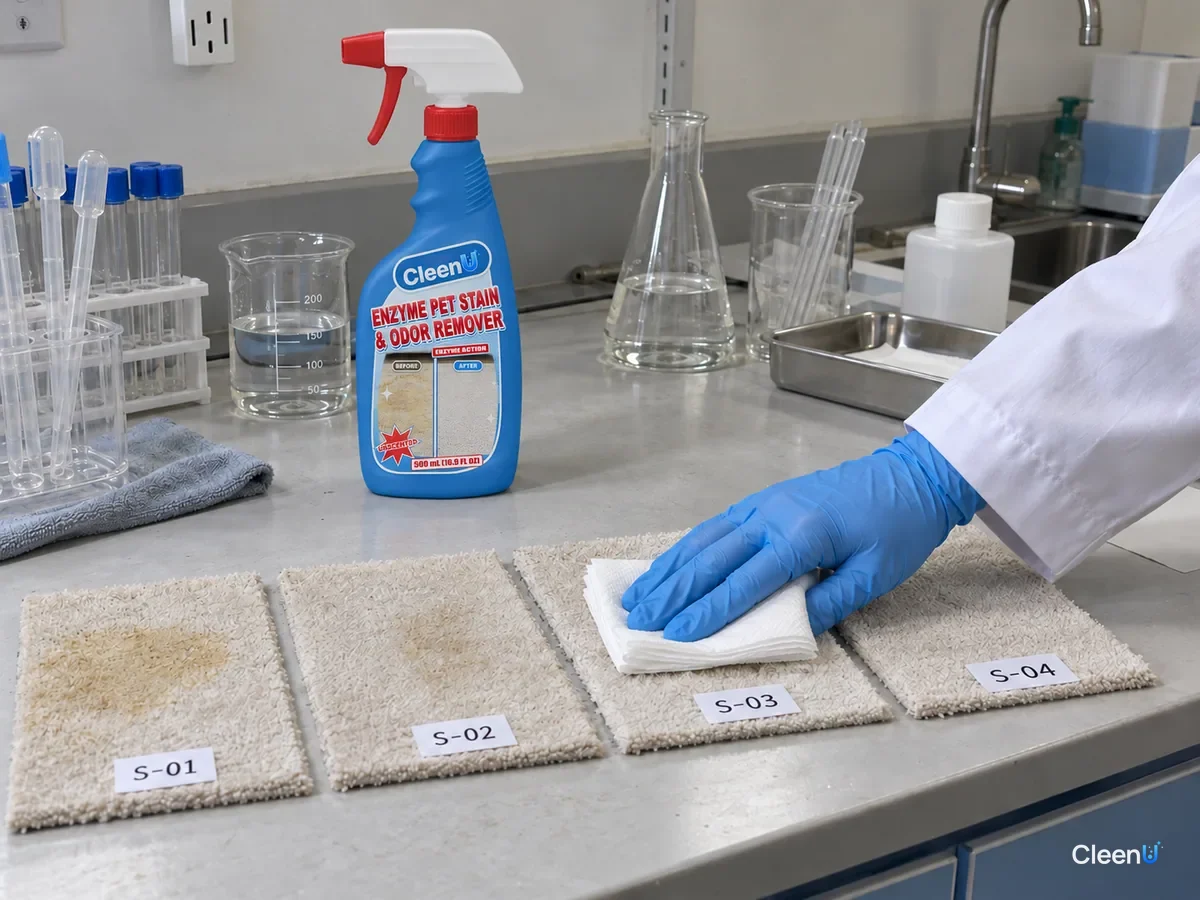
A pet enzyme cleaner handles step one: enzymes with nonionic surfactants, close to neutral, fragrance-free. Blot first, spray to the depth of the stain, wait 10 to 15 minutes, blot dry, and air-dry. Protease targets food protein and mucus, lipase targets fat, amylase targets starch from kibble, and the surfactants help carry the broken-down residue into your towel. Fragrance-free means no perfume covering the smell, so a quick sniff afterward tells you what's left. It's not for wool, silk, or other animal-protein fibers, and it shouldn't be used at the same time as or right after chlorine bleach. CleenU Enzyme Pet Stain & Odor Remover is one example: its directions cover cat and dog vomit as well as urine, and it contains all three enzymes.
A mildly alkaline carpet spot cleaner handles step two: low-foam nonionic and anionic surfactants with mild alkaline builders, ideally with an anti-resoiling component and no bleach. It's built for surface marks like drink spills, sauce and grease spots, and muddy footprints. On vomit, it's for the grease marks and food-color stains left after the enzyme treatment has dried. The anti-resoiling component helps keep the cleaned spot from attracting dirt faster than the carpet around it. Skip silk rugs and untested pure wool or hand-woven rugs, don't spray until the backing is soaked, and don't scrub.
Don't spray both on the same spot at once. It's too much liquid, and you won't be able to tell which step did what. Enzyme first, full dry, then carpet cleaner.
For the protein, fat, and odor in pet vomit, use our fragrance-free Enzyme Pet Stain & Odor Remover.
Nylon, polyester, olefin, wool: fiber type sets your limits
Check the label on the back or corner of the rug for fiber content. The same mess behaves very differently on different fibers.
What to watch for by carpet fiber
- Nylon
- Durable and resilient, but it has sites that bond with acid dyes, so bile pigment and treat colorants can dye it; act fast; the standard steps apply
- Polyester
- Resists water-based dyes better but attracts oil, so grease clings; a carpet cleaner pass after the enzyme step is often needed
- Olefin (polypropylene)
- Usually solution-dyed, so its own color is stable, but it also attracts oil; blot patiently on long pile
- Wool
- Animal-protein fiber that protease cleaners can damage, sensitive to alkaline products, and prone to felting with heat and scrubbing; scrape, blot, press with room-temperature water, then call a pro
- Blends, hand-knotted, silk
- Test a hidden spot with a damp white cloth first; stop and call a pro if color transfers or the pile distorts
Shag and long-pile rugs add their own challenge. The long, open yarns let solids fall to the base and hide liquid underneath. Lift along the pile when you scrape, press longer and more times when you blot, and expect longer drying, which makes the weighted-towel step even more important.
Cat hairballs vs. dogs that eat too fast
Cat hairballs. Cats swallow hair while grooming, and it comes back up as a mucus-bound tube, often with a small puddle of yellow or clear liquid and foam. The solid part is easy; pick it up with a paper towel. The liquid is the problem. There isn't much, but it often contains bile and leaves a yellow mark on light carpet, so don't skip the blotting, enzyme, and weighted-towel steps. The Cornell Feline Health Center notes that a hairball every week or two generally isn't a long-term concern.
Dogs that eat too fast. A dog that gulps food sometimes brings back a big pile of whole, undigested kibble. There's a lot to scrape, but less bile, so color is less of an issue than grease and odor. Many owners split meals or switch to a slow-feeder bowl; if it keeps happening, ask your vet. Food that comes up suddenly without heaving is regurgitation, which the Cornell Riney Canine Health Center notes can point to an esophageal problem, so mention it to your vet too.
Dogs that eat grass. Grass in the vomit usually means green color. Chlorophyll can mark light carpet too; handle it like a yellow mark: enzyme step, weighted towels, then the carpet cleaner once dry.
When to call the vet instead of worrying about the carpet
Cleaning only deals with the aftermath. Veterinary sources list these as reasons for an exam or prompt care (Cornell Feline Health Center and Cornell Riney Canine Health Center, accessed Oct 2026):
- A cat vomiting more than once a week
- Vomiting along with lethargy, loss of appetite, diarrhea, or changes in drinking or urination
- Blood in the vomit, or vomit that looks like coffee grounds
- A dog vomiting for more than 24 hours, or with abdominal pain, fever, or lethargy
- Even regular once-a-week vomiting in a dog, which can signal disease
If you think your pet ate medication, a cleaning product, a toxic plant, or a foreign object, call your veterinarian right away or contact the ASPCA Animal Poison Control Center at (888) 426-4435 or Pet Poison Helpline at (855) 764-7661 (both may charge a fee). Don't induce vomiting unless a professional tells you to. A photo of the vomit plus a note of the time and how many episodes helps your vet.
Cleaning and disinfecting are separate jobs. If your vet suspects something contagious, or someone at home is immunocompromised, follow the vet's advice, use a product labeled for fabrics, and don't use it at the same time as or right after an enzyme cleaner.
Still smells or still stained? Work down this list
- The liquid wasn't fully blotted out. Most common. The surface looks clean, but liquid at the base of the pile wicks smell and color back up as it dries. Do another round of blotting and weighted towels.
- The enzyme didn't get enough time or didn't reach the base. Wiping right after spraying, or only dampening the yarn tips, leaves protein and fat untouched below. Spray to the base and give it the full 10 to 15 minutes.
- Hot water or scrubbing happened early. Heat sets protein and scrubbing spreads the stain and fuzzes the pile. Expect extra enzyme rounds, and accept that color may only lighten.
- It's dye, not dirt. If damp white towels no longer pick up color but the mark is still there, bile pigment or treat colorant has probably dyed the fiber. The carpet cleaner can lighten it; for a dark mark on light nylon, ask a professional carpet cleaner.
- It's a water ring or resoiling: too much liquid or leftover residue. Spray less, blot more, use weighted towels.
- The smell is coming from somewhere else. Pets don't always throw up in just one place. Check under the sofa, under the bed, and along curtain hems.
Three home checks
Three home checks: press a damp white cloth on a hidden corner before you start to see whether the rug's dye transfers; watch the color on each white towel as you blot, since fading means progress and no change means the color is in the fiber; and once dry, close the room for an hour or set a bowl over the spot, then sniff.
The three checks line up with the three most common failures: a rug that bleeds dye, residue that never left, and an odor source still deep in the pile. You can see the first two while you work. The third has to wait until the spot is fully dry, because while it's wet, water holds odor molecules back and they evaporate slowly; a sniff after drying is the honest one.
Why pet stains get enzyme first, carpet cleaner second
Enzyme cleaners and carpet spot cleaners are two separate systems because they work on different parts of the problem. The enzyme cleaner sits near neutral pH, a range its enzymes are chosen to stay stable in, and it uses nonionic surfactants with no bleach so nothing in the formula works against the enzymes. Its job is to break down protein, fat, and starch residue so it can be lifted out. The carpet cleaner is mildly alkaline, pairing anionic and nonionic surfactants with mild builders, and it's good at loosening grease and surface color from fibers, with an anti-resoiling component to keep the cleaned spot from getting dirty faster.
Putting both jobs in one bottle usually means compromising on pH and surfactants: push the alkalinity up and enzymes lose activity, add more anionic surfactant and it can interfere with them. Using two in sequence lets each work under its own conditions, which is why the order is enzyme first, full dry, then spot cleaner.
If your home mixes carpet and hard floors and you run a robot mop, see Robot mops and rugs: keeping carpets dry in mixed-floor homes. For the rest of a pet home, see Cleaning floors in a pet home and our pet home cleaning hub.
Pet vomit on carpet: questions people ask
How do you get dried vomit out of carpet?
Break up and scrape the dried solids first, then vacuum the crumbs. Re-wet the residue with an enzyme cleaner, let it sit 10 to 15 minutes, and blot. Dried vomit usually takes two rounds, and weighted paper towels at the end help keep a yellow ring from wicking back up.
How do you get the vomit smell out of carpet?
Remove the source: protein and fat residue at the base of the pile. Spray an enzyme cleaner down to the base, give it the full dwell time, blot, and dry completely. Fragrance sprays and carpet powders only cover the smell for a few hours.
How do you get a yellow cat vomit stain out of carpet?
First figure out whether it's residue or dye. Press a damp white paper towel on it. If yellow still transfers, it's residue, so do another enzyme round with weighted towels. If nothing transfers, bile pigment has likely dyed the fiber; once dry, spot-treat with a carpet cleaner to lighten it.
Should I pour baking soda on vomit?
It works as a quick absorbent, not as a cleanup. Baking soda soaks up some surface liquid and odor but doesn't reach residue at the base of the pile, and white powder is hard to fully vacuum out of shag. Use a little, and vacuum thoroughly.
Can I use hot water?
No. Heat sets protein, so protein stains usually get harder to remove, and hot water can felt a wool rug. Room-temperature water is enough.
Can I use bleach on vomit?
No. Chlorine bleach can strip the carpet's own color, and it shouldn't be used at the same time as or right after an enzyme cleaner. If disinfecting is needed, follow your vet's advice and use a product labeled for fabrics, separately.
My wool rug got thrown up on. What now?
Scrape, blot, and press with room-temperature water, then call a professional rug cleaner. Wool is an animal-protein fiber that protease cleaners can damage, it's sensitive to alkaline products, and heat or scrubbing can felt it.
Can I use the enzyme cleaner and the carpet cleaner together?
One after the other, not at the same time. Use the enzyme cleaner for protein, fat, and odor, let the spot dry completely, then spot-treat any remaining grease or color with the carpet cleaner.
The vomit has blood in it or looks like coffee grounds. Should I clean first?
Call your vet first. Snap a photo and note the time and number of episodes, then clean. Veterinary sources list blood or coffee-ground vomit as a reason for prompt care.
How often is it normal for a cat to throw up hairballs?
The Cornell Feline Health Center says a hairball every week or two generally isn't a long-term problem. Vomiting more than once a week, or with lethargy or loss of appetite, calls for a vet visit.
Can I just throw a small rug in the washing machine?
Only if its care label says it's machine-washable. Scrape and blot first, or the mess spreads through the wash. Use the cold or room-temperature setting and gentle cycle the label calls for, and lay it flat to dry.
To clean vomit from carpet, work in order: scrape the solids from the outside in, blot the liquid with white paper towels, spray an enzyme cleaner down to the base of the pile, wait 10 to 15 minutes, blot dry, and weigh down a stack of towels so color can't wick back up. Once it's fully dry, spot-treat any grease or yellow mark with a carpet cleaner. Skip hot water and scrubbing, and leave wool, silk, and hand-knotted rugs to a professional. If your pet is vomiting often, vomits blood, or seems unwell, see your vet first; cleaning only handles the aftermath.
Sources
- Cornell Feline Health Center, "Vomiting" (accessed Oct 2026)
- Cornell Riney Canine Health Center, "Vomiting" (accessed Oct 2026)
- ASPCA Animal Poison Control Center; Pet Poison Helpline (accessed Oct 2026)
- OpenStax, Biology 2e, "Enzymes" (accessed Oct 2026)