
Troubleshooting
Cat Urine Smell Won't Go Away? Why It Comes Back After You Clean, and How to Stop It
Direct answer
When cat urine smell won't go away, urine usually soaked into the backing or pad and was never fully found or flushed out. Bacteria keep turning urea into ammonia, and a cat-specific compound releases sulfur odors. Find every spot, soak to the depth, blot, and dry completely.
Smell came back? Check these five things first
- Is the strongest smell at the spot you treated, or next to it, in a corner, or under the bed? If it's elsewhere, you missed a spot
- With the lights off, sweep a UV flashlight along the bed, baseboards, curtain hems, and furniture legs
- Press a white paper towel on the old spot; check whether it's damp underneath or picks up a yellow tint
- Think back to what you used: ammonia cleaners, vinegar, bleach, and scented sprays each cause problems
- Has your cat been peeing outside the box, going often, or passing small amounts? See the vet first
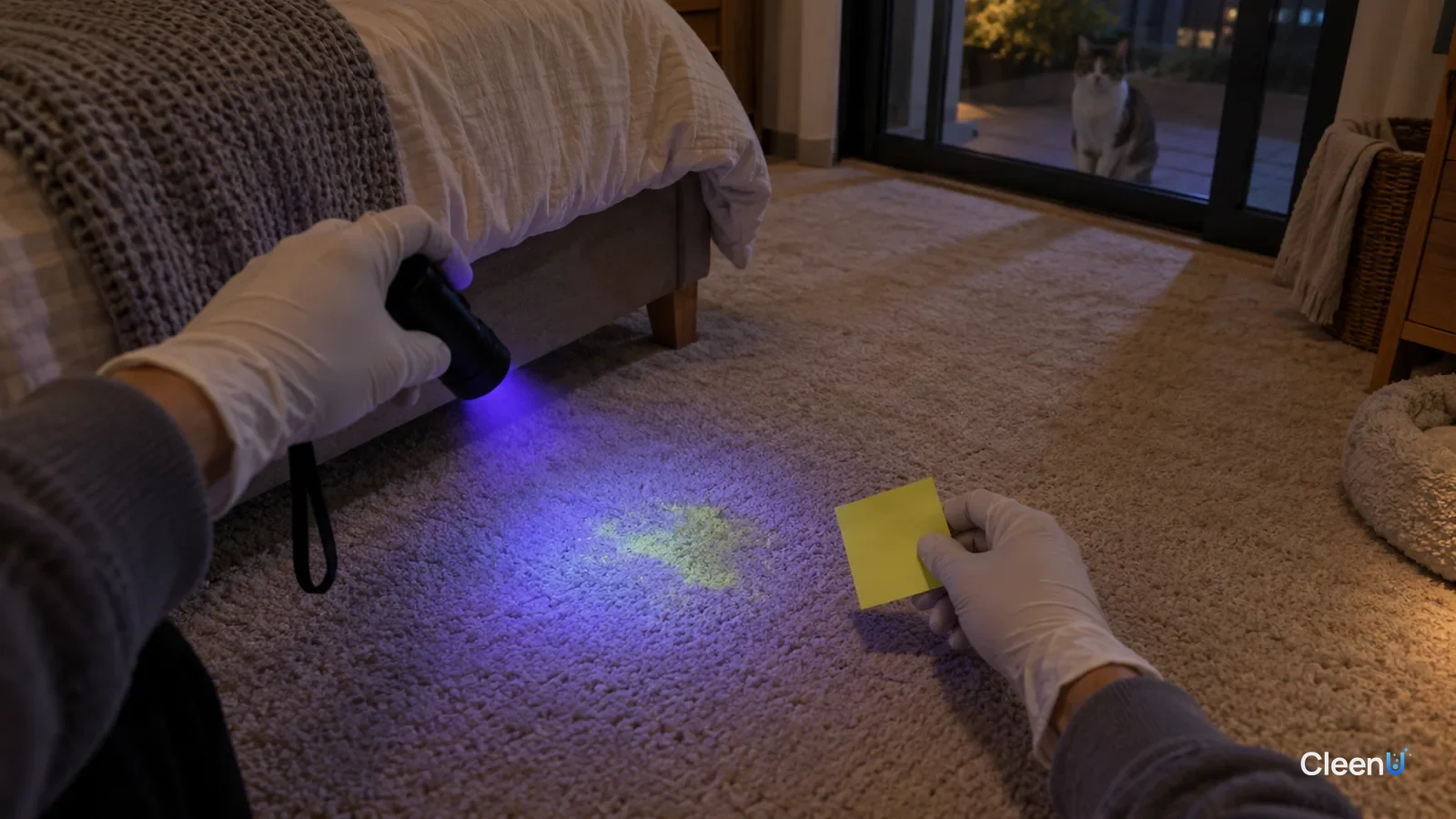
If the cat urine smell won't go away no matter how often you scrub, the cleaner is rarely the real problem. You're cleaning the part you can see. Getting rid of it takes three things: find every spot with a UV flashlight and your nose, soak an enzyme cleaner as deep as the urine went and blot it back out, and dry the carpet all the way through to the backing. Skip one, and the smell tends to be back within days.
Cat urine is concentrated, and even a small puddle wicks into the backing, the pad, or the gaps between floorboards. Down there, bacteria keep turning urea into ammonia, and felinine, a compound unique to cat urine, slowly breaks down into sulfur odor molecules. The next time the spot gets damp from mopping or a humid week, the smell usually comes back stronger.
Why cat pee is harder to get out than dog pee
The first reason is concentration. The International Renal Interest Society (IRIS) lists typical urine specific gravity in a well-hydrated animal at roughly 1.015 to 1.045 for dogs and 1.035 to 1.060 for cats. More dissolved material per drop means a small puddle of cat urine usually leaves more urea, salts, and other solids in the carpet once the water evaporates.
The second reason is felinine, a compound dog urine doesn't have. A 2006 study in Chemistry & Biology, by researchers working with Japan's RIKEN institute, found that cauxin, a protein abundant in cat urine, converts a precursor into felinine. RIKEN's summary notes that pure felinine has no smell. Left at room temperature, it breaks down into volatile compounds carrying thiol (sulfur) groups, and those produce the sharp "catty" smell. The researchers identified several sulfur volatiles above cat urine, including 3-mercapto-3-methyl-1-butanol (MMB), and called them candidates rather than confirmed culprits.
That's why cat urine smell gets worse as it sits. It also varies: cauxin and felinine rise with age after about three months, and adult males usually have more than females. If your cat's urine suddenly smells different, ask your vet.
What happens to a cat urine spot between the accident and the comeback smell
- Fresh: urea, felinine, proteins, and salts are dissolved in water and wick into fibers and backing
- Hours to days: bacterial urease splits urea into ammonia and carbon dioxide; the spot usually turns alkaline and smells sharper
- Meanwhile: felinine slowly breaks down at room temperature and releases sulfur volatiles
- Drying: the surface dries first; urea, odor precursors, proteins, and salts stay in fibers, backing, and pad
- Re-wetting: moisture redissolves the residue, bacterial activity and evaporation resume, and the smell usually returns
The urea-to-ammonia step is well documented. Many bacteria make urease, which splits urea into ammonia and carbamate, and the carbamate falls apart into a second ammonia molecule (reviewed by Mobley and colleagues in Microbiological Reviews, 1989 and 1995). Carpet already carries plenty of bacteria, so urea in a urine spot gets broken down sooner or later, and the spot usually ends up more alkaline and more ammonia-heavy.
You'll also read that dried cat urine forms uric acid crystals that "reactivate" with moisture. We couldn't find veterinary or academic sources that support this; the Merck Veterinary Manual notes that most dogs convert uric acid into soluble allantoin, and only a few breeds such as Dalmatians excrete much poorly soluble urate. A dried cat urine spot holds mostly urea and its breakdown products, sulfur odor compounds and their precursors, proteins, and salts, and most of that dissolves in water. So the strategy is to get liquid down to the residue, then pull it back out.
Three reasons the smell comes back after you clean
You missed a spot. This is the most common reason. The Cornell Feline Health Center notes that cats return to places they've marked, and a cat that pees outside the box rarely picks one place: bed legs, under the bed, corners, curtain hems, and behind doors are all common. Marking cats often spray walls, curtains, or the side of a headboard, leaving only a few drops on the floor. The smell you notice days later may come from a spot you never saw.
The cleaner never reached the urine. Urine sinks into the backing and pad, and a light mist on top doesn't. Use roughly as much liquid as the original accident and cover an area wider than the visible stain.
It never fully dried. Putting a mat or pet bed back on the spot, or closing up the room on a rainy day, traps moisture in the backing. Residue and bacteria keep working, and the smell returns with a musty edge.
How to find cat pee with a black light, and where it fools you
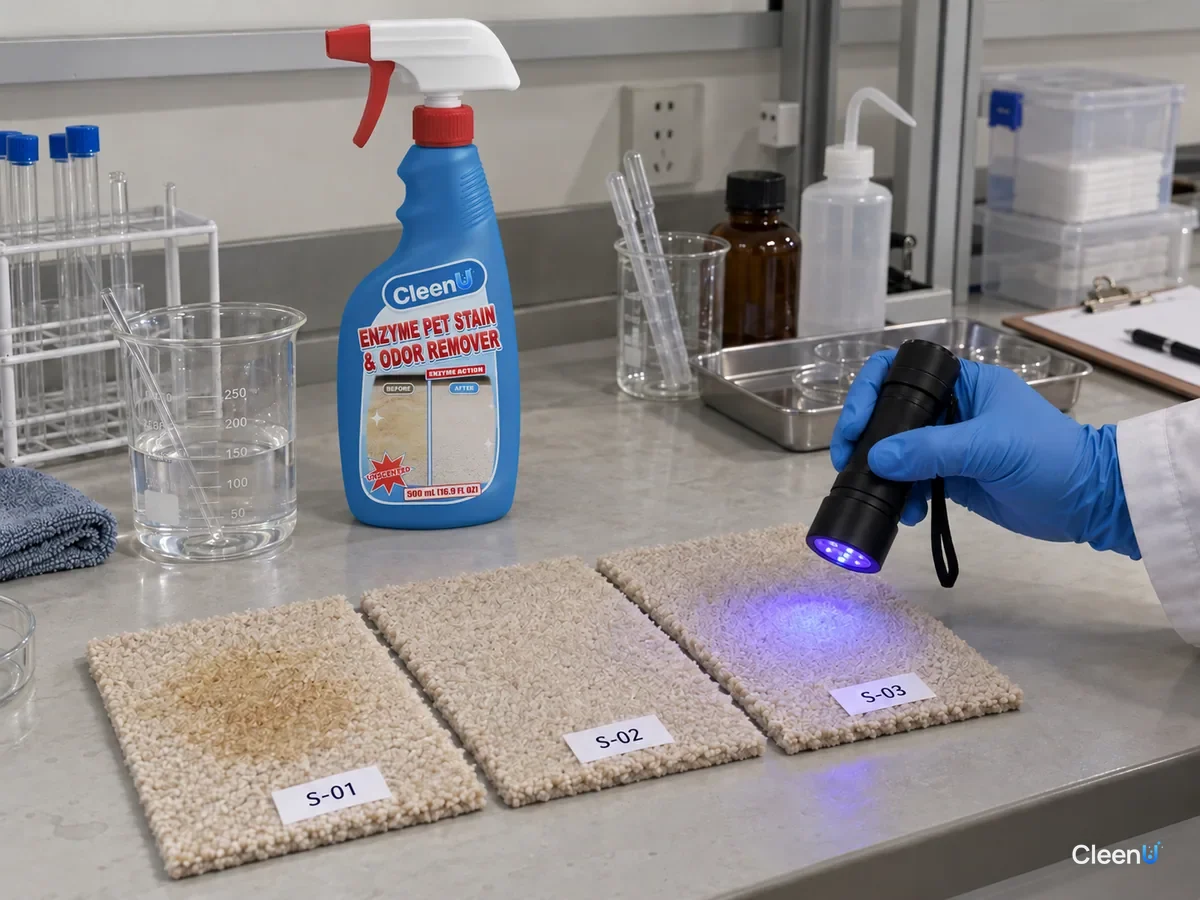
Your nose tells you which area smells; a UV flashlight (often sold as a black light) narrows it to specific spots. Some components of dried urine fluoresce and usually show up in the dark as pale yellow or yellow-green patches, drips, or runs.
- Wait until dark or close blackout curtains, and turn off every light.
- Hold the light low and sweep slowly across the floor at a shallow angle.
- Start with your cat's routes and known accident spots, then bed legs, under the bed, corners, curtain hems, behind doors, and furniture legs. On walls, scan from the floor up to about tail height.
- When something glows, sniff it and press a white paper towel on it. If it smells like urine or the towel turns yellow, mark the edge with painter's tape.
- Finish the whole room before turning the lights back on.
Pet UV flashlights are usually 365 nm or 395 nm; a 365 nm light typically gives off less visible purple glow, so stains stand out more. Never shine it in people's or pets' eyes.
A black light misleads in a few predictable ways:
- Other things glow. Laundry brighteners, some carpet fibers, drink spills, certain glues, and paper towels can fluoresce. Confirm every glow by smell and a paper towel.
- Treated spots can still glow. The compounds that fluoresce aren't necessarily the ones that smell. Judge success by the re-wet sniff test, not the glow.
- Fresh, faint, or hidden stains are hard to see, especially on dark or patterned carpet. Get down and sniff section by section.
- It only shows the surface. Urine usually spreads wider in the backing, so treat past the outline you marked.
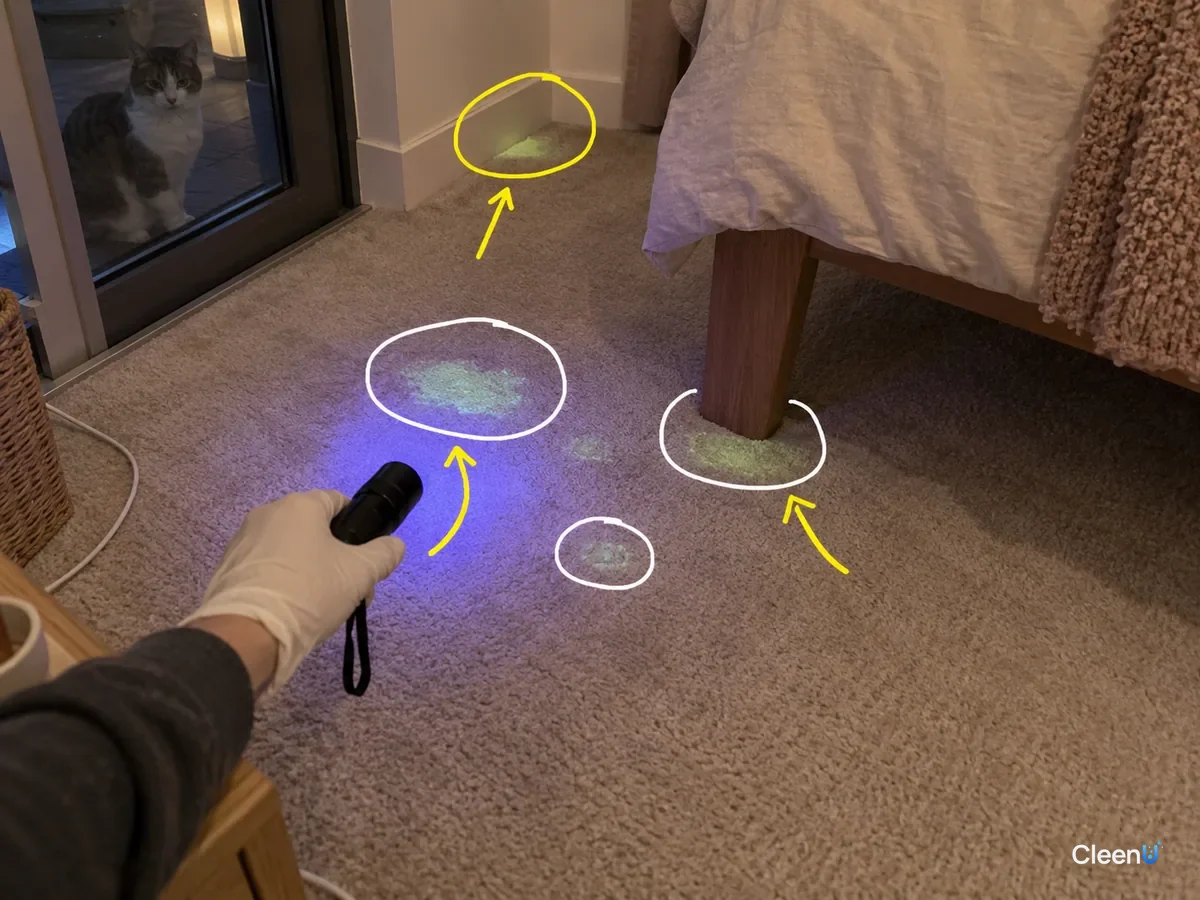
Pair it with a re-wet test: mist a suspect spot with water or lay a damp towel on it, wait about ten minutes, and sniff. Residue you can't smell dry often shows up damp, which is why cat pee usually smells more when it gets wet again.
Why vinegar, baking soda, bleach, and scented sprays don't fix it
Vinegar ties up some ammonia, so the smell eases briefly, but it does nothing for the sulfur compounds or the residue in the pad. The Cornell Feline Health Center advises against products containing ammonia or vinegar on soiled spots because they smell like urine and can be irritating. Ammonia cleaners are worse: the ASPCA points out that urine already contains ammonia, so these can draw a cat back to the spot.
Baking soda absorbs a little surface odor and moisture but can't reach the backing, and the powder lingers in the pile. Use it, if at all, after the spot is treated and dry.
Bleach reacts with ammonia, including the ammonia in urine, to form chloramine gas, according to the Tennessee Poison Center. That's why bleach on a urine spot often makes the room smell harsher, and it can strip carpet color. Don't use it at the same time as or right before an enzyme cleaner either: hypochlorite denatures proteins, enzymes are proteins, and it typically knocks them out.
Rubbing alcohol and scented sprays carry away almost no residue; fragrance just hides the smell from you, not from your cat's far keener nose. Cornell's wording is that odors need to be neutralized, not just deodorized.
Different materials, different methods, different limits
| Material | Where urine goes | What to do | Where DIY tops out |
|---|---|---|---|
| Synthetic low-pile carpet | Pile and backing; pad if the volume was large | Blot, soak wider than the stain, wait, blot hard, lift a corner to dry | Pad soaked and two treatments still smell: replace that pad section |
| Wool or silk rugs | Same, but the fiber is protein | No protease cleaners; blot and call a rug cleaner | DIY risks color loss and felting |
| Upholstered cushions | Foam under the fabric | Wash removable covers per tag; soak and blot foam locally, stand to dry | Deeply soaked foam rarely comes fully clean |
| Washable bedding | The fabric | Rinse the spot with cool water, then wash per tag | Repeat once if needed |
| Mattresses | Ticking, quilting, foam or latex | Light passes, never saturate, blot each time, force air through | Deep saturation has a ceiling |
| Sealed wood, tile | Surface and seams | Blot fast, spray and wipe, soft-brush grout | Urine in board seams or dark staining is a flooring issue |
| Leather, suede | Surface and stitching | Blot with a damp cloth, clean as leather | Don't soak; call a pro if it reached the lining |
Wool and silk are protein fibers, and a protease can't tell urine protein from rug protein. Foam needs enough liquid to reach the urine but not so much that it stays wet for days, so use light passes, blot each time, and run a fan.
What to look for in an enzyme cleaner, and what it can and can't do
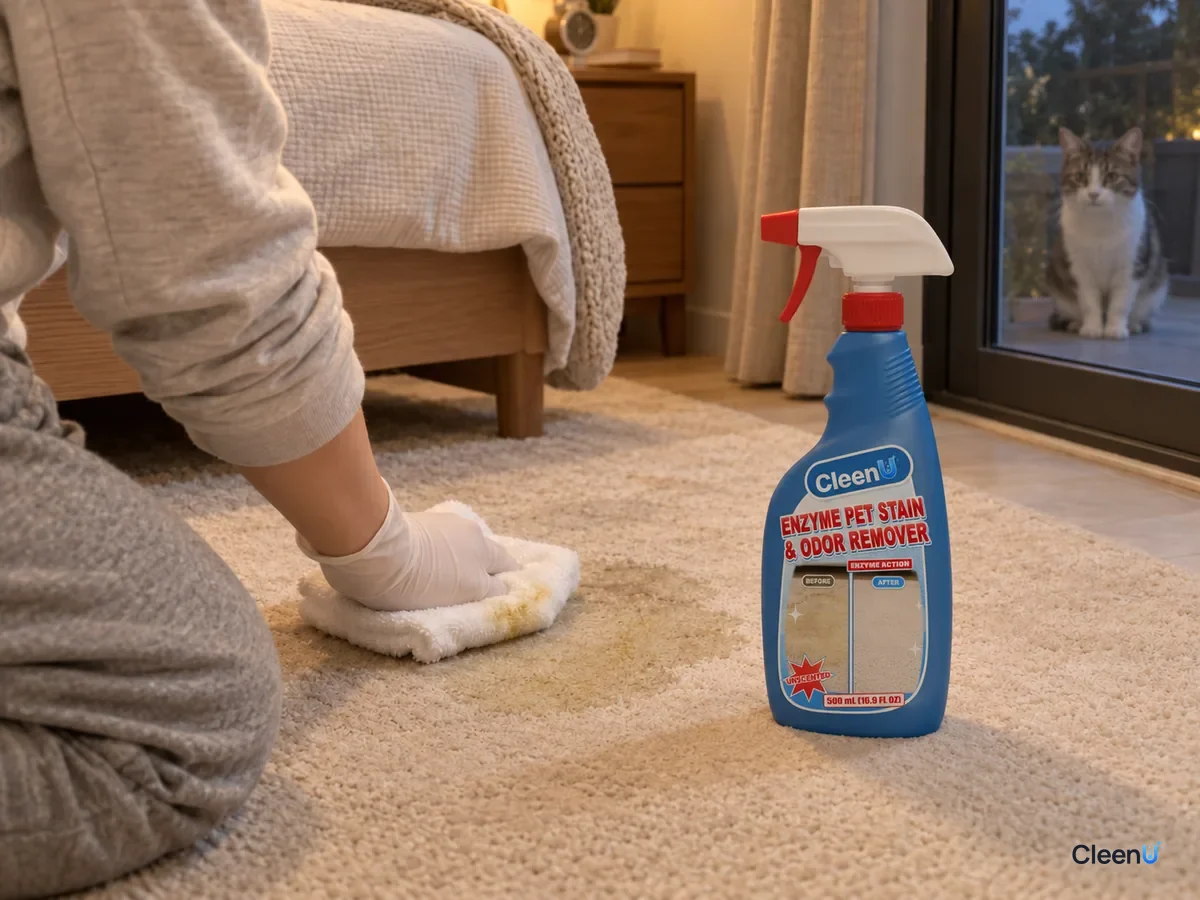
When you pick a cleaner for cat urine, check three things. It should contain enzymes such as protease and lipase that break down the organic residue in the stain. It should include surfactants that wet the fibers and carry loosened residue out. And it should be unscented, so when you can't smell urine afterward, it's because the source is gone, not covered up. CleenU Enzyme Pet Stain & Odor Remover is one example: a ready-to-use spray pairing protease, lipase, and amylase enzymes with nonionic surfactants, close to neutral, with no added fragrance. The enzymes break down protein- and oil-based odor sources, the surfactants help carry the residue out, and blotting removes it.
It's a cleaner, not a disinfectant. It can't replace finding every spot or drying completely. Per the product page, skip wool, silk, and other animal-protein fibers, genuine leather and suede, and unsealed hardwood; don't use it with or right after chlorine bleach; and spot-test dark fabrics. Keep pets out until the area is completely dry.
For cat urine on carpet, upholstery, and around the bed, try CleenU Enzyme Pet Stain & Odor Remover.
For floors, litter areas, and pet gear, see our pet home cleaning guide.
How to treat a cat urine spot, step by step
This example uses a beige low-pile bedroom rug. Adjust for other materials using the table above.
- Shut the cat out until the spot is dry.
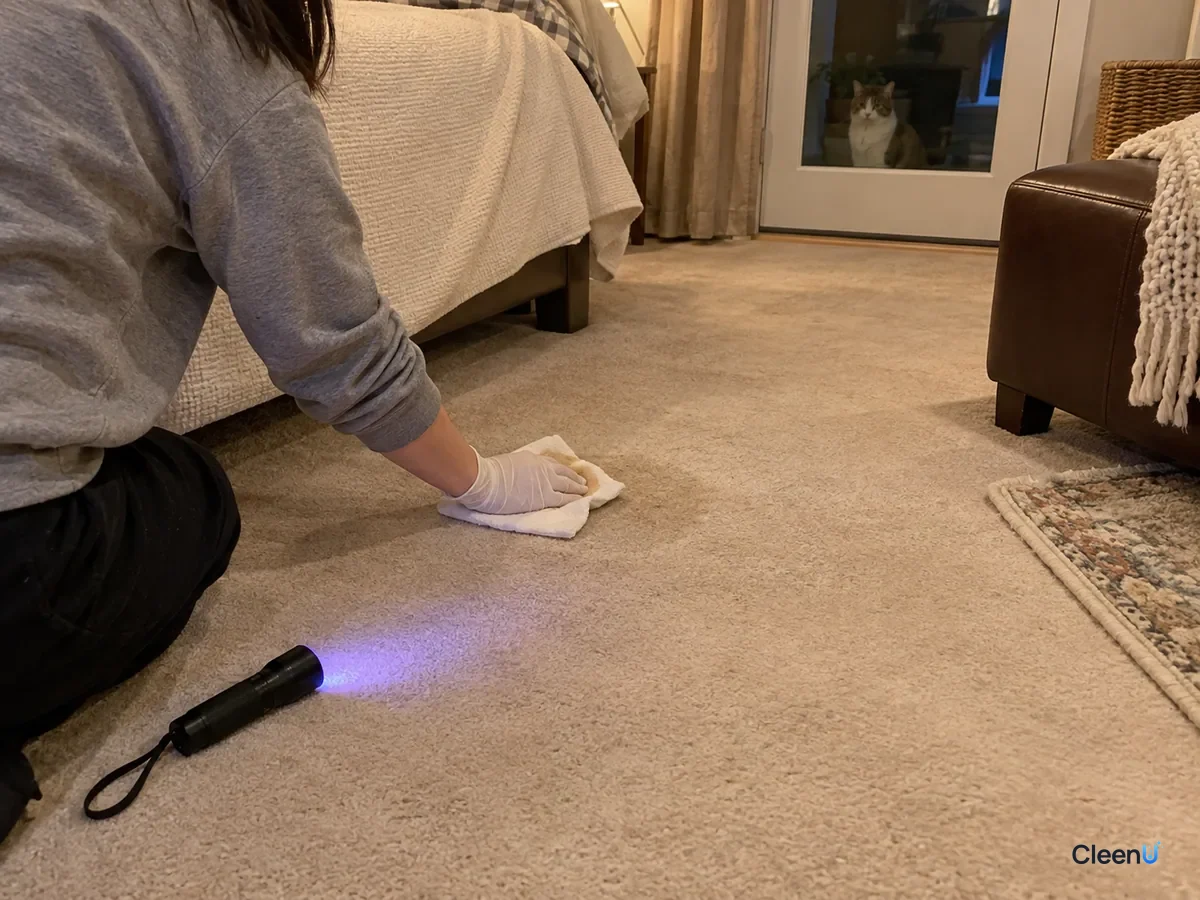
- Blot fresh urine. Press thick paper towels or an old towel down hard with your palm or foot, switching to dry sections. Press, don't rub; rubbing pushes urine wider and deeper.
- Spot-test somewhere hidden, blot, and check for dye transfer or pile changes.
- Soak it. Spray past your taped outline until the carpet is clearly wet, using about as much liquid as the accident. Pre-wet an old dried stain with plain water for a few minutes first.
- Wait 10 to 15 minutes. Don't blot early. If the surface starts drying, mist a little more.
- Blot it back out with a clean white towel, pressing hard and moving to dry sections until little or no yellow comes up.
- Dry it completely. Open a window, aim a fan at the spot, and lift the rug corner so the underside gets air. Keep mats, beds, and the cat off it until dry.
- Re-check. Once it feels as dry as the surrounding carpet, do the re-wet sniff test. If you still smell urine, treat again with more liquid over a wider area.
If two proper treatments still leave a clear smell and the area isn't shrinking, the urine has likely reached the pad or floor, and surface treatment has done what it can.
Stop and rethink if you see any of these
Stop if the test spot fades, fuzzes, or the backing glue softens; if the material is wool, silk, leather, or suede; if two treatments still leave a clear smell on the re-wet test and the area keeps growing; or if anyone gets eye, nose, or throat irritation, especially after bleach was used. In the first three cases, stop treating it yourself and consider replacing the pad or calling a professional cleaner. For irritation, open windows and leave the room. If your cat strains, pees often in small amounts, has blood in the urine, licks its genitals a lot, or strains with nothing coming out, take it to a vet right away; a male cat straining without producing urine is an emergency.
How to know it's really gone: the re-wet sniff test
Not smelling anything while the carpet is wet doesn't count. It's done when the spot is fully dry and still doesn't smell after you re-wet it:
- Dry: feels like the surrounding carpet; a pressed paper towel comes up dry.
- Dry sniff: no urine or ammonia smell up close.
- Re-wet sniff: mist or cover with a damp towel for about ten minutes; still no urine smell.
- UV re-check: a faded glow is a good sign; a remaining glow isn't a failure by itself.
- Your cat: over the next few days, it stops sniffing, scratching, or squatting there.
Why insist on re-wetting a dry spot? Dried urine is only short of water. The urea and protein residue are still there, and once the spot gets damp, bacteria pick up where they left off and the ammonia and sulfur notes of cat urine come back. A spot that smells fine right after spraying may just be masked by moisture or fragrance. A spot that stays odor-free after drying and re-wetting has actually lost its source. That's also why an unscented cleaner helps: with no fragrance in the way, what you smell on the re-wet test is the real result.
For a fairer read, ask someone who doesn't spend much time in that room to sniff, since your own nose adapts. Use the same spot, the same small amount of water, and the same ten-minute wait each time so the results compare.
When your cat pees outside the litter box, treat it as a health signal first
Cleaning handles the result, not the cause. If your cat suddenly starts going outside the box, call your vet first. The Cornell Feline Health Center lists medical causes first: urinary tract inflammation makes urination painful, frequent, or urgent; kidney disease, thyroid disease, and diabetes increase drinking and urination; digestive problems make defecation painful; and older cats with mobility or cognitive issues may not reach the box in time. Cornell adds that sick cats don't always act sick.
Get your cat seen promptly if it strains or cries while peeing, goes often in small amounts, has blood in its urine, or licks its genitals a lot. A male cat, neutered or not, that strains repeatedly with little or nothing coming out is an emergency, and Cornell says it needs immediate care. The ASPCA also recommends a full vet exam before working on litter box behavior.
Once medical causes are ruled out, look at the box: Cornell and the ASPCA both mention one more box than cats, unscented fine-grained litter about 1 to 2 inches deep, and quiet spots away from food. Clean without finding the cause, and your cat picks a new spot; fix the cause without cleaning, and the old smell keeps pulling it back.
Still smells? Work down this list
Cat urine smell still there after cleaning: likely causes and fixes
| Cause | What you'll notice | What to do | Next time |
|---|---|---|---|
| Spots you haven't found | Smell centered away from what you treated, stronger near walls, under the bed, or on vertical surfaces | Sweep the room with UV in the dark, confirm by sniff and paper towel, treat each spot | Scan the whole room every time |
| Cleaner didn't reach deep enough | No smell on top, but it shows when pressed or re-wet | Re-treat with more liquid over a wider area, wait, blot hard | Match liquid to the accident; pre-wet old stains |
| Never fully dried | Smell returns after mopping, rain, or a humidifier, with a musty note | Lift the rug edge and run a fan until the underside is dry | Keep mats and beds off until dry |
| Pad or subfloor saturated | Still smells after two treatments; area not shrinking | Pull back the carpet, replace soaked pad, call a flooring pro for the subfloor | Put a washable waterproof pad where accidents happen |
| Ammonia, vinegar, or scented products used | Cat keeps returning to sniff, scratch, or squat | Wet with plain water, blot out, let dry, redo the enzyme treatment | Use only unscented enzyme cleaner on urine |
| Cat is still peeing there | New spots every few days | See the vet, then adjust number, placement, and litter of boxes | Scoop daily; watch how often and how much your cat pees |
The first three causes account for most comeback smells and cost the least to fix, so start there.
On cost: washable or cheap doormats aren't worth repeated treatments. Carpet pad usually costs less than carpet, so swapping a soaked section beats spraying it over and over. For deeply soaked mattresses and sofa foam, decide whether "mostly gone" is good enough or call a pro; urine in the subfloor is a flooring repair. A sensible stopping point: after two correct treatments, if the dry spot still smells when re-wet, change approach instead of buying a third bottle.
Afterward, put a washable waterproof pad where your cat used to go and treat fresh accidents right away. For everyday floor care, see cleaning floors in a pet home; if you have a robot mop, read can a robot mop clean up pet urine? first.
Cat urine smell that keeps coming back: common questions
Why does cat pee smell keep coming back?
Because the source is still there. Usually a spot was missed, the cleaner didn't reach as deep as the urine, or the area never fully dried, so residue releases ammonia and sulfur odors when it gets damp. Search with a UV light in the dark, then soak, wait, blot, and dry.
How long does cat urine smell last?
As long as the source is there, it won't fade on its own and returns whenever the spot gets damp. Once treated properly, a fully dry spot shouldn't smell; if it smells after re-wetting, treat it again.
What gets rid of cat urine smell?
An unscented enzyme cleaner used with hard blotting and complete drying. Enzymes break down protein- and oil-based odor sources and surfactants help carry residue out. Skip ammonia cleaners, vinegar, and heavy fragrance.
Is everything that glows under a black light cat pee?
No. Laundry brighteners, some fibers, drink spills, and glue can glow too. Sniff any glowing spot and blot it with a white paper towel; urine smell or a yellow tint confirms it.
The spot still glows after cleaning. Did it fail?
Not on that evidence alone. The compounds that glow aren't always the ones that smell. Go by the re-wet sniff test once it's fully dry.
I used an enzyme cleaner and it still smells. Is the product the problem?
Check the method first: too little liquid, blotting early, covering it before it dried, or a missed spot. If two proper treatments still smell, the pad is likely saturated.
Can I pour bleach on cat pee?
Don't. Bleach reacts with ammonia compounds in urine to form irritating chloramine gas and can strip carpet color, and it can knock out an enzyme cleaner used afterward.
Do vinegar and baking soda get rid of cat pee smell?
Only partly. Vinegar briefly dulls some ammonia and baking soda absorbs a little surface odor, but neither removes residue in the backing, and vinegar leaves its own smell.
Do I need to rinse after the enzyme cleaner?
Not on carpet or upholstery. Wait 10 to 15 minutes, blot, and air-dry. On tile and other hard floors, you can wipe with a damp cloth and let it dry before your cat walks on it.
How long should I keep my cat out of the room?
From the first spray until the spot is completely dry, meaning it feels like the surrounding carpet and a pressed paper towel comes up dry.
What about cat pee on a wool rug or leather couch?
Don't use a protease-based cleaner. Wool and silk are protein fibers, and leather shouldn't be soaked. Blot with a dry towel, then call a rug cleaner or leather specialist.
If I clean the spot well, will my cat stop peeing there?
Cleaning removes the smell that draws your cat back, but you still need the reason. See your vet to rule out urinary and other health problems, then review your boxes.
Sources (accessed Oct 2026)
- IRIS, "Urine Specific Gravity"
- Miyazaki M, et al., Chemistry & Biology, 2006; RIKEN Research, "How cats produce their distinctive smell"
- Mobley HL, et al., Microbiological Reviews, 1989 and 1995
- Merck Veterinary Manual, "Urolithiasis in Dogs"
- Cornell Feline Health Center, "Feline Behavior Problems: House Soiling" and "Feline Lower Urinary Tract Disease"
- ASPCA, "Litter Box Problems"
- Tennessee Poison Center (Vanderbilt), "Why shouldn't I mix household chemicals with bleach?"
Not a substitute for veterinary care.
When cat urine smell won't go away, the fix is rarely a stronger or better-smelling cleaner. It comes down to whether you found every spot, whether the cleaner reached as deep as the urine, and whether the area dried all the way through. Find spots with a UV light and your nose, soak them with an unscented enzyme cleaner, wait, blot hard, dry the backing with a fan, and confirm with a re-wet sniff test. If two proper treatments still leave a smell, check the pad and floor instead of adding more product. And if your cat keeps going outside the box, see the vet and clean at the same time.