
Comparison
Degreaser vs Dish Soap vs Baking Soda for Kitchen Grease
Direct answer
Pick by the state of the grease. Dish soap handles fresh, light grease and needs rinsing. Baking soda works through mild alkalinity and gentle abrasion, so it's fine on thin grease but slow on old buildup. Old, polymerized grease film is a job for a dedicated alkaline, solvent-based degreaser.
How to choose
-
Washing dishes or wiping fresh grease off the stovetop after cooking
Choose Dish soap, then rinse or wipe with a clean damp cloth
It's the most effective and gentlest option for fresh grease.
-
Light scorch marks on pans or sink stains, and you'd rather skip chemicals
Choose A baking soda paste, rubbed gently and rinsed off
Mild alkali and gentle abrasion suit small areas of light grime.
-
Yellowed, tacky grease on the range hood, backsplash, or cabinet doors
Choose An alkaline, solvent-based kitchen degreaser, left to sit, then wiped and rinse-wiped
Only saponification plus solvent swelling breaks down oxidized, polymerized film.
-
Grease on aluminum, raw wood, or marble
Choose Dish soap or a neutral cleaner
Strong alkali darkens aluminum and damages raw wood and stone.
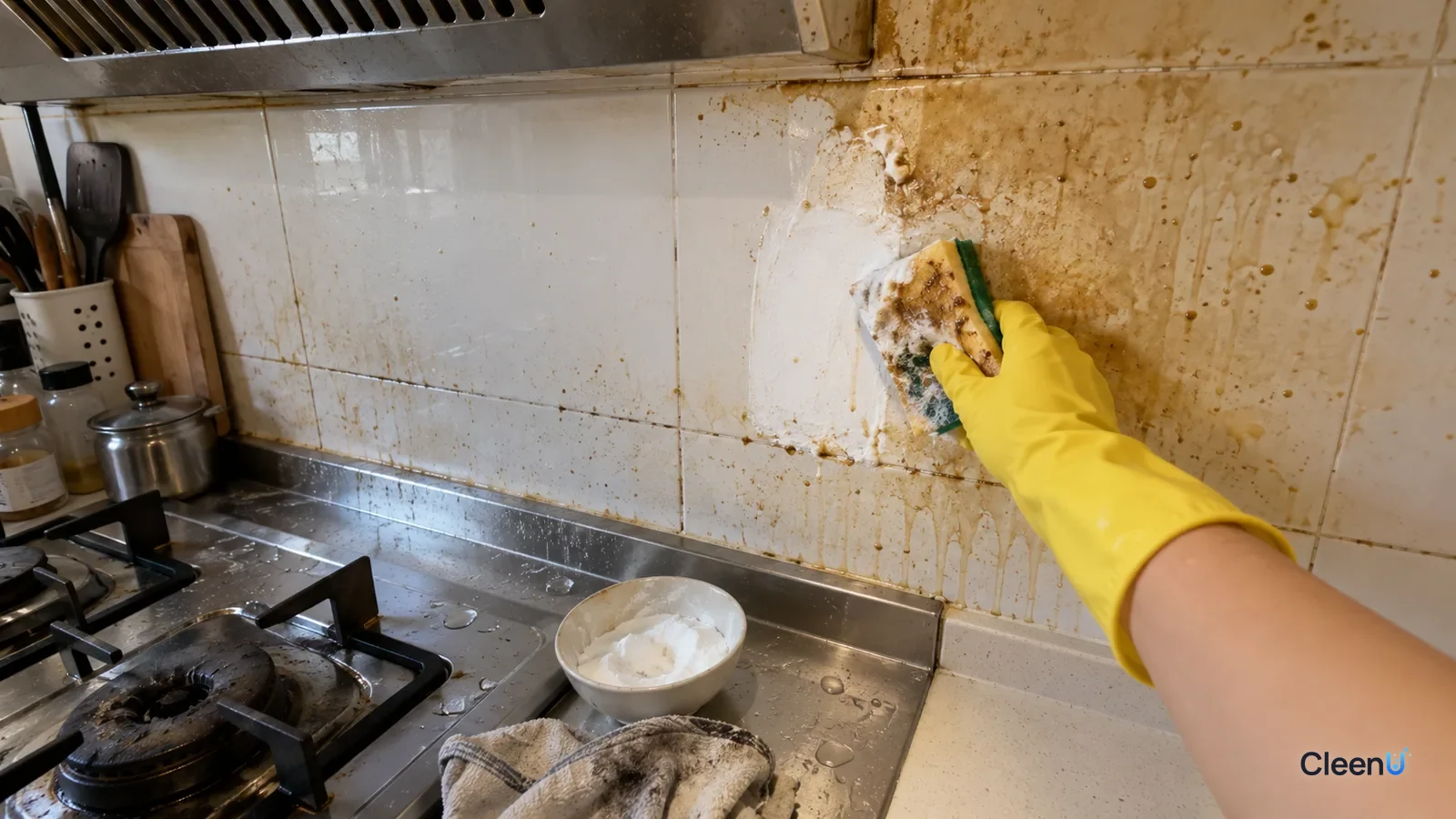
Most kitchens have three grease fighters on hand: dish soap, baking soda, and a kitchen degreaser. Opinions online are all over the place: dish soap is enough, baking soda does everything, you have to buy a degreaser. In reality they work differently and are good at different kinds of grease. Used right, they all work; used wrong, they waste your effort.
First, figure out what kind of grease it is
Fresh grease: splatter and drips right after cooking. Liquid triglycerides that flow easily.
Light film: grease from the past few days or a week or two. A little tacky, still light in color.
Old buildup: months or years of grease on the range hood, backsplash, and cabinet doors that has reacted with oxygen and polymerized from a liquid into a tacky, yellowed, hardened film mixed with dust. At that point it's closer to paint than to oil.
Carbonized crust: hard, brittle black buildup on stovetops, ovens, and pan bottoms, food and grease carbonized by high heat.
Each needs a different tool.
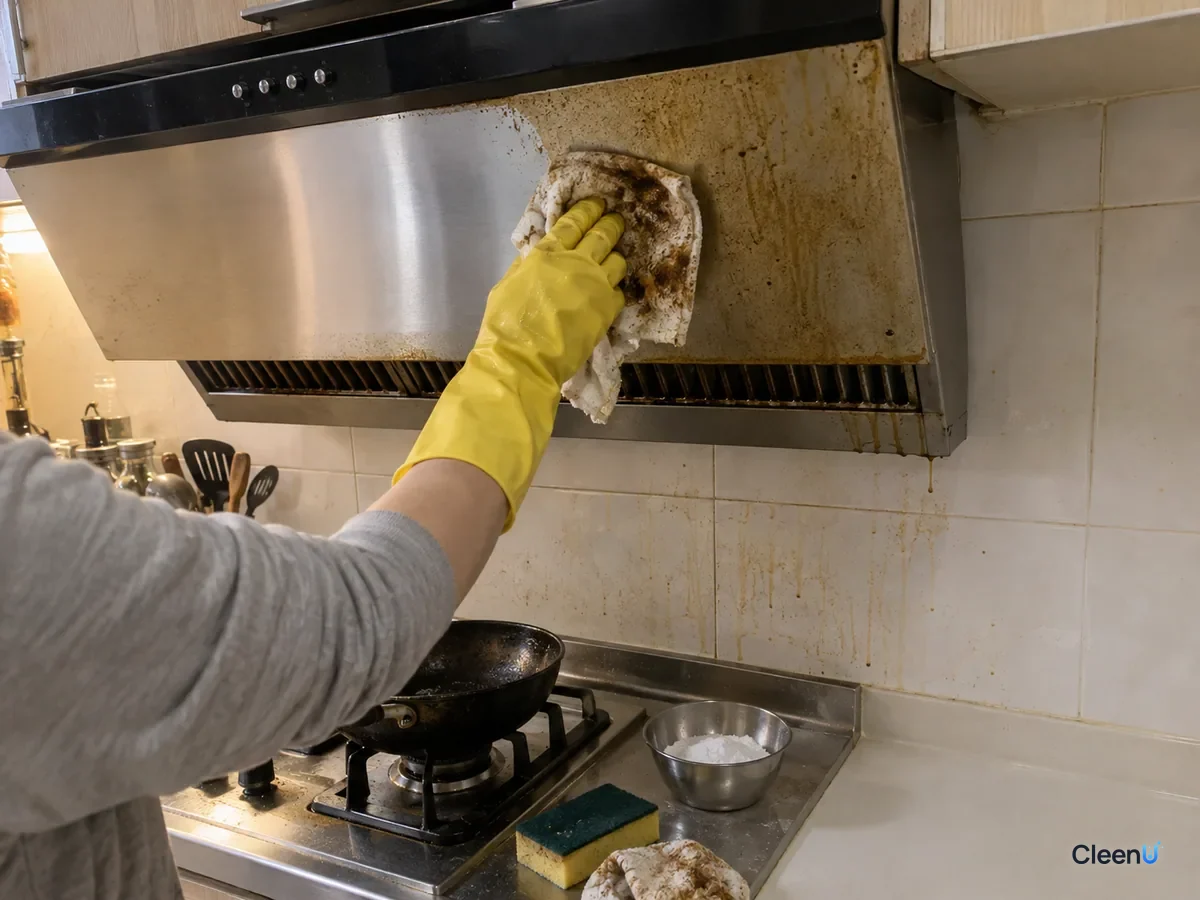
Dish soap: for fresh grease
Dish soap is mainly anionic and nonionic surfactants, usually close to neutral pH. Surfactant molecules have one oil-loving end and one water-loving end, so they wrap grease into tiny droplets that water carries away. It's excellent on fresh grease, which is why it's made for dishes: the grease on plates is almost always fresh.
Its limits: surfactants struggle to penetrate oxidized, polymerized film, so it works slowly on old grease. And because it's high in solids and foamy, on backsplashes and range hoods you can't rinse, it leaves a white, tacky residue.
Baking soda: mild alkali plus gentle abrasion
Baking soda is sodium bicarbonate, mildly alkaline in water (around pH 8.3). That alkalinity saponifies a little grease, but it's weak, so it's slow. Baking soda does most of its work through gentle abrasion, scrubbing grime off the surface, and its particles are soft enough not to scratch most surfaces.
It's good for thin grease, light scorch marks on pan bottoms, and sink stains. On large areas of old grease film it's slow, and it dries to a white powder you have to wipe off.
Dedicated kitchen degreaser: alkali plus solvent
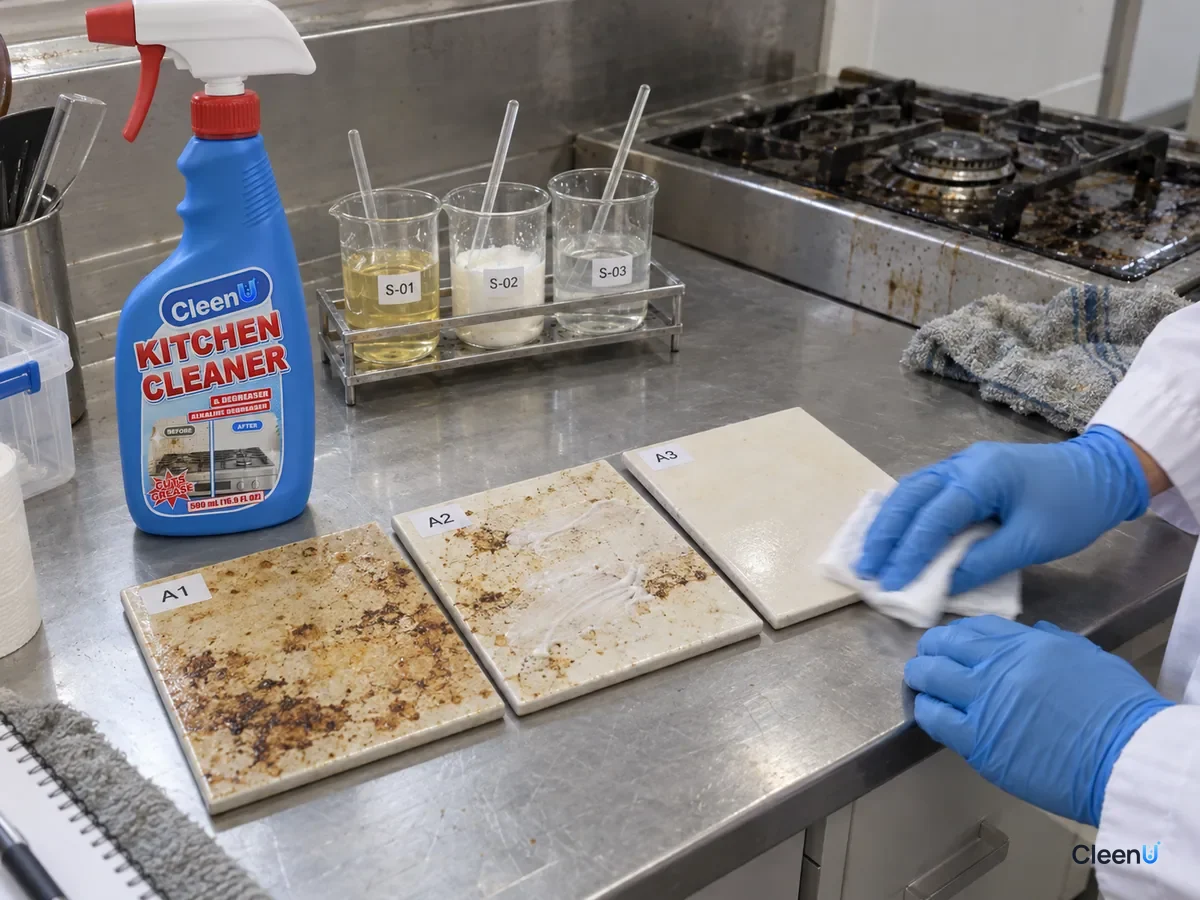
A dedicated kitchen degreaser is usually a stronger alkaline formula with solvent and surfactants. Take CleenU Kitchen Cleaner & Degreaser as an example. It's an alkaline kitchen degreasing spray, pH 10.0 to 11.5 as supplied, made with alkaline builders, nonionic surfactants, and glycol ether solvent, with no chlorine and no abrasives. It's ready to use: let it sit 1 to 3 minutes, 5 for sticky grease, then wipe and follow with a plain-water wipe.
The builders saponify by breaking the ester bonds in polymerized grease. The glycol ether solvent swells and softens the hard film and loosens its grip on the surface. The surfactants emulsify what's loosened so the cloth can lift it. Working together, they handle old grease film that dish soap and baking soda can't.
It has limits too: not for aluminum cookware or trim, unsealed wood cabinets, natural marble, hot stovetops, or carbonized oven crust, and never mixed with acidic or chlorine cleaners. It's more alkaline, so wear gloves and always finish with a clean-water wipe.
Why old grease turns into something like paint
Cooking oils are full of unsaturated fatty acids, which have carbon-carbon double bonds along their chains. Once oil lands on a backsplash or range hood, oxygen, heat from the stove, and kitchen light slowly attack those double bonds and form peroxides. The peroxides then link neighboring oil molecules together. The molecules keep growing, and the oil goes from a liquid that flows to a thick semi-solid and finally to a yellow, hardened, net-like film. It's the same family of reactions that makes oil paint and wood finishing oils "dry."
That film also traps airborne dust and cooking particles, so it keeps getting darker. And it doesn't just sit on top of the tile or stainless steel. It fills the microscopic texture of the surface and locks in mechanically.
That explains why the three tools perform so differently. Dish soap surfactants are great at wrapping up droplets of oil that can still move, but against a cross-linked net they only work on the outermost layer. Baking soda's mild alkalinity breaks a few of the ester bonds, too slowly to matter much, so mostly you're relying on arm strength to grind the film off. An alkaline degreaser comes at it from two directions at once. The alkali breaks ester bonds in the film so the net loosens and fragments, the solvent soaks in and swells it, and the surfactants carry the pieces away.
What each one is like to actually use
Wipe a backsplash tile with months of buildup using diluted dish soap and this is what usually happens. The suds slide around on top of the film. Loose grease and dust come off first and the cloth turns yellow, but the tile still feels tacky under your finger. It takes pass after pass, and every pass needs a clean-water wipe afterward or the wall dries with a white haze.
With baking soda paste, you spread the paste over the grease and scrub in circles with a sponge. That's fine for a small spot. Over a whole backsplash or a range hood, your wrist gives out first, and then you have to clean white powder out of every grout line.
With an alkaline degreaser, the sequence is different. Wipe loose dust off the surface with a damp cloth, then spray the degreaser and let it sit on the film for 1 to 3 minutes, or about 5 minutes on the stickiest spots, without letting it dry. When the film starts to change color and soften, wipe in one direction, turning to a clean face of the cloth every so often. Finish with a wrung-out cloth and plain water to remove the saponified grease and any cleaner left behind. When the surface no longer feels tacky and a dry cloth comes away clean, you're done.
If a spot is still sticky after one round, the film there is extra thick. Spray again and give it another dwell instead of reaching for steel wool. If after two or three rounds a spot is still yellow but no longer tacky, it's most likely discoloration of the surface itself, such as aged plastic or a yellowed coating, not grease, and more cleaning won't change it.
Side by side
Dish soap vs baking soda vs kitchen degreaser
| Factor | Dish soap | Baking soda | Kitchen degreaser |
|---|---|---|---|
| How it works | Surfactants emulsify | Mild alkali plus gentle abrasion | Alkali saponifies, solvent swells, surfactants emulsify |
| Fresh grease | Excellent | Fine | Excellent |
| Old polymerized film | Slow | Very slow | Made for it |
| Carbonized crust | Barely works | Light marks only | Limited (use oven cleaner for ovens) |
| Residue | Foamy; rinse or wipe with water | White powder; wipe clean | Wipe with water |
| Surfaces | Gentle | Gentle, mildly abrasive | Not for aluminum, raw wood, or marble |
Which should you use?
Common myths
Baking soda plus vinegar is stronger. The two fizz dramatically, which looks impressive, but the fizz is sodium bicarbonate and acetic acid neutralizing each other into sodium acetate, water, and carbon dioxide. The mild alkali and the mild acid cancel out, and what's left cuts grease worse than baking soda alone. The bubbles are just gas escaping. They don't lift grease.
Dish soap plus degreaser adds up. A degreaser already contains surfactants. Adding dish soap mostly adds foam and residue, which means more rinse wipes. Use them separately: degreaser for old buildup, dish soap for everyday upkeep.
Stronger and longer is always better. The dwell time is there so the alkali and solvent can soak into the film. Past the label time, the liquid starts to dry and leaves a residue that's harder to wipe off. A longer alkaline dwell also puts more stress on nearby caulk and coatings.
Spraying a hot stovetop. A burner that was just on evaporates cleaner almost instantly, so it does nothing except leave marks. Let it cool first.
What to look for if you buy a degreaser
If you decide to buy a dedicated kitchen degreaser, a few things on the label are worth checking. The pH range tells you whether it's alkaline or near neutral; alkaline cuts old grease better but also means keeping it off aluminum, raw wood, and natural stone. Look for a solvent in the formula, since old film needs to swell before it lets go. Check for abrasives; a formula without them is a better fit for stainless steel and painted finishes that scratch easily. And look for a clear dwell time and a list of surfaces it isn't for. A product that tells you what not to use it on is usually more trustworthy than one that claims to cut every kind of grease everywhere.
Finally, think about where you'll actually use it. If most of your grease is on a range hood, backsplash, and cabinet fronts, a ready-to-use trigger spray saves time because you don't have to measure or mix. If you mainly wash pots and plates, a good dish soap is still the right everyday tool, and a degreaser is something you reach for every few weeks.
Whatever you use, the last step is the same: wipe away the dissolved grease and any cleaner with a clean damp cloth, then dry. For the rest of the kitchen, see How to clean a kitchen. For backsplashes, see How to clean grease off a backsplash, and for range hood filters, see How to clean a range hood filter.
Dish soap, baking soda, and kitchen degreaser fight grease in different ways. Dish soap emulsifies with surfactants and is best on fresh grease. Baking soda uses mild alkalinity and gentle abrasion for small areas of thin grease and light scorch marks. A dedicated kitchen degreaser combines alkaline saponification, solvent swelling, and surfactant emulsification for old, polymerized film. Choose by the state of the grease, keep strong alkali off aluminum, raw wood, and marble, and always finish with a clean damp cloth and a dry wipe so no film is left behind.