
How-to
How to Clean a Dog Crate, Pet Carrier, and Cat Tree, Material by Material
Direct answer
Take your pet and all bedding out, remove solids and hair, then clean by material: spray, scrub, and rinse metal and plastic; spot-clean wood, sisal, and plush without soaking. Let everything dry completely before your pet goes back in.
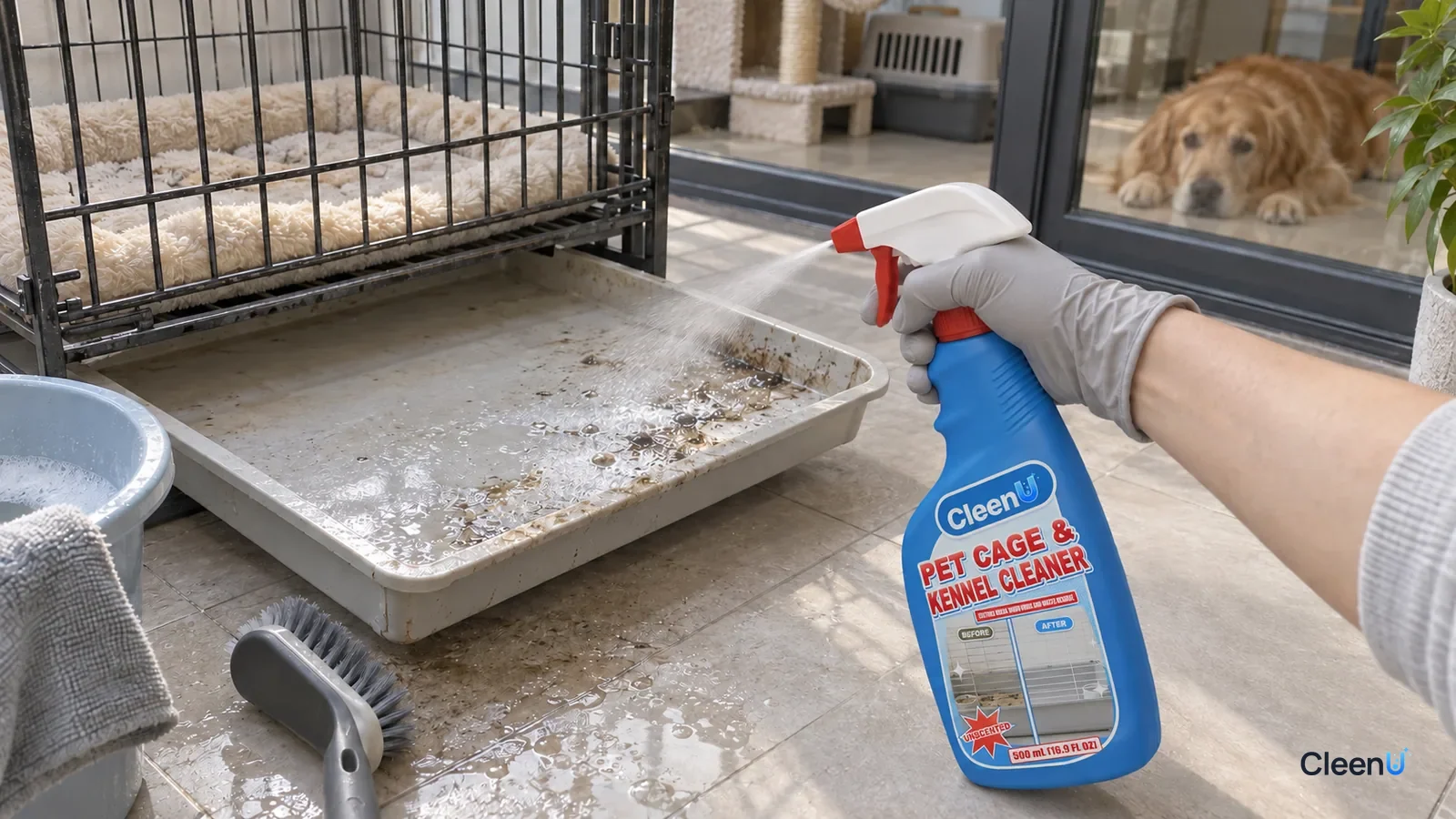
If you're figuring out how to clean a dog crate because hosing it down didn't fix the smell, you're not alone. A quick rinse usually misses three things: the bedding and crate pad, which hold most of the odor; urine that ran to the tray's edges and seeped underneath into the base and seams; and moisture left in the crate, which keeps releasing whatever odor remains. Crate smells come from predictable spots. Find them, use the right amount of water for each material, and dry thoroughly, and you'll get further than any amount of hosing.
Materials vary a lot in how much water they can take. Metal wire, plastic trays, and hard carrier shells don't absorb liquid, so you can spray, scrub, and rinse them. Wood, particleboard, sisal rope, and plush soak liquid in, and flooding them drives odor deeper and makes drying slow.
Where crate odor hides: trays, bars, and corners
Crate soil follows a pattern. A quick look before you start saves a lot of wasted scrubbing.
| Spot | Main soil | What it smells like | What to focus on |
|---|---|---|---|
| Crate pad, blankets, pee pads | Urine, drool, dander, hair | Strongest; often the main source | Wash or replace separately; don't hose with the crate |
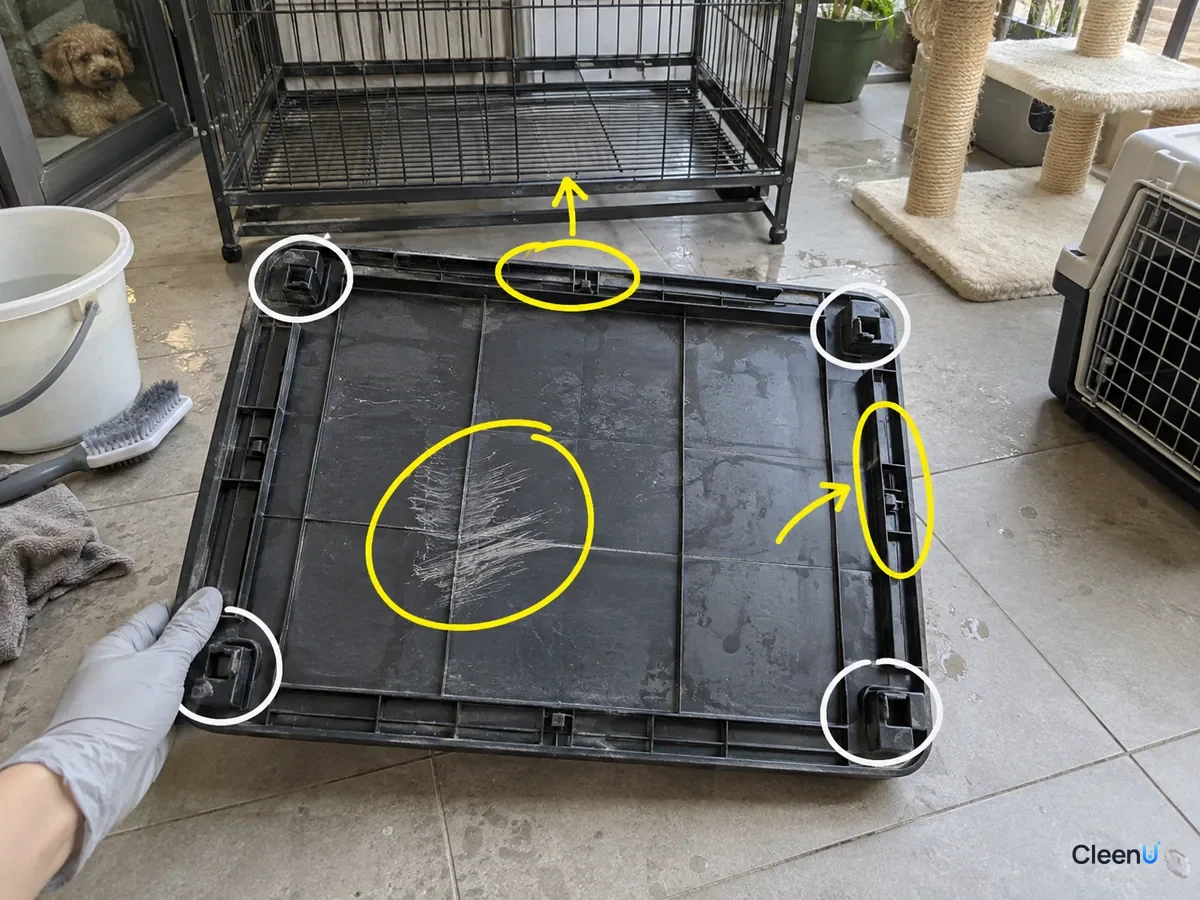
| Plastic tray | Dried urine residue, stool smears | Urine smell up close | Corners, edges, scratches, and the underside |
| Under the tray, base rails | Urine that ran off the tray edge | Only noticeable once the tray is out | Pull the tray and check the floor under the crate |
| Lower bars, door frame | Marking urine, stool rub marks | Localized urine smell | Scrub bars bottom to top |
| Bars near the door, latch | Drool, nose oils, chew marks | Faint, musty | Bar intersections and the latch gap |
| Corners | Stool, vomit | Strong, concentrated | Scrape solids first, then spray and scrub |
Cat trees are different. Sisal posts carry scent from scratching (cats have scent glands in their paws, so scratching is partly marking) plus trapped hair. Platforms and hammocks collect hair, dander, and the occasional hairball. A condo can hide urine. And the particleboard base is the part that suffers most when liquid gets in. Carriers usually get dirty on the road: a stressed or carsick pet may pee or vomit, and liquid runs along the floor grooves into the corners and the seam between the two shell halves.
One more spot people miss: the floor under the crate. Urine that leaks off the tray can soak into carpet or wood seams, so if the area always smells, move the crate and look.
Why material decides how much water you can use
The same cleaner gets used differently on different materials, and it comes down to whether liquid soaks in.
Why you can hose a wire crate but not soak a sisal post
- Non-absorbent materials (stainless steel, powder-coated wire, PP and ABS plastics) hold soil on the surface; a cleaner wets it, a brush lifts it, water carries it away, and the surface dries fast
- Once powder coating is chewed or chipped, bare steel exposed to urine salts and moisture rusts easily, and rough rust spots hold soil and odor
- Older plastic trays develop fine scratches where urine residue hides; scrub along the scratches
- Absorbent materials (solid wood, particleboard, sisal rope, plush, cotton pads) are full of tiny pores, and capillary action pulls liquid in along with the odor compounds dissolved in it
- Pouring water on absorbent materials pushes surface odor deeper, and the moisture inside is slow to dry; damp sisal and plush can mildew, and wet particleboard swells and stays warped
- So absorbent materials get a light spray, dwell time, blotting with a damp cloth, firm pressing with a dry towel, and fast drying
A typical cage cleaner combines a blend of enzymes with nonionic surfactants and cyclodextrin. On a crate, each part has a job. Surfactants wet dried residue and loosen it from bars and trays. The enzymes help break down organic residue such as drool and stool smears. Cyclodextrin, a ring-shaped sugar molecule, can trap some odor molecules in its hollow center. The 3 to 5 minute dwell gives the cleaner time to wet and work; wipe it off too soon and it hasn't done much, but don't let it dry on the surface either.
Fragrance-free matters because the crate is where your pet spends the most time. A strong scent reads as "clean" to us but may be an unfamiliar smell to a dog or cat. There's also a common mistake to avoid: the Cornell Feline Health Center advises against ammonia- or vinegar-based products on urine spots because they smell like urine and can be irritating, and the ASPCA notes that ammonia cleaners may draw a cat back to the spot. That applies inside a crate too.
Dog crates and hard carriers: spray, scrub, rinse
Cleaning a dog crate or hard carrier, in order
Take your pet and all bedding out
Move your pet to another room and remove the pad, blankets, pee pads, and toys. Keep your pet away from freshly sprayed surfaces until everything is dry.
Caution:Never clean the crate with your pet inside, and never spray through the bars.
Dry clean first
With gloves on, scrape stool and vomit into a sealable bag using paper towels or a scraper, then vacuum or brush out hair and kibble crumbs. Dry before wet keeps you from smearing solids or turning hair into a wet mat.
Take it apart
Pull the plastic tray out of the crate and fold the crate if it folds. For a hard carrier, remove the bolts or wing nuts, split the two halves, and take off the door. Rails, seams, and bolt holes are only reachable this way.
Spray thoroughly and wait 3 to 5 minutes
Spray both sides of the tray, the corners, the lower half of the bars, the latch, and the inside of the carrier, with extra on urine spots and smears. Let it sit 3 to 5 minutes, out of direct sun so it doesn't dry.
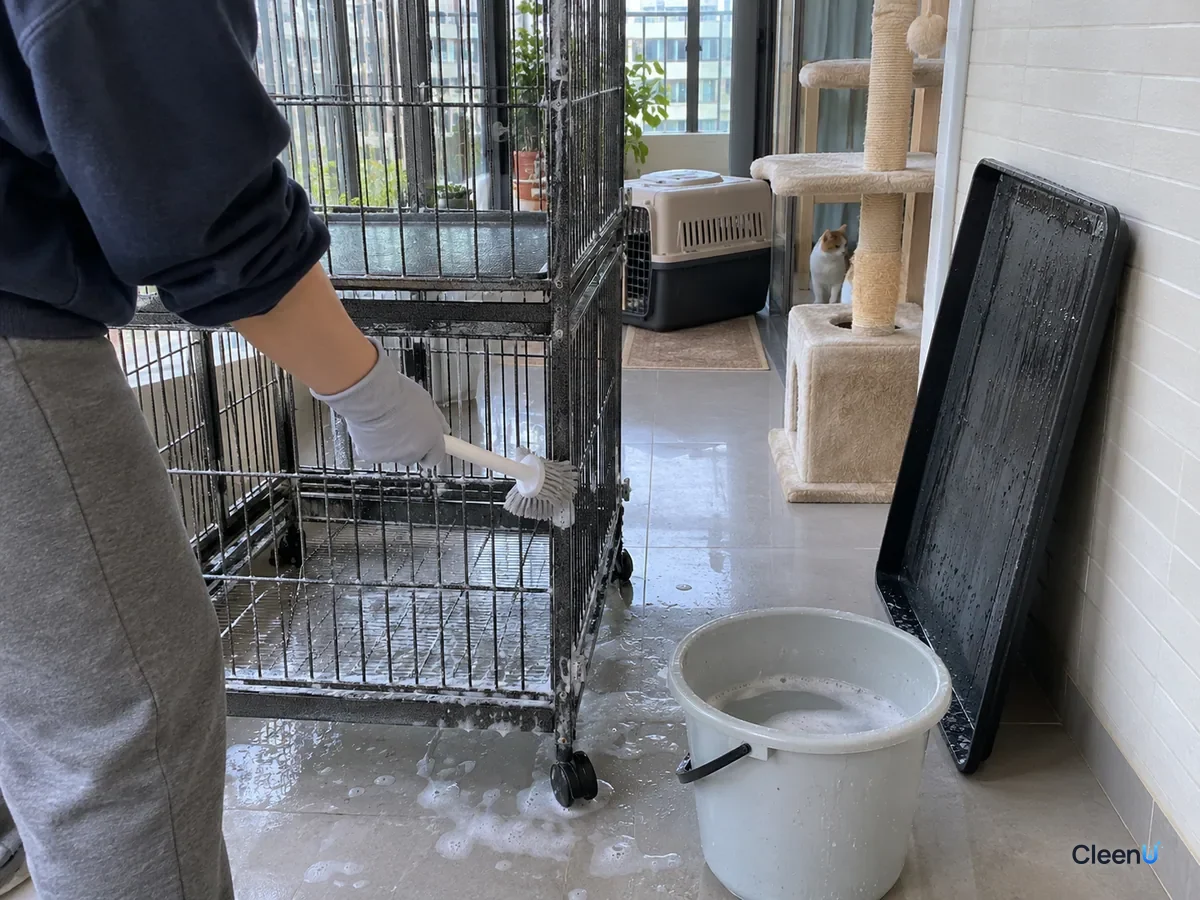
Scrub the dirtiest areas first
Use a long-handled brush on tray corners and scratches and a small brush on bar intersections, the latch gap, and carrier vent holes. Scrub bars from the bottom up, then flip the tray and do the underside and the rails.
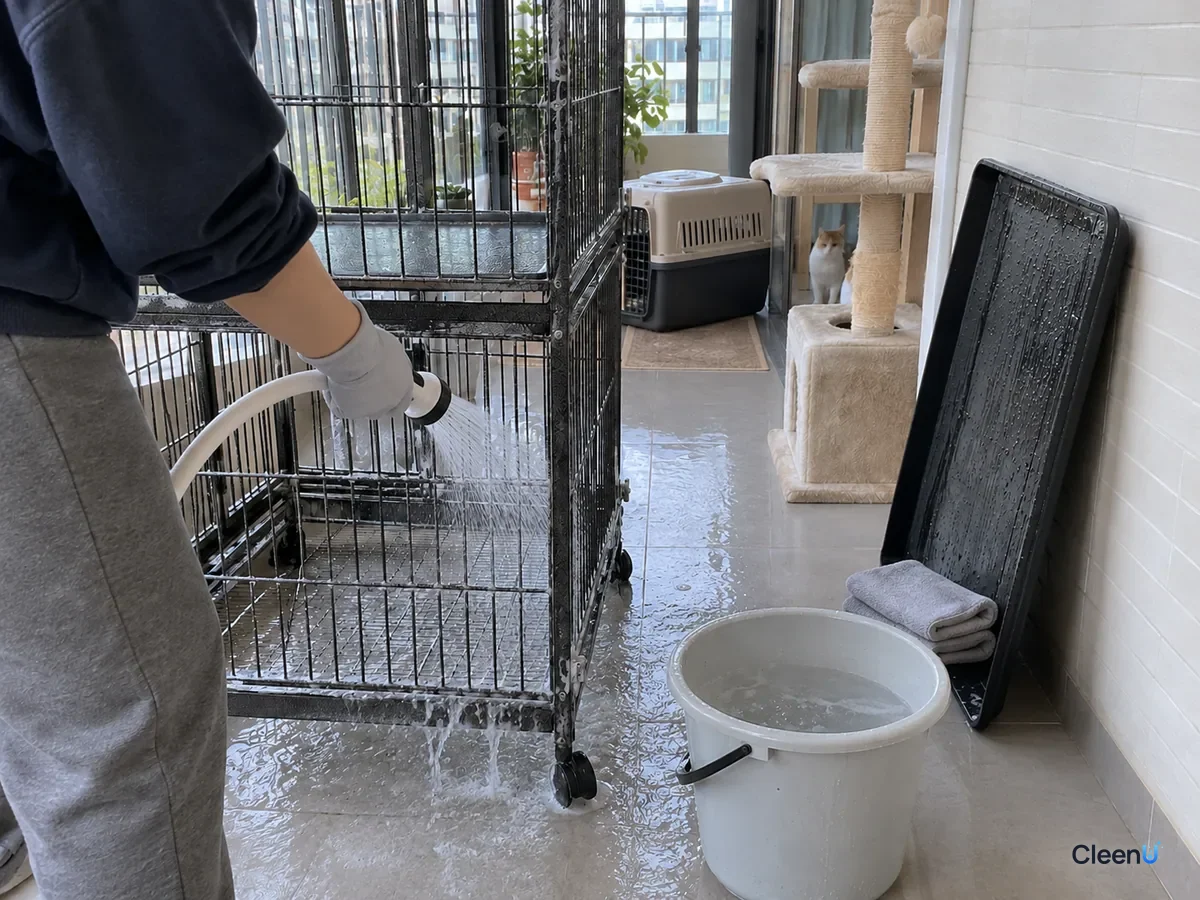
Rinse or wipe clean
Rinse metal and plastic until there's no foam and nothing feels slick. Where hosing isn't practical, wipe twice with a damp cloth, using a fresh cloth for the second pass.
Wash bedding separately
Machine-wash pads and blankets per the label, pre-treating heavy urine spots. Replace disposable pee pads. Bedding is often the smelliest part, and skipping it means the crate will smell no matter how well you scrubbed.
Dry completely
Stand the tray on edge and dry carrier halves separately, in a ventilated or sunny spot. Don't hold a hot hair dryer close to plastic, which can warp it.
Smell and feel before reassembling
Sniff tray corners, seams, and the latch up close; you shouldn't smell urine or cleaner. Feel the seams and rails for dampness. Only then put the bedding back and let your pet in.
When to stop and change course
If powder coating is flaking off in large patches, bars are rusted to the point of peeling, or the plastic tray is cracked, further cleaning won't do much, so replace the part. If wood darkens or starts to swell, stop adding water, blot it dry, and let it air out. If sisal or plush shows black or green mildew spots, don't keep scrubbing; replace it. If the crate still smells clearly of urine after two rounds, check the bedding, the space under the tray, and the floor under the crate rather than using more cleaner. If a pet that never soiled its crate suddenly starts peeing in it or vomiting often, that may be a health or behavior signal, so see your vet. If your pet is sick or your vet asks you to disinfect, follow your vet's instructions; a cleaner doesn't replace disinfection.
How to clean a cat tree: spot-clean sisal and plush
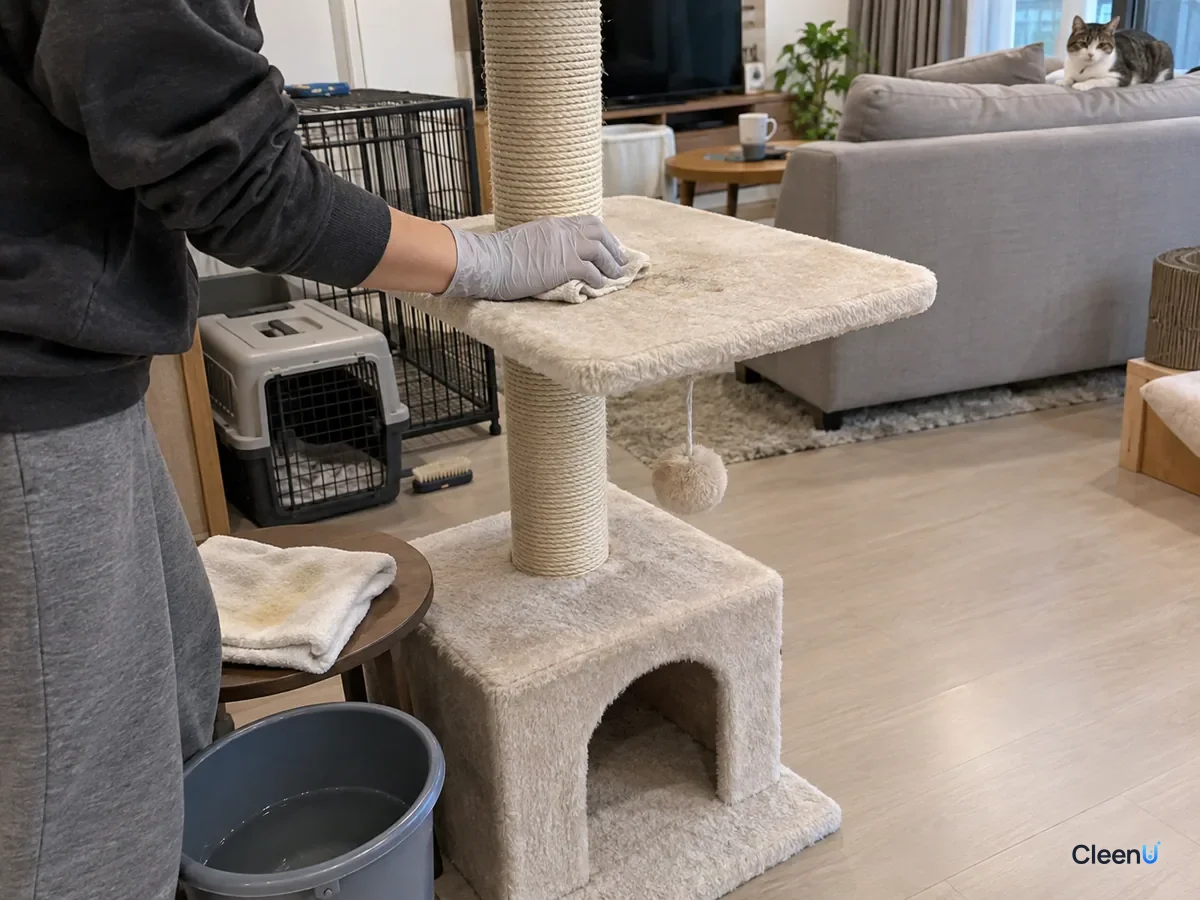
A cat tree is the one item you should never soak. Bases and platforms are usually particleboard wrapped in carpet or plush, and posts are cardboard tubes or wood wrapped in sisal rope. The routine looks different from a crate:
- Dry clean first. Vacuum platforms and hammocks with a brush attachment, then sweep a rubber glove or lint roller along the pile to pull out hair. Brush sisal posts up and down with a stiff brush to lift hair caught between the coils.
- Spot-treat soil. Blot vomit or urine with paper towels; don't rub. Spray cleaner onto a cloth or mist it lightly over the spot and let it sit 3 to 5 minutes.
- Press with a wrung-out damp cloth to lift the loosened soil, then press hard with a dry towel. Repeat once or twice rather than soaking it in one go.
- Point a fan at it or set it somewhere airy until a pressed paper towel comes away dry. Wash removable hammocks and pads per the label.
Sisal is a wear item. Once a post is shredded or loose, or still smells after two rounds on a urine spot, rewrapping it with new sisal rope costs little and beats repeated cleaning. Replace mildewed sisal outright. And if particleboard in the base has absorbed urine and swollen, odor will keep coming from inside where no cleaner can reach; replacing the base or the whole tree is the practical call.
How to clean a pet carrier after a trip
With carriers, the mess usually happens on the road and sits for hours. When you arrive, bag soiled pads and wipe liquid and solids out of the carrier floor, even if a full cleaning has to wait. At home, split the shell and follow the crate steps, paying extra attention to vent holes, the door grille, and floor grooves. For soft fabric carriers, remove and wash pads and liners per the label, then spot-treat the shell: spray, wait, blot with a damp cloth, and dry. Don't submerge the whole bag.
The step people skip is storage. Carriers sit unused for months, and one closed up while still damp comes out smelling musty. Dry it completely, then store it with the door open or the halves apart.
Rabbit hutches, bird cages, and hamster cages
| Pet | What's different | Cleaning focus | Watch out for |
|---|---|---|---|
| Rabbit | Lots of urine, often high in calcium, which leaves white scale on trays | Remove bedding and droppings daily; spray, scrub, and rinse the tray | White calcium scale isn't organic soil, so enzymes and surfactants won't remove it; soak plastic trays in diluted white vinegar or citric acid, scrub, rinse, and never use acid and chlorine back to back |
| Bird | Droppings dry fast on grates, perches, and cup rims | Wet dried droppings first so they soften, then scrape; scrub perches and grates separately | Move the bird to another room and ventilate while cleaning and drying, since birds' respiratory systems are more sensitive to fumes and sprays; scrape or replace wooden perches rather than soaking them |
| Hamster | Usually picks one corner as a toilet; bedding absorbs urine | Spot-clean the toilet corner daily; change all bedding and scrub the bin periodically | Many keepers save a small handful of clean old bedding during full cleanouts to soften the change; spot-wipe wooden hides, don't soak |
| Cat (in a crate or boarding cage) | A litter box inside spreads litter across levels | Clear all litter before spraying, or it turns to paste | Clean the litter box itself separately |
Small cages put pets close to every cleaned surface, so keep the animal elsewhere until the floor and bedding are dry.
How often should you clean a dog crate?
| When | What to do |
|---|---|
| Daily | Remove stool and vomit; spot-treat urine the same day; swap out wet pee pads |
| Weekly | Wash pads and blankets; pull, spray, scrub, and rinse the tray; wipe the bars |
| About monthly, or when odor builds | Full teardown including rails, latch, and the floor under the crate; check for rust, scratches, and warping |
| After an accident | Same-day cleaning after urine, vomit, or diarrhea in the crate; same-day cleaning for a carrier after travel |
| When your pet is sick | Follow your vet's guidance on cleaning and disinfection |
Clean more often during puppy house-training, with senior dogs, or when pets share a crate. Vacuum cat trees weekly and spot-treat as needed.
Why "fully dry" matters, and how to check
Drying decides how long the cleaning lasts. Leftover moisture keeps releasing odor compounds, which is why a crate can seem to smell worse right after washing. Damp wood, sisal, and plush invite mildew, and a pet walking on a damp surface and licking its paws can pick up cleaner residue.
It's dry when all of these check out
- The tray's underside and rails show no droplets or water marks
- A paper towel pressed into carrier seams and bolt holes comes away dry
- Wood has returned to its normal color and doesn't feel cool
- A dry paper towel pressed firmly on sisal or plush for a few seconds stays dry
- Up close, there's no urine, mildew, or cleaner smell
- The floor or rug under the crate is dry
Sunlight and airflow are the best dryers. Keep hot air away from plastic, and use a fan rather than a space heater on a plush cat tree.
Checking that it's really clean
The simplest home check is a next-day sniff of the tray corners, latch, and seams. Odor returns most readily on warm, humid days, so if you smell nothing then, it's genuinely clean. A UV flashlight in a dark room can help you locate old urine spots on light plastic and fabric, but it only shows you where to look, not how clean something is.
Check two more things. First, feel: once the bars and tray are dry, run a hand over them. A tacky or squeaky-dry drag, or a white haze, means cleaner wasn't fully rinsed or wiped off, and your pet will pick it up on its paws and lick it off, so wipe again with a damp cloth and dry. Second, color: press a white paper towel onto treated sisal or plush. Yellow on the towel means urine is still wicking up; the fabric's own color on the towel means dye is transferring, and next time that spot should get only a wrung-out damp cloth.
If odor comes back quickly, the usual culprit isn't too little cleaner but a source you missed. The underside of the tray, the slide rails, the seam between carrier halves, and the pads are the spots most often skipped, so go back through the hiding spots above one at a time.
Choosing a cleaner for crates and cat trees
Let the crate decide: fragrance-free, because it's where your pet spends the most time; something you can spray and wipe as well as rinse, because sisal, plush, and wood can't be hosed down; and no ammonia or vinegar, which smell like urine and can draw a pet back to the same spot.
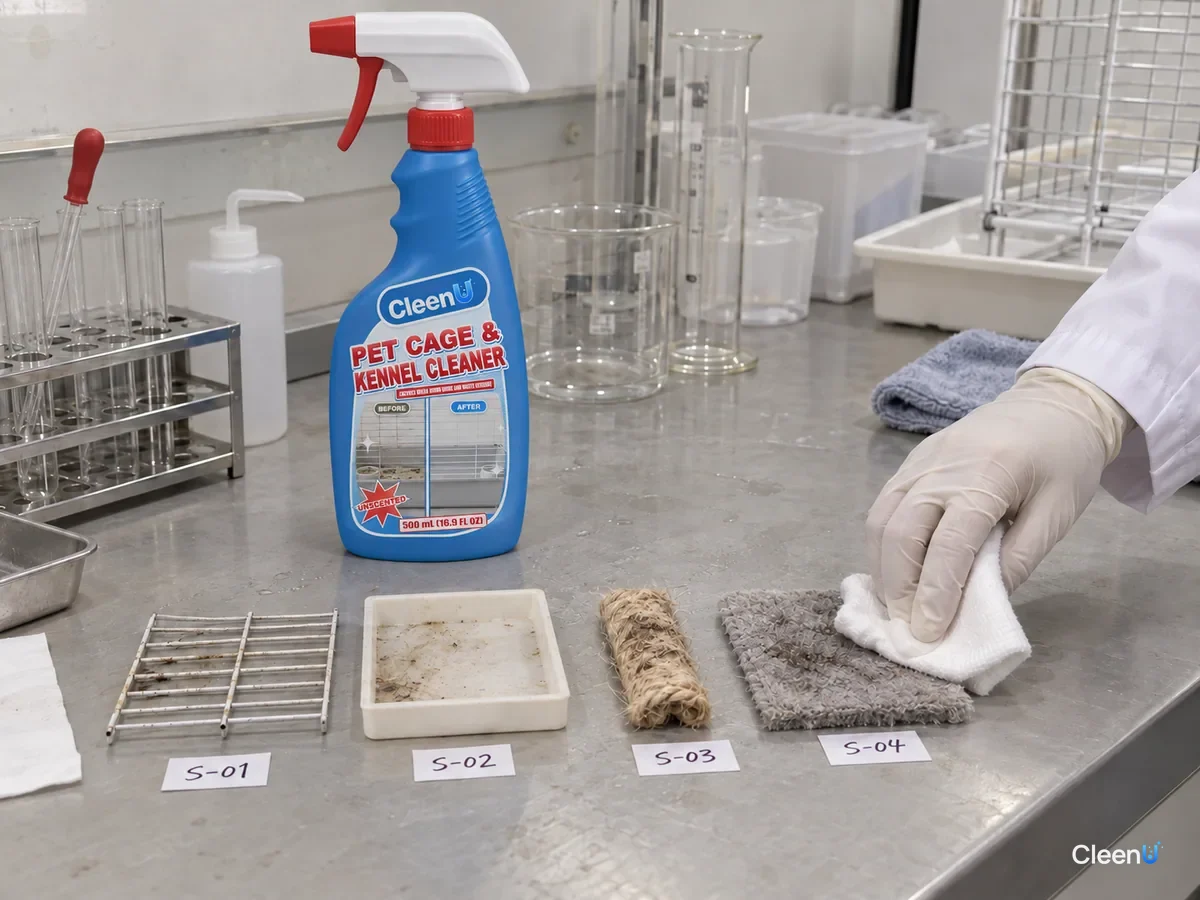
Take CleenU Pet Cage & Kennel Cleaner as an example. It's a fragrance-free, ready-to-use spray that combines a blend of enzymes with nonionic surfactants and cyclodextrin. Directions match this guide: remove your pet and bedding, spray thoroughly, wait 3 to 5 minutes, scrub, then rinse or wipe dry, and let everything dry fully before your pet returns. Don't use it with your pet in the crate, don't leave wooden crates or parts wet for long, don't use it in place of vet-recommended disinfection, and don't mix it with chlorine bleach.
For a fragrance-free spray you can scrub, rinse, or wipe on crates, carriers, and cat trees, take a look at CleenU Pet Cage & Kennel Cleaner.
If urine has already soaked into the carpet under the crate, that's a different job that needs a carpet method. For everyday floors, see cleaning floors in a pet home, and for the bigger picture, our pet home cleaning hub.
Common mistakes worth unlearning
More water means cleaner. True for metal and plastic, backward for wood, sisal, and plush, where more water drives odor deeper and slows drying.
Using ammonia or vinegar cleaners on urine spots in the crate. They smell like urine, and ammonia may draw a pet back to the spot; both Cornell's Feline Health Center and the ASPCA advise against them.
Soaking the crate in bleach. Chlorine bleach gets used up by organic matter, and mixing it with urine's ammonia compounds can release irritating chloramine gas. Clean first, and if your vet calls for disinfection, do it as a separate step with thorough rinsing. More on why mixing is risky in why you should never mix bleach and toilet cleaner.
Covering it with fragrance. Scent masks odor for a while but leaves the source, and a strong unfamiliar smell in your pet's crate isn't necessarily welcome.
Still smells after cleaning? Likely causes, most common first
- Bedding wasn't handled. Pads, blankets, and pee pads absorb the most urine. Wash them separately and replace anything that won't come clean.
- Urine under the tray or under the crate. Pull the tray and check the rails, then move the crate and check the floor or rug, and treat to the depth it soaked.
- Not fully dry. Seams, rails, sisal, and plush still hold moisture. Dry longer and sniff again the next day.
- Damaged surfaces. Heavily scratched trays or rusted bars hide residue you can't scrub out. Replace the tray or the crate.
- Absorbent parts took on urine. Wood, particleboard, or sisal that soaked up urine can't be reached by a cleaner. Replace that part.
- Ongoing marking. If your pet re-soils the same spot soon after cleaning, it may be a behavior or health signal. See your vet, then rethink crate placement and use.
Wash, replace a part, or replace the whole thing?
Wire crates and hard carriers are durable and worth cleaning properly. Sisal rope, plastic trays, pee pads, and crate pads are wear items; replace them once they're damaged or hold odor, since they cost less than repeated scrubbing. Two cases are worth giving up on: a cat tree base whose particleboard has swollen and absorbed urine, and an old wire crate rusted to the point of peeling. Neither surface can be cleaned well enough, and more effort just brings the smell back.
Dog crates, carriers, and cat trees: common questions
How do I get urine smell out of a dog crate?
Deal with the bedding and the space under the tray first, then clean the crate, then dry it completely. Wash or replace pads, scrub both sides of the tray, check the rails and the floor under the crate, and sniff again the day after it's dry.
How do I disinfect a dog crate?
Clean it first, then disinfect only when needed. For routine care, a crate that's been scrubbed, rinsed, and dried is in good shape. If your pet is sick or your vet asks for disinfection, use the product and contact time your vet recommends, then rinse and dry, and never mix it with other cleaners.
How often should you clean a dog crate?
Remove solids and treat urine daily, wash bedding and scrub the tray weekly, and do a full teardown about once a month. Clean more often during house-training, with senior dogs, or when pets share a crate.
How do I clean a dog crate tray?
Pull it out, spray both sides and the corners, wait 3 to 5 minutes, and scrub along any scratches with a stiff brush. Rinse until nothing feels slick, then dry it standing on edge. If dried stool is stuck on, spray and wait for it to soften before scraping.
How do I clean a cat tree?
Mostly dry cleaning and spot treatment, never soaking. Vacuum, brush the sisal, blot spots, mist lightly with cleaner, then press with a damp cloth and a dry towel and fan-dry.
What should I do about mold on a cat tree?
Replace the moldy sisal section or panel rather than cleaning it. Mold usually means moisture deep inside, so wiping the surface won't reach it. Use less liquid on future spot cleaning and dry fully before your cat uses it.
How do I clean a hard pet carrier?
Split it into halves, remove the door and hardware, spray and wait 3 to 5 minutes, then scrub corners, floor grooves, vent holes, and seams. Rinse, dry the halves separately, and store it only when fully dry.
Can my pet stay in the crate while I clean it?
No. Move your pet to another room during cleaning and drying, never spray through the bars, and let your pet back in only when every surface is dry.
Can I use cleaner on a wooden crate or dog house?
Yes, sparingly, and never soak it. Spray onto a cloth or mist the spot, let it sit, blot with a damp cloth, then dry. Stop adding water if the wood darkens or swells.
How do I remove white crust from a rabbit cage tray?
Soak the tray in diluted white vinegar or citric acid, then scrub and rinse. That crust is calcium scale, not organic soil, so enzymes and surfactants won't remove it. Never use acid and chlorine products back to back.
Can I spray a cage cleaner directly on my pet?
No. A cage cleaner is for crate and accessory surfaces only. Use pet wipes or grooming products made for your pet's coat and skin.
Sources
Accessed October 2026; summaries are ours.
- Cornell Feline Health Center, "Feline Behavior Problems: House Soiling."
- ASPCA, "Litter Box Problems."
- Tennessee Poison Center (Vanderbilt University Medical Center), "Why shouldn't I mix household chemicals with bleach?" (2018).
- CDC, "Chemical Disinfectants," from the Guideline for Disinfection and Sterilization in Healthcare Facilities.
Getting a dog crate truly clean has less to do with how much water you use than with three habits. Find every source: bedding, the tray's underside, and the floor under the crate. Match water to material: spray, scrub, and rinse metal and plastic, and only spot-clean wood, sisal, and plush. Dry completely and sniff again the next day. Clean carriers the day you get home and store them dry, keep cat trees to vacuuming and spot treatment, and replace sisal or boards that have absorbed odor. Keep your pet elsewhere while you clean and dry, and if your pet suddenly starts soiling its crate or vomiting often, see your vet.