
Q&A
How to Clean Marble Floors Safely
Direct answer
Use a pH-neutral cleaner labeled for natural stone, diluted per the label, with a barely damp mop, then dry the floor. Vinegar, lemon, citric acid, descalers, and toilet bowl cleaners etch dull spots into marble. Strong alkaline and chlorine products also wear down the surface and its protective treatments over time.
Can you use this on a marble floor?
Yes
- A pH-neutral cleaner labeled for natural stone, diluted per the label
No
- White vinegar, lemon juice, citric acid: acid reacts with marble and leaves dull etch marks
- Descalers, toilet bowl cleaners, acidic bathroom cleaners: stronger acid, faster etching
- Bleach and chlorine disinfectants: can discolor stone and damage sealers and polish
- Steel wool, the rough side of a sponge, scouring powder: scratch the polished surface
It depends
- Dish soap: a little, well diluted, works in a pinch, but it leaves a film, so rinse afterward
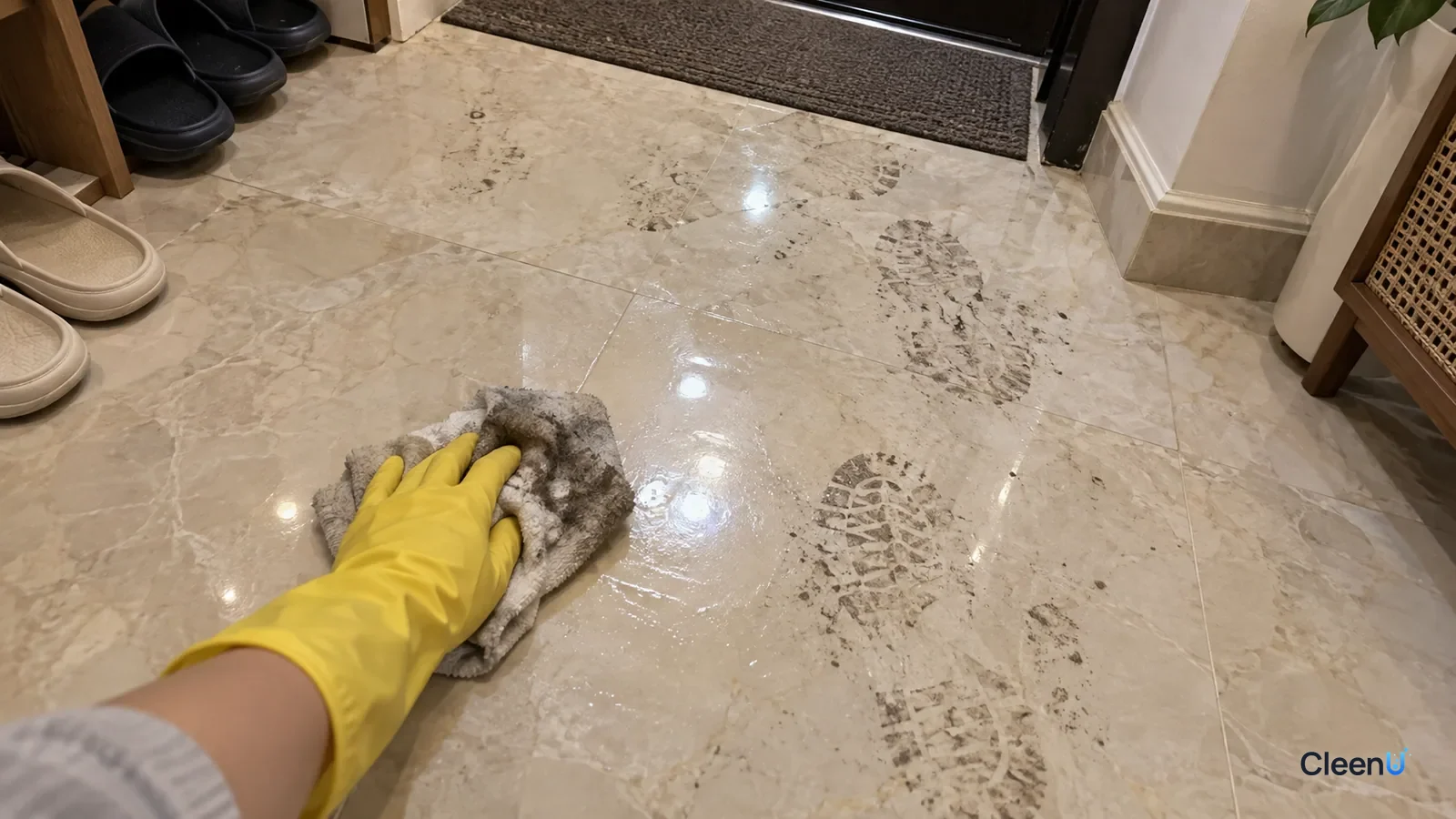
Marble floors are beautiful, but a year or two in, many people notice the marble near the entry and kitchen has lost its shine, with pale or dark patches and spots that feel rough. Often the problem isn't dirt. It's the wrong cleaner.
Why marble and acid don't mix
Marble is mostly calcium carbonate, sometimes with magnesium carbonate, the same family of minerals as limescale, limestone, and seashells. It's an alkaline mineral, and acid reacts with it: hydrogen ions turn calcium carbonate into water-soluble calcium salts, water, and carbon dioxide.
That's exactly the reaction you want on limescale, which is why descalers are acidic. On marble, it means acid slowly dissolves the surface. Polished marble is flat and reflects light like a mirror. Where acid has dissolved it, the surface is rough and uneven, light scatters, and you see a dull, pale, or dark mark. That's called etching.
A drop of lemon juice, a splash of vinegar, spilled juice, soda, or wine can leave a visible dull ring within minutes. Etching is physical damage. No cleaner will wipe it away; it takes professional honing and polishing to restore.
Limestone, travertine, and terrazzo with marble chips have the same weakness. Granite and quartz are much more acid-resistant, but regular acid use can still break down their sealers.
Why skip strong alkalis and bleach too
Strong alkaline kitchen degreasers and oven cleaners can dull marble over time and strip sealers and polish treatments.
Bleach and other sodium hypochlorite products oxidize and bleach. They can change the color of some stones, and leftover salts can work into the stone's tiny pores.
How a neutral stone cleaner is designed
Day-to-day stone care is about lifting footprints, greasy marks, and dust without harming the stone or leaving residue.
Take CleenU Tile & Stone Cleaner as an example. It's a pH-neutral daily tile and stone cleaner, pH 7.0 to 8.5 as supplied, made with nonionic surfactants and a chelating agent, with no acids, no chlorine, and no abrasives. Use it straight to spot-clean, or dilute 1:20 to mop floors. No dwell time; wipe or mop and let it air-dry.
With no acid, it doesn't react with calcium carbonate. The nonionic surfactants emulsify skin oil and greasy footprints, and the chelating agent binds calcium and magnesium in tap water, which cuts down on white water marks drying on polished stone. It's made for ceramic tile, marble, granite, quartz, terrazzo, and other sealed hard surfaces. It isn't a treatment for rust or oil stains in stone, isn't for wood floors or carpet, shouldn't be alternated with acidic cleaners, and you should wring the mop well after diluting.
Everyday marble floor care
Vacuum or use a soft broom or dust mop to pick up grit first. Grit is polished marble's worst enemy; ground in under shoes and mops, it slowly dulls the surface.
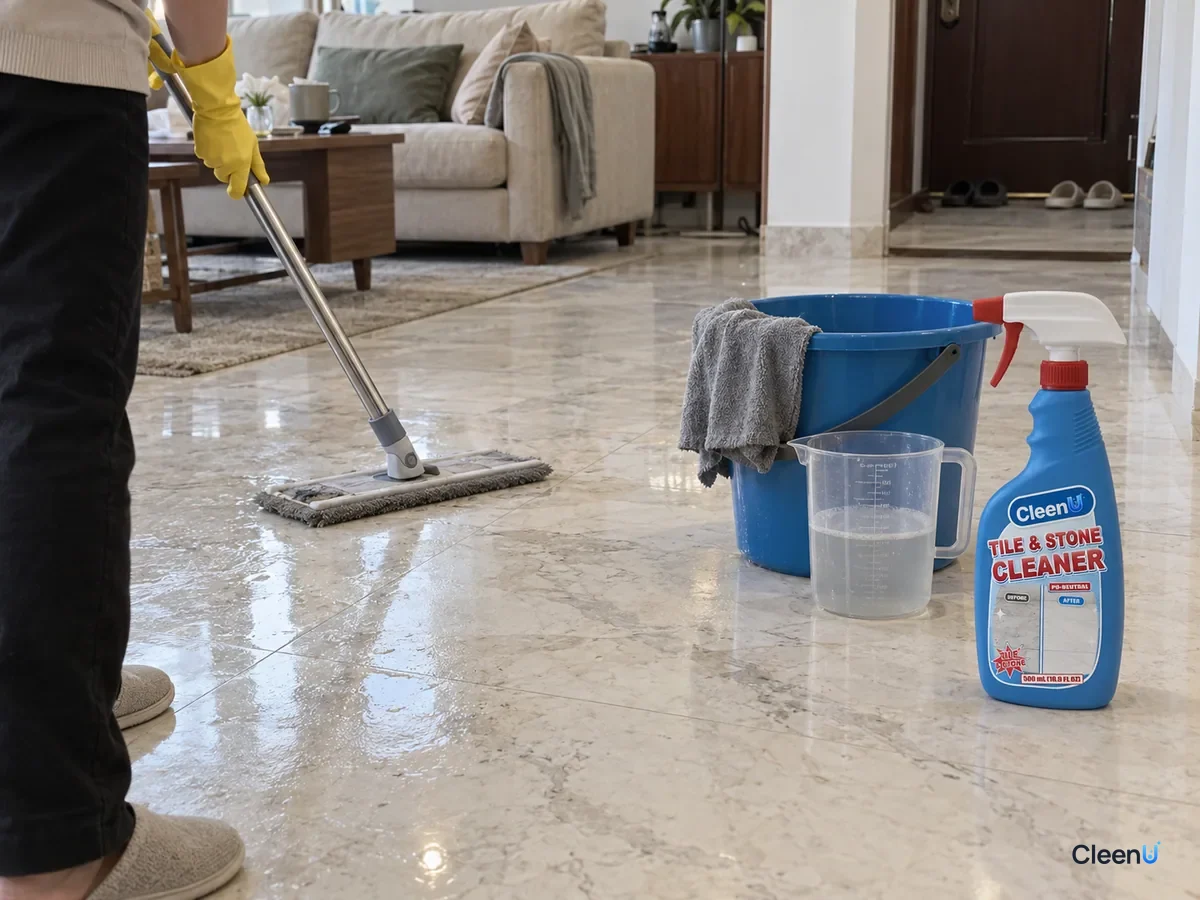
Dilute a neutral stone cleaner per the label (for example 1:20), wring the mop until it's barely damp, and mop in one direction.
Follow with a dry microfiber pad or open a window so the floor dries quickly. Water left on polished stone leaves white hard-water marks.
Put mats at entrances to catch grit, and wipe up oil and juice spills by the kitchen right away with a damp cloth.
If you spill vinegar or juice
Blot it up immediately with a clean damp cloth, don't wipe it around, then wipe with plain water and dry. The faster you act, the less etching.
If a dull ring has already formed, cleaning won't fix it. Light etching can be treated with a marble polishing powder; deeper marks need professional honing and polishing.
Not every white spot is etching
White marks on marble can also be:
Hard-water marks: dried water spots. Wipe with neutral stone cleaner and dry.
Cleaner residue: a film from using too much product. Mop twice with plain water.
Efflorescence: white, powdery crystals from alkaline salts in the stone or mortar bed migrating to the surface with moisture, common on new floors or floors with moisture coming up. Fix the moisture first, then have a professional treat it.
Etching: dull and slightly rough, nothing scrapes off with a fingernail, and the surface feels rougher than the surrounding stone.
For streaks, stickiness, and slippery floors, see Sticky floor after mopping and Why floors look streaky after mopping. For other floor types, see How to clean every type of floor.
Does marble need regular sealing and polishing?
Many marble floors get a penetrating sealer after installation to reduce absorption and staining, and some get a polish or crystallization treatment for shine and wear resistance. Both need periodic maintenance, depending on traffic, usually assessed by a stone care professional. Using a neutral cleaner every day protects those treatments; the wrong acid or alkali makes them wear out faster.
What's on a marble floor, and how each kind comes off
Most of what ends up on a marble floor falls into three groups. Each relates to the stone differently, so each needs a different approach.
Grit. Sand tracked in on shoes is full of quartz, which is much harder than calcite, the main mineral in marble. Ground under shoes and mops, it acts like fine sandpaper and leaves countless tiny scratches in the polish. Over time the area by the door turns dull and gray. That's why the first step is always getting grit off the floor with a vacuum, a soft broom, or a dry dust mop before any wet mopping. Wet-mopping over grit just presses it into the stone and drags it around.
Oily footprints and grease marks. They show up most by the kitchen and around the dining table, where shoe soles leave grease and skin oil as dark marks on the shiny stone. This soil sits on the surface. The nonionic surfactants in a neutral cleaner wet and emulsify it, lifting the oil off the stone so the mop can absorb it. No acid or strong alkali needed, and a properly diluted solution is plenty.
Stains that soak in. Marble is somewhat porous. Where it was never sealed, or the sealer has worn off, oil, coffee, tea, or red wine can soak into the stone and leave dark marks that won't wipe off. Here's how to tell: after the surface is clean and dry, the color is still there, and its edges look blurry, as if it bled outward. A daily neutral cleaner only handles the surface. Soaked-in oil stains and rust marks call for a stone-specific poultice, and a stone care professional is the safer bet.
Why dilute it, instead of going stronger?
Polished marble works like a mirror, so any residue shows. Mix the cleaner too strong and the surfactant dries into a thin film that looks blotchy in side light, feels draggy underfoot, and attracts dust faster. The chelating agent binds calcium and magnesium in tap water to cut down on white hard-water marks, but it also works best at the right dilution. More concentrate doesn't clean better. It just leaves more behind.
So for floors, mix at 1:20, wring the mop until it's barely damp, and let the floor dry quickly. That balances cleaning power against residue. For a single greasy spot, spray the ready-to-use cleaner onto a cloth, wipe, and follow with a cloth dampened in plain water.
Adjusting for your floor
Polished vs. honed. Polished marble shows scratches and etching most. Honed marble hides etching better, but its surface is more open, so it soaks up oil and colored spills more easily. Blot spills on honed floors even faster.
Light vs. dark stone. Light marble shows soaked-in oil and yellow rust marks more. Dark marble shows hard-water spots and cleaner residue more, so drying after mopping matters even more there.
Newly installed floors. Moisture in the mortar bed takes time to escape, and in the meantime the floor can feel damp and develop a white powder. That's efflorescence, not dirt and not etching. Don't try to scrub it off with acid. Wait until the floor has fully dried and have the installer deal with it.
Terrazzo. It's marble chips set in cement or resin. The marble chips are acid-sensitive, and a cement matrix gets eaten by acid too, so treat it like marble and stick to neutral products.
How to tell the floor is properly clean
Once it's mopped and fully dry, look across it from the doorway at a low angle. Even sheen, no mop lines, and a floor that feels neither draggy nor slick underfoot means the footprints and grease are gone and nothing was left behind. If one spot is clean but still dull, and feels rougher than the area around it, that's surface damage, not a cleaning problem. Stop there rather than adding more cleaner or scrubbing harder.
Stop if you see this
If large areas turn dull, pale, or rough, stop using your current product and wipe with plain water to see if it changes. Don't try to grind or polish it yourself; call a stone care professional. Keep acidic, chlorine, and strong alkaline products off marble, and blot acidic spills immediately and rinse. Floors are slippery while you mop, so take care.
Cleaning marble floors: common questions
Can I clean marble with vinegar?
No. Vinegar is an acid that reacts with the calcium carbonate in marble and leaves dull etch marks that no cleaner can remove.
What should I mop marble floors with?
A pH-neutral cleaner labeled for natural stone, diluted per the label, with a barely damp mop, then dry the floor or let it air out.
Can a dull ring on marble be wiped away?
No. That's etching, physical damage to the surface. Light etching can be treated with marble polishing powder; deeper marks need professional honing and polishing.
Can I use dish soap on marble?
A little, well diluted, works in a pinch, but it leaves a film, so rinse afterward. A neutral stone cleaner is the better everyday choice.
Can I disinfect marble floors with bleach?
We don't recommend it. Chlorine can discolor stone and damages sealers and polish treatments.
Is granite cleaned the same way as marble?
Use a neutral cleaner for both day to day. Granite resists acid better, but regular acid can still break down its sealer, so skip acid there too.
For a neutral stone cleaner with no acid or chlorine and a chelating agent to cut water spots, made for everyday mopping of marble, granite, quartz, and tile, take a look at our Tile & Stone Cleaner.
Marble is mostly calcium carbonate, and acid is its enemy: vinegar, lemon juice, descalers, and toilet bowl cleaners all etch dull spots that cleaners can't fix. Strong alkaline degreasers and bleach wear down the surface and its sealers over time. Day to day, remove grit first, mop with a pH-neutral cleaner labeled for natural stone at the label dilution using a barely damp mop, and dry the floor. Blot acidic spills immediately. Leave existing etching to a stone care professional, and keep up with periodic sealing and polishing.