
Troubleshooting
Mirror Black Edges: Can Cleaning Fix Desilvering?
Direct answer
Black edges on a mirror are usually desilvering: moisture has corroded the silver coating on the back. It's damage to the mirror itself, and no cleaner can remove or repair it. Confirm it isn't surface grime, then keep it from spreading by spraying cleaner on a cloth and keeping liquid away from the edges and back.
What you see
After a few years, your bathroom mirror has a dark or gray-brown band creeping in from the edges, like ink bleeding through paper. It's slowly working its way toward the center, and a few black spots may have appeared in the middle. Scrubbing with glass cleaner doesn't change a thing.
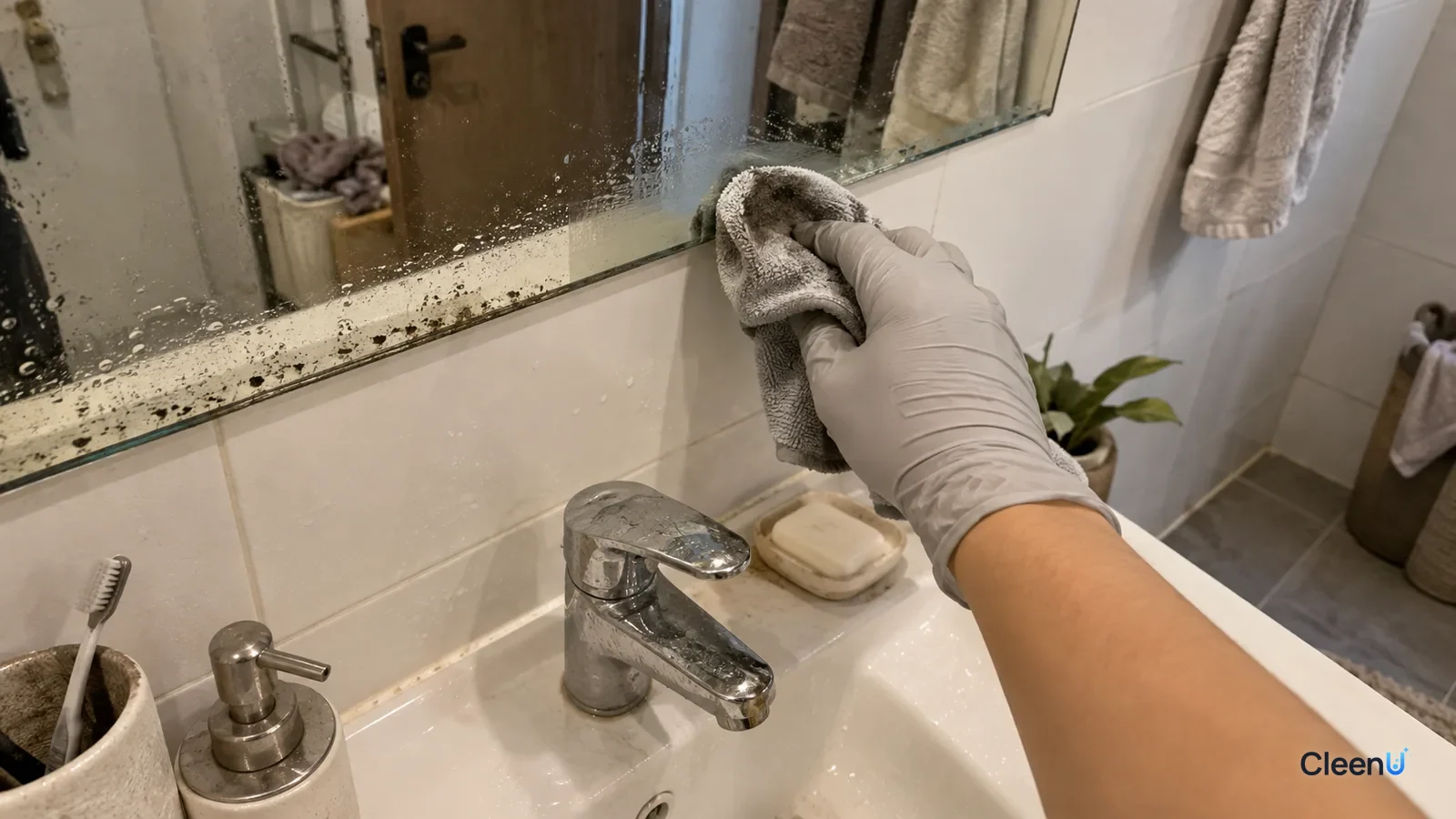
The first time people see black mirror edges, they assume it's dirt and scrub harder, which only adds to the worry. Most of these marks aren't on the mirror's surface. They're inside it. Once you understand how a mirror is made, it's clear why you can't wipe them away and how to keep them from spreading.
How a mirror reflects
A typical household mirror is a sheet of clear glass with a very thin layer of silver (or aluminum) applied to the back. That metal does the reflecting. A copper layer often goes over the silver (copper-free mirrors skip it), and then one or more coats of protective paint. When you look in a mirror, light passes through the glass, hits the silver on the back, and bounces back.
So the "mirror surface" you see is really the silver backing, viewed through the glass. Grime on the front can be wiped off, but if the silver on the back is the problem, nothing you do on the front can reach it.
How black edges form
The bathroom is the hardest place for a mirror: high humidity, big temperature swings, and constant splashes of water, cleaners, and personal-care products.
The edges are the weakest point. On cut glass, the back paint is often thinner at the edges than in the middle. Mounting adhesives or tapes that aren't mirror-safe neutral types can contain acids or solvents that attack the backing. Moisture and cleaner seep around the edge to the back and slowly work through damaged paint to the copper and silver.
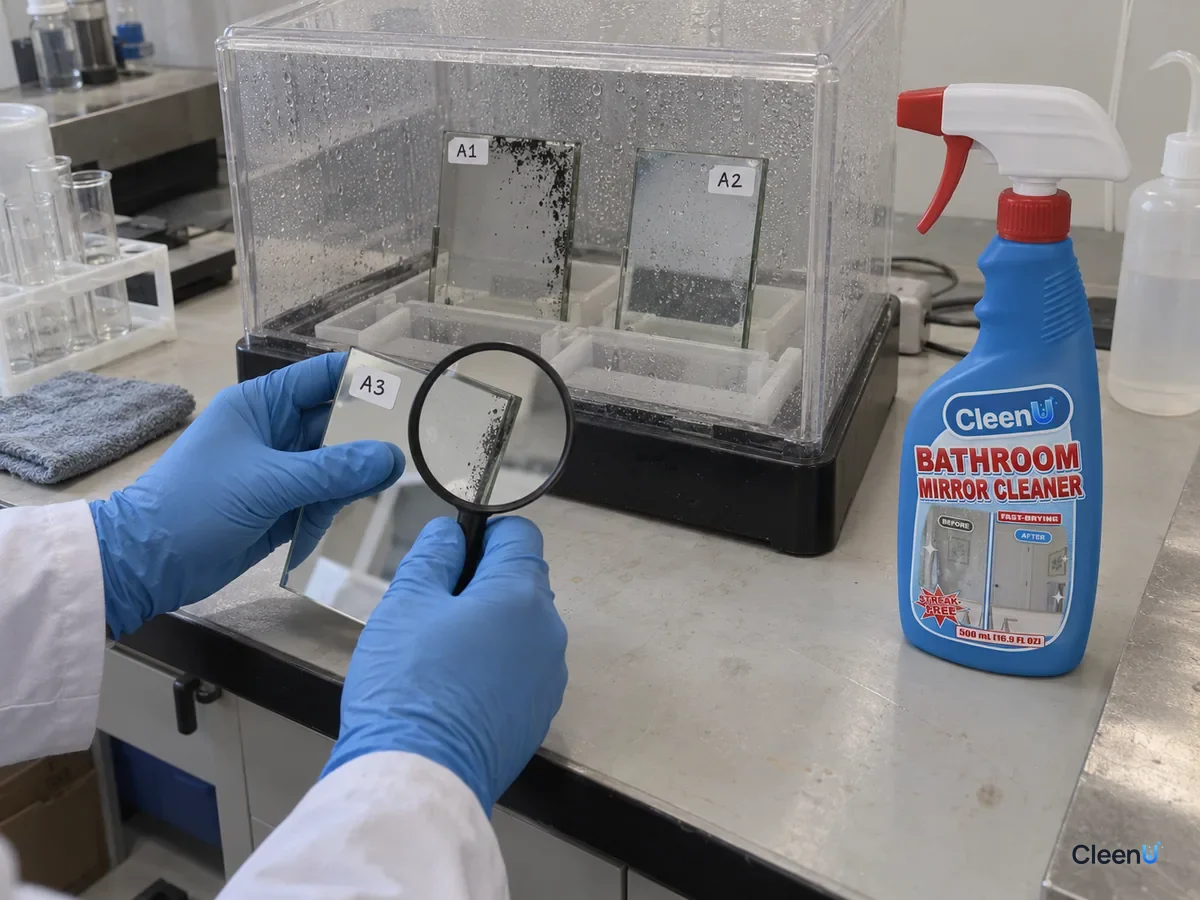
In damp conditions, silver and copper react with water, oxygen, and airborne sulfur and chlorine compounds, forming black silver sulfide and copper oxides. Corroded areas no longer reflect, so from the front they look black or gray-brown. Corrosion starts at the edge and spreads inward wherever the protective layer is weakest, which is why black edges always seem to "grow" from the corners toward the center.
Ammonia-based glass cleaners, acidic descalers, and chlorine disinfectants that regularly get sprayed onto the edges and seep behind the glass speed this up.
Surface grime or desilvering?
Figure out what the black edge is in five steps
-
Step 1 Scrape lightly with a fingernail or soft plastic card, or wipe with a cloth and cleaner. Does the black lighten or come off?
- Yes
- It's surface grime, such as mildew, soap scum, or dirt trapped in a frame. Wipe it with cleaner on a cloth and use a cotton swab on frame gaps.
- No
- Go to the next check
-
Step 2 Viewed at an angle, does the black look like it's behind the glass, with a smooth, flat surface on top?
- Yes
- That's almost certainly desilvering, and cleaning can't remove it. Keep going to decide whether to act.
- No
- Go to the next check
-
Step 3 Is the black limited to the outer inch or so, without getting in the way of using the mirror?
- Yes
- Keep using it and focus on slowing it down: keep liquid out of the edges and ventilate the bathroom.
- No
- Go to the next check
-
Step 4 Has it spread toward the center, or is it growing quickly?
- Yes
- Replace the mirror. Choose a bathroom-rated mirror with a moisture-resistant backing and sealed edges, and mount it with mirror-safe neutral adhesive.
- No
- Go to the next check
-
Step 5 Is the black right under a decorative frame or trim strip?
- Yes
- Water may be collecting in the frame, or an old seal may be failing. Check for trapped water; if needed, remove the frame, clean and dry everything, and reinstall.
- No
- Keep up the routine below and watch whether the edge grows.
Why cleaners can't fix desilvering
A cleaner removes things stuck to a surface: oil, soap scum, scale, dust. Desilvering is a chemical change in the metal on the back. The corroded silver has turned into silver sulfide and oxides, and it sits behind the glass under paint where cleaner can't reach. Even if it could, nothing would turn it back into reflective silver.
You'll find "desilvering fixes" online: scraping off the back paint, taping on foil, painting on silver. On small spots near the edge they can make the black less noticeable, but they can't restore a true mirror finish, and taking a mounted mirror down risks breaking it. For most homes, if the edge doesn't bother you, keep using the mirror; if it does, replace it.
Cleaning a mirror without speeding up the damage
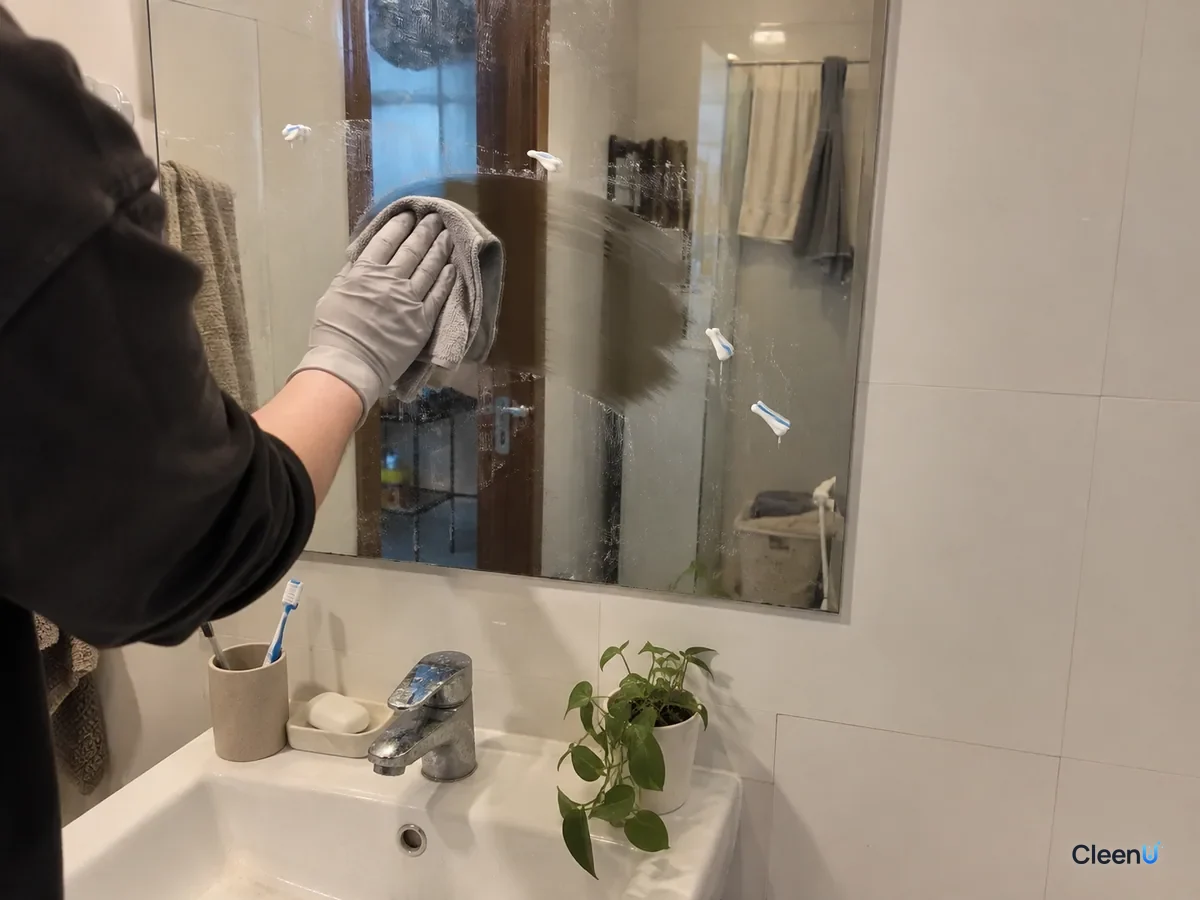
Day to day, a bathroom mirror needs toothpaste spots, skincare splatter, fingerprints, and water spots removed. All of that is on the front of the glass and wipes off easily. The key is keeping liquid away from the edges and back.
Take CleenU Bathroom Mirror Cleaner as an example. It's a fast-drying mirror and glass spray, pH 6.5 to 8.0 as supplied, made with fast-evaporating alcohols such as isopropyl alcohol and low-residue surfactants, with no ammonia. It's ready to use: spray and wipe, no dwell time. The alcohol dissolves the oily part of skincare products and evaporates quickly, so liquid spends less time sitting and running on the glass. The surfactants lift toothpaste and fingerprints. No ammonia means no ammonia reaching the back paint at the edges.
Its label is clear that it isn't for mirror edges or backs and that you should avoid pooling. So the right way to use it is:
Spray the cleaner onto a microfiber cloth instead of covering the mirror.
Wipe from the center outward, and wring the cloth a little drier as you reach the edges. Don't press back and forth along the edge.
Dry the glass and edges with a dry cloth afterward.
Wipe the gap between frame, mirror, and wall with a dry cloth only.
For toothpaste spots and water marks, see How to clean a bathroom mirror.
How to slow down black edges
Run the fan or open a window after showers to lower humidity. If the mirror faces the shower, keep a door or panel between them.
Don't clean mirrors with ammonia or chlorine products, and keep descaler from splashing onto the edges.
Wipe splashes off the edges with a dry cloth as they happen.
When installing or replacing a mirror, choose a bathroom-rated one with a moisture-resistant backing and sealed edges, and use mirror-safe neutral adhesive rather than standard acid-cure silicone.
Leave a small air gap between the back of the mirror and the wall so it isn't pressed against damp drywall.
Why liquid always ends up at the edge
You may never aim at the edge and still find it wet. That's capillary action. The narrow gaps between the mirror and the wall, the frame trim, or the adhesive pull liquid in the moment it touches them, and the narrower the gap, the faster it pulls. Spray straight onto the glass and the drips run down to the bottom edge, where that gap drinks them up. There's no airflow in there, so it can stay damp for days, and that slowly wears down the protective backing.
So "spray the cloth, not the mirror" isn't fussiness. It controls where the liquid goes. The cloth holds the cleaner, the glass gets only a thin film, the fast-drying alcohol evaporates, and nothing runs down to the bottom. When you reach the last inch near the edge, switch to a drier part of the cloth and sweep along the edge rather than pressing into the gap.
Common spots on the front, and how each one comes off
Toothpaste spatter is the classic white dot. Toothpaste contains a mild abrasive, humectants, and surfactant. Once the water evaporates, you get a hard white speck, and the humectant leaves the rim a little tacky so dust sticks to it. It's water-soluble; it just needs a moment to rewet. Hold the dampened cloth on it for a few seconds, then wipe gently and it dissolves into the cloth. No need to scrape with a fingernail.
Skin care and hairspray mist is oily. The tiny droplets dry into a thin greasy film, and plain water just smears it into a haze. The alcohol dissolves the oily part, the surfactant emulsifies it, and the cloth carries it away. Finish with a dry cloth and the glass clears. Fingerprints work the same way, since they're mostly skin oil.
Dried water spots are calcium and magnesium salts from tap water. A light layer comes off with regular wiping. If it has built up into a crust you can feel, a fast-drying mirror cleaner isn't designed for it. Deal with the scale using a proper descaling method first, keeping well away from the edges, and then go back to routine wiping.
You're done when the glass looks clear under an angled light, with no haze, no white specks, and a dry edge all the way around. If streaks keep coming back, the cloth is usually the culprit, either dirty or washed with fabric softener, and swapping it fixes more than adding cleaner does. For more on streaky glass, see Why glass streaks after cleaning.
Stop if you see this
If the mirror is cracked, chipped, or loose, stop using it and have a professional deal with it so it can't fall. Don't take down a large wall-mounted mirror yourself to "fix" black edges. Don't spray cleaner all over the mirror so it runs into the frame and back, and don't use ammonia or chlorine products. If cleaner gets in your eyes, rinse with water.
Black mirror edges: common questions
What removes black edges from a mirror?
If it's desilvering, nothing will. Wipe a spot with cleaner on a cloth to check. If it doesn't lighten and looks like it's behind the glass, the silver backing is corroded.
Will the black spots keep spreading?
Yes, especially in a humid bathroom. Good ventilation and keeping liquid away from the edges slow it down.
Can a desilvered mirror be repaired?
Not back to a true mirror finish. Small areas can be masked from behind to look less obvious, but taking the mirror down carries risk. If it bothers you, replace it.
Can I clean a bathroom mirror with regular glass cleaner?
Use an ammonia-free mirror cleaner on a cloth instead. Ammonia that regularly seeps into the edges may speed up backing damage.
How do I keep a new mirror from desilvering?
Choose a bathroom-rated mirror with a moisture-resistant back and sealed edges, mount it with neutral mirror adhesive, ventilate the bathroom, and keep liquid away from the edges when cleaning.
What are black spots in the middle of a mirror?
Usually a pinhole or scratch in the back paint that let moisture reach the silver. Same cause as black edges.
For an ammonia-free mirror cleaner that dries fast when used on a cloth and handles toothpaste and skincare splatter without running toward the edges, take a look at our Bathroom Mirror Cleaner.
Black mirror edges usually aren't dirt. The silver backing has been corroded by moisture and chemicals that seeped in from the edge, which is called desilvering. It's behind the glass, where cleaners can't reach and can't restore it. Wipe a spot with cleaner on a cloth to check: if it comes off, it's grime; if not, it's desilvering. If the edge doesn't get in your way, keep using the mirror; if it spreads, replace it. Spray an ammonia-free mirror cleaner on a cloth, keep liquid out of the edges and back, and ventilate the bathroom to slow it down.