
OEM/ODM
Choosing an Enzyme Cleaner Manufacturer for a Private-Label Pet Cleaner: Stability, Scent, and Claims
Direct answer
Settle three things before sampling: enzymes and pH that work with the surfactant and preservative system; shelf life proven with accelerated and in-use testing; and claims limited to stain and odor removal, with no germ-killing, non-toxic, or pet-safe language. Start fragrance-free.
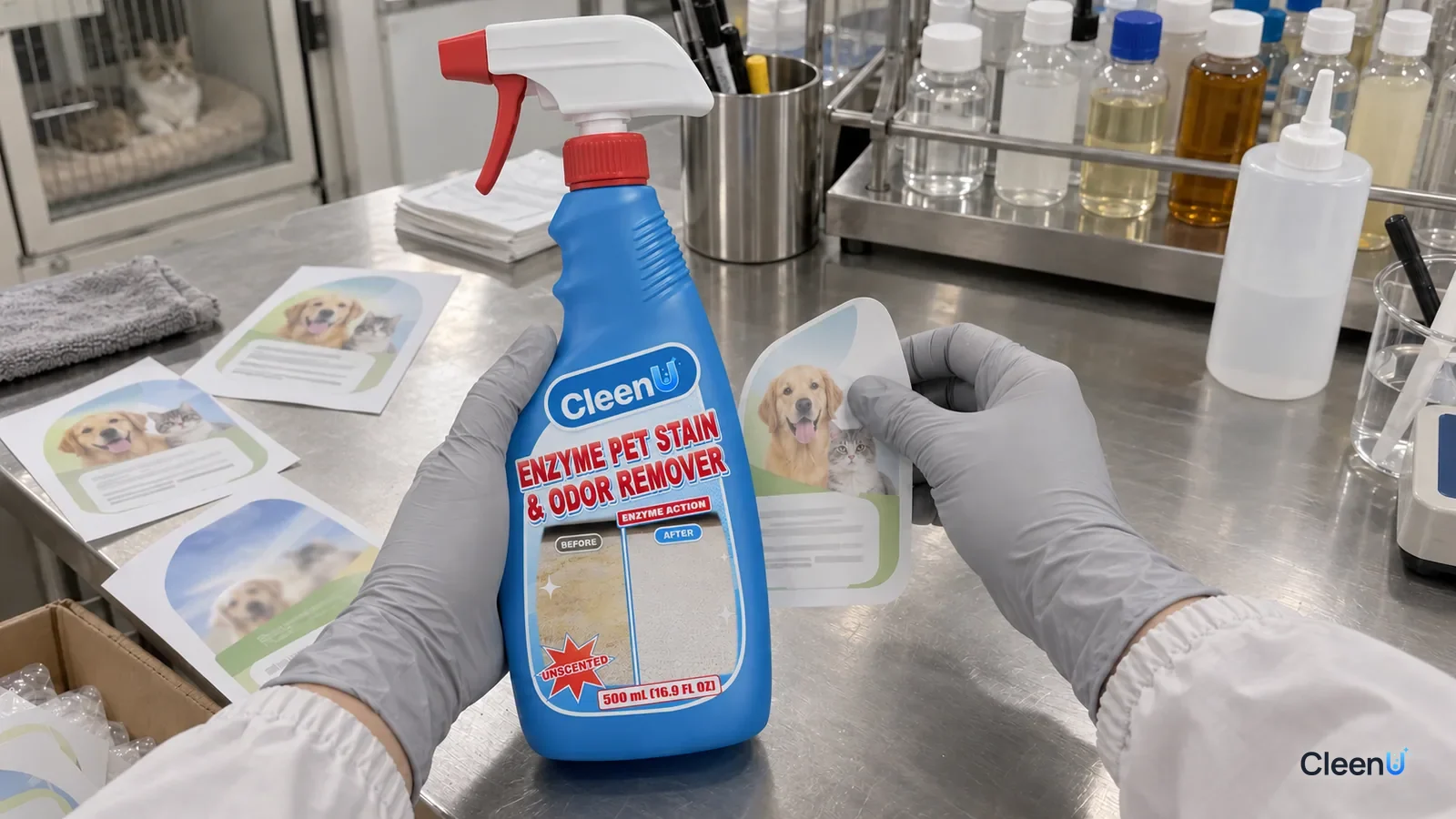
When brands talk to an enzyme cleaner manufacturer about a private-label pet product, the first questions are usually MOQ, price, and lead time. Those matter, but three other things decide your star rating after launch. Will the enzymes still work after a summer container crossing, weeks in a hot fulfillment center, and a month on a customer's shelf? Will the scent earn reviews or cost you them? And will any word on the label, listing, or an ad turn your cleaner into a product that needs federal registration? Decide all three with your manufacturer before the first sample, not after it arrives.
This guide is for pet brands, Amazon and Shopify sellers, and distributors planning a private label enzyme cleaner for pet stains and odors. We use CleenU Enzyme Pet Stain & Odor Remover as a reference point. Formula ratios and enzyme activity values belong to individual projects, so they aren't published here. The U.S. regulatory points were checked in October 2026; confirm them against current official text and with your compliance advisor. This isn't legal advice.
What the product actually has to remove
The formula target depends on the promise. Is this a urine product, or does it also cover vomit, food spills, and drool? Is it for carpet, mattresses, and upholstery, or also hard floors and crates? A different promise means a different enzyme blend and different directions.
Take urine. Bacteria break urea down into ammonia, which gives the sharp edge. Cat urine also carries felinine, which has almost no smell when fresh but breaks down over time into sulfur-containing odor compounds. Add proteins, salts, and skin cells. Once all of that soaks through carpet pile into the backing and pad, the surface can look clean while the deeper residue keeps releasing odor. Vomit and food spills are mostly protein, fat, and starch.
So an enzyme pet cleaner works as a team. Enzymes cut large protein, fat, and starch molecules into smaller pieces that dissolve more easily. Surfactants wet the fibers and carry the loosened residue out. The user's actions, saturating, waiting, and blotting, physically remove it. Enzymes need moisture, time, and contact, which is how the directions on CleenU Enzyme Pet Stain & Odor Remover read: blot first, spray until the area is saturated to the depth the urine reached, wait 10 to 15 minutes, blot dry, and air-dry.
One boundary belongs in your product file from day one. Breaking down uric acid takes a specific enzyme such as uricase. CleenU Enzyme Pet Stain & Odor Remover uses protease, lipase, and amylase: it breaks down protein- and fat-based odor sources and, with the surfactant, lifts urine out of the fiber. It isn't described as dissolving uric acid crystals, and your marketing shouldn't say so unless your formula has the right enzyme and data behind it.
Picking the enzyme blend: match the stain, don't stack the list
Protease handles blood, milk, food proteins, and pet secretions. Lipase handles fats and oils. Amylase handles starch. A protease-led blend, with lipase and amylase added to match the promised stain range, is common practice for pet urine products.
"More enzymes, better product" fails for three reasons. Enzymes are specific, so one with nothing to work on just adds cost. Protease breaks down proteins, and every other enzyme is a protein, so in a liquid it slowly digests lipase, amylase, and even itself; the longer the list, the harder the stabilization. And enzymes are among the pricier raw materials, so past a certain dose the gain is much smaller than the added cost and risk.
Common stabilizers include polyols such as glycerin and propylene glycol, calcium salts, boron-based stabilizers, and protease inhibitors. Each has a trade-off. Heavy polyol loads change viscosity and cost. Some proteases depend on calcium for their structure, so a strong chelator added for hard water needs checking. Boron stabilizers face classification and labeling limits in some markets, which matters if you export beyond the U.S. Microbial cultures are a separate route with different storage, odor, and claims, so pick one route at the start.
How an enzyme cleaner loses activity in the bottle
- Heat loosens the enzyme's folded shape until it can't bind its target, and warm storage speeds this up
- Protease digests the other enzymes and itself, so complex blends need more stabilization
- Oxidizers such as chlorine bleach and peroxides damage protein structure, so enzymes usually stop working after contact
- Some surfactants, extreme pH, and strong chelators weaken certain enzymes
- With weak preservation, microbes feed on proteins and sugars, and the product can sour, thin out, or build gas
Surfactants, preservatives, and pH: where enzymes clash
Surfactants. Some anionic surfactants bind to proteins and change enzyme structure, more so at higher concentrations. Nonionics are usually gentler, which is why CleenU Enzyme Pet Stain & Odor Remover pairs its enzymes with nonionic surfactants. It also means an enzyme cleaner isn't built to foam: heavy foam takes more blotting and leaves more residue.
Preservatives. Enzymes and protein-based ingredients are microbe food, and a ready-to-use spray is mostly water. There are two traps. Some preservatives only work in acidic products and do little near neutral. Oxidizing biocides destroy the enzymes. The system has to work at your pH and leave the enzymes intact, and the proof is a preservative challenge test: inoculate the sample with specified microbes, sample over time, and confirm the counts drop. CleenU can run preservative challenge testing for your project, which matters most for spray bottles opened and pumped for months.
pH window. Many detergent proteases prefer alkaline conditions, but a pet enzyme cleaner goes on carpet, couches, and mattresses, touches hands, and the pet returns once it dries. Most products sit near neutral, trading some enzyme activity for gentler contact with materials. CleenU Enzyme Pet Stain & Odor Remover runs pH 6.5 to 8.0 at 25 °C (77 °F). pH drift in storage is a warning light that something is breaking down or growing, so check it at every stability time point.
Fragrance is another variable. A new scent means rechecking appearance, pH, odor, and stability. Don't assume "only the scent changed."
Stability: hot shipping and the opened bottle
When an enzyme cleaner draws "didn't work" reviews, the formula often isn't the problem. The enzymes lost part of their activity before the bottle arrived. Summer containers and fulfillment centers can run hot for weeks, and the loss is invisible.
Unopened shelf life. CleenU's enzyme products, including Enzyme Pet Stain & Odor Remover, carry a 24-month unopened shelf life. A modified formula needs its own stability data before you print a date.
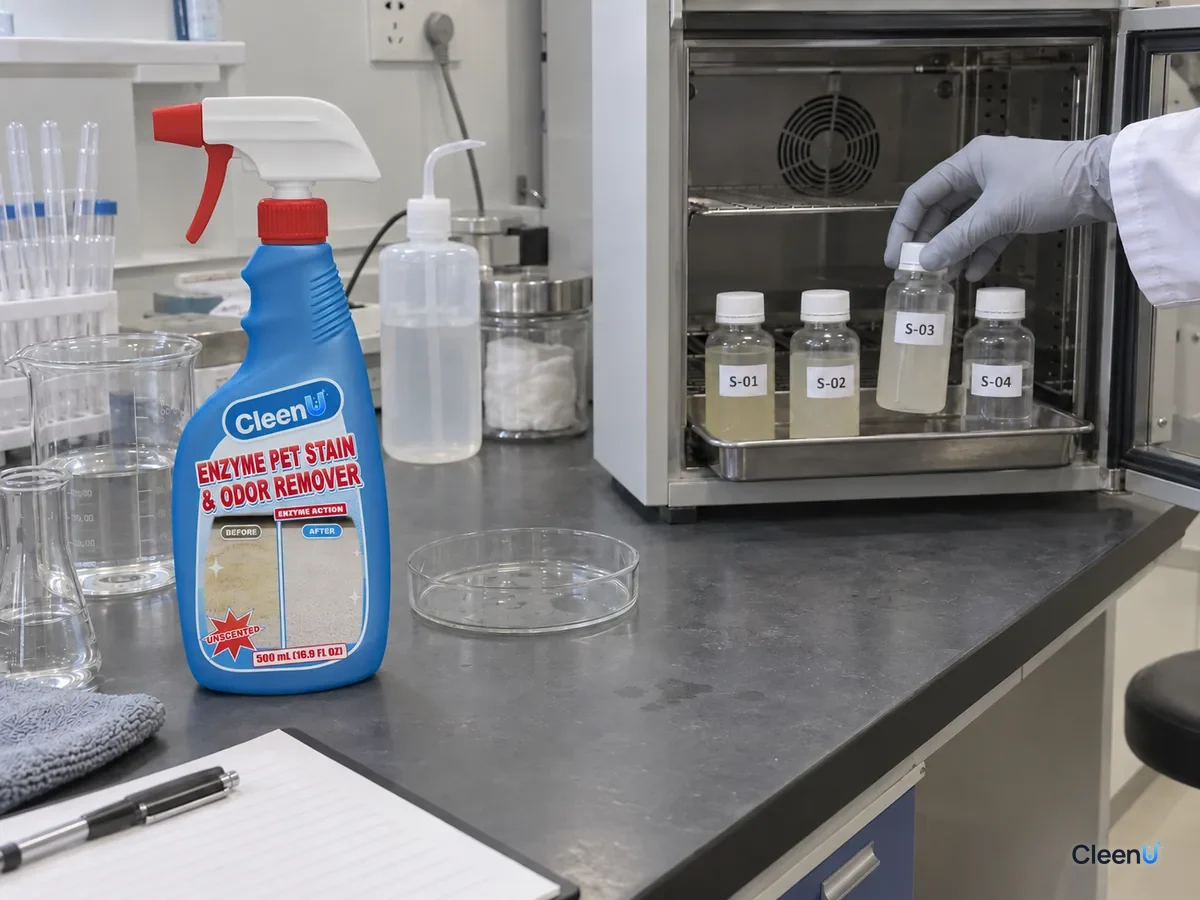
Accelerated stability. Split one batch: one group goes into an incubator above room temperature to age faster, one stays at room temperature as the retained sample, and one goes through freeze-thaw cycles. At set intervals, compare appearance, color, odor, pH, viscosity, and remaining enzyme activity. The accelerated trend flags risk early; the room-temperature sample confirms the final shelf life.
Enzyme activity. The enzyme works on a standard substrate, such as casein or a synthetic substrate that changes color when cut, at fixed temperature, pH, and time. The product formed is converted into activity relative to the starting sample. The number only compares samples within one method, so when two suppliers quote enzyme activity, ask how each was measured.
After opening. Each trigger pull lets in air and microbes. An in-use test sets the opened-bottle period: spray on a schedule that mimics real use, store at room temperature or warmer, and test microbes and key specs over time. Until then, the safer label language is storage guidance: close tightly, store cool, keep out of sun and heat. Winter shipments can freeze, so add a storage temperature line.
For test design, see stability testing for heat, cold, and retained samples and why water-based cleaners need preservatives.
What you can customize, and what to leave alone
You don't need to change everything on the first order. Pick the one or two things that must set you apart, such as scent and packaging design, and keep a proven formula base: fewer sampling rounds, stability data you can lean on, and a launch date you can plan around. Covering a stain type the existing formula doesn't promise becomes a development project with a full stability plan. Distributors buying enzyme cleaner wholesale under an existing label should still confirm storage history, batch codes, and whether label claims fit their market.
Packaging: the sprayer sets the dose, the bottle sets the lifespan
The sprayer decides whether customers can follow the directions. Urine soaks down, so CleenU Enzyme Pet Stain & Odor Remover uses a higher-output trigger. CleenU Mattress Stain & Odor Cleaner uses fine mist that leaves fabric just damp, and CleenU Litter Box Odor Eliminator takes a few light mists on top of the litter. A fine-mist head on a urine product wets only the top layer and earns "didn't work" reviews.
For the bottle, check three things. Light tends to affect fragrance, color, and some raw materials more than the enzymes, so if you want a clear bottle, add a light-exposure arm to the stability plan. The bottle, sprayer gaskets, and dip tube touch the formula for months, so store the final package with the formula and watch for warping, seepage, and clogging. And add an inner seal under the cap, with drop and leak tests on the final packaging; that's the most direct fix for "arrived leaking" reviews. If customers report a swollen bottle with an off smell, preservation may have failed and microbes produced gas. Trace the batch code instead of just sending a replacement.
Scent and reviews: why fragrance-free usually wins
In pet cleaning, a nice smell can be the problem. Fragrance covers urine odor, the customer thinks the job is done, and when it fades the deeper residue smells again. Heavily scented products often collect both "too strong" and "still stank once the perfume wore off" reviews.
So we recommend fragrance-free first for urine, litter box, and crate products. CleenU Enzyme Pet Stain & Odor Remover, Litter Box Odor Eliminator, and Pet Cage & Kennel Cleaner are all fragrance-free. CleenU Pet Odor Eliminator, a model for any private label pet odor eliminator, has a fresh linen scent, and CleenU Mattress Stain & Odor Cleaner has a light scent with a fragrance-free option. Each choice shapes reviews differently:
- Fragrance-free: reviews focus on whether the odor is gone. Fragrance-free means no added fragrance; the base can still have a faint smell, so approve it at the sample stage.
- Light scent: a subtle "just cleaned" cue with a low fragrance load and a smaller stability effect.
- Strong scent: fits a room-freshening product, not a urine product, and the listing should explain that fragrance and odor removal are different jobs.
According to the ASPCA Animal Poison Control Center (accessed Oct 2026), the risk essential oils pose to pets depends on concentration and use. If you want essential oils as a selling point, review them with your manufacturer and compliance advisor first, and don't market "plant oils" as proof of gentleness.
U.S. claims: the words that change what your product is
These points come from public EPA, FTC, CPSC, and FDA rules and guidance, checked in October 2026. Confirm the current text with your compliance advisor before launch.
Germ-killing claims require EPA registration. EPA's guidance on when a cleaning product is a pesticide lists claims to sanitize, disinfect, or sterilize; to prevent, remove, neutralize, or control odor-causing bacteria; and unqualified claims to remove biofilm. Any of them makes the product a pesticide that needs registration, whether it appears on the label, a website, a listing, an ad, or a sales pitch. Claims to clean, remove stains, and remove or neutralize odors generally don't, as long as nothing in the full set of materials makes a germ claim. In short: no germ claims, no registration trigger. Popular lines like "enzymes eat bacteria" land on the registration side. The preservative in the bottle protects the product itself, and EPA's treated-article exemption doesn't let you turn that into an antibacterial claim.
Non-toxic, natural, and eco-friendly fall under the FTC. The Green Guides say consumers read "non-toxic" as non-toxic to people and the environment, which needs competent and reliable scientific evidence, and the cleaning-product example specifically includes household pets. Unqualified "eco-friendly" or "green" claims shouldn't be used. In a 2016 action, the FTC treated "all natural" as meaning no synthetic ingredients, and most surfactants, preservatives, and stabilizers in an enzyme cleaner are synthetic or processed.
"Safe around pets" can cancel a required warning. Under CPSC rules, a hazardous substance that needs cautionary labeling can't carry words that offset the warning, and the regulation's own examples are "harmless" and "safe around pets." Whether a warning is needed depends on toxicity and irritation data; neutral pH alone doesn't settle it.
Pet wipes have an FDA line. FDA's Center for Veterinary Medicine treats grooming aids that only clean or beautify animals as outside drug rules. Claims to treat, relieve, or prevent disease can make a product an unapproved new animal drug. If wipes launch in the same line, their copy can't borrow "antibacterial" or "prevents infection."
CleenU Enzyme Pet Stain & Odor Remover is a cleaning and odor-removal product, not a disinfectant, with no EPA registration and no environmental certification. We don't describe it as antibacterial, non-toxic, or pet-safe, and we recommend the same boundary for your version.
Common claims and safer rewrites
- Kills odor-causing bacteria, antibacterial
- Breaks down protein- and fat-based odor sources and lifts urine out as you blot
- Removes biofilm
- Leave it out; name the specific stains it cleans
- Non-toxic, pet safe
- No bleach, no added fragrance; keep pets away until the area is completely dry
- All natural
- Name the source of specific ingredients, backed by supplier documents
- Permanently eliminates odor
- Saturate, wait, blot; old stains may need a repeat treatment
- A material list with no limits
- Not for wool, silk, leather, suede, or unsealed hardwood
Amazon listings: the label, images, and copy have to agree
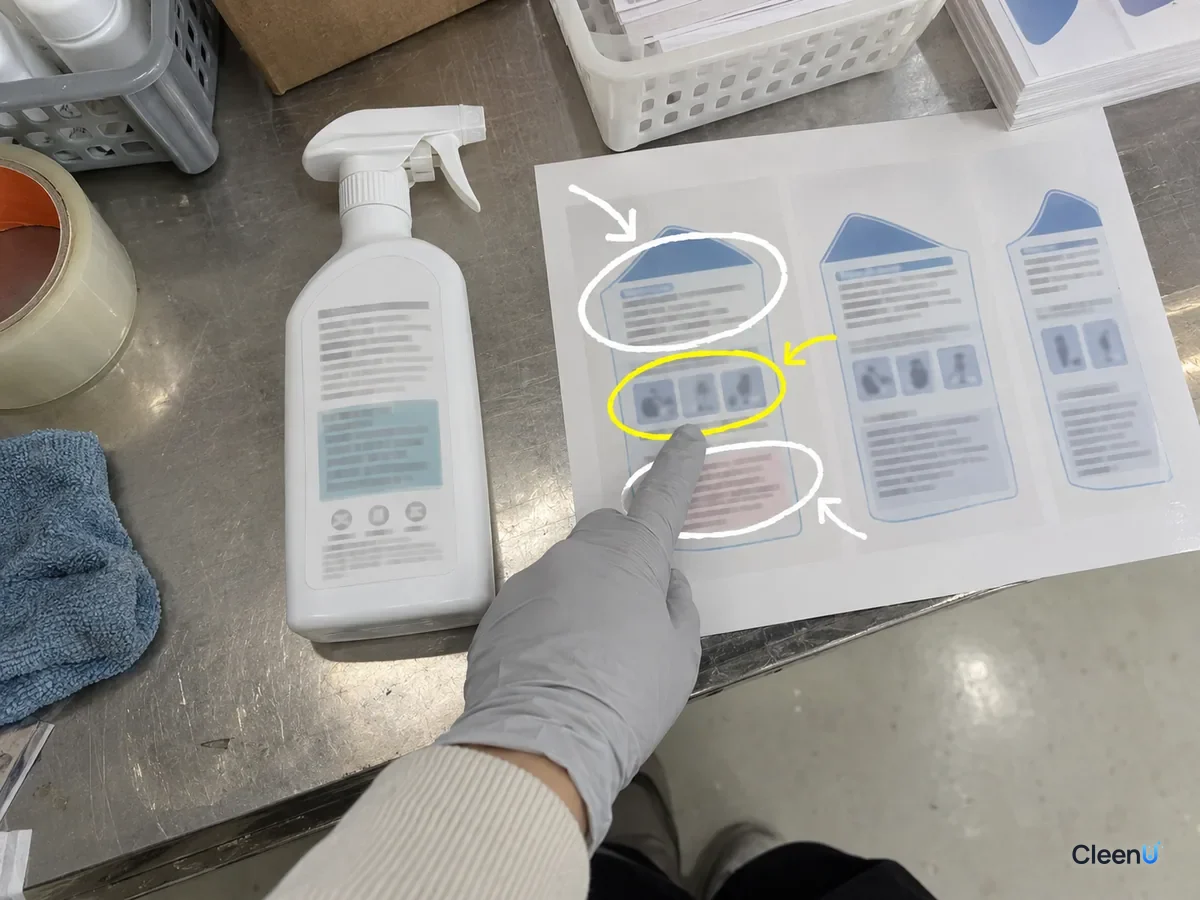
EPA counts claims on websites, ads, and promotional material, including testimonials a brand features, so a careful label doesn't help if a main-image callout, a bullet, A+ content, or a Q&A reply says the product kills germs.
Before publishing, line up a simple consistency sheet:
- Main use: if the title says urine stain and odor remover, bullets shouldn't pitch whole-home disinfecting.
- Directions: label, listing, and video show the same steps. One "just spray and walk away" line teaches customers to skip waiting and blotting.
- Do-not-use list: wool, silk, leather, suede, and unsealed hardwood belong in the listing too.
- Scent wording: fragrance-free everywhere, not "fresh scent" in one bullet.
- Ingredients, size, documents: match the SDS and label, show net contents in U.S. and metric units, and update after any change.
Cleaning products are often sent through Amazon's dangerous goods review, where sellers upload an SDS or exemption sheet per ASIN. That process comes from third-party seller resources, so follow Seller Central's current instructions. We provide the SDS, TDS, and COA per project after you inquire. See also selling robot mop cleaning solution on Amazon, whose SDS and claims sections apply to pet cleaners, and which label claims you can make.
Sample approval: what your team tests and what the factory tests
Samples answer two questions: does the product work in a real home, and will it keep working until the last bottle? The second needs factory testing.
A quick check at home. Put a little fresh urine on scrap light-colored carpet or an old towel, let it dry, and treat it exactly as the label says. Then shine a UV flashlight on it in the dark and look for glowing patches. The next day, add a few drops of water or warm it with a hair dryer and smell whether odor returns. Rub with a damp white cloth to check for color transfer. It doesn't replace lab work.
Factory acceptance testing. A complete plan usually covers the checks below, listed as methods and pass criteria, not results. CleenU can arrange the stability, preservative challenge, cleaning and odor, material, and packaging checks for your project:
Acceptance checklist for enzyme pet cleaner samples
- Basic specs: appearance, color, odor, pH, and viscosity against the sealed approved sample
- Enzyme activity: measured by a fixed method as the baseline for stability comparisons
- Accelerated stability: incubator aging, room-temperature retained sample, and freeze-thaw, comparing specs and remaining activity over time
- Preservative challenge: inoculate, sample over time, and confirm the preservative system works
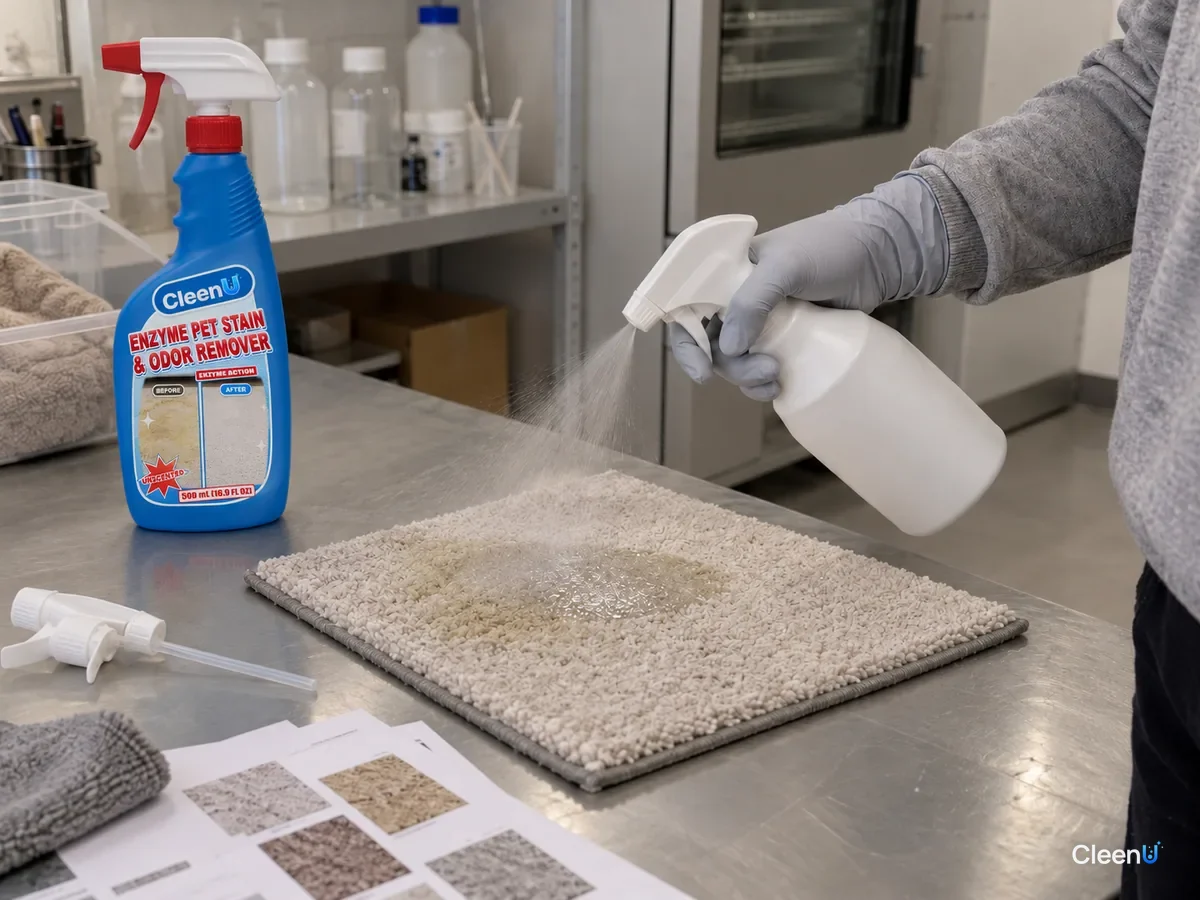
- Cleaning and odor: treat protein and urine-type soils on standard fabric swatches, check residue under UV, re-smell after rewetting or warming
- Material compatibility: white-cloth colorfastness rub and a hidden spot on sealed wood, to confirm the do-not-use list
- Packaging: sprayer output and pattern, bottle storage check, inner seal, drop and leak tests
- Claims: line-by-line review of label, listing, and ad copy
At approval, record the version, characteristics, and comparison method, and keep a sealed retained sample. Compare production the same way. "Same as the sample" alone is hard to settle in a dispute.
The samples passed, so why do some reviews say it doesn't work?
The usual causes, roughly most to least likely:
- No saturation, no wait. A light mist and a quick wipe never reach deeper residue. Put "saturate, wait 10 to 15 minutes" on the front label and main image.
- Scent expectations. Fragrance-free makes some customers think nothing happened; scented products smell bad again when the perfume fades. Explain on the listing how to judge results.
- Bleach came first. Chlorine bleach damages protein structure and usually stops enzymes from working, and bleach on urine can form irritating chloramine gas. Say clearly not to use the product with or right after bleach.
- Inventory sat in the heat. Manage turnover, avoid hot storage, keep retained samples from every batch.
- It went on wool or silk. These animal-protein fibers are protein themselves, so make the do-not-use list easy to see.
- The pet keeps going in the same spot. That can be a health or behavior signal, so the pet should see a veterinarian; cleaning only handles the aftermath. Saying so on the listing heads off some unfair reviews.
Where the money is worth spending
- Worth it: stability and preservative challenge testing. Skipping them can cost a batch of inventory and your rating.
- Worth it: a sprayer that matches the directions.
- Not always worth it: more enzymes or higher doses beyond what the promise needs.
- Not worth it: claims the formula can't support. They won't cover a delisting and relabel.
Stop and check before printing if any of these apply
The label, listing, main image, or ads include kills germs, antibacterial, destroys odor-causing bacteria, removes biofilm, non-toxic, pet safe, or all natural; the scent, stabilizer, or enzyme blend changed without a new stability run; a sample separated, changed color, developed a strong off smell, or built gas under accelerated conditions; you plan a clear bottle without a light-exposure check; or pet wipes in the same line make treatment or disease-prevention claims. Review with your manufacturer and compliance advisor before you finalize artwork and order inventory.
What CleenU brings to a private-label enzyme pet cleaner
CleenU is a household cleaner manufacturer serving brands with OEM and ODM production. An enzyme pet cleaner project can start from CleenU Enzyme Pet Stain & Odor Remover: a ready-to-use blend of protease, lipase, and amylase with nonionic surfactants, pH 6.5 to 8.0 at 25 °C (77 °F), fragrance-free, in a 500 mL (16.9 fl oz) trigger bottle, with a 24-month unopened shelf life. It isn't for wool, silk, or other animal-protein fibers, leather or suede, or unsealed hardwood, and shouldn't be used with or right after chlorine bleach.
The MOQ for private label and OEM is 500 bottles. Free samples take about 3 days, and production takes about 7 calendar days after packaging and labels are approved. SDS, TDS, and COA are provided per project after you inquire. Scent is selectable, and we can sample to your target. Production runs through five quality checkpoints: incoming materials, weighing verification before batching, in-process check before filling, first-piece and patrol checks during filling, and finished-goods inspection. Batch codes trace back to raw-material lots and production records, so if a batch is reported as weaker, we can pull its retained sample and raw-material records and tell a shipping problem from a production problem.
To start your private label from a proven fragrance-free enzyme formula, take a look at our Enzyme Pet Stain & Odor Remover.
For other pet-home product directions, see our pet home cleaning solutions. For how we work, see OEM/ODM and private-label cleaning products. Once you know your market, channel, scent, and packaging ideas, start an inquiry with this product.
Questions brands ask about private-label enzyme pet cleaners
Can an enzyme cleaner claim to kill bacteria?
Not unless the product is registered with the EPA. Claims to kill germs, sanitize, disinfect, or control odor-causing bacteria are pesticide claims, on websites, listings, and ads too. Stain and odor removal claims generally don't require registration.
How long does enzyme cleaner last?
CleenU's enzyme products, including Enzyme Pet Stain & Odor Remover, have a 24-month unopened shelf life. A modified formula or new scent needs its own accelerated and room-temperature stability data.
What is the MOQ for private label enzyme cleaner?
The MOQ is 500 bottles. Free samples take about 3 days, and production takes about 7 calendar days after packaging and labels are approved. Final terms come with a formal quote.
Does an enzyme cleaner break down uric acid crystals?
CleenU Enzyme Pet Stain & Odor Remover isn't described that way. Its protease, lipase, and amylase break down protein- and fat-based odor sources while the surfactant lifts urine out; uric acid needs a specific enzyme.
Will adding more enzyme types make it work better?
No. Match the enzymes to the stain instead. Unused enzymes only add cost, and protease digests other enzymes in a liquid, so longer blends are harder to stabilize.
Why go fragrance-free for a pet urine product?
Fragrance-free lets customers judge odor removal honestly and avoids reviews from scent that masks urine and then fades. Fragrance is also a stability variable.
Can summer shipping kill the enzymes?
It can cost activity. Heat speeds up enzyme loss, and you can't see it. Gauge the risk with accelerated stability, avoid long hot storage, and keep retained samples from each batch.
What should the label say about use after opening?
Set an opened-bottle period only after in-use testing. Until then, use storage guidance: close tightly, store cool, and keep out of direct sun and heat.
Can we put non-toxic or pet safe on the package?
No, leave them off. The FTC reads non-toxic as non-toxic to people and the environment, including household pets, and on products needing a warning, "safe around pets" can be seen as offsetting it.
Can customers use enzyme cleaner right after bleach?
No. Don't use them together or back to back. Chlorine bleach usually stops enzymes from working, and bleach on urine can form irritating chloramine gas.
What documents can you provide for Amazon review?
We provide the SDS, TDS, and COA per project after you inquire, with each COA matched to a batch code, for your team or compliance advisor to use in label and platform submissions.
How do we make sure production matches the approved sample?
Seal a retained sample and record specs and methods at approval. Production runs through five quality checkpoints with batch traceability, and you compare deliveries against the sealed sample the same way.
A private-label enzyme pet cleaner comes down to a few decisions. Pick enzymes for the stains you promise and check them against the surfactant, preservative system, and pH. Protect shelf life with accelerated aging, retained samples, freeze-thaw, and in-use testing. Match the sprayer to the directions and use an inner seal plus drop and leak testing. Start fragrance-free so reviews reflect real odor removal. Keep claims to stain removal, odor removal, and specific "free of" statements, with no germ-killing, non-toxic, or pet-safe language, and make the label, listing, and ads agree. U.S. rules cited here were checked in October 2026; confirm the current text before launch. CleenU can start from an existing fragrance-free enzyme formula, with a 500-bottle MOQ, free samples in about 3 days, and production in about 7 calendar days after packaging and labels are approved.
Sources
- EPA, "Determining If a Cleaning Product Is a Pesticide Under FIFRA," and PRN 2000-1 on the treated articles exemption (accessed Oct 2026)
- FTC Green Guides, 16 CFR 260.4 and 260.10, and FTC press release on "all natural" claims, April 12, 2016 (accessed Oct 2026)
- CPSC, 16 CFR 1500.122 (accessed Oct 2026)
- FDA, CPG Sec. 653.100 "Animal Grooming Aids" (accessed Oct 2026)
- ASPCA Animal Poison Control Center, guidance on essential oils and pets (accessed Oct 2026)
- Tennessee Poison Center, "Why shouldn't I mix household chemicals with bleach?" (accessed Oct 2026)